• Virginia Tuition Hikes Exceed Inflation Again

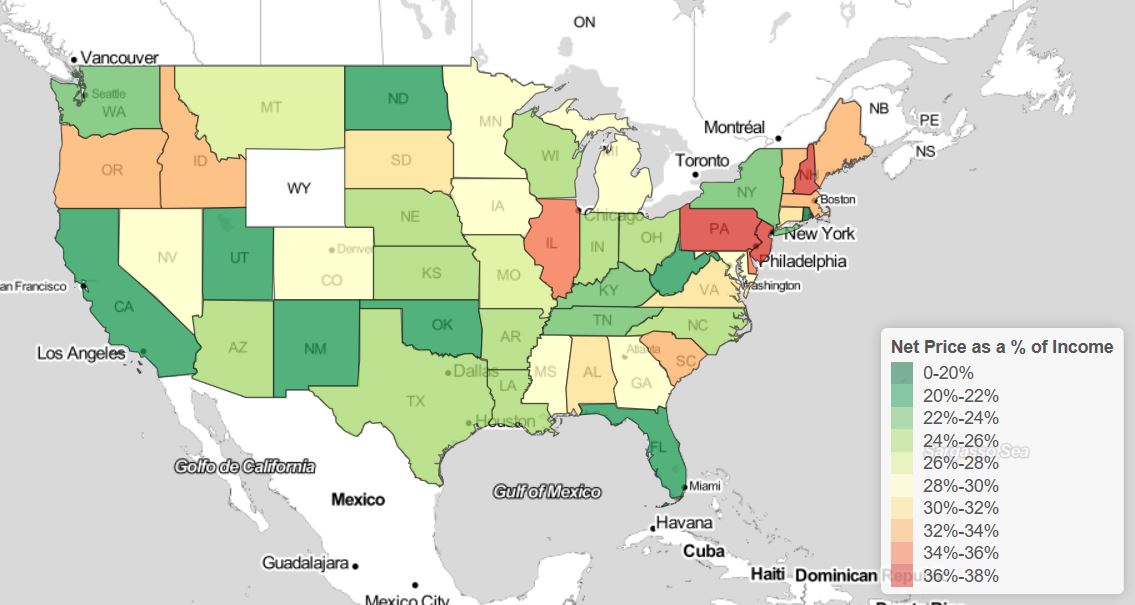
    Cost of attending a four-year state college as a percent of household income. Click for interactive version. Sources: Penn and Vanderbilt

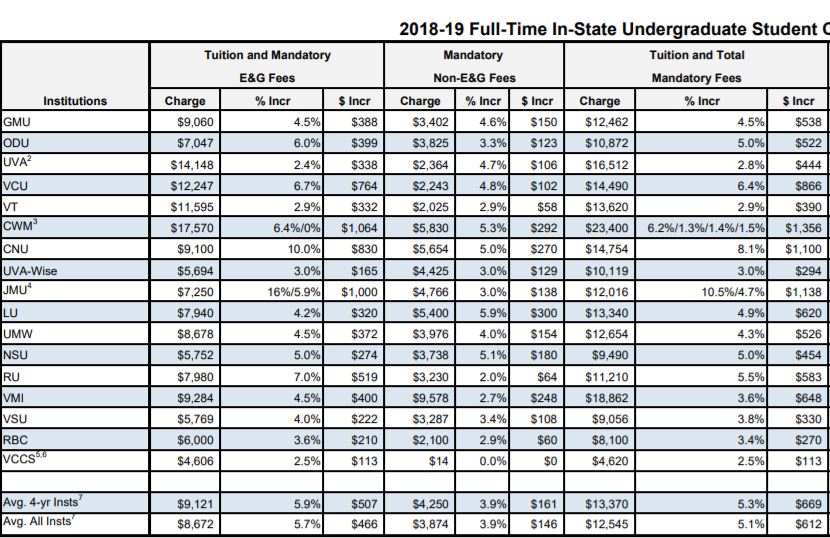
    Tuition and mandatory fees at Virginiaโ€™s state colleges and universities are rising an average of 5.3 percent for the term starting next month, eighty percent faster than inflation.ย  The increase at the stateโ€™s community colleges for next term of 2.5 percent tracks well behind the current 12-month consumer price index (2.9 percent).

    The report is contained in advance materials for the July 17 meeting of the State Council of Higher Education in Virginia. Director Peter Blake reports tuition and fees will increase by an average of $669 at four-year institutions and $113 at Virginiaโ€™s community colleges under charges set recently by the institutionsโ€™ governing boards. Increases range from $330 at Virginia State University to $1,100 at Christopher Newport University. โ€œThe systemwide increase is slightly higher than the increases in the previous two years,โ€ he wrote.

    2018 tuition and fee hikes. Source: SCHEV

    Looking at tuition alone, the average increase is just under 6 percent, but smaller growth in mandatory fees softens that a bit.ย  Four years at the College of William and Mary will cost a new freshman paying the full freight almost $94,000 (before room and board), but at that school each incoming classโ€™s in-state tuition rate is fixed for four years. A new in-state student at the University of Virginia will need at least $66,000 for four years but may face three more tuition hikes before graduation.

    Christopher Newport University in Newport News had the largest overall increase on a percentage basis, 8.1 percent, and the new cost of four years there for new in-state students is $59,000 (again, with further increases likely.)
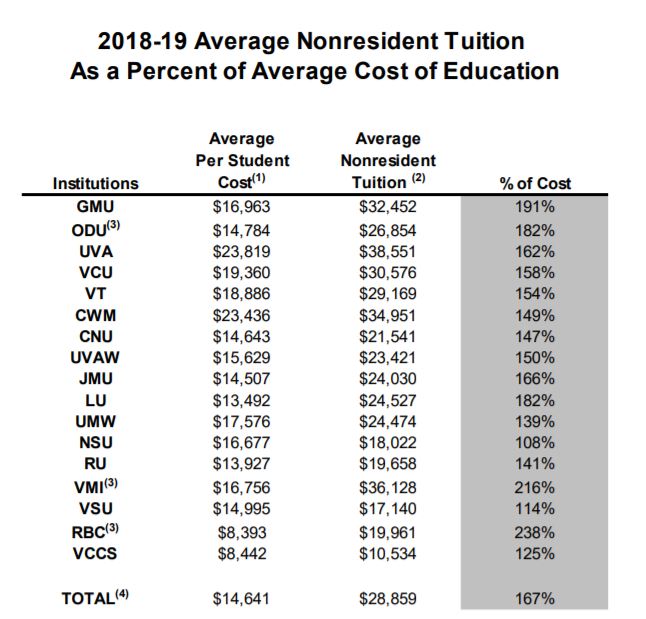
    Out-of-state price compared to cost. Source: SCHEV

    Out-of-state students pay substantially more in tuition than the cost of their education, according to another chart in the SCHEV data. It is more than double at some schools, and close to double at others. The pattern between Virginia and William and Mary reverses, with Virginia charging the higher premium for non-Virginia residents.

    The state provides more than $2 billion annually from taxpayers as direct support for the schools or financial aid for individuals. The General Assembly increased General Fund support for the schools by more than $165 million in the new budget, but with most of the additional dollars in the second year of the budget starting July 2019. The increase for the coming school term for operations and aid was a modest $17 million. Much of the new money over the period is going to things unrelated to classroom instruction.

    On Friday SCHEV sent out a news release focused on University of Pennsylvania data showing that Virginiaโ€™s higher education system faces lower risk than almost all other states. Whether that is because of Virginiaโ€™s strength or weaknesses in other states is unclear. It still warned Virginia’s population would not have the needed number of degree or certificate holders by 2025.

    Virginiaโ€™s 4th graders were highly-ranked compared to other states on the National Association of Educational Performance but only 47 percent were proficient or better in mathematics, and 43 percent proficient or better in reading. By 8th grade those were down to 38 and 36 percent.ย  In four years those 8th graders are the college admission pool.

    The Penn report ranked Virginia 41st on affordability. It included interactive charts comparing the affordability of state systems across the country by comparing costs to average household incomes. Cross-referencing the recent CNBC business networkโ€™s Best States for Business ranking, Virginia and Massachusetts had the highest costs on that basis among the top ten states, at 32 percent of household income. Five of the ten had costs at or below 25 percent of household income, with Florida the lowest at 20 percent.

    Virginiaโ€™s community colleges, which are seeing significant enrollment declines, cost only 17 percent of average household income. That is right in line with most of the other top-ten states in CNBC’s list, with Colorado and Minnesota the most expensive for two-year degrees.

    A debate continues to rage over whether rising school costs are driving away students, but the Virginia schools under the largest enrollment pressure, the community colleges and the two historically-black institutions, stand out in the SCHEV data lower overall costs, lower cost increases, and lower mark-ups for out of state students.

  • Watch Your Tongue. The PC Vigilantes Could Come for You

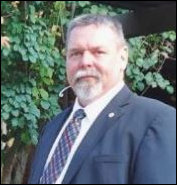
    Donald Green: fired for a politically incorrect Facebook post

    The digital mob now rules. Watch what you say on social media. Anything you write, or like, or re-tweet, can and will be used against you. If you work in any capacity for public schools there is a good chance that you will be reported, investigated, and perhaps even fired for privately expressed views — whether or not it affects your job performance in any way.

    I’m not talking about candidates for national office, such as Republican nominee Corey Stewart… who now isย catching flak for KKK fliers tossed onto driveways in Prince William County.ย He denounced the KKKย yesterday in unvarnished terms, but his partisan foes will continue to play up the story. As far as I’m concerned, he brought the problem upon himself when he dallied with far-right figures involved with last year’s United the Right rally in Charlottesville. Even if he doesn’t hold racist views (which I doubt he does), he showed poor judgment in associating with people who do. If he aspires to statewide office, hisย past associations are fair game.

    My concern is what is happening to regular folks. PC vigilantes are running amok, and craven administrators are caving in.

    First case in point, in the news today: The Chesterfield school system has fired its chief of security, Donald Green, who had served since 2014. What was his offense? Did he bungle his job? No. Did Chesterfield schools suffer unforgivable lapses in security? No. He committed the cardinal sin three years ago of sharing the Facebook post displayed to the right.
    Now, we can have a debate over the substance of the tweet. I don’t know who these children were. Perhaps they were Palestinians. Perhaps they were indoctrinated by ISIS. But, objectively speaking, there are children in the Middle East raised to hate people in the West. And, objectively speaking, there are people in the West for whom it is dogma that all cultures are morally equal and who assert that it is bigoted to argue otherwise. Is the original post provocative? Sure. Can reasonable people disagree about the validity of the point it is making? Sure. Does it send a message of hate against American Muslims or Muslims in Chesterfield County? Only in the fevered imaginations of the PC vigilantes.

    According to theย Chesterfield Observer,ย however, multiple citizens took screenshots earlier this week of the offending posts (apparently there was more than one) and sent them to school administrators. The human resources staff opened an investigation. The school system confirmed Thursday that Green is no longer employed by the school system. Stated school spokesman Shawn Smith:ย โ€œWe take seriously our responsibility to provide a safe, supportive and nurturing learning environment that is free from disruptions and distractions.โ€

    Really? Green, who made the Facebook post made in 2015, was creating “disruptions and distractions” in 2018? The people who made an issue of the post were not creating the disruptions and distractions?

    Second case in point, also in the news today: A teacher twice recognized as a Teacher of the Year by the Norfolk school system made the following post to a group of Facebook moms: “Going on a field trip to the zoo tomorrow from 1-3 with my 60 middle school kids from the hood. Fair Warning!”

    WAVY TV says what happened next:

    “I was like, ‘Wow?ย Are you kidding me? Why would you say something like this?’” said Sydneigh Lillard, a mother of three who is part of the Facebook group. “It was really sick to me for that to be coming from anย educator.”

    Lillard said educators, in her opinion, are supposed to serve as role models and help uplift students. Lillardย doesn’t think the teacher was doing anything close to that in this case.

    “To draw negative attention to them by referring to them as kids from the hood?” Lillardย said. “People don’t think of positive things when they think of ‘the hood’. But being from the hood doesn’t mean the kids are bad.”

    Rather than point out Lillard’s absurd and tortured reasoning — that the teacher had implied that being from the “hood” means the kids were bad — Norfolk public schools responded to the controversy as follows:

    Norfolk Public Schools (NPS) is aware of a disturbing social media post that has been circulating today.ย The views expressed in this post are not reflective of NPS as we pride ourselves with being the cornerstone of a proudly diverse community.ย A full investigation has been launched into this situation. As this is a personnel matter we are limited in making any further comment.

    WAVY-TV thoughtfully declined to release the name of the teacher on the grounds that she “has not been charged with any crime.”

    Wow, it’s hard to keep up with the latest evolution in politically correct speech. I didn’t know — and obviously the teacher didn’t know — that it now is a thought crime to refer to “the hood” — not even in a light-hearted reference to her rambunctious, middle-school charges from the inner city. No doubt fearful of losing her job, the teacher issued online an abject, groveling apology.

    It’s not as if either Green or the teacher of the year had evinced sympathy for the KKK. (Just curious, is it now not merely odious but a firing offense to sympathize with the KKK?) It’s not as if they had uttered racist sentiments. It’s not as if they had used the “N” word. It’s not as if they had called someone a “nappy headed ho.” A fever has gripped this country, the realm of “acceptable” speech is contracting severely, the arbiters of acceptable speech are the most easily offended among us, and charges of politically incorrect language send administrators into a paroxysm of fear. Innocent people are being investigated and are literally losing their jobs over thought crimes.

    This is the Red Scare all over again — except it’s not limited to State Department employees and Hollywood screen writers. The PC enforcers see racists under every bed and read racism into every remark. Everyday Americans are being assailed by the PC vigilantes and losing their jobs. You want more Corey Stewart? This is how you get more Corey Stewart.ย You want more Donald Trump?ย This is how you get more Donald Trump. People who are not crass, bullying, belligerent jerks like our president need to stand up and put an end to this madness or more Americans will see Trump as their only defender. And if you think things are ugly now, you ain’t seen nothing yet.


  • Wasn’t the U.S. Supposed to Be the Villain Here?

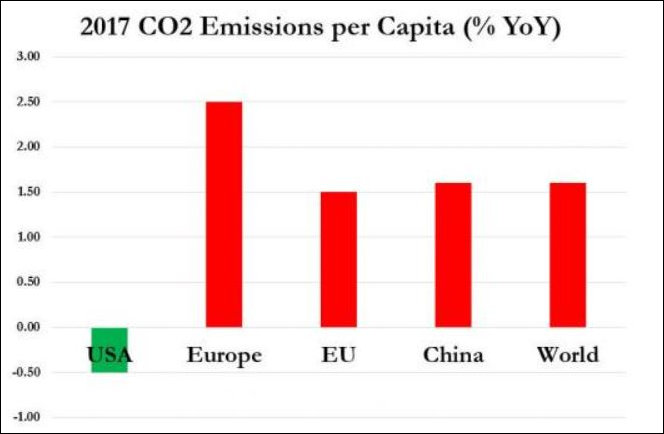
    Source: ZeroHedge

  • A Calamitously Misplaced Emphasis in School Safety

    Virginia, a General Assembly committee on school violence was told yesterday, is a national leader in school safety but it still could do more to prevent violence, bullying and harassment. Among the options explored were hiring more counselors and providing more training. Judging by the reporting of the Richmond Times-Dispatch, much of the discussion focused on how to prevent or respond to school shootings.

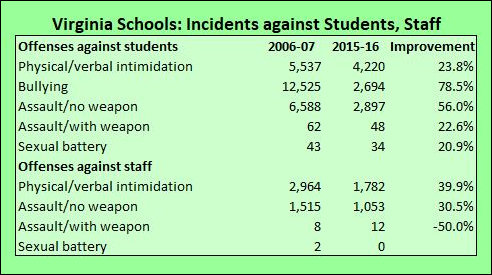
    As best I recollect, no Virginia K-12 school has experienced a Columbine-scale mass shooting. Yet the threat of rare but spasmodic violence dominated the session. Remarkably, the matter of routine violence in schools didn’t animate any discussion — even though, according to state statistics, Virginia schools reported 2,897 assaults against students (no weapons), 48 assaults with firearms or other weapons, and 34 sexual batteries in the 2015-16 school year.

    If I were a social justice warrior, I might criticize the contrasting attitudes — high anxiety about the remote threat of violence in the kind of affluent, white-dominated schools where mass shootings typically take place and indifference toward routine violence at predominantly black schools — as a classic example of institutional racism. I must confess to being mystified by the silence. One might be tempted to conclude — unfairly, I’m sure — that SJWs living in affluent, white-dominated school districts place greater importance on the safety of their own children.

    We do know that SJWs are extremely concerned about the injustices — arrests, suspensions, other punishments — perpetrated upon school students committing the violent offenses, mainly on the grounds that the offenders are disproportionately African-American. I have blogged in the past that the victims of violent and disorderly behavior, also disproportionately African-American, don’t warrant much sympathy presumably because they don’t advance the Narrative of Institutional Oppression.

    In perusing Virginia’s school safety data, I came across a remarkable finding that no one is touting. If we believe the official statistics, Virginia schools are much, much safer today than they were a decade ago. Physical and verbal intimidation is down 24% for students, 40% for teachers. Bullying is down almost 80%. Assaults on students are down 56% for students and 30% for teachers. Those are astonishing numbers. Surely this is one of the great public policy victories of our time. Surely this is cause for widespread celebration!

    Or perhaps the numbers are worthless — another case of truth being sacrificed on the altar of political correctness and bureaucratic butt-covering.

    What has changed in the past 10 years? The most obvious difference between now and then has been the crusade initiated by the American Civil Liberties Union and the U.S. Department of Justice against school disciplinary policies that disproportionately impacted minority and disabled students. DOJ has compelled numerous Virginia school districts to revamp their disciplinary procedures with the explicit goal of reducing the racial disparity in punishments.ย Those school districts have adopted a less punitive, more therapeutic approach to dealing with student misbehavior.

    Here’s the critical question: What is driving the decline in reported school infractions and violence: new-and-improved disciplinary policies that are changing student behavior for the better… or teachers and administrators giving the DOJ and ACLU the numbers they want to see?

    I suspect the latter. Anecdotal information I hear about a school in eastern Henrico County suggests to me that teachers and administrators are losing control of the school.ย Teacher burn-out is ferocious, and more than the usual number of teachers submitted resignations this year.ย 

    How might we get a better handle on the facts on the ground? We could survey teachers and ask them if they believe discipline has improved or worsened. Absent such a survey, we could measure teacher turnover. Teacher churn is an objective measure, the number is readily compiled and not easily gamed.

    Meanwhile, in la-la land — er, I mean the General Assembly — people are talking about better training for crisis response, better coordination with emergency responders, increased mental health services, and more “social-emotional learning,” whatever that is. Virginia is well prepared to deal with crises that may never happen. How well is the Commonwealth doing in dealing with routine anarchy? We won’t know unless we gather the data to find out — but it doesn’t appear that anyone is interested in finding out.


  • AP’s Latest Hit Piece: Journalism or Polemic?

    Here we go again. The Associated Press’ Alan Suderman has popped out another context-free article making an issue of Dominion Energy’s tenfold increase in lobbying expenses over the past year to more than $1 million.ย That spending, writes Suderman, “came during a period when the company successfully pushed through legislation that could lead to substantial increases to electric bills.”

    It is a legitimate exercise in journalism to report the lobbying expenditures of the state’s largest investor-owned utility, especially when it is as politically influential as Dominion and when the utility backed controversial and far-reaching legislation. But it’s not legitimate to strip the story of highly relevant context such as… oh, I don’t know… maybe, how much other stakeholders spent on lobbying, advertising, education and outreach.

    If Dominion were alone in increasing its investment in influencing legislators, that would be one story. If, given the magnitude of the stakes involved, the utility’s spending was matched by the spending of other interest groups, that would be a very different story. Suderman did not raise the latter possibility in his article, thus creating a highly negative impression of Dominion — an impression he reinforced by quoting Clean Virginia, a group formed to counter Dominion’s political influence:

    “It’s unfortunate that at a time when refusing monopoly money has become a hallmark of good governance, Dominion is doubling down on its political spending in an attempt to rig the rules in Richmond and mislead Virginians about the cost of their corruption,” said Brennan Gilmore, executive director of Clean Virginia.

    Suderman notes in passing that Clean Virginia is a “newly formed group.” Ironically, Clean Virginia does not yet appear in the Virginia Public Access Project (VPAP) database as a campaign donor, even though the organization has pledged to back General Assembly candidates who refuse Dominion money, nor as a registered lobbyist, even though the group is actively involved in influencing public opinion. Come to think of it, the Clean Virginia website does not say where its money comes from either. One guess is that some, if not all, of its funding comes from its founder and chairman, Michael Bills, a wealthy investment manager (founder of Bluestem Asset Management) from the Charlottesville area. But there is no way for members of the public to find out — Clean Virginia’s 990 filings have yet to show up in the ProPublica database of nonprofit companies.

    While Clean Virginia is a cipher, Dominion details precisely how much money it contributes to political campaigns, whom it has hired as a lobbyist, how much it has contributed in gifts and entertainment, and (through other reports) how much, and to whom, its nonprofit foundation donates money.

    There’s a real asymmetry at work: Dominion scrupulously documents its lobbying activities but other players in the burgeoning renewable-energy and energy-efficiency fields, not to mention some of the company’s most relentless critics, do not. Suderman calls out Dominion for its spike in lobbying-related activity but cares not a whit what others are spending or their refusal, for whatever reason, to be fully transparent about their activity.

    Actually, there’s an even bigger asymmetry at work. While Dominion exercises its influence largely through campaign donations and lobbying, the company’s critics make their power felt by devoting resources P.R., education and outreach to influence public opinion — expenditures that aren’t captured in any database.

    If it were possible to compile all the information needed to make a valid comparison, perhaps we would find that Dominion’s bolstered its spending by many times more than others did — although that would raise a different set of issues. (Dominion spokesman David Botkins argues that the spending surge was necessary to “break through the fake news and propaganda perpetuated by anti-energy groups like Clean Virginia and their ilk.”) Alternatively, perhaps we would find that Dominion’s spending increase was matched by others. We don’t know what we’d find until someone does the digging. But it is patently unreasonable to skewer Dominion for its spending surge without (a) comparing the increase to that of other stakeholders, and (b) acknowledging that Dominion is being more transparent than many of its critics.

    Biased journalism such as Suderman’s is what causes many Virginians to mentally discount whatever they read. “What is this reporter not telling me?” readers wonder. “Is this just a hit piece?”


  • Apologies for Sloppy Reporting

    Earlier today I published a post dissecting an article by Alan Suderman with the Associated Press on the topic of Dominion Energy’s lobbying expenditures. I took him to task for the biased way in which he framed the issue. But in my rush to publish my post I made numerous mistakes of fact. Sloppiness is just as inexcusable as bias, so I have taken down the post until I can rewrite it with accurate information. I apologize to my readers.


  • You Can End this Folly, Governor Northam!

    Children at the Virginia Tech Graduate School Child Play Group

    At the Annandale Cooperative Preschool, parents volunteer three to six hours a month to serve as teachers and class assistants. One big benefit is the pleasure of watching their toddlers mature. Another is more affordable tuition.

    Now comes a proposal from the Virginia Department of Social Services that would require school staff, including the parent volunteers, to take up to 30 hours of training. The purpose of the requirement is to align preschool standards with federal requirements for providers receiving money under the Child Care and Development Block Grant Act of 2014. Here’s the kicker: Cooperative preschools don’t receive block-grant funds.

    Reports the Washington Post:

    Parents and school directors say the training commitment would be disproportionate to the amount of time parents spend helping in classrooms, which administrators said equals about three to six hours a month.

    Working families would be hard-pressed to find time to complete the training, said Marie Sloane, director of education at the Annandale school.

    Without enough parents, the school would have to hire four assistant teachers for part-time slots that Sloane said are already difficult to fill โ€” nearly doubling her six-teacher staff and probably increasing tuition. Cooperative preschools, she said, generally cost less than comparable schools because of parental participation. Monthly tuition at the Annandale Cooperative Preschool ranges from $233 to $416.

    Bacon’s bottom line: What madness is this? There is a shortage of daycare workers and daycare facilities in Virginia, and even when the service is available, paying for it is financially burdensome for many families. Cooperatives that tap the volunteer labor of parents are a fantastic way to make daycare more affordable.

    Regulators want to regulate. Bureaucrats want to expand their power. To borrow a phrase from GEICO, that’s what they do. Once in a while, when public safety and health is at stake, regulations are justified. But this is not one of those instances. There are 35 to 40 cooperative preschools in Virginia, a type of collaborative that has existed for at least 70 years. Parents undergo background checks and must meet health requirements, including tuberculosis testing. Social Services has proffered no evidence whatsoever that the children in these cooperatives are at any additional risk. What possible benefit can come from this?

    Does Ralph Northam want to be known as the governor who presided over the demise of cooperative daycare in Virginia? Does he approve of the relentless advance of the administrative state into every sphere of our lives? I can’t imagine that he does. He needs to shut down this initiative right now.


  • State Solicits Input from Solar, Wind Stakeholders

    A nonprofit company specializing in addressing complex public policy issues has begun holding a series of meetings to solicit input from solar and wind energy stakeholders that will be used to formulate the Northam administration’s update to the Virginia Energy Plan.

    Discussion topics will address community solar, corporate procurement of clean energy, state/local barriers to the deployment of renewable energy projects, and netย metering (connecting rooftop solar panels to the electric grid).

    The nonprofit, Washington, D.C.-based Meridian Institute is organizing the sessions under contract with Dominion Energy, as provided for under the Grid Transformation and Security Act enacted earlier this year. Meridian will publish a compilation of comments around the end of August. The feedback from this and other stakeholder groups addressing energy efficiency, electric vehicles and battery storage will provide input into the Northam administration’s development of the state’s energy plan. The previous plan, written by the McAuliffe administration, was published in 2014.

    The inaugural session was not organized to collect input on the designated topics but to discuss the way Meridian had organized and framed the issues. Stakeholders will have a chance to make specific comments in hearings scheduled in July and August.

    Given the preliminary nature of discussions, no strong points of contention emerged at the meeting, which was held at Virginia Commonwealth University in Richmond earlier today.

    A few members of the roughly 60 people in attendance did wonder if Meridian might suffer from a conflict of interest due to its engagement by Dominion. Tim Mealey, a Meridian managing director, responded that his group is committed to openness, transparency, and reflecting the voices of all stakeholders. Meridian will not be issuing a report or making policy recommendations — its work product will be a summary of the participants’ views. Dominion will not review or approve the summary.

    Several others questioned the way Meridian framed issues relating to the siting of solar and wind projects: What is Virginia doing right regarding the siting of renewable energy projects, and do stakeholders believe there are impediments to siting renewable energy projects in the Commonwealth?

    Adam Gillenwater with the American Battlefield Trust said members of his group do not see the preservation of battlefields as an “impediment” to solar farms but rather as a competing good to be taken into consideration in siting decisions.

    Others noted that the problems encountered by utility-scale solar and wind projects are different from the obstacles experienced by small power producers generating electricity at the rooftop level. Perhaps Meridian would consider conducting separate discussions for utility-scale and rooftop-scale issues, suggested Katharine Bond, Dominion senior policy adviser.

    Mealey did not indicate what changes he might make to the discussion format. It is a “very unusual arrangement” to have an electric utility pay and contract for policy discussions mandated by a piece of legislation, he said. But he did not see that as a problem. His charge is to address the topics enumerated in theย Grid Transformation and Security Act without being “unduly constrained” by the wording of the act.


  • SCC Examiner Rejects Dominion Tax Argument

    A State Corporation Commission hearing examiner has rejected Dominion Energy Virginiaโ€™s arguments that it was correct to ignore a lower federal income tax rate in calculating transmission costs for 2018 and is recommending that the full commission give ratepayers the benefit of the lower tax rate immediately.


    Chief Hearing Examiner Deborah V. Ellenbergโ€™s ruling was issued July 9, following a June 29 hearing where Dominion employees said it had to use the 35 percent tax rate in calculating bills running into 2019, even though the federal corporate income tax rate had dropped to 21 percent effective January 1 of this year.ย  This was the subject of an earlier Baconโ€™s Rebellion post.

    At issue is the rate adjustment clause (RAC) known at Rider T1, which passes along to customers the utilityโ€™s cost for transmission services.ย  It is one of several elements on monthly bills and the utility was seeking a substantial increase.ย  Dominion had put the higher monthly cost for a residential customer using 1,000 kilowatt hours at more than $4, with higher amounts hitting larger customers.

    At the hearing Dominion argued that the T1 rate is driven by a formula approved by the Federal Energy Regulatory Commission (FERC) that includes as a factor the base federal rate, and it had to plug in the higher previous tax rate because it hadnโ€™t consulted with stakeholders since the tax rate had changed.ย ย  Consumer advocates at the hearing said there was no prohibition on correcting the rates based on the new tax rate.ย ย  The hearing officer agreed.

    โ€œI find it disappointing that the Company has taken the position that the revenue requirement should include a 35% federal income tax rate that is no longer in effect rather than incorporate the significantly lower tax rate made effective even before the Company made its informational filing with the FERC in January 2018, and well before it filed this Application in May 2018,โ€ she wrote. โ€œIt could, and should have, like other utilities, revised its annual filing to include the known and certain tax rate change. I recommend the Commission direct the Company to file a corrected annual filing with FERC effective January 1, 2018.โ€

    The RAC tariff in question is due to be adjusted September 1 and stay in place 12 months. ย ย Ellenberg suggested that the full commission adjust the new rate to reflect the lower taxes, saving consumers $71 million during the period.ย  She also suggested an additional reduction of $46 million to reflect the lower tax liability during the first eight months of 2018.ย  Dominion was arguing that consumers would have to wait until the true-up process in future cases to see rates adjusted to reflect the lower tax rates.

    Ellenberg ruled against Dominion on a second point, involving a $13 million credit being paid to Dominion by the regional transmission organization PJM.ย  Dominion argued that payment was for generation services at its Yorktown plant, which is staying open longer than planned.ย  Ellenberg agreed with the SCC staff, the Attorney General and other consumer advocates that the payment was for transmission services and should reduce the revenue requirement for Rider T1.ย  The cost of operating Yorktown is fully recovered in base rates and the fuel charge.

    If the full commission adopts her recommendations, Dominionโ€™s request for $755 million for Rider T1 over the next 12 months will be reduced to $625 million, which is about the same as was approved a year ago.ย  That wipes out the 20 percent increase requested by the utility, with any increase in transmission costs being balanced by the lower taxes.


  • Back In Top 5, The Challenge Is To Stay There

    Corks are popping all over Richmond as the business network CNBC announced this morning that Virginia is back in the top five of itsย annual survey of best states for business, ranking number 4.ย  It is the only state in the top five east of the Mississippi. The full Virginia report is here.

    The photo on the CNBC page shows a Huntington Ingalls-built warship, but one of the amphibious ships built in Pascagoula, Mississippi. ย Perhaps the web designers remember that the first time Virginia topped this list as number one the announcement was made from pier 3 at Newport News Shipbuilding with the future U.S.S. George Bush in the background as Governor Robert McDonnell took the bow.

    Governor Ralph Northam will get to enjoy the spotlight this time, and should, but the credit needs to be spread widely. The person doing handsprings should be Stephen Moret, president of the Virginia Economic Development Partnership, who has been focused on improving these rankings since coming to Virginia to fix a broken agency its reputation.

    Speaker Bill Howell and the others who joined with McDonnell in pushing forward the transportation tax package years ago deserve a nod, as those projects are starting to come on line. Virginia’s rank for infrastructure improved from number 25 in 2017 to number 20 for 2018, and may continue to rise now.

    Also improved over last year was the ranking for education. Despite growing costs Virginiaโ€™s higher education system, public and private, remains the envy of many other states, but the focus now extends beyond degrees to work-related certifications.

    This ranking is a marketing coup with no immediate value to the average Virginian. Staying in the top five over time will have value, however, as more business location or investment decisions start with Virginia on the short list.

    Looking at the details there are only a handful of individual categories where the state ranked extremely well (workforce, education, business friendliness) and only two where Virginia was below the median โ€“ the related categories of cost of living and cost of doing business.ย  First or second quintile scores in several categories resulted in the good overall score.

    Those outliers deserve some attention. A huge component of the cost of living and cost of doing business is the cost of electricity and other forms of energy, and the trend lines there are bad despite the energetic public relations efforts of a certain large utility. Another huge component of both is state and local taxes, which are under growing pressure to rise and where Virginia has a chance to be creative thanks to federal tax reform.

    Not a time for any resting on any laurels. But some martinis at lunch are indicated.


  • State Employees Not Funding Own Retirement

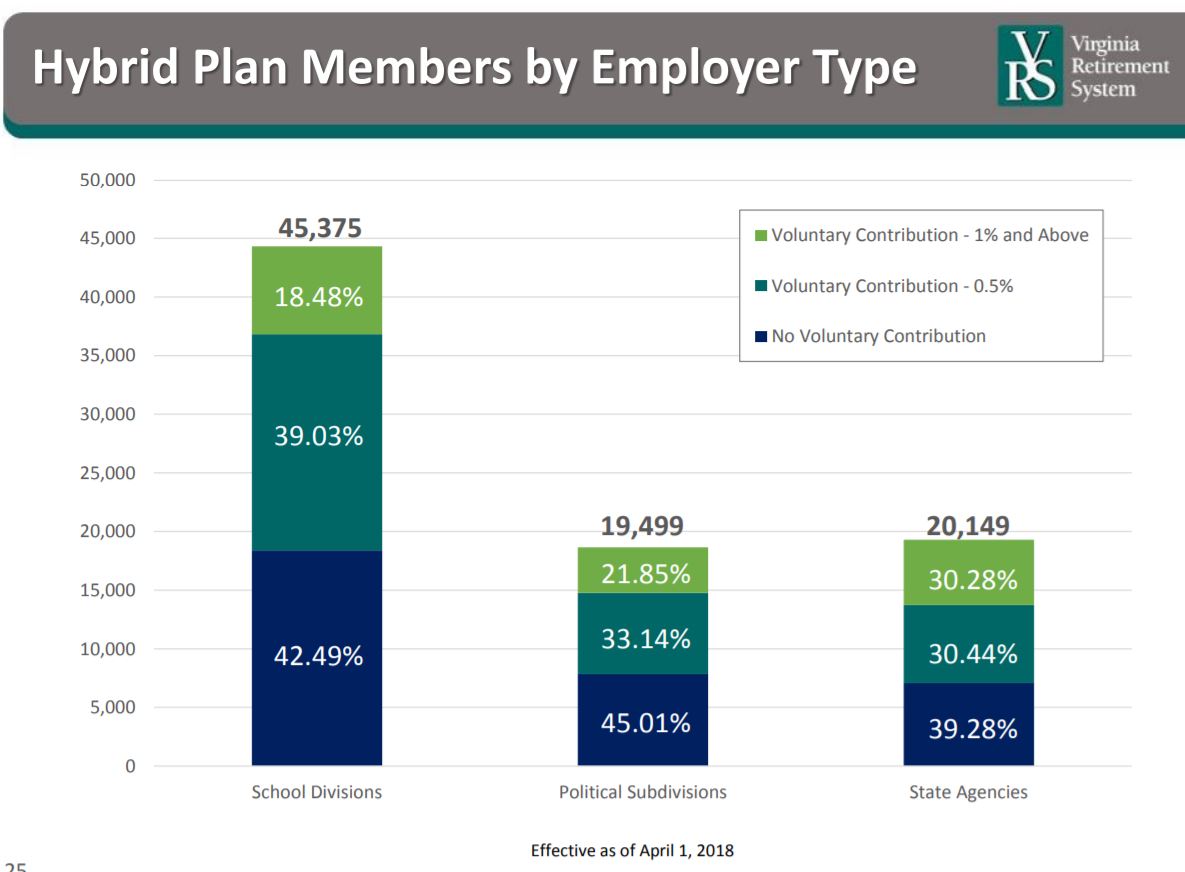
    Source: VRS Report to JLARC

    State and local employees, like many of their peers in the private sector, are declining in droves to contribute to their own retirement plans, despite the availability of matching funds, a.k.a. free money which compounds for decades.

    The Virginia Retirement System has been putting new hires into a hybrid retirement plan that combines a defined benefit with a defined contribution plan which depends on employee contributions. More than 85,000 active workers are now part of the hybrid plan, but only 18 percent of those are socking away the maximum 4 percent of their pay, which is matched with another 2.5 percent by the state.

    Of the rest, 42 percent are contributing nothing, and 36 percent are contributingย  only one-half of one percent, or $50 per $10,000.ย  Most of those are apparently doing so because the state automatically escalated all contribution rates by one-half of one percent on January 1, 2017 and employees had to then intentionally opt out.

    The information was part of the annual report on VRS to the Joint Legislative Audit and Review Commission Monday, covering all aspects of an operation vital to 700,000 participants or beneficiaries.ย  JLARC was presented with aย brief oversight, a longer and more detailedย overview, and the report of an outsideย actuary.

    Since that first โ€œautomatic escalationโ€ the participation has been dropping and it may continue to drop until a second auto-escalation is planned for 2020. ย โ€œCurrent low rates of voluntary contribution by hybrid plan members will result in lower retirement income,โ€ the presentation slide states.ย ย  Thatโ€™s a major understatement, but the hybrid plan and the low participation are saving the taxpayers a bundle in the short run and will save even more as the previous defined benefits plans fade away.

    As of March 1, the overall year to date return was 9.9 percent, slightly behind the goal of 10.0.ย  No figure was given for the end of the fiscal year on June 30 and the last 90 days have been a trade fear-induced roller coaster.ย  The long-term return baked into VRS funding assumptions is 7 percent. ย The five-year average has been 8.1 percent and the 25-year average 8.2, but as the saying goes, past results are not a guarantee.

    The charts tracking the funding status of the various individual retirement plans were all inching up and the average overall is now about 77 percent.ย  Under current assumptions it will take 26 more years to get back to 100 percent funded, where the state was as recently as 2002.ย  The key phrase there is โ€œcurrent assumptions.โ€

    โ€œVRS is actuarially soundโ€ concluded Lance Weiss of Gabriel, Roeder, Smith and Co. (GRS), the outside auditor.ย  He praised Virginia for setting that 7 percent target return a few years back, but then reported it is no longer a conservative assumption but merely a reasonable one.ย  Many of their clients are moving to 6.75 percent, he said.ย  A figure below 6.5 percent was hinted at.ย  With an aging workforce looking at starting benefits in the short term, there is even more reason for Virginia to rethink that 7 percent assumption on return.

    The assumption on return is what drives the size of employer contributions.ย  In another report it was noted that if the two largest funds, those for teachers and for general state employees, moved to a 6.75 percent โ€œdiscount rateโ€ the state would need to increase its annual contribution by $182 million.ย  Changing that assumption also drives up the unfunded liability on both funds and pushes the 100 percent funded goal further out.

    The reports today were merely accepted, with few hard (or easy) questions. It may take a longer period of market uneasiness to undermine the current return assumptions, but House Appropriations Chairman S. Chris Jones told reporters after the meeting he would consider it.

    Senate Finance Co-Chair Thomas Norment did ask out loud if the hybrid plan was โ€œworth keepingโ€ but the question received no response.ย  The defined benefit plan is gone and unless participation patterns change future VRS retirees (86 percent of whom remain in Virginia) will not have the same comfortable income as current retirees.


  • Uberizing Van Pools: A Useful Experiment

    Northern Virginia transportation officials will try an interesting experiment to help cope with traffic disruptions during construction of the $2.3 billion Interstate 66 widening project — they will allow commuters to sign up and pay for van-pool services through a smartphone app. Reports the Washington Post:

    โ€œThis is not just new technology for the area, it is also new technology and service in an area that has been a bit of a desert for transit options,โ€ said Chuck Steigerwald, director of strategic planning at the Potomac and Rappahannock Transportation Commission (PRTC), which oversees a regional van-pool service and runs commuter buses from Prince William to Washington.

    The apps will be critical, he said, to encouraging people to use transit and van-pool services during peak construction on the I-66 expansion, a project that also aims to change the way people move along the corridor.

    The PRTC is planning to launch a free, on-demand ยญmicrotransit service from the Gainesville and Haymarket neighborhoods to OmniRide commuter lots starting next summer. PRTC officials say the agency will develop an app to connect riders to rides. The $1.1.ย million project will provide transportation from residential areas to bus stops for commuters who donโ€™t take the bus because of the challenges of using park-and-ride lots, which are already at capacity, officials said.

    The funding will cover the cost of a software interface that will allow vehicle operators to respond to commuter requests with dynamic, real-time routing. It also will pay for vehicles, onboard vehicle hardware, transit operations and advertising of the services.

    In another high-tech effort, the PRTC is creating a platform for a flexible van-pool program that will connect riders with van pools and facilitate payment of fares. The $317,600 project will enable the use of the technology to potentially transform the way van pools operate in Northern Virginia, said Robert Schneider, executive director of the PRTC.

    Bacon’s bottom line: It’s good to see Northern Virginia transportation officials experiment with new technology. Persuading more commuters to use vans and buses is potentially the most cost-effective way to squeeze more capacity out of the region’s overloaded transportation arteries.

    There’s more to a successful ride-hailing service like Uber and Lyft, though, than just connecting people with rides via smart phone. Ride-hailing companies have sophisticated algorithms to predict when and where ridership demand will materialize and where to pre-position vehicles to serve that demand. As demand waxes and wanes and moves around, these companies respond nimbly. Will PRTC be able to go with the (traffic) flow? We’ll see.

    Another question is whether riders will avail themselves of van pools for the convenience of reaching park-and-ride lots. Might they not prefer to ride a van directly to their destination (or very close to it) rather than to a park-and-ride lot where they then shift to another transportation mode? Will they see enough of a value-add proposition to make it worth their while?

    Finally, I wonder if PRTC ever considered the option of contracting directly with Uber, Lyft or another third-party company to come up with creative solutions. The Washington Post article doesn’t tell us.

    Still, I don’t see how this initiative can hurt. The worst case scenario is that commuters don’t respond. In the context of a $2.3 billion construction project, the cost is peanuts. On the positive side, things just might work out as hoped. If we’re ever going to improve our transportation system, we need to make lots of small, inexpensive experiments, discard the losers, and scale up the winners. You don’t know if something will work until you try it. There is nothing wrong with failure — as long as government acknowledges the failures, shuts them down quickly, and moves on.


  • Eat My (Coal) Dust!

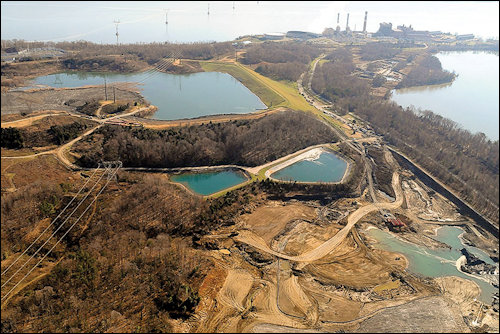
    Possum Point coal ash ponds

    In a possible early-warning sign of what may be in store for Virginia electricity consumers, North Carolina regulators have decided that Duke Energy could charge their Tarheel rate payers the first $778 million chunk of an estimated $5 billion in coal-ash cleanup costs. The sum does not include $100 million in two mismanagement penalties for practices that “resulted in cost increases greater than those necessary to adequately maintain and operate its facilities,” reports the Associated Press.

    Dominion Energy Virginia will likely incur coal-ash disposals costs in the $1 billion to $4 billion range, although no firm figure will be available until the state issues solid-waste permits for a disposal plan. Dominion says that de-watering the coal ash, consolidating the material in a single pit at each power plant, and covering it with a synthetic liner will protect the public at a fraction of the cost of the alternative, favored by activist groups, of hauling the ash to landfills with greater environmental protections.

    North Carolina’s Attorney General said he would go to court to stop Duke from passing along its disposal costs to rate payers. “This case will ultimately be decided by the North Carolina Supreme Court,” he said.

    The coal-ash disputes in North Carolina could prefigure in part what happens in Virginia. State regulators must approve disposal plans for millions of tons of coal ash that accumulated legally over the decades at Dominion’s Bremo, Possum Point, Chesterfield, and Chesapeake power plants. Presumably, Dominion will file with the State Corporation Commission (SCC) to pass along as much of that cost as possible to ratepayers.

    What makes Dominion’s situation different from Duke’s is that Dominion’s base electric rates were frozen between 2015 and 2018, and Dominion has already written off a portion of disposal costs incurred during that period. Also, under terms of recently enacted grid-modernization legislation, Dominion now will plow surplus earnings into renewable-energy, energy-efficiency and grid-upgrade projects. The public has not yet been informed how multi-billion charges for coal ash-disposal costs would be treated from an accounting viewpoint, what impact they would have on Dominion profits, or how the costs would ripple through to grid modernization.

    I cannot foresee any circumstances in which the SCC would dun Dominion for mismanagement penalties. The company has complied with state and federal laws and regulations as well as judicial rulings throughout the process.


  • “All Matters” Makes Lobbyist Reports Worthless

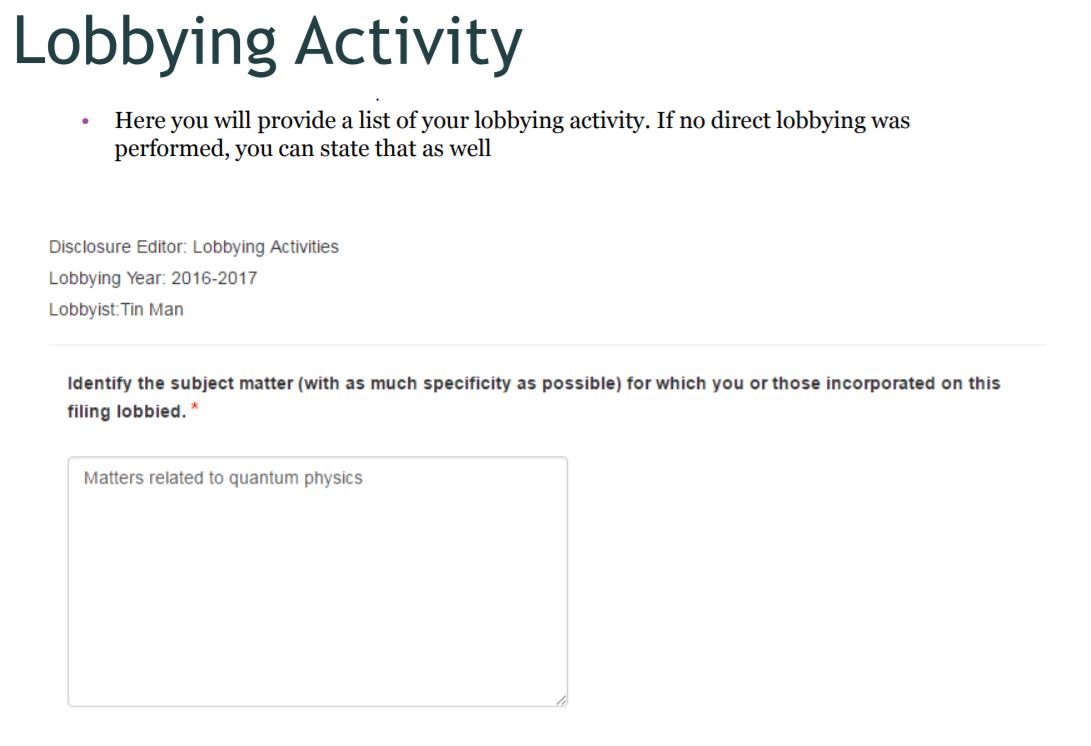
    “Matters Related” phrase used to avoid specifics is blessed by Virginia Ethics Council example.

    โ€œWith as much specificity as possible.โ€

    That is the instruction given to Virginia registered lobbyists about how they should list the various โ€œexecutive and legislative actions and procurement transactionsโ€ they seek to influence on behalf of their principals.ย  ย The instruction to be as specific as possible is routinely ignored and never enforced.

    Most of the hundreds of annual lobbyists disclosure forms filed on behalf of corporations, unions, associations, and government entities reveal nothing about which bills, resolutions, budget items or appointments they sought to influence.ย  Most simply report working onย โ€œall matters related toโ€ or โ€œmatters of interest toโ€ that company or association or entity.ย  One Chamber of Commerce lobbyist replied simply: “business issues.”

    It is hard to blame the lobbyists for being vague.ย  In the illustration above, which is from the official example provided on a state website for those filling out the form, the stock phrase โ€œall matters related toโ€ฆ.โ€ is shown to be acceptable.

    July 1 was the annual deadline for lobbyist filings and if you know how to maneuver on the database you can find them here. ย Set the date range for 2017-2018 and then enter a name for the lobbyist or their principal, which can be a client or an employer.ย  Look for the disclosure reports.ย  There are still some reports missing but most are up.ย  (The data will also eventually be picked up on the Virginia Public Access Project lobbyist listings.)

    A Glimpse Inside the Process

    There are many filings which do list specific bill numbers where the principalโ€™s views were communicated and some even go so far as to list specific budget items by number.ย  But even in those cases it is not possible to determine if lobbyist expressed support, opposition or sought to amend the bill.ย  In some cases lobbyists suggested, requested or actually provided the text of a bill or amendment – an important specific detail never reported.

    So many of the reports fail to list bill numbers or other details that there is no point in singling out anyone for doing so.ย  Some of the largest and busiest law firm lobby shops routinely use the โ€œall mattersโ€ or โ€œmatters relatedโ€ phrase or something similarly amorphous.

    An earlier post described the way some lobbyists evade reporting the names of officials and their families on their entertainment expenses by splitting the cost between more than one client to stay below the $50 reporting trigger.

    This failure to require actual details on which bills, appointments or budget decisions are being influenced โ€“ ignoring what appears to be a clear instruction – is another weak spot in Virginiaโ€™s oversight.ย  Absent that information the reports are worthless.

    Other sections of the reports deal with spending on communication efforts, with advertising, social media and direct mail becoming increasingly common in legislative battles.ย  How much out-of-town lobbyists spent on hotels for themselves, or whether they rented a locker or subscribed to the bill tracking service, are details which are included.ย  They are also details which do not matter.

    The required information on compensation is also meaningless because most lobbyists pro-rate the amount based on the narrow percentage of their time spent in direct contact with legislators or other officials.ย  ย Again, the reports are worthless.

    How much information about what bills drew the attention and effort of the lobbyists could be the subject of debate.ย  The lobbyistsโ€™ natural inclination would be to share nothing.ย  Open government advocates would want to know everything.ย  Right now “nothing” is winning.

    Many of these lobbyists are working for state agencies or for local governing boards, school boards or authorities.ย  They are spending taxpayer dollars seeking to influence tax and spending decisions or changes to their clientโ€™s authority โ€“ undisclosed government-to-government lobbying on our dime.

    The private company or association lobbyists use private dollars, but are often fighting proposed regulations or seeking for the law to give them an advantage over customers or competitors.ย  Many of them are seeking tax changes or spending items in the budget that will provide a benefit to them or their stockholders.

    One of the most important discussions during 2018 has been about filling an open seat on the State Corporation Commission, still unresolved.ย  The SCC is the crucial regulator for multiple businesses in Virginia.ย  You may look in vain for a lobbyist who discloses talking to legislators about any candidate for that job.ย  Does that mean no lobbyist has weighed in?ย  Unlikely.

    Any competent lobbyist can sit down at the end of the session and list the bills or issues worked in the previous weeks, and some record the specific meetings or communications. (Not all are competent, but thatโ€™s another issue.)ย  They know what they did, and in most cases their employers or clients have received regular reports, with full specificity.ย  Requiring a list of bills and issues that were worked on the report would not be onerous.


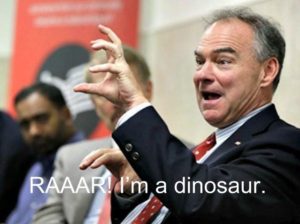
  • “Pterodactyl Tim” Kaine Watch: Lying about SCOTUS Nominee

    The Age of Innocence.ย  Tim Kaine was born in St. Paul, Minnesota, but grew up in Overland Park, Kansas. All that folksy Midwestern-ness seemed to imbue Kaine with a decency and honesty that people noticed. One imagines a young man so innocent and naive that he would sneak behind the barn and do nothing. Kaine even interrupted his studies at Harvard Law to help Jesuit missionaries in Honduras run the prophetically named El Progresso School.


    Once upon a time in Virginia.ย Tim Kaine entered politics the old fashioned way – he married into it. While at Harvard, Kaine met his future wife, the daughter of former Virginia governor Linwood Holton. From there Kaine’s political career proceeded rapidly. 1994 – Richmond City Council, 1998 – Mayor of Richmond, 2001 – Lieutenant Governor of Virginia, 2005 – Governor of Virginia. Through all of those Virginia-based positions Kaine was seen as diligent and likable, even by those who disagreed with his leftist views.

    Creature from the black lagoon.ย Kaine’s journey to the dark side began when he became the chairman of the Democratic National Committee in 2009. He was no longer operating within the corrupt-but-friendly confines of the bourbon-and-branch water set in Richmond. Now he was dealing with the mentally deranged, venomous reptiles-from-hell in the D.C. swamp. He went from Timmy the Sweet to the Lizard of Oz. His election as U.S. Senator from Virginia in 2013 may have pulled him from the deepest cesspool of Washington’s primordial ooze but he was about to make a move that would cement his position as a central character from the original Star Wars cantina scene.

    When you lie down with dogs … …you get up with fleas. In the case of being Hillary Clinton’s running mate – bionic, radioactive killer fleas that infect their host dog with an overwhelming addiction to misrepresentation, deceit and outright lying. Pterodactyl Timmy was hatched in the nest of the high-flying reptiles of the Clinton crime family.

    No such Gorsuch.ย After conversion to the reptilian class Kaine unleashed one of his most outlandish lies. Aiming his beady lizard gaze at then-Supreme Court nominee Neil Gorsuch Kaine claimed on Twitter that,

    He has cavalierly referred to contraceptive use – a constitutionally protected right for 50+ yrs – as โ€˜the wrongdoing of others.โ€™

    Kaine’s quote refers to an opinion then Judge Gorsuch wrote in the famous (or infamous) Hobby Lobby case. He was trying to describe how the owners of the Hobby Lobby company felt about contraceptives. In no way, shape or form could anybody have interpreted Gorsuch’s words as being his own opinion of contraceptives. You can find Judge Gorsuch’s opinion here. You can read Mark Hemmingway’s take on the incident here. In true swamp-dweller fashion Kaine hoped that by telling the big lie he could perhaps sideswipe Neil Gorsuch’s nomination. In this case it turned out Kaine’s dishonesty was exceeded only by his incompetence. Neil Gorsuch is now a member of the U.S. Supreme Court.

    General orders.ย Kaine could have simply apologized, perhaps claiming that Twitter was a poorly chosen vehicle for expressing that opinion. But he didn’t. Instead, he wrote a six-page explanation with a 1,000 word summary of how his lie was actually unvarnished truth. Kaine could have saved himself some time by studying General George Washington. It was he who said, “It is better to offer no excuse than a bad one.” Unfortunately, Pterodactyl Timmy couldn’t find that quote in his bag of carpet. His bad excuse fell on deaf ears. Ramesh Ponnuru over at Bloomberg was having none of it.

    Here we go again.ย On Monday President Trump will put forth his nominee to fill the Supreme Court vacancy caused by Justice Anthony Kennedy’s retirement. Will the high-flying reptile of the D.C. swamp (Pterodactyl Timmy) be able to refrain from further lies about this nominee? Let’s hope so. The last three former governors of Virginia have been Pterodactyl Timmy, Rolex Bob and Terry McCronyCapitalism (whatever happened to that golf cart company, anyway?).ย  We’re getting a bad reputation.

    — Don Rippert