• Leftists Protest Marc Short Appointment at UVa

    Marc Short

    The Miller Center, a nonpartisan affiliate of the University of Virginia dedicated to presidential scholarship and public policy, has taken the bold step of hiring an outgoing member of the Trump administration, Marc Short. The Center is experiencing predictable blowback from campus leftists who regard the hiring of anyone from the Trump team as an abomination.

    This morning more than 300 professors, librarians and students had signed a petition on Change.org, invoking the emotionally charged, upcoming anniversary of the Unite the Right rally to object to Short’s appointment.

    As we approach the first anniversary of the white nationalist violence against this university, this town, and our friends, neighbors, students faculty and staff โ€” all of whom are represented among the injured โ€” it is unconscionable that we would add to our university a person who served in a high-level position for the administration that first empowered, then defended, those white nationalists.”

    The university should not serve as a waystation for high-level members of an administration that has directly harmed our community and to this day attacks the institutions vital to a free society. …ย ย While we do not object to dialogue with members of this administration, we do object to the use of our university to clean up their tarnished reputations. No one should be serving at the highest levels of this administration, daily supporting and defending its actions one week, then representing UVA the next.

    Not only should the appointment be revoked, says the petition, “a full review [should] be held to understand how this appointment was made.”

    The petition presented no evidence that Short, a White House liaison to Congress and a frequent administration spokesman on television, had “supported” or “defended” white nationalists himself. Indeed, a CNN article on Short’s departure highlighted his role in legislative matters such tax cuts, Supreme Court nominations, Obamacare repeal, not the divisive culture-war issues raised in President Trump’s tweets.

    Last night, the Miller School was hanging tough. Howard Witt, director of communications, said in an email to Politico that the Miller study is nonpartisan, bipartisan, and employs former officials from both Republican and Democratic administration.

    “We understand and respect those UVA faculty members and other critics โ€” even some from within the Miller Center โ€” who disagree with the decision to name Marc Short a senior fellow. One of our core values is fostering robust, but civil, debate across our nation’s bitter partisan divide,” said Howard Witt, director of communications and managing editor at the Miller Center, in an email.

    Witt said the addition of Short “deepens our scholarly inquiries into the workings of the American presidency. And his presence reinforces our commitment to nonpartisan and bipartisan dialogue among scholars and practitioners of good will who may nevertheless hold strongly opposing personal political viewpoints. Moreover, Short can offer insights into the Trump administration that are not currently available to our scholars or the public at large.”

    Bacon’s bottom line: Kudos to the Miller Center for sticking to its commitment to foster dialogue across the partisan divide. In a nation where political polarization intensifies daily, institutions that support open dialogue are more indispensable than ever.

    It comes as no surprise that UVa leftists are trying to derail the appointment. Enforcing orthodoxy by shutting down dialogue is in their DNA. Lions hunt, hyenas scavenge, parasites infect, and leftists purge dissenting views.

    This controversy bears watching. The stop-Short campaign started just yesterday — the Change.org petition went live around 6 p.m. — so it hasn’t had much time to build momentum. If the opposition gains steam, it could become a huge test for Jim Ryan, who becomes UVa’s new president Aug. 1. Bacon’s Rebellion will be watching. Alumni will be watching. And Virginia legislators will be watching.


  • Tax Act Impact on Virginia: 5,782 Jobs

    The Tax Cuts and Jobs Act of 2018 will create 218,000 full-time equivalent jobs across the United States this year, asserts the center-right Tax Foundation, which specializes in analyzing the impact of tax policy on the U.S. economy.

    Using its Taxes and Growth econometric model, the Tax Foundation provided a job-creation estimate for each of the 50 states and Washington, D.C. In Virginia, predicts the model, the economic stimulus of corporate and personal income tax reform will create 5,782 jobs.

    That number compares to 20,100 total jobs created between Dec. 2017 and May 2018, according to U.S. Bureau of Labor Statistics data. Annualized, Virginia was on track for creating 48,200 jobs in 2018, suggesting that the tax cuts are accounting for about 12% of the state’s job growth.

    The tax cuts’ impact on Virginia falls in the middling range compared to other states. The 5,872 jobs created in Virginia amounts to 678 jobs per 1 million population, according to Bacon’s Rebellion calculations. On a jobs-per-population basis, the impact ranges from 1,640 in Washington, D.C. to a mere 110 in Oklahoma, both of which appear to be anomalies. Excluding those two, the impact ranges from 564 jobs per million population in Mississippi to 824 in North Dakota.


  • VaNews, the New Power Broker in the Virginia Media Landscape

    When David Poole launched the Virginia Public Access Project’s VaNews digest of news articles about Virginia politics and policy, he had no way of imagining that things would get so complicated. As other news aggregators do, VaNews rounded up the top stories from Virginia’s newspapers, television stations, and selected online publications, excerpting headlines and lead paragraphs, and blasting out an early-morning email to thousands of readers — a highly influential audience of elected officials, government administrators, lobbyists, lawyers, reporters, trade association executives, and others involved in the formulation of public policy in Virginia.

    As the free e-newsletter grew in popularity, it became indispensable reading.ย VaNews now claims 11,700 subscribers. With such an elite audience, it charges $200 daily for one-day sponsorships over and above what it collects in donations. Meanwhile, political and policy blogs clamor to have their content included. VaNews could drive hundreds of page views to their websites — pure gold to smaller publications seeking to expand their readership and influence.

    Now Poole,ย a former state capital correspondent for the Roanoke Times and theย Virginian-Pilot, finds himself in the position of being an arbiter of which publications count as a legitimate news source and which do not. Thanks to the popularity of VaNews, his judgment calls matter. A lot. Not everyone is happy with his decisions, and the issue has come to a head with the inauguration of the Virginia Mercury, an online news publication funded by the progressive Hopewell Fund.

    Tuesday, Poole felt moved to write a letter to the VPAP board.

    You may have noticed that we carried three news articles today published byย Virginia Mercury, a new online news operation funded by progressive groups.

    Some questions have arisen — Is the Mercury a nonprofit newspaper or is it an advocacy organization? Their editor Robert Zullo wrote this introduction, which takes a very clear anti-establishment position. But a lot of editors have preached, “Comfort the afflicted and afflict the comforted.”

    The real question for VaNews is: Who is funding the Mercury? All they’ve said is that they are funded by a large “progressive” foundation. I have asked Zullo for the name of their specific donor. Last week, Zullo said he needed to ask permission to release that information. I have not heard back from him.

    Until Zullo comes clean about funding, we are going to avoid running the Mercury’s coverage of energy and environmental issues. We are making an assumption that the Mercury is similar to theย Southeast Energy News, which is published by a clean-energy group. It looks and feels like conventional journalism, but it is advocacy in the same way an industry newsletter is.

    We are entering a strange time of conversion, where the conventional press is withering away and being replaced with all sorts of experimental organizations. Thanks for your patience and support as we navigate these uncertain waters.

    What once might have been a theoretical concern, easily dismissed, has become urgent as the news staffs of traditional news-gathering organizations shrink and the universe of news articles to draw from contracts along with them. The online publications springing up to fill the news void are seemingly infinite in number, and they vary widely in quality in their commitment to traditional journalism. Clearly, Poole cannot include them all in VaNews. But drawing a clear and objective dividing line is difficult.

    My dog in this fight. I know from personal experience. I asked Poole several months ago if he would include Bacon’s Rebellion news articles in VaNews. While most of our content is commentary, we do publish articles meeting traditional journalistic standards. Poole said he was uncomfortable using our articles, however, citing the journalism sponsorships from Dominion Energy and Partners 4 Affordable Excellence that supported my reporting on energy and higher education. Even though the sponsorship agreements made it clear that I maintained 100% control over the editorial product and even though I was totally transparent about those sponsorships, Poole was concerned that the relationship with advocacy groups called the objectivity of my journalism into question. Dominion, of course, was a particularly controversial sponsor; Blue Virginia, a left-leaning, anti-Dominion blog, had made a big issue about the arrangement.

    I asked Poole, what if I let the sponsorships expire? And what if I drew a clear line between news and commentary? Would he consider the news articles for publication in VaNews? He said he would.

    The Partners 4 Affordable Excellence sponsorship expired in March, and the Dominion sponsorship in June. But Dominion had indicated a willingness to renew the sponsorship for another year. I had a big business decision to make. Thinking of the long-term future of Bacon’s Rebellion, I opted in favor of growing the blog’s readership by making it eligible for inclusion in VaNews, even though it meant losing significant sponsorship income. I let the Dominion sponsorship expire in June. (The company and I parted on good terms.) I then paid several hundred dollars to reconfigure the website and create a “news” page, where all news articles would be published — and easily spotted, and scooped up, byย VaNews and any other news aggregator that wanted them.

    In the meantime, Steve Haner joined Bacon’s Rebellion as a contributing editor. I’d known Haner since we’d worked together at the Roanoke Times more than 30 years ago, and even though he had worked as a GOP operative and a lobbyist in the intervening time, I knew that he knew how to keep his opinions out of his reporting. As he transitions away from lobbying, he has been attending various legislative hearings and public meetings, including most recently the State Council of Higher Education for Virginia meeting, and filing reports for Bacon’s Rebellion.

    On the day we launched our news page, we were delighted to see that VaNews had picked up an article Haner had posted about the Virginia Retirement System. But the e-letter had excluded articles he had written about higher education and I had written about the convening of a solar- and wind-power stakeholder group. Whoah! What happened? Why was our straight news reporting being excluded? (more…)


  • The Va. Political Class in Action: Tidewater Edition

    Shaun Brown

    From the Daily Press: Federal prosecutors say they have evidence of congressional candidate Shaun Brown, a Democrat running as an independent, of “lying to an investor and falsifying campaign finance information to theย Federal Elections Commission (FEC).”

    Brown currently faces charges of conspiracy to commit wire fraud and causing false records, wire fraud, theft of government property and asset forfeiture. The charges are related to a company she runs that is reimbursed for providing food to low-income children in the summer. …

    Prosecutors claim to have evidence that Brown falsely reported giving โ€” and being reimbursed for โ€” more than $700,000 to her campaign for the 2nd congressional district, which runs from Williamsburg to Virginia Beach. …

    The U.S. Attorneyโ€™s Office also claimed to have evidence that in 2014, Brown and another person convinced a third person โ€” identified only as โ€œS.P.โ€ โ€” to invest $100,000 in JOBS Community Outreach Development Corp., the company Brown runs that helps give low-income kids meals in the summer, when theyโ€™re not in school, through a program called Summer Food Service Program. Brown said S.P. would get a return of $750,000 within a year, but S.P. said no money has been returned, according to what prosecutors claim in the court filing. …

    The U.S. Attorneyโ€™s Office for the Eastern District of Virginia claims that Brown directed her company to inflate the number of children they actually fed to theย U.S. Department of Agricultureย and the Virginia Department of Health, which help reimburse companies for their costs. Prosecutors have also accused Brown of falsifying documents in order to get more money from the government.

    The list of particulars goes on, but you get the idea. Brown’s jury trial starts July 24 in Norfolk. Helluva way to conduct a congressional campaign!

    Note: This article has been corrected to note that Brown, though a Democrat, is running as an independent.


  • As Metro Union Articulates Demands, Virginia Needs to Prepare for Strike

    The Washington Metro’s largest union has sent letters to political leaders in Virginia, Maryland, and Washington, D.C. outlining the contract issues behind the union’s veiled threats to conduct an illegal strike. The demands, according to the Washington Post:

    • Roll back a policy reassigning hundreds of custodians to Metro stations and outsourcing some of the work;
    • Reverse rules requiring a 72-hour notice for sick leave;
    • Curb Metroโ€™s shift toward private contracting of certain services;
    • Drop threat to issue three-day suspensions to workers who participated in a July 12 โ€œlate-outโ€ that delayed bus service in parts of the region.

    โ€œOur demand is simple: get [General Manager Paul] Wiedefeld to follow the law, abide by the collective bargaining agreement, and bargain in good faith on all matters under his obligation,โ€ the union wrote in its letter.

    Seventy-two hour notification for sick leave? That sounds strange. I don’t usually know 72 hours ahead of time that I’m going to be sick, and I don’t expect most union members do either. Otherwise, management seems to be making entirely reasonable demands. The number one priority of the union, of course, is to preserve union jobs and maintain union dues revenue — priorities to which, as a taxpayer and occasional passenger, I am utterly indifferent. But the particulars of the contract are not the issue — the prospect of a strike is what should concern us all.

    As Metro management and the union play chicken, Del. Tim Hugo, R-Centreville,ย has urged in aย television interviewย thatย Governor Ralph Northam and Attorney General Mark Herring to prepare for a possible strike and the transportation anarchy that will inevitably follow in Northern Virginia:

    We’ve called on the Governor to make sure he says something, make sure he jumps into this fight. They should move to challenge it in federal court to uphold the compact, the Governor and the Attorney General, because we have to protect the thousands, literally tens of thousands of people in Northern Virginia who rely on Metro to get to get to work everyday.

    The instant a strike is called, the guv and AG need to be ready to file suits, seek injunctions and pursue other remedies to keep the trains and buses rolling. Moreover, they need to let the union know they are ready and willing to act forcefully. Politically speaking, the stakes are much bigger than looking out for the tens of thousands of Virginia Metro riders. Turn those passengers loose on the roads and highways of Northern Virginia, and the entire transportation grid will freeze up. Everyone will be affected. An illegal strike must be shut down as quickly as possible.


  • Saul Trumpinsky – Donald Trump and Saul Alinsky

    Yes Virginia, there is a United States.ย Most posts published on this blog are dedicated to Virginia-specific issues. This post is an exception. It is an attempt to understand the unexpected popularity of Donald Trump. While all states are impacted by the federal government and national politics, Virginia is perhaps the most affected state. The proximity of Northern Virginia to the nation’s capital as well as the military influence over Hampton Roads’ economy make the federal government particularly important to Virginia. So it behooves us to understand the president and how the heck he got elected.

    Saul who?ย Saul Alinsky was a Chicago-born community organizer and writer. He was best known for his book Rules for Radicals published in 1971. Even before his famous (or infamous) book Alinsky was on the political radar. In 1966 William F. Buckley wrote an article in his “On the Right” column calling Alinsky an iconoclast and “close to being an organizational genius.” However, as would be the case with many critics on the left and right, Buckley ultimately found Alinsky’s approach ineffective. Famously, Hillary Clinton’s undergraduate thesis was a 92-page critique of Mr. Alinsky and his methods. Back in 1969, 22-year-old Clinton was sympathetic to Alinsky’s concerns but ultimately found his approach ineffective. Even Hoover’s FBI kept a close eye on Alinsky during the late 1960s. But the 1960s came and went and Saul Alinsky’s Rules for Radicals was written and discussed, and then faded from view. There were momentary flare-ups around Hillary Clinton becoming First Lady and Barack Obama becoming president. However, Alinsky was largely relegated to those creaky crevices of the cultural cranium as a curious cartoon-like character. Or … was he?

    Donald Trump and the resurrection of Saul Alinsky.ย As far back as early 2016 the right wing-media outlet Newsmax began to see parallels between Donald Trump’s approach as a candidate and Alinsky’s Rules for Radicals. After being elected some of President Trump’s conservative critics continued to associate Trump’s actions with the Alinsky brand. Could it be? Could this odd collection of #neverTrumpers have unraveled the secret to Donald Trump’s inexplicable election success? Is he simply following Saul Alinsky’s Rules for Radicals? Repeated searches of Trumpian philosophy found no fond commentary by The Donald for The Saul. However, there are many points of commonality between Trump and Alinsky.

    A baker’s dozen.ย  Alinsky outlines 13 specific rules in his book. Donald Trump is following 12 of them. To wit (along with the Trump translation or Trumplation):

    1. “Power is not only what you have but what the enemy thinks you have.” (Trumplation: constant exaggeration.)
    2. “Never go outside the expertise of your people.” (Trumplation: Make America Great Again. A simple, understandable motto.)
    3. “Whenever possible go outside the expertise of the enemy.” (Trumplation: Canada’s 243% tariff on U.S. dairy products … who knew?)
    4. “Make the enemy live up to its own book of rules.” (Trumplation: Slam Hillary Clinton for taking millions for giving speeches to banks.)
    5. “Ridicule is man’s most potent weapon.” (Trumplation: Crooked Hillary, Corrupt Kaine.)
    6. “A good tactic is one your people enjoy.” (Trumplation: campaign speeches that look like revival meetings, “deplorables” as a badge of honor.”)
    7. “A tactic that drags on too long becomes a drag.” Trumplation: (Whatever happened to the NFL kneeling “controversy”?)
    8. “Keep the pressure on.” (Trumplation: From North Korea to the EU to London to Helsinki backed by an unending chorus of tweets.)
    9. “The threat is usually more terrifying than the thing itself.”ย  (Trumplation: Nominate me or I’ll go third party.)
    10. “The major premise for tactics is the development of operations that will maintain a constant pressure upon the opposition.”ย  (Trumplation: One Donald Trump tweeting, many Democrats attempting to rebut.)
    11. “If you push a negative hard and deep enough it will break through into its counterside” (Trumplation: Forget my business deals, look at Crooked Hillary, Crooked Hillary, Crooked Hillary …)
    12. “The price of a successful attack is a constructive alternative.”ย  (Trumplation: The only rule he seems to have missed although GDP growth through corporate tax cuts might be an example.)
    13. “Pick the target, freeze it, personalize it, and polarize it.”ย  (Trumplation: target individuals not institutions – Carmen Yulin Cruz, Stephen Colbert, Megyn Kelly.)

    Advise to President Trump.ย Read Hillary’s thesis. She did get an “A”. Alinsky’s tactics work well at first but fail to create a lasting unity among their adherents. They generate notoriety at a rapid rate but the momentum doesn’t last. Charles “the Hammer” Martel may have defeated the Moors at Tours but it was his grandson King Charles (aka Charlemagne or “Charles the Great”) who forged an empire. Hammers are forgotten while greatness is not. Hammer time is over. What’s next Mr. President? You’ve taken the rules for radicals as far as they will go. It’s time to start writing “lessons for leaders.”

    — Don Rippert


  • Shrinking Community Colleges Looking to Pivot

    Germanna Community College

    Nothing like losing a quarter of your customers to get your attention.

    That basically is what has happened to Virginiaโ€™s Community College System, with last termโ€™s enrollment down 57,000 (actually only 22 percent) from its peak six years ago during the early days of the economic recovery. That drop exceeds the total enrollment at the 17 smaller campuses and has cost the institutions millions in revenue and forced personnel cuts.

    Chancellor Glenn DuBois and two of the community college presidents shared that information and spent about an hour Tuesday with the State Council of Higher Education for Virginia laying out steps underway to attract more students, which will have to happen if Virginia is to meet the goals it has set for degrees and work certifications.

    DuBois, who has served as chancellor since 2001, spoke again during the meeting at Richard Bland College of his vision of โ€œa college graduate in every householdโ€ and of abolishing the phrase โ€œfirst-generation student.โ€

    One response has been only modest increases in VCCS tuition and fees for the coming year, at 2.5 percent below the official inflation rate and in stark contrast to the four year institutions. The annual cost for a full semester load is around $5,000, but DuBois noted that is still a great deal of money for many Virginians. Students in the community colleges are older, lower income, working part time. Fifteen of the 23 schools have food banks.

    Like many of his predecessors, Governor Ralph Northam has made education and workforce development a high priority and Northam talked during his campaign about lowering or eliminating the cost of attending the public community colleges. About 20 states now have some version of a โ€œpromise programโ€ where all or some high school graduates face no tuition bills at community colleges.

    DuBois said that remains under discussion, which was confirmed a bit later in the meeting by the Governorโ€™s Chief Workforce Advisor Megan Healy. But with a price tag in the hundreds of millions of dollars, โ€œI donโ€™t think thatโ€™s going to happen this year,โ€ Healy said. In 2019 the General Assembly will be considering budget amendments, but the Governor doesnโ€™t do his own full budget until 2020.

    Absent a sudden commitment to free or almost free tuition, a VCCS task force responding to the situation focused heavily on marketing and process improvements. They are leaving the comfort zone, DuBois said, using words like “pivot” and “evolve.”

    What if students didnโ€™t have to apply to attend? The system is working on an open enrollment approach, but it isnโ€™t there yet. It is making progress on reducing the paperwork and migrating the application process to smart phones. People should enroll in one day, โ€œone and done,โ€ said President Janet Gullickson of Germanna near Fredericksburg. โ€œBelieve it or not, thatโ€™s radical.โ€

    The task force also said to make scheduling, degree planning, advising and even payment and financial aid compatible with the mobile environment. An early alert system can flag a struggling student, so a counselor reaches out to them rather than the other way around.

    Do people understand how an associate degree or even a workforce certificate can boost their income? Better marketing may spread the word about the FastForward program which offers reimbursement grants on completion of a workforce credential. The grants โ€œsold outโ€ in their first two years and the General Assembly boosted the funding for this new budget, which may sell out again.

    The target audience is no longer 18 to 24-year-olds.ย DuBois mentioned a Winchester man who lost his long-time job at a recycling center, came to the community college looking for his GED, but in 12 weeks earned a manufacturing technician certificate. He quickly landed a job with 40 percent more pay and, for the first time in his life, full benefits. He will be highlighted as the 10,000th FastForward graduate.

    Another popular certificate program for forklift operations takes just four days. Before any of these programs is approved there is a demonstrated demand for the skills.

    Gullickson mentioned a basic marketing problem she found at Germanna when she started โ€“ no one able to translate for Spanish students dealing with administrative matters. With the changing demographics in that region, the website needed a Spanish version, at an 8th grade reading level so the parents of potential students could understand it.

    Work continues eliminating remaining barriers or duplicate requirements for students seeking to start at a community college and then transfer to a four-year institution. There are state grants for that process, too, which not long ago was getting the most attention as a new role for the community colleges. But based on comments Tuesday, the long-term response to the current challenge may be a system that looks more like its original 1960’s focus on workforce training.


  • Playing with Fire

    Wow, I wouldn’t have expected this from the Washington Post editorial board, but an editorial today lacerated the Amalgamated Transit Union Local 689 for threatening to conduct an illegal strike.

    One might think the union was driven to the edge of such a drastic move, which would be the first such labor action to hit Metro in 40 years, by an assault on employee rights โ€” an unauthorized pay cut, unjustified firings or blatant disregard for worker safety.

    To the contrary.

    The โ€œoffenseโ€ by Metro management that so incensed the unionโ€™s leadership that it might incapacitate the region โ€” and risk the wrath of federal courts, which almost certainly would rule a strike illegal โ€” involves shifting a few dozen janitors from one workplace to another and replacing them with contractors. …

    The union, whose leaders stoke grievances by tossing hyperbolic grenades at management, is playing with fire. Even as an arbitration panel prepares to rule on long-standing contractual disputes involving wages, pensions and other benefits, the union has encouraged two work actions this month, including a late arrival by some 500 workers last week that played havoc with schedules and inconvenienced thousands of riders.

    As the editorialย  observes,ย any annual increase beyond 3 percent in Metroโ€™s operating subsidy from its jurisdictional stakeholders will automatically trigger massive cuts from Virginia and Maryland to operating and capital expenses amounting to more than $200 million this year.

    Bacon’s bottom line: Metro management deserves the full support of Virginia taxpayers and elected officials for its dogged efforts to boost productivity and squeeze costs out of the mass transit system. Management must not bend. And if the union strikes, it must not yield.


  • More Proof that Higher-Ed Sticks It to the Middle Class

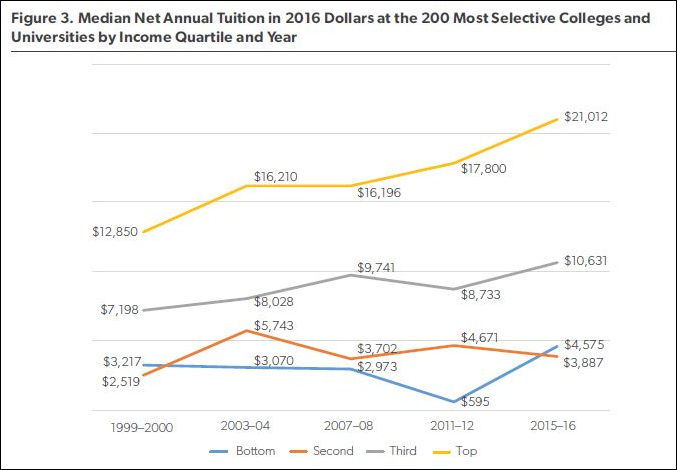
    Source: American Enterprise Institute

    As the cost of attending top four-year college marches relentlessly higher, students from higher-income households are doing just fine: Their family incomes are matching the increase in tuition, fees, room and board. And lower-income students are faring pretty well, too: Scholarships and financial aid cover most of the rising costs. So, if the affluent and the poor aren’t suffering, who is feeling the pain? The middle class.

    A new report by the American Enterprise Institute shows that the big losers from the higher-education business model for leading four-year institutions — aggressive increases in tuition and other expenses offset by generous financial aid for lower-income students — has suppressed college attendance by the middle class.

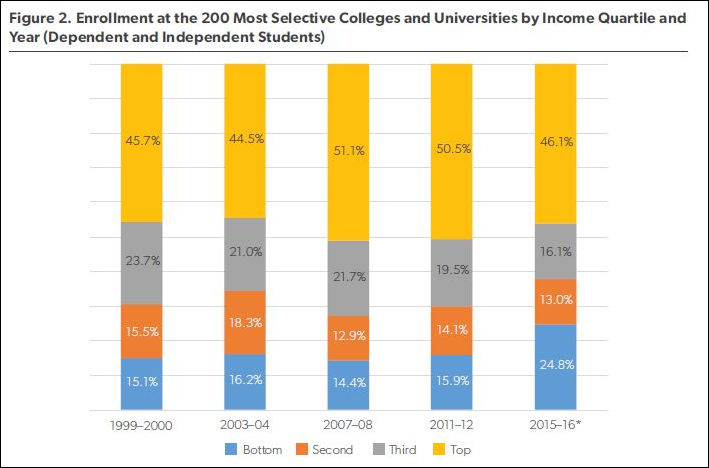
    “We find that, contrary to popular perceptions, the share of students at the 200 more selective colleges who are from low-income families did not decline over the period we studied,” write Jason D. Delisle and Preston Cooper in “Low-Income Students at Selective Colleges: Disappearing or Holding Steady?

    After factoring in grant and scholarship aid, annual net tuition prices at selective colleges have increased by only $11,358 for low-income students since 1999-2000, after adjusting for inflation. For high-income students, the increase was $8,162. …

    The strongest trend in the data is a decline in the share of students in the middle two income quartiles. In other words, the enrollment gains of high-income students in the mid-2000s came at the expense of middle-income students.

    This trend has received relatively little attention from the education community and the national media. It suggests that the narrative regarding income stratification at selective colleges is only half right. Enrollment at selective colleges has changed over time, but it is middle-income students, not low-income students, are becoming less represented on these campuses.

    In the 1999-2000 academic year, 39% of the students enrolled at the top 200 institutions came from the second and third income quartiles. By the 2015-16 academic year, the percentage had fallen to 29%.


    Bacon’s bottom line: If you wonder why the American middle class is feeling all cranky and out of sorts, is voting for crazy candidates, and seems immune to the what’s-the-matter-with-Kansas narratives peddled by the intellectual elites, it’s because of things like this. Upper-income Americans are paying more for tuition than ever — but they can afford it. Their incomes are increasing, too. Lower-income Americans are treated with great solicitude by college administrations and boards of trustees (comprised overwhelmingly by handsomely paid elites) and given huge breaks on their tuition. The middle class, especially the second quartile (as can be seen in the graph above) is left sucking hind teat.

    Combine what’s happening in higher ed with what’s happening in health care, another sector where costs are running out of control. Affluent Americans are insulated from rising medical costs because their incomes are rising. Meanwhile, the political class extends its solicitude to lower-income Americans by expanding Medicaid. What does the middle class get? Not much of anything.

    Similar arguments can be advanced for the effects of energy policy, foreign trade, immigration policy and more. Then toss in the insufferable smugness, arrogance and moral condescension of elite opinion makers, and it’s no wonder so many working- and middle-class Americans feel alienated from the political status quo. It explains a lot about what’s happening in the country today.


  • Report to Agitators, Bomb Throwers and Rebels

    Many thanks to the readers who contribute monthly to Bacon’s Rebellion via the subscriber button atop the left-hand column. I want you to know how your donations have contributed to the blog.

    First, we have migrated Bacon’s Rebellion to a new hosting platform that promises much faster page-loading speeds. If you found the blog frustratingly slow before, you should enjoy the new experience. I suspect that the lethargic download speeds had been discouraging people from visiting the website, and I’m hoping for an uptick in page views.

    Second, we have created a mechanism for separating our news articles (based upon original reporting) from our commentary (opining upon the reporting of others) and posting the news on its own page, which can be accessed via the “News” button on the blog’s navigation bar. We don’t expect this feature to be particularly valuable to readers — you can read the same articles mixed with commentary on the home page as you always have — but it should increase the blog’s visibility for aggregators of news content. The result should be greater exposure for the blog.

    No Bacon post would be complete without a bottom line, and the bottom line is this: Thank you, faithful readers, for supporting the blog financially. Your donations are making a difference.


  • Would an Eviction-Diversion Program Help or Hurt?

    Renters-rights defenders and landlord advocates may be reaching common ground on how to reduce the rate of evictions in Richmond: Create an eviction diversion program. Reports Ned Oliver in the inaugural edition of the Virginia Mercury:

    Planning is still in its early stages, said [Martin Wegbreit, director of litigation at the Central Virginia Legal Aid Society], but it would likely be modeled on similar efforts in other states, like Michigan, where Kalamazoo County established a program in 2007 as part of an initiative to reduce homelessness. In the Richmond area, more than 30 percent of homeless residents surveyed last year said they had been served with an eviction lawsuit, according to a recent survey byย Homeward,ย a nonprofit that coordinates services for homeless people. …

    The one-time program is geared toward low-income families and individuals who can afford their rent but fell behind after an unexpected financial emergency such as a car crash or medical problem. To qualify, they must demonstrate that they are no more than three months behind in rent and show that they will be able to afford their rent once the assistance ends.

    Renters-rights proponents like the idea because it reduces the number of renters evicted from their apartments. The program in Kalamazoo assisted 412 households last year, providing $138,000 in rental assistance, an average of $300 to $350 per family.

    Landlords like the idea because it provides funding to ensure that they get paid rent on time.

    A big question, unaddressed in the article, is where money would come from for an eviction diversion program. NAlso, n one pretends that such a program would settle all the issues between renters and landlords.

    Bacon’s bottom line: The eviction-reduction movement is no more than a palliative for underlying social and economic problems: (1) the tightening shortage of affordable housing in the Richmond region, (2) the inability of poor people to find and sustain living-wage employment, and (3) the inability of some people to manage their personal finances responsibly. Until we address the underlying issues, the problem of evictions will always be with us.

    Still, I’m a big believer in conducting small-scale experiments, which, if successful, can be replicated and scaled, and, if unsuccessful, can be shut down. The key in an eviction-diversion program is not to measure the number of families assisted but to measure the number of evictions. If a program creates a moral hazard in which renters,ย knowing that assistance is available,ย become more lax about husbanding their money, it would be counterproductive. If experience shows that moral hazard turns out not to be an issue, and if the number of evictions demonstrably decline, then the program could prove its worth.


  • More Evidence that Virginia’s Healthcare System Is Broken

    Surprise bills for medical care that Virginians expected insurance to cover are on the rise, a General Assembly healthcare panel was told yesterday. (The Daily News has the story here.)

    Typically, the unexpected charges occur when patients are billed from outside their insurance company’s network. A person might go to a doctor who orders a test from a lab that has no agreement with the insurance company. Or a someone might go to an emergency room and get a bill from an anesthesiologist or pathologist outside the network. Or an emergency-room patient might wind up spending the night at an out-of-network hospital.

    Another problem is the absurdly inflated prices attached to services for which insurance companies negotiate steep discounts. If a patient goes out-of-network, they get stuck with the inflated price. In one example cited in the hearing a Blue Cross Blue Shield member on the Virginia Peninsula was charged $3,687 for urinalysis tests over three months that allegedly could have done at Rite Aid for $50.

    โ€œThereโ€™s no excuse for these kinds of charges for something somebody else is making money with at $50. Basically, itโ€™s fraud,โ€ snapped state Sen.ย Frank Wagner, R-Virginia Beach.

    Bacon’s bottom line:ย Well, labeling the charges “fraud” is unhelpful hyperbole — although I can understand the sentiment. Providers aren’t acting out of some nefarious desire to stick it to their patients. They are trapped in a fundamentally flawed system with two core components.

    First, providers charge prices for services that bear no relationship to the cost of providing the services; they do so as part of their annual dance with insurers, which negotiate discounts as part of their value proposition to members. Over the years, the prices have become untethered from reality. Anyone stuck paying the list prices is totally and utterly hosed.

    Second, insurers have found that they can negotiate steeper discounts by creating exclusive provider networks. Hospitals, doctors and others are willing to offer steeper discounts for policies that steer patients to them. In a marketplace with multiple insurers and multiple providers, the relationships can get very complex and confusing. Checking to see who is in-network and out-of-network can be problematic if the need for treatment is urgent, as it typically is in an emergency room.

    The danger I see is that the General Assembly might create some arbitrary consumer protection that generates unintended consequences in which the new set of problems is even worse than the original set. Before taking hasty, ill-considered action, legislators need to attack the root of the problem — the insane disparity between list prices and negotiated prices. That’s where the system has broken down, and that’s what needs to be fixed.


  • Herring Makes the Right Call

    Mark Herring

    Virginia Attorney General Mark Herring supports abortion rights. He’s sympathetic to the intent behind a federal lawsuit filed by Planned Parenthood challenging states restrictions on abortion. But he has filed a motion to dismiss the lawsuit.

    “Many of the challenged laws are decades old, some of the challenged regulations are under active review, and plaintiffs make power arguments that certain other requirements warrant reconsideration by the Virginia General Assembly,” Herring’s motion states. “But a federal courtroom is not the proper venue for debating the wisdom of these policies.” (See the Washington Post coverage here.)

    Kudos to Herring. Given his over-reach in other matters, I never expected such restraint. But he is absolutely right. The place to reform Virginia’s abortion laws is in the Virginia legislature, not in the federal courts. Herring deserves credit for taking an action that cannot be popular with his political base.


  • Fill Up Your Gas Tanks, Boys, You Might Be Driving to Work

    Ninety-four percent of the Washington Metro’s largest labor union,ย Amalgamated Transit Union Local 689 voted to authorize labor leaders to call a transit strike. Metro workers are forbidden from striking under the mass transit system’s governing authority, and a judge could order strikers back to work. But even a one-day walkout could cause massive disruption to Northern Virginia’s overloaded transportation system.

    โ€œWe understand the ramifications of what weโ€™re asking our members, we understand what a strike would mean,โ€ said Jackie L. Jeter, president of the union, which includes about 8,000 of Metroโ€™s 12,500 active workers.

    โ€œWe will decide the when and where and how,โ€ Jeter said at a news conference, as reported by the Washington Post. โ€œWe have to call a meeting of the executive board after this vote, and then weโ€™ll decide on what weโ€™re going to do.โ€

    The vote follows โ€œlate-outโ€ demonstrations on Julyย 4 and Thursday, in which some employees arrived after the start of their scheduled shifts, delaying some bus service. The actions were meant to send a message to Metro management about stalled contract negotiations, job cuts, privatization, duty reassignments and other issues.ย Local 689 has been without a contract since July 2016.

    Metro management underย General Manager Paul J. Wiedefeld made serious efforts to boost efficiency and productivity at the money-losing organization that has fallen billions of dollars behind in maintenance expenditures, has experienced chronic safety and reliability issues, and has suffered ridership declines.

    The union has not gone out on strike since a wildcat walkout 1978. But after all the safety incidents and with all the trouble keeping trains on schedule, Metro riders don’t want to hear about potential labor disruptions. The union action is only a threat at this point, but riders who are skeptical that Metro offers a viable transportation option will not be reassured.


  • Students Be Damned, Taxpayers Be Damned

    Pretty much since the dawn of time, Virginia’s public four-year colleges and universities have blamed soaring tuition charges on cutbacks to state support for higher education. So, this year the General Assembly funded significant increases in General Funding support, ranging from about 3% for the University of Virginia to 18% for the UVa campus at Wise. And in response, Virginia’s four-year public colleges dutifully reined in their increases for tuition and fees…

    Har! Har! If you fell for that last line, you are truly a fool. As you can read in the previous post by Steve Haner, Virginia’s higher ed establishment jacked up tuition by roughly 6% on average, moderated by a somewhat more modest increase in mandatory student fees. The public colleges and universities did what they always do, which is charge as much as they can get away with.

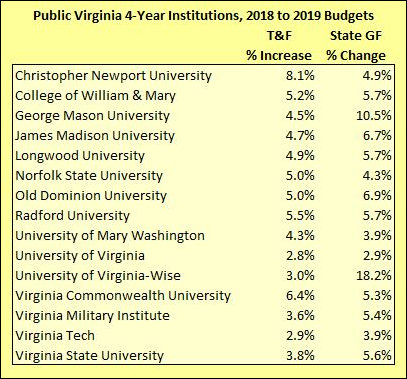
    In the chart above I show the T&F (tuition and fee) increase for each institution between fiscal 2018 and fiscal 2019, based on figures provided by the State Council of Higher Education for Virginia (SCHEV) and published in Steve’s post. Then I show the increase in state General Fund funding based on the budget submitted by outgoing Governor Terry McAuliffe. (Note: These figures do not represent the final budget approved by the General Assembly and signed into law, which I cannot find online. While the legislature might have tinkered with the numbers, however, they did not change significantly.)

    Compare the two columns and you’ll see that UVa and Virginia Tech conducted themselves with restraint, hiking tuition & fees by the smallest percentages, even though the General Assembly gave them the most parsimonious increases in General Fund support. Every other institution raised rates in total disregard for the generous allotments bestowed upon them. Standouts were Christopher Newport University, which hiked fees by 8% in the face of a 5% increase in support, and Virginia Commonwealth University, which is extracting 6% more from its students despite a 5.3% increase in state aid.

    Single year-to-year comparisons of state support can be tricky because sometimes the General Assembly throws in large sums of money to support strategically important programs such as, this year, cyber-security. George Mason University was the major beneficiary of that initiative, which may explain its 10.5% increase in state support. Also, it is important to view the actions of an institution this year in the context of their actions in previous years and in the context of state budget actions, such as cuts to budgeted state support made in response to a deficit scare in fiscal 2018. Therefore, a snapshot analysis like this should be viewed as preliminary and provisional for any given institution. But viewed as a whole, it is hard to avoid the conclusion that the higher ed establishment has hoisted its collective finger to Virginia’s students and taxpayers.

    I have warned that continued aggressive hikes in tuition, fees and other expenses eventually would backfire on institutions with less illustrious reputations. I highlighted the risk that enrollments would decline, cutting sharply into revenues. So far, that hasn’t happened. Yes, I’ll confess… my fears have proven groundless. So far.

    What’s happening? Enrollments are declining at many smaller, less prestigious private institutions. Private colleges lacking big endowments to fund hefty scholarships are more expensive to attend than public peers receiving state support, and they are losing students As long as the small, liberal arts colleges continue to bleed students, the publics may be able to pick up the refugees and continue jacking up tuition without repercussions. We’ll watch the numbers and see how they play out.

    In the meantime, parents of college-bound kids should expect no easing up on the increase in tuition and fees at Virginia publics. There is no indication — none at all — that they are satiated.ย  All colleges and universities have ambitious plans to advance their institutional glory.ย No amount of revenue is ever enough. They will continue raising tuition and fees as long as the market will bear it and taxpayers remain quiescent.