Spanberger loves RGGI. Electricity will cost more.
Based on the most recent carbon tax imposed on the member states of the Regional Greenhouse Gas Initiative (RGGI), Virginians will pay about $500 million more per year for electricity if Virginia again becomes one of those member states. Your vote in November may determine that.
Democratic nominee for governor Abigail Spanberger has pledged to rejoin the RGGI compact and reinstate the carbon tax. Republican nominee Winsome Earle-Sears has promised to maintain the policy of Governor Glenn Youngkin and stay outside of RGGI. There is also a pending lawsuit that challenges Youngkin’s actions in withdrawing.
There is a clear demarcation between the political parties on rejoining RGGI and adding this cost to Virginia’s electricity customers. Getting us out of RGGI was Youngkin’s most successful initiative to lower electricity bills. Every Virginia generator – both utilities and independent generators – had to buy an allowance (pay a tax) for every ton of carbon dioxide its plant emits from using coal, oil or natural gas.
RGGI held its third 2025 auction for carbon emission allowances September 3 and the results were released today. The clearing price to purchase an allowance was set at $22.25 per emitted ton. The peak was a year ago at $25.75 per ton. The first two 2025 auctions cleared at just under $20 per ton.
by Stephanie Lundquist-Arora Republished with permission from IWFeatures
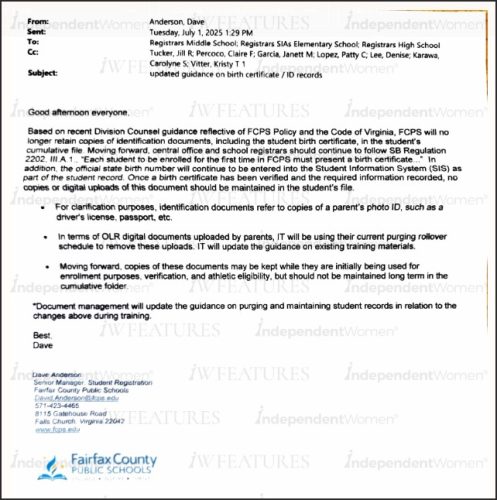
Fairfax County Public Schools is issuing new guidance to public school registrars, telling them to purge copies and digital uploads of students’ personal documents from school records.
Schools have long required these legal documents to prove a student’s identity, residence, and relationship to his or her parents and caregivers. Yet, on July 1, Dave Anderson, Fairfax County Public Schools’ senior district manager for student registration, who earns an annual salary of about $150,000, sent an email to school-based registrars that states, “Based on recent Division Counsel guidance … FCPS will no longer retain copies of identification documents, including the student birth certificate, in the student’s cumulative file. … For clarification purposes, identification documents refer to copies of a parent’s photo ID, such as a driver’s license, passport, etc.”
The email did not provide registrars with a reason for this policy change, and there has been no official communication with parents about the change. This leaves moms like me, who have three children currently enrolled in Fairfax County Public Schools, wondering why the leaders of the largest public school district in Virginia are suddenly determined to destroy student documents proving students’ identification, residency, citizenship, and relationships to parents.
We hold these truths to be self-evident, that all men are created equal, that they are endowed by their Creator with certain unalienable Rights, that among these are Life, Liberty and the pursuit of Happiness. From the Declaration of Independence.
Ladies and gentlemen, l present Tim Kaine, U.S. Senator from Virginia. At the Senate confirmation hearing for Riley Barnes to be Assistant Secretary of State for Democracy, Human Rights and Labor, he belched out the following.
This was in reaction to Barnes’ statement, “We are a nation founded on a powerful principle, and that powerful principle is that all men are created equal, because our rights come from God our Creator — not from our laws, not from our governments.”
Kaine found Barnes’ view of civil rights, “troubling.”
The most famous line in the Declaration of Independence reads as follows: “We hold these truths to be self-evident, that all men are created equal, that they are endowed by their Creator with certain unalienable Rights, that among these are Life, Liberty and the pursuit of Happiness.”
Virginia’s junior U.S. senator Tim Kaine takes exception to that view.
“The notion that rights don’t come from laws and don’t come from the government, but come from the Creator — that’s what the Iranian government believes. It’s a theocratic regime that bases its rule on Sharia law and targets Sunnis, Bahá’ís, Jews, Christians and other religious… pic.twitter.com/XcrPHbVplp
In a humanistic age in which an increasing number of Americans don’t believe in God, does Kaine have a point? If human rights don’t come from God (or other deity), where do they come from? Conservatives like Senator Ted Cruz have attacked Kaine for the statement, the context of which is missing in this clip (and which readers are encouraged to provide). Whatever prompted Kaine to present this argument, it is consistent with humanistic principles and undoubtedly represents the views of many. Feel free to debate in the comments. (To reach the comments, click on the headline then scroll to the bottom of the page. — JAB
Enemy submarines and drones could exploit points of vulnerability, experts warn
Dominion ship installs wind turbines off Virginia coast. Photo credit: Energynews.us
by Kevin Mooney
Offshore wind projects could potentially enable foreign adversaries to hide submarines in U.S. territorial waters and penetrate U.S. air defenses, according to national security and energy policy analysts.
For this reason alone, they would like to see President Donald Trump’s administration pull the plug on projects up and down the East Coast located near to where military exercises take place. The U.S. Air Force and Navy have in the past expressed concern over how wind farms might impact radar and sonar operations to the point where they compromise defensive and offensive capabilities.
The Trump administration seems to be listening.
Officials have already reversed at least some of the prior approvals President Joe Biden’s administration extended to offshore wind plans. Trump’s January executive order called for a temporary cessation and immediate review of federal wind leasing and permitting practices. The decision dealt a blow to several projects that were either already in motion or in the planning stages.
“The U.S. Navy has good reason to be concerned with offshore wind because there could be interference with Navy sonars. Imagine a scenario where China and Russia could park their submarines in the seabed right outside the Chesapeake Bay because our sonars cannot operate as they should.”
Just what Virginia doesn’t need: Violent predators – murderers and rapists – vomited back into society from prison just because they’re old.
But that’s what we get in Virginia, thanks to a wrinkle in the law that allows the parole board to spring inmates once they get a few gray hairs.
Let’s back up.
Many Virginians foolishly believe they live in a no-parole commonwealth.
After all, in 1994 Gov. George Allen brought us “Truth in Sentencing,” a law that guarantees that every convict would serve almost every single day of his or her prison sentence. That measure was designed to slam shut the revolving doors on Virginia prisons.
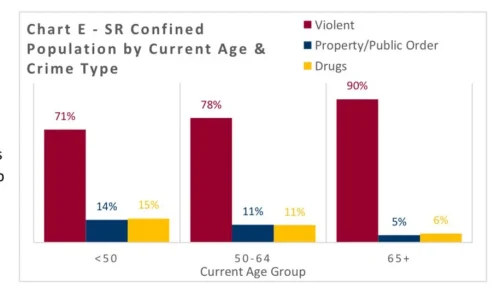
The parole board was left to hold hearings for inmates convicted prior to February 1, 1995 – of which there are very few – and those eligible for geriatric parole. That is, an inmate who’s at least 65 years old with 5 years served, or 60 with 10 years served.
These incarcerated senior citizens can be considered annually by the parole board for release.
Lest you think these geezers are in the big house for passing bad checks, selling weed or knocking off liquor stores, they aren’t.
DOC website shows that 90% of those 65 and older are in prison for violent felonies. A full 29 percent of those are in for rape of sexual attacks.
They should never be released. Even when they’re in hospital beds hooked up to tubes and monitors. Let ‘em die where they belong: in prison. Continue reading.
Another dispute between Gov. Glenn Youngkin and the General Assembly, one that has faint echoes of one occurring north of the Potomac, has taken on a larger life with parties turning to the Virginia Supreme Court.
Before going into the details, some background would be helpful. The Virginia Constitution provides, “The Governor shall have the power to veto any particular item or items of an appropriation bill.” The “item veto” is a powerful tool for the governor, but it is not an unlimited one.
The authorization of an item veto has been discussed in some detail earlier on this blog, therefore there is no need to go into that detail here. In summary, the Virginia Supreme Court, in Brault v Holleman, laid out the parameters on the item veto power:
“While the Governor is empowered to veto any particular item or items of an appropriation bill, he must, for his veto to be valid, strike down the whole of an item; he cannot disapprove part of an item and approve the remainder… Where a condition is attached to an appropriation, the condition must be observed. The Governor cannot veto the appropriation without also disapproving the condition; correspondingly, he cannot veto the condition without also disapproving the appropriation.”
The Clerk of the Virginia House of Delegates is a unique position. By law he is designated the “Keeper of the Rolls.” The law gives the Clerk the responsibility of keeping the originals of all bills that have been passed and signed by the Governor. It also directs the Clerk to “enroll all of the acts of the General Assembly and joint resolutions proposing amendments to the Constitution by such other permanent and substantial method or methods as he may deem proper; and shall have the enrolled acts bound for publication after they have been signed by the Speaker of the House of Delegates and the President of the Senate.”
Several of the technology giants that own data centers in Virginia and are planning many more have settled their internal dispute over Dominion Energy Virginia’s proposal about how to charge them for electricity. The document laying out their new favored compromise was being prepared just as Bacon’s Rebellion last week highlighted their broad differences.
That is the risk when writing about an active dispute in the energy regulatory world. Things change rapidly. The document was filed with the State Corporation Commission at the end of Friday just before the holiday weekend, one business day before a hearing opened Tuesday.
Amazon Data Services, Google, Microsoft Corporation, the Data Center Coalition and the coalition for Virginia’s large industrial users – which are not data centers – all signed on to the proposal. Another heavy hitter, Wal-Mart, took a position of “not opposing.” During this week’s ongoing hearing on Dominion’s pending base rate application, proponents told the SCC judges they wanted to “make your jobs easier.”
The reaction from Dominion was highly negative, complaining both that the move is outside the normal SCC process, and it was wrong to label the document a “stipulation.” It was only a stipulation among the willing, and apparently other parties saw it first when it dropped.
For more than four decades, Northern Virginia drivers have dutifully lined up every two years to have their vehicles inspected for emissions (separate from the equally onerous safety inspections required throughout Virginia). The mandate, which only applies to localities in Northern Virginia, was enacted in 1982 under the 1970 Clean Air Act and was once a reasonable response to the air quality crisis of its time.
That era is long gone. Today’s vehicles are technological marvels compared to those on the road when Ronald Reagan was in the White House, and the region’s air quality has dramatically improved. Yet Virginians are still footing the bill—over $50 million every two years—for a regulatory program that delivers almost no environmental benefit. It’s time for policymakers to acknowledge the program’s success and retire it altogether.
The results speak for themselves. Cars manufactured today emit 98–99% fewer pollutants than their mid-20th-century predecessors. Air quality in Northern Virginia now consistently meets the federal National Ambient Air Quality Standards (NAAQS), even accounting for anomalies like the recent Canadian wildfires which blew into our region.
Cleaner Cars, Cleaner Air
The program’s original goal was clear: reduce the smog and pollution caused by older, less efficient vehicles. At the time, many cars lacked catalytic converters, and even newer models had no sophisticated onboard diagnostics. That’s no longer the case.
The 2025 SOL data are up on the VDOE Web site. This post looks at the statewide data.
But First: VDOE reports pass rate averages for “economically disadvantaged” students (“ED” here, mostly those who qualify for free/reduced price meals), their more affluent peers (“Not ED”), and all students. ED students generally perform less well than the Not ED, see below. Most reports and, it appears, the new Accreditation system look at the all-students averages. That serves to unfairly penalize the divisions with large ED populations. A fair system would look at both groups and probably would emphasize the performance of the group that needs more attention, the ED. This post looks at the ED and Not ED data in addition to those for all students.
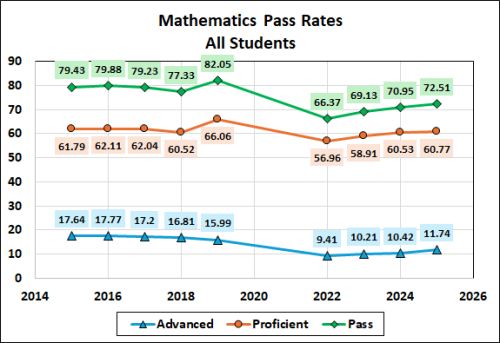
VDOE scores SOL pass rates on a 600-point scale. Scores above 500 are counted as Pass/Advanced. Those from 400 to 500, Pass/Proficient. The sum of those two rates in the overall pass rate. Note: The Board of “Education” lowered the cut scores to the current levels in 2020, creating modest uncertainty in the calculation of the pandemic’s effects. Topic for another day: As set out in the document at that link, Virginia reports proficiency at rates roughly double those published by the NAEP.
The 2021 testing was voluntary so that year’s data surely are not reliable measures. I’ve omitted them here.
The Big Two subjects for Accreditation (and, probably, for functioning in life) are reading and math. To a lesser degree, the accreditation process considers the science pass rates. For reasons that will become obvious, I’ll start with math.
Here are the 2015 to 2025 state average pass rates for the mathematics tests. The Board of “Education” relaxed the math standards in 2019, hence the bump in pass rates that year.
A common complaint, on Bacon’s Rebellion and generally, is about the high costs of colleges. I am usually sympathetic to such complaints. I see the projected costs of the higher ed institutions my grandkids are going to or are considering. But, then, I run across articles like this and this and I become very cynical.
For those of you who do not have access to the Washington Post and the New York Times, I will summarize the articles. They are about students and their parents spending tons of money to decorate their college dorm rooms. There is a whole market out there for items to decorate dorm rooms. Here is the result of a Google search of “Decorate dorm rooms.” The pictures are amazing.
And it is not just the cost of the furnishings. Many students hire specialized design consultants to help them make their dorm rooms “livable.” Costs vary, depending on the range of services desired. A full package can include consulting with the client over what is desired, selecting and procuring the furnishings, and showing up on move-in day to completely set up the room. It is big business in some areas. One dorm design consultant, who graduated from college in 2021 with a degree in integrated marketing communications (I have no idea what that entails), had more than 200 clients in 2024. She employed 25 seasonal employees. Her fee was $10,000 per room ($5,000 for each student). Another consultant, for a “basic bedding, design and decor package” typically charges “$2,500 in design and $3,500 in procurement.”
The National Retail Federation projects that Americans will spend $12.8 billion this year for dorm or college apartment furnishings. Keep in mind that this is for rooms that come already furnished by the college.
Celebrating a proud American tradition of labor! — JAB
by Kerry Dougherty
Labor Day. America’s most ambiguous national holiday.
Think about it. On other special days – Memorial, Independence, Veterans, Thanksgiving, Presidents, Martin Luther King and Christmas – we pause, however briefly, to honor a beloved person or a historical event.
We have parades, visit cemeteries, blast fireworks, give thanks, recite a famous speech or watch “It’s a Wonderful Life.”
Not on Labor Day.
Take a peek at the festivities scheduled this weekend. Wait. What festivities? The Rock ‘n’ Roll Half Marathon moved on years ago, so there’s nothing to do today other than hit the beach and cook out.
Swimming and eating burgers has nothing to do with Labor Day’s grittier, trade union roots.
And that’s a good thing.
I’m not sure anyone wants to mark Labor Day by dragging a picket sign to the beach or by joining a national scavenger hunt to look for Jimmy Hoffa’s body.
Does anyone plan to watch “Norma Rae” today? Or gather the family together for a few choruses of “The Ballad of Joe Hill”?
Anyone inviting the repulsive Randi Weingarten to their cookout?
I didn’t think so.
On Labor Day, it’s not what we do, it’s what we don’t do – labor. Continue reading.
I pulled this image off the Internet. Upon reflection, I did not check its provenance when I originally posted it. I suspect it is AI-generated. I do not vouch for its authenticity. — JAB
The world is descending into a very dark place when a man gets arrested for professing his love for bacon. But that’s what it’s come to in the United Kingdom. The gentleman shown above was participating in a July protest in Dalton-in-Furness against construction of a mega-mosque when he broke into a sing-song chant of “we love bacon.” Police hauled him off on suspicion of a public order offence, specifically “racially or religiously aggravated harassment intended to incite disorder or offend the Muslim community.”
Some peoples’ sensitivities apparently matter more than others’.
The year: 2075. The American colonies on the Moon are getting restless under Washington’s tyrannical rule….
This second edition of “Dust Mites” has a snazzy new cover, includes helpful lunar maps, and is 5,000 words tighter than the original. The sequel, “Trogs,” is scheduled for publication this summer.
Advertisement
Advertisement
Advertisement
Advertisement
About
Bacon’s Rebellion is Virginia’s leading politically non-aligned portal for news, opinions and analysis about state, regional and local public policy. Read more about us here.
Fund the Rebellion
Shake up the status quo! Your contributions will be used to pay for faster download speeds and grow readership. Make a one-time donation by credit card or contribute a small sum monthly.
Can’t wait until tomorrow
For your Bacon’s Rebellion fix?
Enter your email address to receive immediate notifications of new posts by email.
SUBSCRIBE
Search Bacon’s Rebellion
Categories
Archives
The Jefferson Council
Protecting Thomas Jefferson’s Legacy at the University of Virginia
Forgot Your Password?
Shoot me an email and I’ll generate a new password for you.