• Entrepreneurs, Rent Seekers and the Just Society

    by James A. Bacon

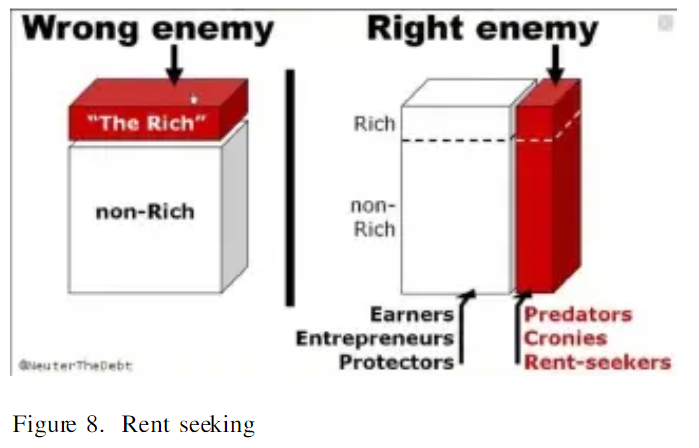
    It’s a lazy, rainy day, and for amusement, I’ve been reading Nassim Nicholas Taleb’s online work, “Principia Politica,” in which he applies his insights into risk, probability, and the non-linearity of complex systems to the realm of governance and politics. The graphic displayed above appears about halfway through the presentation without any elaboration but it beautifully summarizes how I view the world.

    The left-hand image summarizes the thinking of the political left in the United States today, which defines “the rich” — the millionaires and billionaires, in Bernie Sanders parlance — as the enemy. The underlying assumption is that all wealth is, to one degree or another, illegitimately gained and that concentrations of wealth are harmful to society. This is the default mode of thinking of much of academia, the journalism “profession, think tank pundits and the nation’s intelligentsia.

    The right-hand image summarizes the thinking of those, like me, of a conservative-libertarian bent. I have no problem with the existence of rich people in our society. I am far more interested in how people acquired their wealth. To me, predators, cronies and rent seekers are the bad guys. (more…)

  • Dr. Kingโ€™s Dream or George Orwellโ€™s Nightmare – the University of Virginia at a Crossroads

    by James C. Sherlock ย Updated Aug. 17 at 8:24 AM

    This letter is a response to the recommendations of the University of Virginiaโ€™s Racial Equity Task Force which are to be taken up this week by President Jim Ryan and the Universityโ€™s Board of Visitors.

    Dear President Ryan,

    Martin Luther King dreamed of the day that his children would “one day live in a nation where they will not be judged by the color of their skin but by the content of their character.โ€ The University seems poised to go in a different direction. You charged your racial equality task force to focus on the color of skin.

    A focus on class would have produced a far better and more constitutionally sound set of recommendations and honored Dr. Kingโ€™s vision. Picking a racial group for preferential treatment runs head on into constitutional equal protection guarantees and any sense of true equity.

    In doing so you assured a very racially divisive and highly politicized result. Regrettably but unsurprisingly, the recommendations of the task force view education as a means by which to advance a form of race-based social justice that aligns with a specific political viewpoint.

    The report asserts controversial and arguable positions as dogmatic certainties. Some schools of the University have already adopted those same critical theory positions. Course listings and reading lists and the writings of many professors in the Universityโ€™s humanities and social science departments and the Curry school already indicate large-scale enforcement of this viewpoint. (more…)


  • Uncertainty Shrouds College Move-in Day this Year

    VCU move-in day. Photo credit: Richmond Times-Dispatch

    Against the backdrop of a stubbornly persistent COVID-19 epidemic, college kids are heading back to campus. Virginia’s colleges and universities soon will find out if all the students who paid deposits do, in fact, plan to attend this fall.

    Preliminary evidence suggests that enrollment numbers will not decline dramatically, although epidemic-control measures will significantly reduce the number of students living on-campus.

    Virginia Tech, which was dealing with an over-enrollment issue only two years ago, seems to be the most heavily impacted. While 6,728 freshmen enrolled at Tech, the university now projects the number to fall slightly below its goal of 6,675 when a census is taken in September, reports the Roanoke Times. (more…)


  • Meters Keep Spinning On Unpaid Utility Bills

    Amounts various Virginia utilities are owed by customers as of June 30, four months after the State Corporation Commission prohibited utility disconnections. Source: SCC

    By Steve Haner

    During the first four months of the COVID-19 pandemic, Virginians piled up $184 million or more in unpaid bills with several Virginia utilities, and that was before the worst of the heat arrived in July.

    The figure comes from a short letter from the State Corporation Commission to General Assembly leaders dated today, listing the totals in arrears as of June 30.ย  The SCC issued an order in March, renewed in June, which prohibited the disconnection of regulated utility customers for unpaid bills during the recession. The order was extended after legislators claimed they would be addressing the problem at the August special session.

    The SCCโ€™s order suspending disconnections expires on August 31. That legislative session is now just four days away and no suggestions for a solution have surfaced publicly. No bill on the topic is filed. This issue is not mentioned in a story in todayโ€™s Richmond Times-Dispatch listing some of the budget actions Governor Ralph Northam will propose next week.ย  (more…)


  • Make It Easier to Remove Bad Cops

    by James A. Bacon

    The overwhelming majority of Virginia policemen and deputies are good people doing a creditable job under often-trying circumstances. But not all. Every profession has its bad apples. And in Virginia, state law makes it impossible to strip officers of their certification unless they have been convicted of a felony or certain misdemeanors. Even then, some manage to stay on the job.

    The Virginian-Pilot provides a list of convicted criminals who still have police certifications. including:

    • A former Hampton detective who pleaded guilty in federal court to providing a local drug dealer with information while working as a narcotics detective.
    • A former Henrico County sheriffโ€™s deputy who pleaded guilty to having a sexual relationship with an inmate.
    • A former school resource officer in Bedford County who was initially charged with abducting a teenage girl and taking her to Kentucky. He pleaded guilty to five counts of indecent liberties with a minor.
    • A Dinwiddie sheriff’s deputy who was found guilty of assault and battery after he pulled over his ex-fiancรฉ and forced her to the ground and pepper sprayed her.

    (more…)


  • Big Prison Releases Likely as Legislators Exploit Pandemic

    by Hans Bader

    With the public distracted by the pandemic, Virginia’s liberal legislature is likely to pass laws that would release many prisoners. A special legislative session begins on August 18, to address criminal-justice and COVID-19 issues. The Democratic Caucus has agreed to expand good-time credits for prisoners, effectively shortening their sentences. Parole would be reinstated in Virginia, if legislation proposed by state Sen. John Edwards, D-Roanoke, has his way. Virginia largely abolished parole in 1995, but Edwards, chairman of the Senate Judiciary Committee, would not only reinstate it, but apply parole retroactively to people already convicted of crimes. Legislation proposed by Sen.John Bell, D-Chantilly, would expand geriatric parole for inmates who have committed any type of crime, except those who have committed Class 1 (capital) murder.

    Cumulatively, these bills would result in shorter average sentences for inmates. Shorter sentences can lead to an increased crime rate, while longer sentences tend to reduce the crime rate. The National Bureau of Economic Research has a web page titled โ€œSentence Enhancements Reduce Crime.โ€ It discusses how Californiaโ€™s Proposition 8 reduced crime by keeping โ€œrepeat offendersโ€ off of the streets. According to the study it cites, โ€œBecause convicted criminals were serving longer sentences, years after the lawโ€™s change they were still locked up, rather than out on the streets committing crime.โ€ Murderers sometimes commit murder again after being released from prison, even those released from prison at an advanced age. (more…)


  • Woke War on America’s No. 1 High School

    by Asra Q. Nomani

    Last month, Suparna Dutta spent countless hours researching how her son could safely return to school this fall as a rising sophomore at Thomas Jefferson High School for Science and Technology, a sprawling campus of classrooms, laboratories and open spaces with names like โ€œGandhi Commonsโ€ and โ€œEinstein Commons,โ€ outside the nation’s capital here off Braddock Road. Little did she know that a secretive โ€œtask forceโ€ assembled by orders of Virginia Gov. Ralph Northam was quietly meeting to discuss legislating radical changes to the school that would threaten the very future of the school.

    Unbeknownst to Dutta โ€” and me, also a TJ mother โ€” Virginia Secretary of Education Atif Qarni, a former teacher, met remotely on Friday, July 24, with a carefully curated list of Democratic lawmakers, state education officials and others in a โ€œDiversity/Equity/Inclusion Groupโ€ to make recommendations to the Virginia State Legislature on how to increase the number of Black, Hispanic and low-income students at the stateโ€™s 19 Governorโ€™s Schools, specialized public school programs with admissions requirements. The group met again on Friday, July 31, and last week on Friday, August 7, and is expected to issue its recommendations in the coming days.

    In its final meeting last week, the group weighed several options that would gut TJโ€™s merit-based, race-blind admissions process and replace it with standards that they even admitted in their private meetings would essentially be race-based. They are expected this week to issue several recommendations to the Virginia General Assembly before it convenes in special session next week, including: quotas from every middle school in the county (to boost acceptance from certain middle schools with underrepresented minorities); a second-step lottery in the admissions process; and an admissions bump for students with โ€œsocioeconomic disadvantageโ€ (also a backdoor way to increase underrepresented minorities). (more…)


  • August 14: VJ Day Celebrated In Honolulu

    He that outlives this day, and comes safe home,
    Will stand a tip-toe when the day is named…

    There is one more major World War II milestone to note, and this short video does that well.ย  In recent weeks, as the anniversaries of the nuclear bombs passed, we were subjected to the usual 20-20 hindsight claims that it wasn’t necessary, and Japan was ready to cave.ย  We descendants of the Greatest Generation, who understand that an invasion of Japan would have been 1,000 times worse than Iwo Jima and Okinawa combined, lose no sleep over what was probably one of the easiest — and most correct — decisions President Harry Truman ever made.

    Hat tip:ย  Chris Braunlich, whose father was on a troopship in the Pacific 75 years ago today.


  • Northam’s “Anti-Asian, Anti-Immigrant” School Initiative

    Thomas Jefferson High School

    by James A. Bacon

    More than 1,500 parents, students and alumni of the prestigious Thomas Jefferson High School for Science and Technology have petitioned Governor Ralph Northam to halt the “secretive and bigoted, anti-Asian, anti-immigrant effort” to substitute race-based admissions for the meritocratic admissions criteria now in place.

    The petitioners accuse Secretary of Education Atif Qarni of using Thomas Jefferson and other elite Governor’s schools around the state as a “Petri dish for experiments in social engineering.” They share the goal of increasing the number of black, Hispanic and economically disadvantaged students at “TJ,” as the Fairfax-based science and technology school is known, but not through the use of “short-sighted race-based solutions.”

    The school created a furor this summer when it publicly released the admissions statistics for the entering class. Seventy-three percent were classified as Asian, 18% as white, 6% as multiracial and other (including black) and 3% Hispanic. (more…)


  • Governor Northam, Crack Down on Nursing Homes, Not Restaurants

    By Carol J. Bova

    Last week Julie Henderson, director of the Virginia Department of Health (VDH) Office of Environmental Health Services, said her agency was going to request $6 million for 92 positions to educate the public and businesses about executive orders and how to enforce them.

    If there is $6 million available for enforcement and education personnel, send them out to the nursing homes, correctional facilities and other congregate settings. Restaurants are not causing the deaths and suffering occurring from those outbreaks.

    Of 956 virus deaths reported since June 1, 498 or 52% were from long term care facilities. Since the outbreak tracking began, long-term care facilities were responsible 1,294 of 1,370 outbreak deaths โ€“ thatโ€™s 94.5% of all outbreak deaths.

    Let citizens make their own choices about going to restaurants. Post a warning if a restaurant isnโ€™t meeting your standards, but shutting them down based on a complaint system isnโ€™t going to save lives in the same way enforcing basic hygiene and infection controls in nursing homes will. Put the money where itโ€™s going to make a difference. (more…)


  • COVID Workers Comp On House Democrat Bill List

    By Steve Haner

    The coming Special Session of the General Assembly will be narrowly focused but filled with controversy, based on the legislative wish list just released by House of Delegates Democrats. Only two bills listed fall outside of the major categories of โ€œCOVID-19 Reliefโ€ or โ€œCriminal Justice and Police Reform.โ€

    Under the heading “COVID Relief,” the Democrats wish to reopen their drive for employee paid leave and. as predicted. want to designate COVID-19 as a workplace disease.

    The Senate Democrats have their own list, released in June and reiterated in a more recent news release. The release claims that one of the bills is ready for public viewing, but provides no link and the bill mentioned is not yet available through Legislative Information Services. Neither caucus has yet revealed any thoughts on how to amend the state budget, a task where Governor Ralph Northam naturally takes the lead.

    Here is the list from the House Democratic Caucus, with some thoughts following:

    COVID-19 Relief:

    • Requiring businesses to grant paid sick leave for Virginia workers.
    • Prohibiting garnishments of stimulus relief checks. (Office of Attorney General bill)
    • Establishing a presumption of workersโ€™ compensation for first responders, teachers, and other high-risk essential workers.
    • Providing immunity from civil claims related to COVID-19 for complying with health guidance.
    • Combating price gouging for Personal Protective Equipment. (Office of Attorney General bill)
    • Protecting Virginians from eviction during a public health emergency.
    • Creating a Commonwealth Marketplace for PPE Acquisition.
    • Mandating transparency requirements for congregate-care facilities during a public health emergency.

    (more…)


  • A College-Student Bill of Rights

    by James A. Bacon

    College students should be reimbursed if they don’t receive the full benefits they pay for in tuition, fees, room, and board, declares the Partners for College Affordability and Public Trust.

    โ€œCOVID-19 has illuminated the long over-due need for basic consumer protections for those who are struggling to pay for the cost of college,โ€ said Partners president James Toscano in a statement launching the Tuition Payer Bill of Rights.ย  โ€œAs we saw in the spring when campuses were forced to close, colleges and universities cannot guarantee delivery of the quality of instruction, services and benefits they advertise. Still, very few are offering tuition discounts or are refunding fees, and in fact, some are actually raising their tuition.โ€

    Over 100 class action lawsuits have been filed against institutions across the country for breach of services delivered. Toscano believes the litigation would be unnecessary if consumer protection policies existed. โ€œFor any other investment the size of college tuition, there are fundamental consumer rights in place to make sure that consumers are fully informed of the cost and benefits of the services for which they are paying, and they have a recourse if these are not delivered.”

    The situation in Virginia is in flux as public and private universities receive an influx of college students for the new academic year. Higher-ed institutions are adopting an array of measures to combat the spread of COVID-19, including frequent testing, contact tracing, and social distancing. Athletic events are being canceled. More classes are being taught online. While the policy mix varies from institution to institution, campus life will not be the same, and in many cases neither will the learning experience. (more…)


  • Closing the Digital Divide More Imperative than Ever

    by James A. Bacon

    As K-12 schools, community colleges and universities shift ever more learning online, the so-called “digital divide” — disparate access to high-speed Internet access and computers — is looming as a bigger problem than ever before.

    A new analysis by the State Council on Higher Education for Virginia (SCHEV) finds that more than 200,000 K-12 students (14%) and more than 60,000 college students (10%) lack broadband subscriptions in the home. The survey also found that 173,000 K-12 students (12%) and nearly 23,000 college students (4%) lack a laptop or desktop computer.

    The lack of access to broadband is most acute in rural areas, where broadband infrastructure is spottiest, but is widespread in Virginia’s urban areas as well. Half of all students without devices live in urban areas.

    โ€œThe research looked at whether students actually had broadband service in the home,โ€ said Tom Allison, SCHEVโ€™s senior associate for finance and innovation policy and author of the report, โ€œrather than if it was available in their area. That is important because a household might have a dozen companies to choose from, but wonโ€™t benefit if they canโ€™t afford it.โ€ (more…)


  • Substandard Schooling for All!

    by Kerry Dougherty

    File this under โ€œYou just canโ€™t win.โ€

    Parents of Fairfax County school children have had enough. For decades these folks were accustomed to excellence in public education. They proudly sat atop the Virginia educational heap. Shoot, Fairfax is home to Thomas Jefferson High School, widely considered the best public high school in the country:

    “Thomas Jefferson High School for Science and Technology is a Fairfax County public magnet school so competitive that its 17-percent acceptance rate is identical to Georgetown Universityโ€™s. Since 2008, Newsweek and U.S. News & World Report have both ranked it the number-one high school in the country three times,โ€ according to Washingtonian Magazine.

    So, imagine parents’ chagrin when they found that the county was completely unprepared for distance learning when the governor ordered the schools closed last spring. Fairfax Countyโ€™s experiment in virtual education was a complete disaster.

    This is not what families in one of Virginiaโ€™s wealthiest counties expect or will tolerate.

    To make matters worse, militant teachers groups in Northern Virginia — including a bona fide union, the Fairfax County Federation of Teachers — made their opposition to in-person learning abundantly clear earlier this summer. (more…)


  • Do Summer Camps Warrant Bail-out Funds?

    Camp Mount Shenandoah: less screen time, more time outdoors

    by James A. Bacon

    A philosophical question to ponder: If the Commonwealth of Virginia shuts down an entire industry by executive order to prevent the spread of the COVID-19 virus, what moral obligation does it have to help the businesses survive the epidemic?

    Literally no industry in Virginia has been more impacted by the emergency shutdown than overnight summer camps. Summer camps do not comprise a particularly big industry — one guesstimate is that 75 establishments generate in the realm of $100 million a year — so they cannot be said be be economically “essential.” But they are essential, camp advocates say, for the mental health of thousands of Virginia kids, who need physical activity and social interaction.

    Many industries have been slammed by the emergency shutdown. However, none but the summer camps have been entirely shuttered for all three phases. Camps generate 90% or more of total revenue from seven to 12 weeks during the summer, and if they are forced to close during that period, there is no way to make up for lost revenue. (more…)