• Department of Education Details Foreign Ties of Virginia Universities

    by James A. Bacon

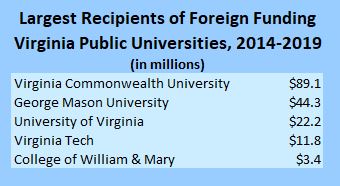
    Virginia’s five research universities received $170 million in foreign funding between 2014 and 2019, according to federal Department of Education disclosure data. Virginia Commonwealth University accounted for almost half the total sum, thanks mainly to contracts with the Qatar Foundation. VCU’s School of the Arts has operated a campus in Qatar’s Education City since 1998.

    The Trump administration has raised the issue of foreign gifts and contracts with American higher-ed institutions, suggesting that foreign states with interests antithetical to those of the United States — China, Russia, Saudi Arabia (which has underwritten the spread of fundamentalist Islam) and Qatar (a potential proxy for Iran) in particular — have exercised influence in the U.S. through their ties to U.S. colleges and universities. Congress requires higher-ed institutions to report foreign gifts and contracts valued at more than $250,000.

    None of the five Virginia universities reporting foreign gifts and contracts were among the 12 for which DOE has opened compliance investigations for failure to properly disclose the gifts. (more…)

  • Sorority Member Put on Probation for Criticizing BLM

    by James C. Sherlock

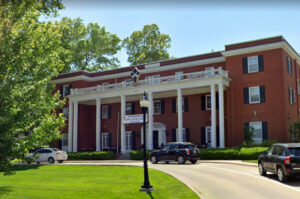
    Kappa Alpha Theta University of Kansas – credit New York Post

    I quote below a story from the New York Post posted today at 7:48 AM and authored by Lee Brown.

    Karl Marx is alive and living in Kansas.

    The sound you hear is George Orwell turning over in his grave.

    Does anyone think this canโ€™t happen in Virginia?

    A University of Kansas sorority has put a member on probation for โ€œunbecomingโ€ behavior on social media โ€” for sharing a post criticizing Black Lives Matter.

    (more…)


  • Senator Warner Is Missing in Action

    by Emilio Jaksetic

    As co-chair of the Senate Intelligence Committee, Senator Mark Warner, D-VA, was vociferous about the need to investigate allegations of Russian collusion by President Donald Trumpโ€™s 2016 campaign. But Virginia’s senior senator was silent in 2019 when the Department of Justice (DOJ) Inspector General identified serious defects and failings with FBI and DOJ handling of the investigation of those allegations. He was silent when a former FBI attorney pleaded guilty in August 2020 to criminally altering a document used to support a request for a FISA warrant in the Russian collusion investigation. And he has been silent about the subsequent discrediting of the Steele dossier.

    Now Warner seems reticent about the need to investigate allegations of foreign payoffs to Hunter Biden or question if former Vice President Joseph Biden knew about those foreign payoffs.

    Multiple sources of information support the allegations against Hunter Biden:

    • Peter Schweizerโ€™s books, “Secret Empires” (Harper, 2019) and “Profiles in Corruption” (Harper, 2020);
    • Various emails reported by the New York Post (October 2020);
    • A Senate report issued October 11 (โ€œHunter Biden, Burisma, and Corruption: The Impact on U.S. Government Policy and Related Concernsโ€) available here.

    (more…)


  • Open the Schools. Now.

    by Kerry Dougherty

    Stay with me today, friends, and I promise not to rant about the stupidity of public school closures for at least another week.

    Fact is, two developments in Virginia are so alarming that they scream out for comment.

    The first, a story inย The Richmond Times-Dispatchย Tuesday, showed that a full 20% of Richmond public school kids are considered chronically truant. That is, theyโ€™ve already missed 10% of all virtual class time.

    Not good. But understandable.

    Older children may be unsupervised when theyโ€™re supposed to be spending hour after hour staring open-mouthed at computer screens. The temptation to hit the streets may be overwhelming. Surprisingly, though,ย many of the habitually absent children are in elementary and middle schools.

    These kids are likely from dysfunctional homes where parents are not involved in their kidsโ€™ academic life. Without guidance from Mom and Dad, many children just drift away. Theyโ€™re lost. They need to be in school. (more…)


  • Health Enterprise Zones for Virginia

    by James C. Sherlock

    Image credit: Gordon Johnson

    COVID-19 exposed what many already knew: Poor people suffer broad disparities in health outcomes when compared to their wealthier counterparts.ย 

    In my original post on health care legislative initiatives in the 2021 General Assembly Session, I recommended the establishment of Health Enterprise Zones.

    That initiative seeks reduction of health disparities among Virginiaโ€™s poor and among geographic areas, improvements health care access and health outcomes in underserved communities and reductions of health care costs and hospital admissions and re-admissions.

    The Health Enterprise Zone (HEZ) initiative has been proven to work in Maryland and New Jersey. ย 

    The Maryland results have been spectacular. Andย  in Maryland the zones have proven net positive for the state budget.

    (more…)


  • Virginia’s Higher-Ed Juggernaut Keeps on Truckin’

    Source: “The State of Higher Education in Virginia,” Oct. 20, 2020, presentation to the Senate Finance and Appropriations Committee.

    During what may be the sharpest economic contraction in United States history, Virginia’s public colleges and universities managed to increase their tuition & fees by 1.6% this year — 1.7% if you don’t include the community colleges, which enacted no increases at all. Despite the challenge of the COVID-19 epidemic and the recession, enrollment at Virginia’s public four-year institutions declined only 0.2%, according to data presented by Peter Blake, executive director of the State Council of Higher Education for Virginia, to the Senate Finance and Appropriations Committee today.

    I have to credit Virginia’s public universities with their resilience. I’ve been predicting for several years that at some point they would hit a wall of resistance to the ever-escalating cost of attendance. Sooner or later, I thought, students and parents would rebel. Well, that hasn’t happened yet. If the public colleges can survive this year’s double whammy, they may be impervious to market forces. (Hat tip: Steve Haner)

    — JAB


  • Joe Biden, the SALT Cap and Virginia’s Hidden Taxes

    by DJ Rippert

    SALT of the Earth. The Trump Administration pushed through a change to the US tax code which capped the deduction for State And Local Taxes (SALT) at $10,000 per year. Previously there had been no cap. The imposition of the cap effectively increased the federal taxes paid by high-income earners, especially in high tax states / localities. Given that many high-income, high-tax areas in the U.S .are solidly Democratic, this loophole reduction rankled Democrats in the Congress. Those Democrats have made several unsuccessful attempts to repeal the cap.

    Democrats are likely to win the presidency in the upcoming election and may take control of the U.S. Senate as well. If that happens, it is likely that they will make good on their prior efforts to remove the SALT cap. In Virginia, Democrats control the House of Delegates, the Senate and the Governor’s mansion. They have used that control to raise state taxes including the passage of a number of hidden taxes that have been implemented through regulation. If Joe Biden is elected, will the hidden taxes imposed by Virginia’s Democrats put the state’s residents at a disadvantage since they won’t be deductible when the SALT cap is lifted? (more…)


  • Germs, Guns and Schools

    byย  James A. Bacon

    Twenty days into the school year, more than one in five (21.2%) of students in Richmond Public Schools have been chronically absent, according to the Richmond Times-Dispatch. Chronic absenteeism has always been a problem in the school system, but it’s worse in 2020 — up three percentage points from last year.

    This data is worth examining for at least two reasons: (1) for what it tells us about unintended consequences of the Richmond district’s approach to handling the epidemic, and (2) for what it reveals about increasing violence in Richmond’s inner city.

    The epidemic. Administrators attribute the high absenteeism in part to the virtual instruction and lack of supervision, mainly at the elementary school level, the RTD reports. Said Harry Hughes, RPS chief of schools: “We are operating virtually in the middle of a health pandemic. COVID has exacerbated an existing problem, and made it much worse.” (more…)


  • Does Racism Still Reside At VMI?

    The Stonewall Jackson statue at VMI.

    By Peter Galuszka

    On this blog, at least, there has been plenty of grief at the University of Virginia over controversies involving diversity. But over at Lexington, a town not far away, an even bigger battle involving the issue has been engaged.

    Black students and alumni at the Virginia Military Institute, the stateโ€™s public military college, complain that the institution is involved in systemic racism that hasnโ€™t gone away years after Blacks and women were finally allowed to enter.

    Students complain that they are criticized and told to leave the school if they object to having white supremacist figures, such as Confederate General Stonewall Jackson, included in school emblems, hear classroom stories by a faculty member favoring the Ku Ku Klan and face social media insults decrying the color of their skin, according to The Washington Post. (more…)


  • A Measured Consequence: More Heavy Drinking

    by Carol J.Bova

    Yesterday, Jim Bacon wrote about โ€œthe unmeasured consequences of societyโ€™s reaction to the COVID-19 epidemic.โ€ The RAND Corporation COVID-19 Update on October 8, 2020 provided a reference to a longitudinal survey that examined one of those consequences — alcohol usage.

    JAMA Network Open published a Research Letter, โ€œChanges in Adult Alcohol Use and Consequences during the COVID-19 Pandemic in the USโ€ by Michael S. Pollard, PhD and Joan S. Tucker, PhD, RAND Corporation, Santa Monica, California; and Harold Green, Jr. PhD, Indiana University School of Public Health, Bloomington, Indiana.

    The survey study data, collected from May 28 to June 16, 2020, found the frequency of alcohol consumption overall increased 14% over a baseline survey from April 29 to June 9, 2019.

    Heavy drinking was defined as five or more drinks for men and four or more for women within a couple of hours. For women in the study, the increase was 17% and โ€œthe Short Inventory of Problems scaleโ€ showed a 39% increase, โ€œwhich is indicative of increased alcohol-related problems independent of consumption for nearly 1 in 10 women.โ€ (more…)


  • The New Secret Weapon in Economic Development: Mine Water

    Map credit: InvestSWVA “Project Oasis” report

    by James A. Bacon

    I don’t know if the latest scheme cooked up by Southwest Virginia’s economic developers is crackpot or genius, but it certainly is intriguing. As the coal industry of the state’s coal counties continues to bleed out, regional leaders are looking for ways to diversify the economy. And they think they might have identified a unique resource in the region — geothermal cooling — that will make it attractive to data centers.

    Data centers are energy hogs. Massive banks of servers generate a lot of heat, which takes a lot of energy to cool. As a consequence, electricity is one of the biggest cost components of every data center.

    A data center in Pennsylvania uses an limestone cave, which has continually replenished supply of 52ยฐ water, to cool a data center. As it happens, Southwest Virginia has limestone caves. Moreover, the region is riddled with underground coal mines that have flooded with water. According to an InvestSWVA report, “Project Oasis: Market Analysis for Data Center Investment in Southwest Virginia,” using mine water for cooling could reduce the electricity required for cooling the data center by 90%. The annual savings would be more than $1 million annually. (more…)


  • Virginia Needs to Stop Playing Politics with School Reopenings

    by DJ Rippert

    Politics over science. Michael Hartney is a national fellow at the Hoover Institution, Stanford University, and an assistant professor of political science at Boston College. He and a collaborator have studied school reopening decisions across the United States looking for factors that correlate with the seemingly arbitrary differences in school reopening policies from one school system to the next. His conclusion is that the politics of the community and the strength of the teachers’ unions play a far greater role in reopening decisions than any application of science. As Hartney writes in an Newsweek op-ed piece, “Education policymakers should consider public health indicators like the number of COVID cases, deaths and the acuteness of the pandemic’s spread in a given community when deciding when and how much to reopen schools. But such factors have not driven decision-making. Instead, it is partisanship and the power of the teachers’ unions that have largely determined which schools opened and how much they opened.”

    Facts are stubborn things. Hartley’s analysis seems thorough. He studied nearly 10,000 school districts. The correlation between political attitude and school reopening policies appears to be real. As Hartley writes, “Even when comparing schools in counties that experienced very similar case rates, partisanship best predicted whether schools opened. For example, counties that voted 60 percent for Hillary Clintonย in 2016 were nearly 20 percentage points less likely to hold in-person classes than counties that backedย Donald Trump to the same degree.” A look at Virginia’s reopening map shows a notable east – west division between the 68 school divisions that are fully remote and the 64 divisions that have some level of generalized in-person teaching. (more…)


  • Virginia: 4,500 “Excess” Deaths This Year, Only Half from COVID-19

    by James A. Bacon

    It’s good to see that the left-leaning Virginia Mercury making the same observation as Bacon’s Rebellion about the unmeasured consequences of society’s reaction to the COVID-19 epidemic. Research from Virginia Commonwealth University shows than an additional 4,500 Virginians died between March and August over the number that would have been predicted from past years’ experience. (more…)


  • Assembly Protected Utilities, Not Other Businesses

    First published this morning (with some slight differences) by the Thomas Jefferson Institute for Public Policy.

    By Steve Haner

    Now that the Virginia General Assemblyโ€™s โ€œCops and COVIDโ€ special session is all but finished, will it be easier or harder for the stateโ€™s struggling economy to recover in 2021? It will be harder, probably, except for the utilities.

    The initial reason Governor Ralph Northam recalled legislators starting August 18 was to review the state budget for COVID recession-related changes. Then a series of confrontations between police and Black Americans added law enforcement and criminal punishment to the agenda.

    But the legislators reached far beyond those issues in the 270 pieces of legislation introduced, of which 56 have now passed (many of them duplicates).ย  The Assembly recessed October 16, but did not adjourn, and that will delay the effective date of the various new laws until perhaps March 1.

    What did the legislature do for or to the business climate in Virginia? (more…)


  • Open Schools and Students Will Return. Maybe.

    by Kerry Dougherty

    Whoa. Who could have foreseen THIS?

    Public schools — offering a substandard educational product this year — are seeing an alarming drop in enrollmentย as parents yank kids and enroll them in private or homeschools.

    Virginia public schools are down 37,000 students from last year, according to The Daily Press. And because schools are funded on a per-pupil basis, public school districts are getting less money. A lot less.

    Naturally, school officials are howling and demanding that the state find the loot to make up for their โ€œshortfalls.โ€

    Youโ€™d think educators would have a passing knowledge of economics: Educate fewer students and you get less money.ย Itโ€™s quite simple.

    Why should schools be paid for kids who are no longer enrolled?

    If administrators want their coffers full, they have to reopen schools fully and get kids back in class. Theyโ€™d better do it fast, before their parents realize how much better the alternatives are to whatโ€™s been offered in public school classrooms. (more…)