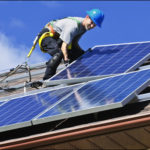
• Solar Panels in Virginia: A Primer

    by Emilio Jaksetic

    Virginia law (Virginia Code, Section 67-701 ) makes it easier for owners to consider installing solar panels on their property by limiting the ability of community associations to prohibit or restrict the installation of solar panels on the ownerโ€™s property.ย  While the statute is likely to encourage the use of solar panels by property owners, there are some things that should be considered by property owners, community associations, and local government officials.

    First, community associations in Virginia should get legal advice about the scope and applicability of Section 67-701 before trying to prohibit or restrict an owner from installing a solar panel on the ownerโ€™s property.ย  (The relevant definition of โ€œcommunity associationโ€ is provided by Section 67-700.)

    Second, owners should not rush to install solar panels on their property, and community associations should not rush to install solar panels on the common areas of their community, without considering the following: (more…)

  • Remote Learning Takes Predictably Highest Toll on Virginiaโ€™s Most Vulnerable – There are Villains

    by James C. Sherlock

    The most predictable (and predicted) crisis in the history of the nationโ€™s public schools has come to pass.ย The education and thus future prospects of millions of poor children have been destroyed by weak governors and mayors, aggressive teachers unions and feckless boards of education who not only should have known better, but did know better. ย 

    The Facts

    I wrote in June in this space:

    Every study has found that in the past few months K-12 schools have had very little success in teaching large groups of children remotely.ย Remote learning is much harder, inherently much less successful, and exacerbates the differences in outcomes between those with a lot of support at home and those with less.

    Ignoring for a moment the daunting challenges at the teacher end, remote learning in K-12 generally works only for children whose families provide a stable and supportive learning environment, are motivated to learn, undistracted and have access to the tools necessary to do the work.

    If school boards require remote learning, they will do so knowing it wonโ€™t be effective.ย 

    (more…)


  • Bacon Bits: Stream-of-Consciousness Edition

    New sparkplug for Colonial Williamsburg. Carly Fiorina, former CEO of Hewlett-Packard, unsuccessful candidate for president and Virginia resident since 2011, has joined the Colonial Williamsburg Foundation Board of Trustees as chairwoman. It is gratifying to see Fiorina, a truly dynamic individual, apply her talents to a Virginia enterprise. Colonial Williamsburg has suffered a long-term decline as American interest in visiting historical sites has ebbed. Like all tourism attractions, the preserved colonial town also has been hobbled by mandated and self-imposed travel restrictions during the COVID-19 epidemic.

    Speaking of conserving history… The American Battlefield Trust has issued a report describing how developing massive solar farms can be made compatible with the preservation of rural historical resources. “Conflict tends to arise when developers disregard the historic and cultural landscapes on or near potential solar sites,” states the report, “Siting Solar in Virginia: Protecting Virginia’s Historic Landscape While Meeting the State’s Clean Energy Goals.” The report advises: (1) early planning and consultation can help avoid harm to historic resources; (2) localities should establish clear rules and guidelines; (3) developers should consider locating solar facilities on greyfield or brownfield land, or co-locating with existing uses such as rooftops and parking lots; (4) developers should proactively engage with the State Historic Preservation Office.

    Speaking of solar production… Dominion Energy has scrapped its plans to build a $200 million gas-fired peaking plant at the Southern Virginia Megasite in Pittsylvania County. Reports the Chatham Star-Tribune: The company said it no longer believes it is possible to build the units planned in Pittsvylania County “despite the economic and reliability benefits for our customers.” Peaker plants offset fluctuations in supply and demand to maintain a stable electric grid, a concern that will become all the more pressing as Virginia moves to increased solar production. “We plan to conduct a further reliability study to determine how best to move forward to maintain the around-the-clock service our customers need.” (more…)


  • Governor Northam, If You Want to See Educational Equity in Schools, Visit Southwest Virginia

    Standards of Learning (SOL) pass rate for English, 2017-18. Source: Virginia Department of Education

    by James A. Bacon

    The Northam administration’s education equity initiative declares that “equity” will have been achieved when outcomes can no longer be predicted on the basis of race, gender, zip code, ability, socioeconomic status or languages spoken at home. The administration does not acknowledge it, but there is a region of Virginia that has largely achieved educational equity — the last place in Virginia that the anti-racist progressives running the Virginia Department of Education (VDOE) would look. But the evidence is right there in its so-called “road map to equity,” “Navigating EdEquityVa.”

    I am, of course, referring to far Southwest Virginia, which is, electorally speaking, the reddest region of the state — the religious, culturally conservative, gun-clinging, Trump-voting economic backwater of Appalachia.

    In this post I replicate several maps taken from the EdEquity manifesto. The maps are tiny in the VDOE document, so they become blurred when I blow them up to a size where they can be interpreted. While the graphics are fuzzy, the conclusion is crystal clear. Students in Southwest Virginia school systems, among the poorest in the state, pass at higher rates than any other region of Virginia. That holds true not just for demographically dominant whites, but African Americans, Hispanics, the economically disadvantaged, English learners and students with disabilities. (more…)


  • Hell Has Frozen Over!

    by Dick Hall-Sizemore

    I just can’t help myself — the Washington Post editorial page and Bacon’s Rebellionย conservative contributors and commenters (that is to say, the bulk of the blog) are in agreement on an issue!

    In an editorial in today’s issue, the Post opposes the wholesale forgiveness of student loans. Now the two groups disagree on the reasons for their opposition. Folks on BR fulminate that it would be unfair to those people who have worked and paid off their loans and also that it would send the wrong message about having to be responsible about borrowing. (I happen to agree with both arguments.) The Postโ€™s main objection is that it would be the opposite of progressive policy; it would, in fact, benefit high income folks the most. (To be fair, some BR commenters made this same point, as well.)

    The Postโ€™s recommendation:ย  making sure that everyone who qualifies enrolls in an existing plan that links debt repayment to a borrowerโ€™s income.

    Gotta love it when two opposites come to the same conclusion, even if by different routes.


  • University of Chicago Principles, Freedom of Expression and Virginiaโ€™s Universities

    by James C. Sherlock

    Where does education stop and indoctrination begin? ย 

    A useful demarcation line is freedom of expression. Many Virginia colleges and universities have crossed that line. Students, faculty and administrators live in fear of reprisal for speaking their minds. ย 

    Some institutions maintain anonymous tip lines that lead to non-judicial procedures through which careers can be ended not only without due process, but without any indication of any crime or offense other than making someone uncomfortable. ย 

    Which would get most Americans canceled two or three times a month.

    I wrote in late September that a national survey of 55 colleges and universities about student perceptions of free speech on those campuses revealed horrendous results. ย ย 

    Two of the universities surveyed were Virginia and Virginia Tech.ย  Some of the results there:

    • Tolerance measured the studentsโ€™ willingness to allow controversial speakers to come and speak at their campus. UVa, 48.7, Virginia Tech 49.2.
    • Openness measured the studentโ€™s perceived ability to have difficult conversation on campus. UVa 60%, Virginia Tech 68.4.%.
    • As for ability to speak their minds, only 43% of UVa students felt they always could do so, 48.5% of Virginia Tech students.

    So what have those two schools and the rest of the state-supported colleges and universities done about it? (more…)


  • Racism Does Not Explain the Variability in Public School Suspensions

    by James A. Bacon

    Across the Commonwealth of Virginia, black students comprise 22% of total student enrollment but 52% of all students suspended. Black students are 4.5 times more likely to be suspended from school than white students are. So states the Northam administration’s “road map to equity,” “Navigating EquityVA.”

    The disproportionate suspension of black students is evidence, the report suggests, of systemic racism built into Virginia’s public educational system that punishes “marginalized” students. The report doesn’t come right out and say that explicitly, it just presents the data which, presumably, is so manifestly self-evident that it requires no elaboration.

    The discussion of school discipline is typical of the thinking behind the document, which provides justification for the top-down re-engineering of the organizational culture of Virginia public schools around the principles of “anti-racism.”

    The analysis is astonishingly shallow. The engineers of this educational restructuring start with the conclusion in mind — the system is racist — and work backwards to the statistics that fit. They ignore alternative explanations, such as the possibility that, due to a complex set of reasons, African-American communities suffer from higher rates of out-of-wedlock births, absentee fathers, children raised on the “streets” and students not socialized in the norms required to participate in school. (more…)


  • They Came for the Basketball….

    This cartoon is circulating among University of Virginia alumni… along with a link to an essay by Joel Gardner on the James G. Martin Center for Academic Renewal website, “UVA and the Dangerous Politicization of Our College Campuses.”

    — JAB


  • Northam Refrains from Expanding COVID-19 Restrictions. For Now.

    by Kerry Dougherty

    Some folks will thank him. But I wonโ€™t. I refuse to express gratitude to Gov. Ralph Northam for not announcing more COVID-19 restrictions during yesterdayโ€™s press conference that would strip away even more of our liberties.

    Like most Virginians, I am, however, relieved. Governors across the country — mostly Democrats — appear to be in an arms race to see just how arbitrary and oppressive their emergency orders can get before leading to an insurrection.

    Reading slowly from his notes, as always, Northam warned that if numbers continue to spike โ€œeverything is on the table.โ€

    Lucky us.

    Numbers may be up, but Virginia still has plenty of hospital beds — 6,954 including surge beds. ICUโ€™s are operating at 77 percent and no hospital in the commonwealth is reporting a shortage of supplies or PPE. (more…)


  • The Strange Case of the Pandemic Patriots

    by Peter Galuszka

    In rural Southwest Virginia, the coronavirus pandemic has gotten so bad that Ballad Health, a major health care provider there, is suspending elective surgery for a month.

    System-wide, Ballad, which also operates in adjacent states, had 45 available beds as of Wednesday, only 13 or 14 of them ICU beds, according to the Virginia Mercury.

    In Southwest Virginia, the number of beds occupied by COVID-19 patients has soared from an average of 76 a day in late April to 361 as of Wednesday, the Mercury reports.

    Meanwhile, in other rural parts of the state, such as Campbell County and Appomattox County, public officials are protesting the โ€œtyrannyโ€ of Gov. Ralph Northamโ€™s COVID 19 restrictions, such as closing bars at 10 p.m. and not allowing people to congregate in groups larger than 25.

    โ€œFree people have a duty to push back against these restrictions,โ€ said County Supervisor Charlie A. Watts II, according to The Washington Post.

    Is this the same state? How strange since the pandemic is pushing to new heights as more people contract the disease and die. Public Enemy No. 1 is, of course, Northam, a Democrat that conservatives like to pummel. Ironically, compared to other governors, Northam has actually been fairly moderate. This week he announced he is not ordering more restrictions although he urges caution. (more…)


  • Does a $9 Billion Carbon Tax Get Your Attention?

    by Steve Haner

    The 2021 General Assembly is now six weeks away, with the holidays in between.ย  We know no more about the coming Northam Administration proposal to impose a carbon tax and rationing scheme on our motor fuels than we did months ago. Keeping you uninformed may be part of the plan.

    All we have is the Transportation and Climate Initiative organization’s own data and modeling, which are quite extensive.

    The initial added tax per gallon of gasoline in Virginia could range from 17.5 cents to 28 cents per gallon, depending on which of the 25% reduction scenarios the still-unseen TCI memorandum of understanding uses. By 2032 the tax could range between 36 cents and 57 cents per gallon, TCI projects.ย  (more…)


  • Walter Williams RIP

    Virginia conservatives lost one of their intellectual heroes earlier today when Walter Williams passed away at the age of 83.

    A professor of economics at George Mason University, Williams was a prolific author of articles, columns, book reviews and scholarly papers. Adopting a low-key, common-sense tone, he relentlessly applied economic logic in defense of free-market principles, against government intrusion into the economy, and against the delusions of do-gooders. Along with Thomas Sowell, another African-American pioneer of contemporary conservatism, Williams paved the way for younger African Americans to embrace conservative and free-market ideas.

    Williams showed how government interventions in the economy often have unintended and undesirable consequences. More controversially, he showed how discrimination on the basis of race imposed an economic cost not only on the victims but the discriminators, and he illuminated how segregation in the Jim Crow era was the product of state- and local-government laws, ordinances and regulations. Without government coercion to back them, the rules could not have been enforced. But Williams’ work transcended race. A defender of the U.S. Constitution and individual liberties for all people, he was an inspiration to millions of Americans.

    — JAB


  • Alexandria School Chief Transfers Kid to Private School

    Gregory C. Hutchings Jr.

    Gregory C. Hutchings, Jr., superintendent of Alexandria public schools, presided over the conversion this fall from teaching in-person to teaching online in the face of the COVID-19 epidemic. The effort seems to have been competently executed. Schools made sure that learn-at-home students were equipped with Chromebooks, partnered with Comcast to provide free internet to poor families, made training videos available, and set up a family helpdesk.

    So, it was curious that Hutchings pulled one of his two children from Alexandria’s T.C. Williams High School and enrolled her at Bishop Ireton High School, a Catholic school which, like most private schools, remains open and largely COVID-free.

    When queried by T.C. William’s student news outlet Theogany, Hutchings said in a statement: ย โ€œI can confirm that our family made a decision to change my daughterโ€™s school this school year. Decisions like these are very personal family decisions and are not taken lightly. This in no way impacts my absolute lifelong, commitment to public education, to which I remain as personally dedicated as ever.โ€ (more…)


  • UVa Vice Provost’s Tough Job: Recruiting More Blacks to a “Racist” University

    Stephen Farmer

    by James A. Bacon

    Pity poor Stephen Farmer. The newly appointed vice provost for enrollment at the University of Virginia has a thankless job: fulfilling the goal of admitting more African Americans and Hispanics, even as Virginia’s flagship university has inadvertently branded itself as a racist institution.

    Farmer’s appointment was highlighted in the most recent issue Virginia, the UVa alumni magazine. A UVa alumnus, Farmer was recruited from the University of North Carolina at Chapel Hill where he was vice provost for enrollment and undergraduate admissions. With a record of attracting more first-generation students and students from underrepresented minorities, Farmer has made “remarkable contributions to the shape of the class,” says Provost M. Elizabeth Magill.

    Taking charge of both undergraduate admissions and student financial services, Farmer will build new strategies for attracting applicants and supporting students’ financial needs. “There’s a real logic in bringing them together,” Magill said.

    He has two big challenges. First, in its recent report, “Audacious Future: Commitment Required,” UVa’s Racial Equity Task Force has articulated the goal of building a student body that “reflects the racial and economic demographics of the Commonwealth of Virginia.” Only 7.4% of the undergraduate student body is African-American, compared to about 20% of Virginia’s population. Only 7.4% is Hispanic, compared to about 10% of the state population. Asians are significantly over-represented: 17.1% of the student body compared to 5.6% of the state population. Whites are slightly under-represented.ย  (These numbers are calculated from data published on UVa’s Diversity Dashboard, omitting foreign students and students whose race is unknown.) (more…)


  • Individual Virginians have Political Power If They Will Use It

    by James C. Sherlock

    We discuss here every day issues such as Virginiaโ€™s dangerous shortage of health facilities inspectors that have great consequence to the people of the Commonwealth regardless of their political affiliation.

    The Director of the Office of Licensure and Certification in VDH was brave to provide an unvarnished reply to my FOIA request. ย Every reader bemoaned this situation. ย It screams for redress.

    Yet the vast majority of Virginians have never contacted their Virginia Delegate or Senator, much less the Governor. ย Most donโ€™t do it either because they donโ€™t know how or donโ€™t think it will have an effect.

    I know from my personal experience that it can have an effect. ย Rules for effectiveness: Be respectful in your communications and clear on both the issue you are addressing and what you want from your elected officials.

    If you know the name of your legislators;

    • for your senate member contact information go to https://apps.senate.virginia.gov/Senator/index.php ,
    • for your House member https://virginiageneralassembly.gov/house/members/members.php
    • and then click on the name.

    If you donโ€™t know your members, ย https://whosmy.virginiageneralassembly.gov

    If you donโ€™t know the member personally, an email to his or her office works best because you can be more specific and the legislative assistant who reads it has a record. (more…)

