Virginia’s General Assembly convenes tomorrow in Richmond. But a handful of pre-filed bills give us a taste of what’s to come when Democrats come roaring back into power.
Remember when Virginia Democrats promised to make Virginia more “affordable?”
Yeah, about that.
New: Virginia lawmakers introduced a bill to authorize all counties and cities to impose an additional local sales and use tax at a rate not to exceed one percent with the revenue used only for public school capital projects. pic.twitter.com/uunf4LSWxu
In December 2025, the Virginia Department of Education (VDOE) issued new school report cards for the 2024-25 school year under the new school accountability system.
The school report cards provide an overview of schools’ performance under the new system, as well as summarize such results into 1 of 4 summative ratings: Distinguished; On Track; Off Track; or Needs Intensive Support.
The new system looks at various factors largely prescribed by federal law, such as: academic proficiency and growth for elementary and middle schools; academic proficiency for high schools; chronic absenteeism for all schools; career and college readiness for high schools; and graduation rates for high schools. More information on the scoring system for such ratings are available on the VDOE’s website here.
As stated in the December 2025 (generally positive) report of Virginia’s Joint Legislative Audit and Review Commission (JLARC) on the new school accountability system: “the [new system] is an improvement over the prior system…and has design elements that more precisely and comprehensively measure performance than the prior system.” JLARC said no major revisions to the new system are needed, while suggesting various “refinements”. (Matt Hurt of the Comprehensive Instructional Program wrote about some tweaks he would like to see.)
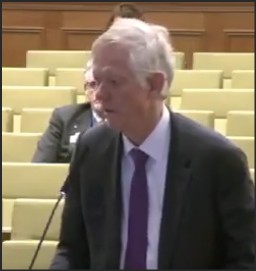
Video: VA @SenatorHashmi, soon to be Lt. Governor, asks UVA President Scott Beardsley about the process for selecting him, why he disagreed with so many in the UVA community, plus Gov.-elect Spanberger, that the presidential search be slowed down. https://t.co/sInBVzY6vUpic.twitter.com/EbFnFeTFnq
Newly appointed UVA President Scott Beardsley (appearing at the 1:06 point in the video) looks old, tired, and drained in his testimony before the General Assembly. Based on this performance, the odds of him standing up to lawmakers’ demands appear to be roughly zero. Interesting question: Will legislators decide to keep him, thinking that he can be badgered and bullied into compliance, or will they agree only to a board that will select someone more to their ideological liking? — JAB
In December JLARC released a report on the School Performance and Support Framework (SPSF), Virginia’s new accountability system. The report states that the new system is better than the old Accreditation system, but improvements are needed. From the perspective of an educator who has spent the last twenty years focusing on student outcomes and accountability, I largely agree with the report. The following are some facets of the system that should be reviewed and hopefully improved.
Complexity
I used to believe that the old Accreditation system (our previous accountability system) was extremely convoluted. However, compared to the SPSF, I would now consider the old Accreditation system the model of simplicity.
Under the old Accreditation system, there were only a few things that were calculated differently among schools by level (elementary, middle, or high school), namely graduation rates, college and career readiness, and growth. Given that there was no summative score for each school, there was more inherent simplicity. There were thresholds for each of those categories to identify schools for overall support, and there were predetermined thresholds for subgroup performance for federal accountability purposes that everyone knew prior to beginning the school year.
I’m pleased to announce that Todd Truitt will join the Bacon’s Rebellion team as a regular contributor. His editorial concentration will be K-12 education policy in the commonwealth.
Todd is a parent of two Arlington Public Schools (APS) students in Arlington County and an education advocate during his free time. He has been active on K-12 education policy issues as a volunteer at the local level for 5 years and at the state level for two years. His main areas of focus in education policy are on accountability, assessment, instruction (especially math) and school finance.
Petersburg, VA, which voted nearly 90% for @SpanbergerForVA is an absolute hell hole… but they’ll send zoning inspectors out to fine you for trying to improve your lot, while the neighbor’s crack house is ignored https://t.co/ZzdvF8kpD9pic.twitter.com/clLmDkHckC
This is a cautionary tale. So when the ghoulishness of Canada spreads to Virginia you can‘t say you weren’t warned.
Here’s how it starts:
In 2016 Canada passed the so-called MAID law, legalizing medical assistance in dying.
It was presented as a compassionate measure. One that would allow suffering patients, whose deaths were imminent, to get help from their doctors in ending their lives.
However, it wasn’t long before so-called medical doctors were actively killing patients who were not near death but whose conditions were uncomfortable. A decade later, they’re starting to execute the mentally ill. (Killing the mentally ill was approved in Canada last year but implementation was supposedly delayed until March 2026. The case cited below shows it’s already in effect.)
Between 2016 and 2023 60,000 Canadians were killed by these executioners with medical degrees. In 2023 alone 15,000 Canadians were murdered by medical providers.
MAID now accounts for 4.7% of all deaths in Canada. Continue reading.
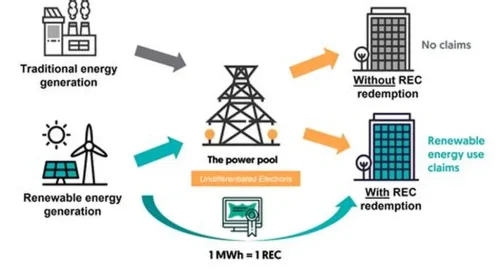
All electrons are agnostic until buying a REC makes you green!
A key, but poorly understood, provision of the Virginia Clean Economy Act (VCEA) is a requirement that Virginia’s two largest electric utilities must either generate or purchase a growing number of renewable energy certificates (RECs). Eventually their RECs must equal 100% of their non-nuclear generation. What are RECs and why do they matter to you?
Put simply, a REC is an electronic record that proves a generator produced one megawatt hour of electricity from an approved “renewable” source, usually solar or wind. It can be a utility, an independent energy generator, a business with solar on its roof or even a shared community solar system that is granted a REC. A small portion of RECs are awarded for hydro or geothermal generation.
The certificate is issued and tracked by a third party, and – here is the point – can be sold. Recording and tracking RECs is one of the jobs done by the PJM Interconnection regional grid operator. There are several marketplaces compiling and transferring them.
The buyer then “retires” the REC, in effect cashing in the environmental virtue of that “green” energy. It can be retired only once. The entity that earns the REC can also be the one to retire it, but usually they are traded.
One website that reports on the REC industry put the total world REC market at more than $20 billion in 2024, predicting it will exceed $40 billion by 2030. The annual compound growth rate is higher than 10%. The same website was quite open about what is going on:
“By buying RECs, companies can effectively offset their carbon emissions and achieve 100% renewable energy consumption without significant investment in renewable energy infrastructure.”
Women can sue their bosses for running a workplace that feels like a fraternity house, but men can’t sue when their workplace feels like a Montessori kindergarten.
The incoming Spanberger administration, writes Victoria Cobb, president of the Family Foundation, “is structured to consolidate power in Richmond, expand bureaucratic reach, and normalize government intrusion into family life, healthcare, education, and the economy.”
From a Thursday Family Foundation Action Letter:
Governor-elect, Abigail Spanberger, is quickly making her selections for cabinet and senior staff appointments. But these are not just routine staffing decisions, they are signals of the kind of administration and government she intends to implement. And the signal coming from Richmond is deeply troubling for Virginians who value limited government, individual liberty, parental rights, and constitutional restraint.
As the saying goes, personnel is policy. When you look carefully at who is being placed in charge of health care, labor, education, public safety, elections, and the overall legal strategy of the Governor’s Office, a consistent theme emerges: centralized authority, aggressive regulation, and ideological governance, with little regard for the proper limits of government power.
Below are some of (not all) Governor-elect Spanberger’s troubling appointments:
As it becomes clear that the 90-day pause of the Dominion Energy Virginia offshore wind project is probably its final death rattle, the folks who encouraged the Trump Administration to kill it are looking to shift the blame to outgoing Virginia Republican Governor Glenn Youngkin.
One of the organizations that filed a federal lawsuit against the project, a lawsuit that itself proved to be a futile exercise, is promoting a letter it sent the governor demanding he rescind his previous support for the $11.2 billion facility, which was just about to enter its final stage of construction when the federal pause order came down just before Christmas.
The National Legal and Policy Center was joined in the lawsuit by the Committee for a Construction Tomorrow (CFACT) and the Heartland Institute. All have been dancing a joyous victory jig on the project’s watery grave for about two weeks, although the Trump Administration’s pause order had nothing to do with the allegations of injury to the whales they had raised.
Nobody with the utility, the Commonwealth of Virginia or the federal agencies involved has formally declared the project dead. The silence is deafening. News reports indicate Dominion is telling the federal court hearing its challenge to the order that the federal government has refused to provide details on the supposed new national security threat it has identified. The goal of the pause apparently was not to give the utility, and the developers of four similar projects elsewhere on the East Coast, a chance to look at how to mitigate that “risk” after all. More should be clear after a hearing on January 16.
As all this unfolds, this policy group wants Youngkin to do a public mea culpa:
The year: 2075. The American colonies on the Moon are getting restless under Washington’s tyrannical rule….
This second edition of “Dust Mites” has a snazzy new cover, includes helpful lunar maps, and is 5,000 words tighter than the original. The sequel, “Trogs,” is scheduled for publication this summer.
Advertisement
Advertisement
Advertisement
Advertisement
About
Bacon’s Rebellion is Virginia’s leading politically non-aligned portal for news, opinions and analysis about state, regional and local public policy. Read more about us here.
Fund the Rebellion
Shake up the status quo! Your contributions will be used to pay for faster download speeds and grow readership. Make a one-time donation by credit card or contribute a small sum monthly.
Can’t wait until tomorrow
For your Bacon’s Rebellion fix?
Enter your email address to receive immediate notifications of new posts by email.
SUBSCRIBE
Search Bacon’s Rebellion
Categories
Archives
The Jefferson Council
Protecting Thomas Jefferson’s Legacy at the University of Virginia
Forgot Your Password?
Shoot me an email and I’ll generate a new password for you.