
Last night I took down a post that published the text of a letter from a parent unhappy with the drift toward wokeness of a prestigious Atlanta, Ga., prep school. I did so at the request of the author’s ex-husband who was distraught at the potential impact on their children should the existence of the letter become common knowledge in the student body. Our nation’s culture wars are ugly enough as they are. I have no desire to inflict collateral damage on innocents. — JAB
-
Note on Deleted Post
-
Schools Desperately Short of Bus Drivers; Carpooling App Needed
 by James C. Sherlock
A Fairfax County Public Schools Twitter message August 19:
“If you can walk with or drive your child (and perhaps a neighbor’s), please do. Also, we ask that you update your transportation status through your school, if you choose to not have your child take the bus.”
WTOP reported that as of Aug. 12, Fairfax County Public Schools was short 190 drivers.
Parents have already made plans and notified school districts if their children will be bus riders. I expect that the interlocking administration and logistics of car pools and buses to T-bone one another because of the late start and lack of preparation for the car pool option at scale. But that is where many districts are.
Driving a school bus is a difficult, nerve wracking and hazardous job. The training required makes them professional drivers. The demand for such skills and the pay and benefits in the private sector are very high and growing because of a labor shortage in the face of increasing demand.
Like pretty much every other type of blue collar work. (more…)
-
Charlottesville Police Morale in the Dumps
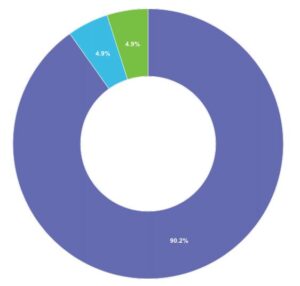
Question: Has the current political climate in the city caused you to reduce your normal policing activities (traffic stops, arrests, community policing, etc.) for fear of being targeted by community groups? Dark blue = yes. Light blue = no. Green = undecided. by James A. Bacon
Morale in the Charlottesville Police Department is in the tank. Large majorities of respondents to a survey conducted by the Virginia Police Benevolent Association said they did not believe that either Police Chief Rashall Brackney or the command staff had their backs; 90% said that the political climate in the city caused them to reduce their normal policing activities — traffic stops, arrests, community policing — for fear of being targeted by community groups.
Eighty-four percent of the 62 members who responded said they had considered other career options, and 81% said the police chief, in her role as a leader, made them feel less secure in their future with the Charlottesville Police Department.
“They don’t feel like they have a voice with their leadership,” said Michael Wells, senior vice president of the Police Benevolent Association’s Central Virginia Chapter Board. “I know it was bad working conditions, I just didn’t know that it was that bad. Lack of trust and leadership is a big thing that stuck out to me.” (more…)
-
Challenging JMU with a Slingshot
 by Joe Fitzgerald
The reasons Jake Conley might win are moral and the reasons he might lose are legal.
Jake Conley is the Breeze editor suing JMU over FOIA requests the student newspaper made for the location of Covid cases on campus. Call it the Dorms to Avoid suit.
JMU declined to provide the info, citing privacy laws that allow it to withhold health information about issues involving 10 or fewer of its 21,000 students.
It’s worth noting that for 10 or fewer of the 697 cases among on-campus students last year to be in one dorm, there would have to be 70 dorms. Or the 25 dorms the school actually has would have 28 cases each, but never 10 at the same time.
Also worth noting, the Breeze isn’t suing JMU, because the paper is part of JMU and can’t sue itself. So the editor is acting as a citizen of Virginia, and is technically on his own unless someone joins the suit or decides to represent him for free. JMU on the other hand can send its staff attorney or, in a pinch, call in the state Attorney General’s office. (more…)
-
The New Normal: COVID Ain’t Going Away
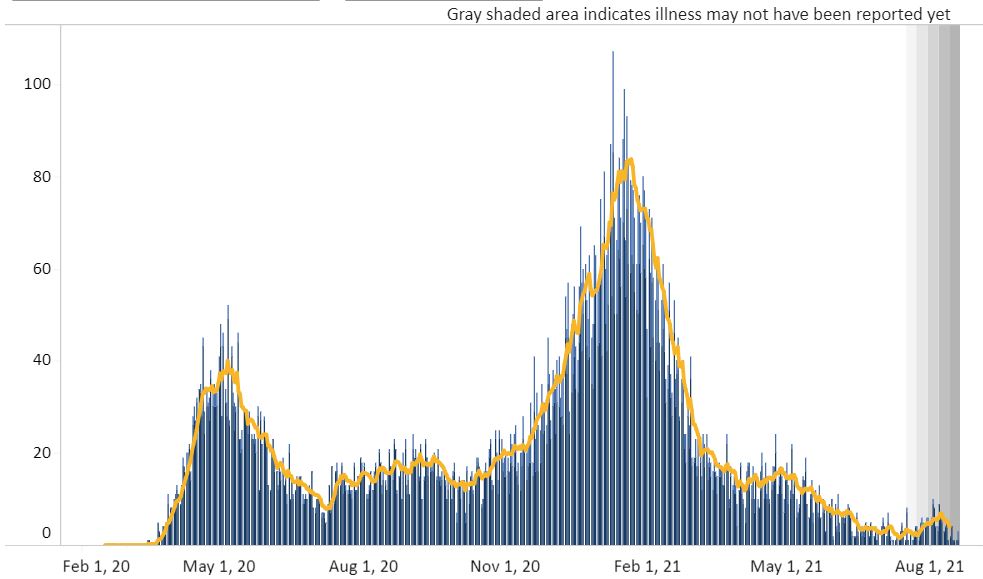
Number of COVID deaths in Virginia. Source: Virginia Department of Health by James A. Bacon
The number of confirmed COVID-19 cases is surging in Virginia, driving continued controversy over mask and vaccination mandates. As has been the case throughout the 18 months of the epidemic here, the media is focusing on the number of cases, which undeniably has increased sharply. The seven-day moving average is up to 1,850, a third of the December-January peak.
Hospitalizations have risen, too, with the seven-day moving average now exceeding 40 per day and showing no sign of leveling off. The good news (so far) is that, as seen in the graph above, deaths have nudged only a little higher. Perhaps the greatest under-reported story of the pandemic is how good hospitals and doctors have gotten at treating the virus.
Here’s what we’re not measuring on a daily basis: suicides, drug overdoses and other tragedies stemming from the shutdowns in response to COVID. Life is full of tradeoffs, and so is public health policy. (more…)
-
Complexity and Single-Party Rule in the Modern University

Allan Stam Bacon’s Rebellion publishes here a thought piece by University Professor Allan C. Stam, a professor of politics and public policy at the University of Virginia. Although the column describes research universities generally, Stam says that his critique applies to Virginia research universities and the University of Virginia. JAB
by Allan C. Stam
Large research universities have evolved into amalgamations of housing complexes, food service industries, semi-pro sports franchises, health systems, research enterprises, vocational training centers, and education systems. The administrative design of complex universities is such that they are nearly incapable of being efficiently managed. Running a modern research university is a bit like running a small city absent democratic accountability. Both jobs are growing more complex with layers of byzantine regulations often overwhelming their leaders.
Both types of organizations, universities and city management, are also inherently political which today means increasing polarization and conflict. Political systems distribute resources and services not by market means, but instead by power-based mechanisms. At the same time as the administrative burdens in our universities rises, they have, like most large cities, become single-party systems.
The combination of these two challenges: single-party rule combined with unmanageable complexity is leading universities down an unfortunate road. So-called administrative bloat is a direct consequence of excessive administrative complexity. Ideological intolerance and the stifling of free speech and thought is the consequence of universities’ emergent political monoculture. The combination of these two factors has created tremendous risks for the future of the American research university. (more…)
-
State Mental Health Plan Too large, Complex to Succeed?
 by James C. Sherlock
I really want Virginia’s mental health program to work. It looks like a major struggle, however.
I will recommend a major change: state control of the Community Services Boards (CSB)s. I think that will be necessary for the plan to have any chance of succeeding.
I have just finished reading a draft 409-page report to the federal government that describes planned efforts to expand and improve the state’s mental health care system. It has been developed by the Virginia Department of Behavioral Health and Developmental Services (DBHDS) for the signature of the Secretary of Health and Human resources.
Three things jump off the pages — all of the hard things are to happen going forward, the complexity of the program will be enormous and the state will not have enough control to make it happen.
-
More “Not CRT” Indoctrination at JMU

James Madison University by James A. Bacon
Gubernatorial candidate Terry McAuliffe calls the outcry over Critical Race Theory in Virginia public schools as a “right-wing conspiracy.” Governor Ralph Northam terms it “a dog whistle that Republicans are using to frighten people.” Defining CRT narrowly, as an abstract legal theory dating back to the 1930s, Virginia media outlets from The Washington Post to Virginia Public Media have repeated Democratic Party talking points that CRT is not “taught” in public schools.
The most delicious quote comes from Juli Briskman, a member of the Loudoun County Board of Supervisors, who said the political backlash is due to an “ill-informed misinformation campaign designed to poke and inflame white fragility through fear mongering.” The phrase “white fragility” is a term commonly used by those who apply Critical Race Theory to the discussion of race. This left-wing narrative divides the country between oppressors and oppressed, defines whites as the oppressors, and holds that most Americans are racist, structural racism is endemic, and Americans who deny they are racist are in fact racist, in essence, guilty of… white fragility.
A rose by any other name is still a rose, to paraphrase that dead white man William Shakespeare. Yet while Democrats and their media allies proclaim, “There’s nothing to see, move along now,” the evidence of that CRT– by whatever name you call it — is being applied in Virginia educational institutions continues to roll in.
From Fox News, we now read that James Madison University is training student employees that people who identify as male, straight, cisgender, or Christian are “oppressors” who engage in the “systematic subjugation” of other social groups. (more…)
-
The Goochland Revolution: Making Growth Pay for Itself
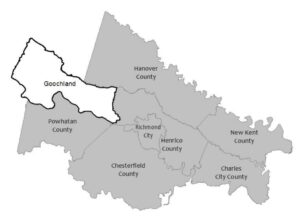
Goochland County’s location within the Richmond MSA by James A. Bacon
Ken Peterson, a leader of Goochland County’s turnaround from fiscal basket case to bearer of a AAA bond rating, thinks he has discovered the holy grail of fast-growth county governance: how to make development pay for itself.
In previous posts I described how Peterson and his fellow fiscal conservatives swept into power in the so-called Goochland Revolution of 2011 and began implementing strict financial discipline. The exurban county west of Richmond, population 23,000, put management systems into place that identified the Level of Service (LoS) desired for schools, utilities, roads, and other public amenities, and then set up a 25-year capital improvement plan that identified how much money would be needed to pay not only for the upgrades but the ongoing maintenance. Goochland would not fall into the deferred-maintenance trap on Peterson’s watch. To the contrary, the county has accumulated large reserves.
Skeptics might say that Peterson and his allies benefited from fortunate timing. The year 2011 coincided with the nation’s recovery from the great real estate crash of 2008. Growth in fast-urbanizing Henrico County had reached the county line and was leap-frogging into Goochland. Tax revenues gushing from the economic revival made it easy to balance budgets and keep the base property tax rate at an incredibly low $0.53 per hundred dollars of assessed value. However, one might argue, if Goochland follows the same path as Virginia’s other fast-growth counties — Fairfax, Loudoun, Prince William, Stafford — it could experience the same fiscal stresses that they have. (more…)
-
Warner Promises Tough Questions on Afghanistan Collapse

Image by Gerd Altmann from Pixabay Fiasco. The hasty and chaotic withdrawal of American forces from Afghanistan has shocked politicians from both sides of the aisle. Virginia’s own Senator Mark Warner, Senate Intelligence Committee Chairman, will work with other committees to investigate how the US was caught off guard by the Taliban’s quick victory. The Hill quotes Warner as saying, “As the Chairman of the Senate Intelligence Committee, I hope to work with the other committees of jurisdiction to ask tough but necessary questions about why we weren’t better prepared for a worst-case scenario involving such a swift and total collapse of the Afghan government and security forces.” Warner correctly adds, “We owe those answers to the American people and to all those who served and sacrificed so much.”
Warner described the images from Afghanistan as “devastating.” (more…)
-
Marijuana and Casino Legalization Linked to Increases in Mental Illness and Substance Abuse

Paul Krizek (D-Pamunkey Nation) by James C. Sherlock
We know what is going to happen.
Dr. Daniel Carey M.D., Virginia’s Secretary of Health and Human Resources, will soon apply to the federal government for funding for substance abuse prevention grants.
He knows.
He plans to tell the federal government that additional people, mostly poor and Black, are going to suffer and die from mental illness and substance abuse because we legalized marijuana, casinos and sports betting.
But apparently we did it for a good cause — equity — or so some say.
The opening statement of that draft application reads:
Statewide Impact of COVID-19 Pandemic on Behavioral Health and Substance Use
The unprecedented COVID-19 pandemic and the resulting health impact, uncertainty, social isolation, and economic distress are expected to substantially increase the behavioral health needs of Virginians. Increased alcohol, substance use, including increased overdose rates are key concerns, as well as COVID-19 impacts already evident in Virginia.
-
The New Higher Ed: Volcanoes! Hikes! NGO Workshops!

Somerville Munt by James A. Bacon
Somerville Munt, a recent graduate of Fluvanna County High School, was disappointed when notified in March that she had been wait-listed by the College of William & Mary. She figured there was no chance of getting in. Then, a week later, W&M contacted her again with an unexpected proposal: It would guarantee her admission in the spring of 2022 if she spent a gap semester this fall studying abroad in a program offered through Verto Education in cooperation with W&M.
Semesters abroad with Verto cost $15,000 to $25,000, depending upon location. Even so, she signed up immediately.
The Wall Street Journal recounted that story recently in an article describing how some colleges and universities are coping with enrollment uncertainties arising from the COVID-19 pandemic. No one wants to admit too many students, but no one wants to admit too few. Letting students study abroad during their first semester, an experience normally reserved for upperclassmen, gives higher-ed institutions a tool for fine-tuning their enrollments. (more…)
-
Carilion’s Opportunity to Advance the Knowledge About COVID
 by James A. Bacon
Roanoke-based Carilion Clinic, the leading health care system in western Virginia, will try using the carrot and the stick in a campaign to elevate the percentage of employees who have been vaccinated for COVID-19, reports The Roanoke Times. Vaxxed employees will receive $150 in their Oct. 15 paycheck, while unvaxxed employees will be subject to weekly testing.
More than 70% of Carilion’s 13,000-person workforce, including 99% of its physicians, have gotten the jab. But three out of ten have not.
If Carilion will be monitoring roughly 2,500 employees, it strikes me that the health system can turn all those nasal swabs into data that is useful for more than just tracking the incidence of COVID in its workforce.
Here’s the thing: Many hospital anti-vaxxers are COVID survivors. I don’t have a percentage, but anecdotal accounts in news reports suggest that it is considerable. The anti-vaxxer argument is that previous exposure to COVID-19 confers natural immunity. There is considerable scientific evidence to support their position. (GMU professor Todd Zywicki’s lawsuit cited much of that evidence.) But many remain unconvinced. (more…)
-
There’s Gold in Them Thar… Press Releases?
 by Jock Yellott
It seems there is a vein of quartz underground in Buckingham County sparkling with gold. The General Assembly almost prohibited mining it, but then backed off. This time.A string of historic gold mines going back to the 19th Century appear as red dots on the county geological survey map like chigger bites on the skin of the land. Exploratory drilling by a Canadian company, Aston Bay Holdings, found significant new quantities of gold there.
From about the depth of a water well — 150 to 300 feet– Aston Bay’s diamond drills pulled up broken columns of translucent white quartz flecked with yellow metal. They drilled and drilled again for about 200 yards, two dozen holes, rarely drilling without finding more quartz glinting with gold. (more…)
-
310 Virginia Companies in the Inc 5000 This Year

Charis Jones, CEO of Sassy Jones, No. 75 in the Inc. 5000 And now for a bit of good news. Virginia’s entrepreneurial economy is faring very well, thank you. This year 310 Virginia companies are ranked in the Inc. 5000 list of fastest growing privately held companies. Five were ranked in the Top 100.
How does that compare nationally? In very rough numbers, Virginia accounts for one out of every 40 Americans and one out of every 40 dollars of U.S. GDP. But one out of 16 private fast-growth companies is located here.
As always, the entrepreneurial ferment is concentrated in Northern Virginia, which has the best developed venture capital network, the most highly educated workforce, and a deep reservoir of IT talent. Nearly 75% of Virginia’s Inc. 5000 — 227 companies — reside in the Virginia portion of the Washington Metropolitan Statistical Area.
The Richmond metro (44 companies) and Charlottesville metro (6 companies) also punch above their weight. (more…)



