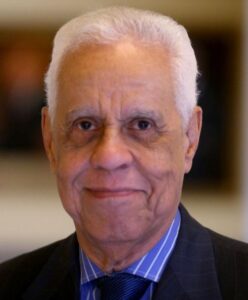
Monty Python’s Church Police, a famous sketch we can now watch being played out in Virginia politics.
By Steve Haner
Now here’s a phrase I never expected to type, even in a blog post: menstrual data. Looks like the 2023 Virginia General Assembly will be best remembered down the road for a silly bill that sparked a very avoidable stumble and then turned into a National Thing.
Governor Glenn Youngkin (R) was even the target of well-publicized staged outrage from the Biden Administration, suddenly diverted from balloon- watching by a nationwide flood of search warrants seeking data on women’s periods. Except there don’t actually seem to be any such search warrants and there may not actually be any interest in such information. (more…)
Daffodils, v. “February Gold”. Plant source: Brent and Becky’s Bulbs, Gloucester Va.
by Dick Hall-Sizemore
February is known for many things. Although it is the shortest month, some have claimed that, with its usually dreary weather (this year being an exception), it actually feels like the longest. To divert us from its normal dark days, in addition to cheerful early daffodils, February offers us Groundhog Day, Valentine’s Day, Presidents Day (Washington and Lincoln) and Black History Month.
All of those are worthy subjects for celebration, but only one, Presidents Day, is officially recognized. However, in its infinite wisdom, the Virginia General Assembly has chosen to officially declare February to be:
Looks like Washington Post reporter Ian Shapira is loading up the big guns to fire another salvo in his unrelenting war on Virginia Military Institute alumni who are critical of the new leadership’s Diversity, Equity & Inclusion policies. This time, instead of attacking traditionalist alumni as a group, he appears to be focusing on Matt Daniel, head of The Spirit of VMI PAC, as an individual.
Shapira obviously has done a lot of digging. Since his Nov. 21 article insinuating that dissident alumni are racist for criticizing VMI’s African-American Superintendent Cedric Wins, he has published only one other article (on a topic unrelated to VMI). Three months after his last hit, the WaPo hatchet man emailed a lengthy list of questions to Daniel that hint at specific allegations the article will make.
One question, for example, sets up the VMI grad and former fighter pilot on charges of anti-Semitism for a blog post in which he criticized leftist mega-donor George Soros — not for Soros’ ethnic identity but his role bankrolling leftist causes.
Anticipating a hatchet job, The Spirit of VMI has published Shapira’s email, and you can read it here. And you can read The Spirit of VMI’s response here.
“What is obvious from the tone, type, and number of questions is that Mr. Shapira … will try to doxx and cancel another VMI Alumnus who has attempted to freely speak and react to to the corrosive actions of the Northam Administration,” said the Spirit of VMI statement. The statement continued: (more…)
Del. Danica Roem (D-Prince William) Photo credit: Virginian Pilot
by Dick Hall-Sizemore
A recent article in the Richmond Times-Dispatch illustrates how governments will fight any attempt to amend the Freedom of Information Act (FOIA) in a way that would make it easier for citizens to obtain information.
Del. Danica Roem (D-Prince William) has been one of the more persistent legislators seeking to amend the FOIA to make information on government activities more accessible to citizens. With her background as a journalist, she knows more about how the FOIA functions than most legislators.
One of the chief frustrations of citizens seeking information on their governments’ activities are the fees government agencies are authorized to charge as a condition of providing requested documents. Roem has introduced legislation in the past that would have capped the fees a government agency could charge. These bills went nowhere, and it did not matter if the Democrats were in the majority (HB 2000, 2021 Session) or the Republicans (HB 599, 2022 Session). This year, she took a more modest approach. (more…)
The latest projections from the Congressional Budget Office (CBO) indicate that, given continuation of current levels of taxation and programmatic spending, the U.S. budget deficit will be running at $2.3 trillion a year by 2033, driven in large part by a $1 trillion-a-year increase in interest payments on the national debt to $1.4 trillion a year.
As it happens, 2033 is just a couple of years away from 2035, the year that Social Security’s Old Age and Survivors Insurance trust fund is scheduled to run out of money and the payout will be limited to what the program brings in from payroll taxes, limiting the payout to 77% of what was promised.
What’s the most likely scenario in the early 2030s? Congress will borrow to sustain the full Social Security payments, adding to the deficit and accelerating growth in the national debt. This year the deficit will be about 4.3% of gross domestic product. By 2033, it will be 7.3% — and that’s before a Social Security bailout. Interest on the national debt, which cannot be cut without triggering a default, will amount to 3.6% of the entire economy.(more…)
Old global warmist spin: as temperatures rise, millions will die.
New global warmist spin: OK, we’ll admit that rising temperatures have resulted in fewer overall deaths due to the decline in cold temperatures, which kill more people than hot temperatures. But rich developed-world countries in northern climes will benefit the most from rising temperatures while poor developing countries closer to the equator will suffer the most.
Washington Post writer Harry Stevens acknowledges that a peer-reviewed paper recently published in Lancet Planetary Health found that the number of people dying from cold is declining faster than the number of people dying from heat is increasing.
Oh, no, what’s a climate hysteric to do? There is no upside to warmer temperatures — none!!! (more…)
While all of the attention in the state press has been on Petersburg’s proposed casino, the estimable Bill Atkinson of the Petersburg Progress-Indexprovided insight into other Petersburg requests to the General Assembly for budget amendments.
Badly needed infrastructure projects and a tourism initiative are each tied to the health of both the Appomattox River and the citizens of Petersburg. (more…)
Those aren’t wood chips or bark in the cow pasture.
David Foster Wallace tells the story of two young fish swimming along when an older, wiser fish swims past and asks, “How’s the water?” One of the young fish looks at the other and asks, “What’s water?”
Absurdity is the water that proponents of the Bluestone Town Center (BTC) are swimming in. Like the young fish, they’ve been in it long enough and deeply enough that they don’t know that’s what it is.
Consider this scenario. A city council member who serves as the council’s representative to the planning commission listens to a long recommendation from the planning staff. She then makes a motion to more or less accept the recommendation. Four weeks later, she asks the planning staff what their recommendation meant.
Yes, this really happened. So did the argument that building apartments in a cow pasture would preserve farmland. (more…)
Racial systemic inequalities have recently been brought to the forefront of our national conscience, shedding light on the centuries of policies that have disadvantaged Black and Brown Americans’ ability to build, maintain, and pass on wealth. A striking 2019 statistic shows that the median family wealth (the difference between gross assets and liabilities) for White Americans was $188,200 compared to $24,100 for Black Americans and $36,100 for Hispanic families.
One area of resounding disparity is the inequality between Black and Brown Americans and their White counterparts regarding access to and knowledge of financial literacy – the ability to understand and apply financial skills related to personal financial management, budgeting, and investing. This gap is evident in the research on Black Americans with regard to low home ownership, low participation in the financial marketplace, high credit card and student loan debt, and expensive credit card behavior (such as paying minimum fees, incurring late fees, and taking cash advances).
The financial literacy education in U.S. public schools is inconsistent across states, often integrated into history or other social studies curricula, or only offered as an optional topic. The good news is the Virginia Board of Education approved one standard unit of credit in economics and personal finance as a requirement for high school graduation beginning with students who entered ninth grade in fall 2011. However, as a mom of teenagers, I noticed first-hand that the personal finance classes my kids participated in were varied in that an economics class fulfilling the personal finance requirement didn’t necessarily teach how to create a budget, or what it takes to build and maintain credit, etc. One potential solution to this problem is a standardized, culturally-relevant, and youth-oriented financial literacy program. (more…)
The 2021 Youth Risk Behavior Survey (YRBS) Data Summary & Trends Report: 2011–2021, wasreleased by the CDC on Monday, provides the most recent surveillance data, as well as 10-year trends, on health behaviors and experiences related to adolescent health and well-being among high school students in the United States.
The survey was completed in the Spring of 2021.
The report writes that teen girls are “engulfed in a growing wave of violence and trauma.”
Illustrations courtesy of CBS
This survey is brought to you by CDC, the national sponsors of school shutdowns. Who could have imagined?
The survey did not include middle- and grade-school students, but we can assess that such conditions did not spring up full grown in the 9th grade.
Where, exactly, are the feminists? Especially the ed-school feminists? Like Positive Behavioral Interventions and Supports (PBIS) cheerleader Professor Catherine Bradshaw at the UVa School of Education and Human Development.
PBIS in place in most schools in Virginia and across the nation in that same 10-year period by design keeps violent and dangerous students in schools.
It is what PBIS is supposed to do. So those students can be socialized.
Or not.
That survey should, but will not, put to rest progressive insistence that out-of-control violence among students and fear in American schools because of violence are figments of conservative imaginations.
It confirms that increasing absenteeism is linked to fear. Which progressives will also continue to deny. (more…)
Pig farm operated by Chinese-owned Smithfield Foods.
by James A. Bacon
Look, I consider myself a China hawk. I detest the communist regime, I consider China a threat to the global order, I think the U.S. should commit to defend Taiwan, and I support measures to crack down on China’s cyber theft and unfair trade practices. But there’s one thing I don’t get. I don’t understand the agitation about the Chinese buying American farmland.
The General Assembly appears to be poised to pass a bill that would prohibit “foreign adversaries” from acquiring or transferring agricultural land in Virginia — a ban that would extend to “meat, dairy, and poultry products; nuts, tobacco, nursery, and floral products.”
According to Virginia Public Media, the Chinese own 14,000 acres of Virginia farmland. (I expect most of this acreage can be attributed to Smithfield Foods, the pork products company.)
So what? How would Chinese ownership of Virginia floral greenhouses, or pig farms for that matter, constitute a danger to U.S. economic, military or political security? (more…)
Physician burnout is a major issue in the U.S., receiving attention in medical education, medical specialties and at various government levels. Moral injury, in my professional and teaching experience, is a significant and growing challenge to physician wellness. Moral injury happens when one’s personal convictions are unwelcomed and one is pressured to think, be silent, speak, act or not act in a way that compromises one’s conscience.
I graduated from the VCU School of Medicine (formerly Medical College of Virginia) in 1991, trained in family medicine and served in a mission hospital in Asia for 16 years. In 2015, I transitioned to a Virginia university practice and became heavily involved in the lives of medical students.
In the time that had passed since I was a medical student, I found the environment of medicine and medical education had significantly changed. One area of change was the emergence of the “provider of services model.” “Provider,” a relatively new term at the time, is now commonplace. (more…)
Race has too long defined Virginia politics. Several efforts to change this dynamic are discussed in my book Remaking Virginia Politics. My gut senses 2023 may feature another noteworthy moment on the road to Dr. King’s dream. The fight between Petersburg and Richmond over a casino license is currently not seen in this light. Neither by the General Assembly. Nor the Virginia media. Let me humbly discuss an alternative view. Based on my experience helping to move Virginia forward.
In Virginia’s political lexicon, Governor Glenn Youngkin is a conservative white Republican. While winning the governorship, he got barely 13% of the vote in Petersburg. His worst showing in any city. Hardly surprising given the city’s roughly 75% black electorate, 85% Democratic in partisan terms. The city has long been economically challenged, with a high poverty rate. Yet Governor Youngkin has made reviving Petersburg a top priority. Conventional political wisdom, to paraphrase singer Johnny Lee, says he is looking for love in all the wrong places. I disagree. (more…)
Now that Democrats have de-confirmed Virginia’s state health commissioner, Colin Greene, they have effectively set a new qualification for the office: it is no longer permissible to express skepticism that “systemic racism” is, in the words of Sen. Jennifer McClellan, D-Richmond, “a public health crisis.”
Ironically, only a few days after senate Democrats sent Greene packing, Old Dominion University has published a graph in its 2022 State of the Commonwealth report that dismembers any idea of systemic racism playing a role in the biggest public health crisis of our generation — the COVID pandemic. The graph above, taken from the study, compares the percentage of COVID-related deaths for each race to its percentage of Virginia’s population.
African Americans accounted for 23% of COVID deaths through October 22 compared to only 19.2% of the state’s population — a four-percentage point gap.
But it turns out that Whites accounted for 68.1% of COVID-related deaths compared to 60.8% of the population — an eight-percentage point gap. Is that evidence of systemic anti-White racism? (more…)
The year: 2075. The American colonies on the Moon are getting restless under Washington’s tyrannical rule….
This second edition of “Dust Mites” has a snazzy new cover, includes helpful lunar maps, and is 5,000 words tighter than the original. The sequel, “Trogs,” is scheduled for publication this summer.
Advertisement
Advertisement
Advertisement
Advertisement
About
Bacon’s Rebellion is Virginia’s leading politically non-aligned portal for news, opinions and analysis about state, regional and local public policy. Read more about us here.
Fund the Rebellion
Shake up the status quo! Your contributions will be used to pay for faster download speeds and grow readership. Make a one-time donation by credit card or contribute a small sum monthly.
Can’t wait until tomorrow
For your Bacon’s Rebellion fix?
Enter your email address to receive immediate notifications of new posts by email.
SUBSCRIBE
Search Bacon’s Rebellion
Categories
Archives
The Jefferson Council
Protecting Thomas Jefferson’s Legacy at the University of Virginia
Forgot Your Password?
Shoot me an email and I’ll generate a new password for you.