Westinghouse, whose flagship AP1000 nuclear reactor is the American entry into the international market for large nuclear power plants, today announced a new reactor, called the AP300, which it claims will be available in 2027.
It will generate about a third of the power of the AP1000 reactor.
It is targeted at about $1 billion per delivered plant, well below the $6 billion plus for an AP1000 plant.
All of the technologies are already licensed by the NRC.
VOYGR™ SMR plants powered by NuScale Power Module™, the first and only small modular reactor (SMR) to receive design approval from the U.S. Nuclear Regulatory Commission (NRC).
I wrote in an earlier article that I had reached out to Clean Virginia on its policy on Small Modular Reactors (SMRs) and had not received a response.
Laura Gonzalez Guerrero, Clean Virginia’s energy policy lead, has been kind enough to contact me with that answer. She was out of the office on April 25th when I inquired.
Ms. Guerrero’s response today:
“Clean Virginia recognizes SMRs as a nascent technology that has neither been fully tested nor proven to be cost-competitive.
Thus, it is our view that this technology warrants further study by the state.
Specifically, we hope state agencies lead a process with stakeholder input to understand and research SMRs and other technologies like hydrogen to determine their viability and the pathways to deploy these technologies in the safest and most cost-effective way possible.”
I fully expect that Clean Virginia, understanding that the Commonwealth has no equivalent state government expertise in next generation nuclear power, will also consider the decisions of the U.S. Nuclear Regulatory Commission.
On April 25, 2023, a group of Virginia Military Institute (VMI) alumni filed suit against the VMI Alumni Association, Inc. The complaint alleges that the Association refused members’ requests for records that will permit them to communicate with 20,000+ fellow members by email — the same vehicle the Association uses, and permits others to use.
The right of Alumni Association Members to obtain such a list, and other corporate records, is guaranteed to all members of Virginia non-stock corporations under state law. Virginia Code §§933 and 845 requires any non-stock corporation to produce such records when requested by members if they have a proper purpose.
The Association’s response was swift and accusatory. It stated that the members list is denied to protect the privacy of its members, and implies the lawsuit is an attempt by out-of-control alumni to usurp the protected means of communications between the Association and alumni. (more…)
We write here often about electric power in Virginia, but usually related to public utilities. We focus on Dominion and Appalachian Power.
There is another big market: industrial power plants independent of utilities and the grid (and thus not requiring State Corporation Commission approval).
Those are not reflected in the plans of the utilities except inasmuch as they lower demand.
Users include the steel and cement industries, oil and gas, pulp and paper, mining, and chemical industries. And military bases.
The United States Navy is the world’s most advanced operational user of nuclear power and thus has both a culture and a corporate structure to support nuclear energy.
Each of the military services needs to maintain the independence of its major bases from utilities to control costs, to ensure reliability by independence from the grid and thus to support uninterrupted operations.
But even the Navy does not currently use nuclear power to provide co-generation of the steam and electricity needs of its shore infrastructure.
Among the technical reasons industrial power plants are conventionally powered:
low-heat commercial nuclear reactors are not capable of efficient co-generation; and
high-heat newer technology reactors shorten the life span of the graphite in the cores.
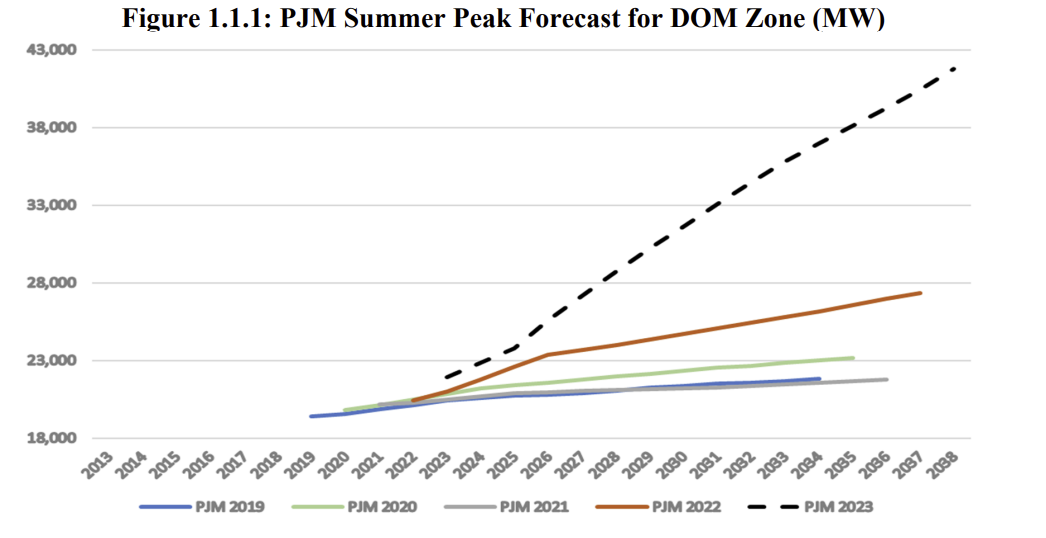
The graph above shows the key trend driving the major revisions in Dominion’s 2023 Integrated Resource Plan, which Steve Haner describes in the previous post. The projections of peak summer electricity demand, based on PJM Interconnection forecasts, has been consistently revised upward, taking a dramatic jump higher in the 2023 iteration. The massive shift largely reflects changes in methodology but it also incorporates data showing that demand is increasing more rapidly than previously projected.
The demand projections underpinning the Virginia Clean Economy Act, which showed electricity demand decreasing somewhat, are a fantasy. It is impossible to reach zero net-carbon in the Dominion service territory by 2045 without putting Virginia’s electric grid at risk of catastrophic failure. (more…)
Rendering of a GE combined-cycle natural gas-burning plant. Despite demands from some for carbon free electricity, Dominion wants to add more gas generation in Virginia.
by Steve Haner
Dominion Energy Virginia has long been warning, albeit somewhat quietly, that the dream of running Virginia’s economy on nothing but solar, wind and battery power was not based on reality. With the filing of its most recent integrated resource plan (IRP) on May 1, proposing how to meet customer needs out 25 years, it has made those warnings concrete.
The alternative plan that the company points to as preferred includes adding natural gas generation as early as 2028, an idea not even hinted at in the previous plan just a year ago. It wants to add 2,900 megawatts of new gas plants in all. That proposal will prove anathema to the climate alarmism movement that imposed the Virginia Clean Economy Act just three years ago, demanding carbon-emissions-free electricity by 2045. (more…)
VOYGR™ SMR plants powered by NuScale Power Module™, the only small modular reactor (SMR) to receive design approval from the U.S. Nuclear Regulatory Commission (NRC). Courtesy NuScale.
by James C. Sherlock
Where is Virginia going with nuclear power, the non-carbon energy source that works 24/7/365 to maintain grid stability for all those sources that do not?
Where we are. Virginia has four nuclear reactors producing electric power — two at Surry station in Surrey County (produces 14% of Virginia’s electricity) and two at North Anna in Louisa County (17% of Virginia’s electricity).
Surry has two Westinghouse pressurized water reactors that went on-line in 1972 and 1973 respectively. Surry’s licenses from the NRC have been renewed to 2052 and 2053 respectively. North Anna has two similar Westinghouse reactors which went on-line in 1978 and 1980, respectively. Dominion expects those licenses to be extended until 2058 and 2060.
In 2017, Dominion was issued a permit by the NRC to build a third, much more powerful and newer technology reactor at North Anna. The permit is good until 2037. It is not in Dominion’s current plans.
Under the Virginia Clean Economy Act (VCEA), Virginia is legally required to retire all baseload generation, except for incumbent nuclear power plants, in favor of renewable generation by 2050.
In 2022, Governor Youngkin released an all-of-the-above energy plan which announced that Virginia would build a Small Modular Reactor (SMR) in southwest Virginia.
The goal is to have the SMR in operation by 2032.
For an explanation of SMR, see Dominion’s short essay starting on page 9 of its Integrated Resource Plan. Dominion has included SMRs as an available resource in all of its plan options beginning in 2032.
That initiative is welcome, but is fuzzy with regard to actual deployment plans, which are not yet formulated.
And fuzzy with regards to compliance with the VCEA, at least to me. If they are not compliant, then the law should be changed to accommodate them. (more…)
Virginia Beach isn’t tornado country. We know the drill with hurricanes. We had a rash of those in the ‘80s and ‘90s. From August to November most of us keep well-stocked hurricane boxes handy. And we have days — sometimes more than a week — to prepare or evacuate when a storm is heading our way.
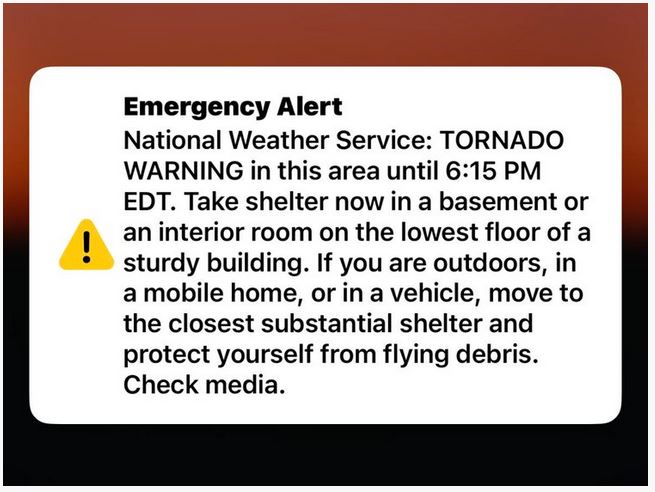
But when an ear-piercing tornado siren shrieked from our cellphones early Sunday evening — giving us what turned out to be a one-minute warning before the twister touched down in Great Neck — it required split-second action.
The Virginia Supreme Court has again ruled against a local government for violating the Freedom of Information Act (FOIA).
The case arose as a result of Deborah Wahlstrom deciding to attend a day-long retreat of the Suffolk City School Board focused on board training and strategic planning. The meeting was publicly advertised and was to be held in a city school. At some point after she arrived and took a seat in the room in which the meeting was to be held, she was told that members of the public could not be in the room and could only view a video feed of the meeting from another room. She remained in her seat. Board Chair Judith Brooks-Buck then approached her and told her that she couldn’t be there because “this is a closed meeting.” Subsequently, she and the Superintendent of Schools John Gordon told her to exit the room and return to the lobby. She refused, citing her legal right to be present in the room.
As the discussion continued and got a little more heated, the superintendent threatened to call the police. Wahlstrom remained in the room. The police were called and the superintendent explained to the police that Wahlstrom was “an enemy of the school division.” The police officer escorted Wahlstrom out of the building and told her she had to leave the property entirely. She was not even allowed to view the meeting virtually. (more…)
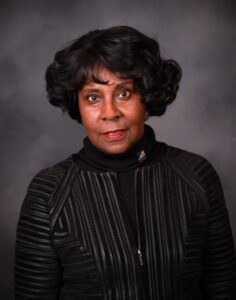
Lisa Coons. Image taken from Virginia Department of Education YouTube clip.
by James A. Bacon
Dr. Lisa Coons, Virginia’s new superintendent for public instruction, has been on the job for only two weeks, but she has clear priorities for reversing the slide in educational achievement in Virginia’s public schools: raise standards, get chronically absentee kids back into the classroom, and address teacher shortages.
Recruited from her job as chief academic officer for the Tennessee public school system, Coons filled the vacancy created by the resignation of Jillian Balow. She granted Bacon’s Rebellion her first media interview. I started with an open-ended question: What are the greatest challenges facing Virginia public schools today? Her gut response: Recruit more teachers.
“We have to get a high-quality teacher in every classroom in the state,” she said. “Remove the barriers and challenges to processing licenses. Create plenty of pathways to bring people into the [teaching] workforce.”
Raising teacher pay is one obvious strategy for reversing the brain drain from schools. Lawmakers have funded significant pay hikes for Virginia teachers, but the raises have lagged cost-of-living increases. Improving working conditions is another approach. Virginia teachers consistently cite disciplinary issues, unsupportive administrators, and lack of respect from students and parents as morale busters. But those issues are inherently local and not amenable to top-down action from Richmond. Rather, Coons is focusing on changing state-level regulations with the goal of enlarging the pool of teachers. (more…)
Two parishioners at a Latin Mass Catholic church in rural Northern Virginia say they witnessed suspicious activity from what looked like FBI vehicles in February, a month after the FBI’s Richmond office published a now-rescinded internal memo focused on “radical-traditional Catholics.”
The FBI’s Washington, D.C. office, which monitors the church’s area, denied any knowledge of such activity in a statement to The Daily Signal.
The two witnesses told The Daily Signal that they saw two cars approach the church, drive through the parking lot as if they were writing down license plate numbers, and then leave, on two separate instances outside Immaculate Heart of Mary Chapel in Linden, Virginia, some 63 miles west of Washington, D.C., between Feb. 12 and Feb. 26. (The memo had been published on Jan. 23 and rescinded on Feb. 9.) (more…)
Teachers unions have fiercely opposed them for years as measures of accountability in K-12. Because SOLs, SATs and ACTS expose both good and bad educational results and measures of student growth over time;
Colleges and universities oppose them because they interfere with diversity, equity and inclusion aspirations.
Thus Virginia colleges and universities, presented with an opportunity by COVID, jumped at the chance to drop the SAT/ACT testing requirement. Now at least some of them are quietly extending that policy.
We’ve extended our current test-optional practice for two years. If you’re applying for admission for Fall 2024 or Fall 2025, you’ll have the choice of sharing or not sharing results from the SAT and ACT.
Whichever path you choose, we’ll consider your application with care and respect, and you won’t be disadvantaged because of the choice you’ve made.
Two-year extension. Any bets?
UVA, William and Mary, Tech and W&L should consider the difference between what they are marketing — exclusivity based on merit — and that policy.
After years of silence, The Washington Post editorialized yesterday that censorship of speech on America’s college campuses had gone too far.
Better late than never.
We welcome them to the fight.
The Post does not note that too many students are arriving on college campuses as already-radicalized warriors of the left, trained, not educated, as such from kindergarten.
It will be a long slog to correct that trend. Perhaps the Post editorial board will one day join that fight as well. But not yet. It does not even acknowledge it is happening.
As for the colleges, the contest for free speech is in the early innings.
They will continually have to fight a battle that cannot be fully won while the left provides fresh troops to every freshman class.
This space has offered the opinion previously that it is unwise to build a new Central State Hospital (CSH) on the site of the old one.
A follow-up FOIA request to the Virginia Department of Behavioral Health and Developmental Services has yielded current “jobs filled” data to compare to “jobs vacant” data reported earlier to enable us to examine significant personnel shortfalls by percentages.
They make a discouraging point about the current status and the future prospects of CHS in Dinwiddie County.
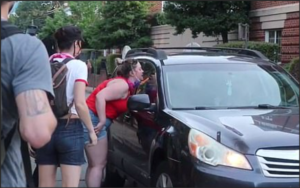
Protesters harass Morgan Bettinger in her car after rumors circulated that she said they’d make good “speed bumps,” a supposed allusion to the Unite the Right rally three years previously in which a neo-Nazi ran his car into a crowd of protesters. Photo credit: WUVA News by way of The Daily Mail.
The Morgan Bettinger case is gaining national notoriety. After Reason magazine detailed the travesty of the University of Virginia student who was punished for using the words “speed bumps” in a way that militant leftist protesters construed as threatening, the Daily Mail has picked up the story. The Daily Mail does not add much new information, but it does crystallize the insanity of the episode, in which rumors spreading on social media panicked UVa officials into running Bettinger through a flawed student disciplinary system.
As the Daily Mail summarized the travesty: “Celebrated BLM activist ruthlessly destroyed white student’s life by accusing her of saying racial justice protesters would ‘make good speed bumps’ — only to later admit she may have MISHEARD.” The chief accuser was Zyahna Bryant, who had been awarded numerous honors in recognition of her student activism. She spread vitriol against Bettinger online, and then demanded that UVa discipline her.
Although UVa’s Office of Equity and Civil Rights (OECR) found no evidence to confirm the allegation that she had verbally threatened the protesters, the student-run judiciary committee compelled her to write an apology to Bryant and perform social justice-related community service if she wanted to graduate.(more…)
The year: 2075. The American colonies on the Moon are getting restless under Washington’s tyrannical rule….
This second edition of “Dust Mites” has a snazzy new cover, includes helpful lunar maps, and is 5,000 words tighter than the original. The sequel, “Trogs,” is scheduled for publication this summer.
Advertisement
Advertisement
Advertisement
Advertisement
About
Bacon’s Rebellion is Virginia’s leading politically non-aligned portal for news, opinions and analysis about state, regional and local public policy. Read more about us here.
Fund the Rebellion
Shake up the status quo! Your contributions will be used to pay for faster download speeds and grow readership. Make a one-time donation by credit card or contribute a small sum monthly.
Can’t wait until tomorrow
For your Bacon’s Rebellion fix?
Enter your email address to receive immediate notifications of new posts by email.
SUBSCRIBE
Search Bacon’s Rebellion
Categories
Archives
The Jefferson Council
Protecting Thomas Jefferson’s Legacy at the University of Virginia
Forgot Your Password?
Shoot me an email and I’ll generate a new password for you.


 by Bob Morris, Gene Rice, and Mike Staso