• Equal Protection, Affirmative Action and Effecting Generational Change

    by James C. Sherlock

    America is the most successful nation in the history of the world because of the freedoms and rights guaranteed by our Constitution.

    More than a hundred other nations have emulated the American Constitution.

    Without constitutionally guaranteed freedoms and rights, we would be chained to the whims of the state. Most immediately to the whims of the executive branch. There would be precious little for the judicial branch to protect.

    A recent Supreme Court decision found affirmative action in college admissions to be unconstitutional under the 14th Amendment, Section 1:

    No state shall make or enforce any law which shall abridge the privileges or immunities of citizens of the United States; nor shall any state deprive any person of life, liberty, or property, without due process of law; nor deny to any person within its jurisdiction the equal protection of the laws.

    Justice Roberts for the majority ruling that the Harvard and UNC admissions programs cannot be reconciled with the guarantees of the Equal Protection Clause:

    Both programs lack sufficiently focused and measurable objectives warranting the use of race, unavoidably employ race in a negative manner, involve racial stereotyping, and lack meaningful end points. We have never permitted admissions programs to work in that way, and we will not do so today.

    Three justices disagreed.

    Justice Sotomayor read her opinion from the bench — a sign of strong disagreement. An excerpt:

    Today, this Court stands in the way and rolls back decades of precedent and momentous progress. It holds that race can no longer be used in a limited way in college admissions to achieve such critical benefits. In so holding, the Court cements a superficial rule of colorblindness as a constitutional principle in an endemically segregated society where race has always mattered and continues to matter.

    Note that Justice Sotomayor, as always careful of the words in her opinions, chose “endemically” to modify โ€œsegregated.โ€ Oxford dictionary: “regularly found and very common among a particular group or in a particular area.โ€

    That is different than the word โ€œsystemicallyโ€ — Oxford: “in a basic and important way that involves the whole of an organization or a country and not just particular parts of it.” (more…)


  • One Hand Applauds for Dominion “Bill Relief”

    by Steve Haner

    Dominion Energy Virginiaโ€™s customers still owe it $1.26 billion for fuel they have already used, as of the end of June.ย  The utility is going to give us either seven or ten years to pay off that debt, but at a total cost of over $1.54 billion if we take seven years or almost $1.7 billion if we take the full decade.

    The difference, of course, is interest, a return on investment (profit) for the lender, almost $300 million on the seven year plan or $400 million on the ten year plan.ย  And that initial $1.26 billion already includes some interest.ย  It was clear from the beginning that extending this debt out like a credit card balance would produce a profit for the lender. (more…)


  • Info-Wars in the College Admissions Debate

    Credit: Bing Image Creator. Pry the data from my cold dead digital fingers.

    by James A. Bacon

    It will be exceedingly difficult to hold an honest conversation in Virginia about the role of race in higher-education admissions and Diversity, Equity & Inclusion. College administrators are the gatekeepers of data critical to the discussion and they will not share it.

    I have been stymied twice this week in my efforts to acquire admissions data: once by the State Council of Higher Education for Virginia, and once by the University of Virginia. SCHEV and UVa officials cite various justifications for being unable to supply the numbers, but I believe the underlying reason is that university administrators simply don’t want to make the data available. Why? Because he who controls the data controls the narrative.

    Since the U.S. Supreme Court issued a ruling restricting the use of race as a factor in admissions, I have embarked upon the mission of laying out the data available in the public domain: how have admissions and enrollment patterns evolved over the past 1o to 20 years? How have preferential policies for selected minorities fared, as tracked by measures of student thriving such as feelings of “belonging,” drop-out rates, student-loan debt burdens and post-graduate income?

    In recent posts, I have documented that males and Whites are slightly under-represented in entering classes at UVa, while my colleague Walter Smith has described UVa’s use of the Landscape platform to provide school- and neighborhood-specific “context” for applicants. Last year Smith shed light on the new racial calculus in UVa admissions by showing how offers to applicants vary by race/ethnicity and legacy status. The Office of Admissions, which was commendably open with its data last year, stopped providing it after we published his article.

    The State Council of Higher Education for Virginia (SCHEV) maintains a searchable online database of higher-ed statistics regarding enrollment, admissions, tuition & fees, financial aid, student debt, retention rates, and degrees awarded. SCHEV breaks the data into dozens of different reports that are searchable by individual institution. It is an invaluable resource for anyone analyzing higher-ed in Virginia. (more…)


  • VMI Superintendent Praises Student Journalists

    by James A. Bacon

    I increased my respect for Cedric Wins. In his personal Facebook page, the Virginia Military Institute Superintendent congratulated Lt. James Mansfield (class of ’22) and Cadet Russell Crouch (class of ’24), co-editors of The Cadet student newspaper last year, for winning the Virginia Press Association’s Journalist Service and Integrity Award.

    That couldn’t have been easy. The student journalists had been critical of the Wins administration’s implementation of Diversity, Equity & Inclusion and its approach to student mental health. But Wins proved he is capable of setting aside any personal pique he might have and applaud the cadets for their significant accomplishment.

    Wrote Wins: “The Virginia Military Institute lauds these cadetsโ€™ commitment to the free exercise of expression and looks forward to working with those cadets who follow in their footsteps.”

    Yes, this the same student newspaper that The Washington Post slammed with allegations of plagiarism and conflict of interest — perhaps the first time in history that a newspaper of such global stature stooped to undermining a prestigious award for a student newspaper of a small college. The Post’s vindictive criticisms — I use the word “vindictive” because The Cadet articles contested a racial-oppression narrative peddled by the Post for two years — successfully triggered a VPA investigation into the allegations. The findings of that investigation, however, found that the contest rules provided no mechanism for reversing the award.

    Wins looks like a bigger man, and The Washington Post looks petty and mean- spirited. (more…)


  • Private Equity in Medicine

    To add to those revealed inย  James Sherlock’s excellent posts about nursing homes and the health care industry generally, here is another culprit–private equity firms.ย  They buy up medical practices in an area, creating great bargaining power with insurance companies, and begin raising prices.ย  The fight is between giant, merged insurance companies and giant, merged medical practices.ย  The losers are patients and the winners are the private investors.

    Today’s Washington Post has a long article describing how this happened with anesthesia practices in the Denver area.ย  The company, U.S. Anesthesia Partners, which calls itself a physician-owned company, was, in reality, created by the private equity firm, Welsh, Carson, Anderson & Stowe, which owns 55 percent of the stock.


  • Nursing Shortages Require Better Oversight of Virginia Nursing Homes – Part Two – State Action Required

    by James C. Sherlock

    Patterns of understaffing, medical harm and abuse in nursing homes are traceable:

    • in some cases to a business model of understaffing to increase profits. Federal fines are built into the business models of the bad actors. Some of the worst post double-digit annual operating margins;
    • in some to other systemic chain-wide issues, perhaps financial instability; and
    • in yet others to local management incompetence and other site-specific issues.

    Regardless of the reason, Virginia regulators and law enforcement agencies must execute the roles they are legally charged to perform.

    State sanctions must be levied.

    • The Health Commissioner can block the admission of new patients until staff levels support them or shut down those facilities that do not meet standards over a long period of time;
    • The Department of Medical Assistance Services (DMAS) can suspend or halt Medicaid payments;
    • The Attorney General can prosecute for civil or criminal violations.

    Enforcement will result in fewer, but better and safer options. (more…)


  • Nursing Shortages Require Better Oversight of Virginia Nursing Homes โ€“ Part One โ€“ The Problem

    By James C Sherlock

    We have some great nursing facilities in Virginia. We also have far more than our share of bad ones.

    Virginia has a decision to make about the latter.

    The federal government sets standards for those that are paid with federal funds. ย It both levies fines and denies payments as it feels appropriate.

    But more direct action to assure quality of and safety in nursing homes is left to the states, who both license and regulate them.

    There are simply not enough nurses nationwide or in Virginia to staff all of the nursing homes currently operating. ย And that shortage is not temporary.

    The decision Virginia needs to make is straightforward:

    • do we want to keep open to new patients the 289 certified nursing facilities currently in operation; or
    • do we want to ensure patient safety.

    We cannot have both.

    The nursing shortage cannot be a reason for government to leave open to new patients grossly understaffed nursing homes. ย If that understaffing is sufficiently chronic, some must be closed.

    Among the bad facilities, some owners are scoundrels. ย Others are just not able to get it done. ย Better enforcement will reduce the number of both.

    Actions must be taken to assure that when citizens need a nursing home, the state license can be trusted as a sign that basic standards are maintained.

    That they will be safe.

    (more…)


  • What It Means to Be a Citizen

    Photo credit: Financial Times

    by James A. Bacon

    The 4th of July, commemorating our nation’s declaration of independence, is an occasion to think about what we appreciate about America. Amidst our social breakdown, culture wars, and vitriolic politics, that’s not an easy thing to do. Among the most demoralizing aspects of our times is the abysmal level of understanding of the source of the precious rights — freedom of religion, freedom of speech, freedom to assemble and petition the government — that we take for granted.

    As Joni Albrecht, director of the John Marshall Center for Constitutional History & Civics, observes in the Virginia Mercury, less than half of U.S. adults could name all three branches of government; only one in four U.S. adults could name a single right identified in the First Amendment.

    Many of our schools fail to teach the basic knowledge required to be a functioning and contributing citizen. According to Virginia Department of Education data, only 70% of Virginia school children passed their Civics & Econ Standards of Learning exam in the 2021-22 school year. Only one in five scored “advanced.” In other words, 30% are politically illiterate, and another 50% are marginally literate. (more…)


  • The Document That Inspired the Declaration of Independence

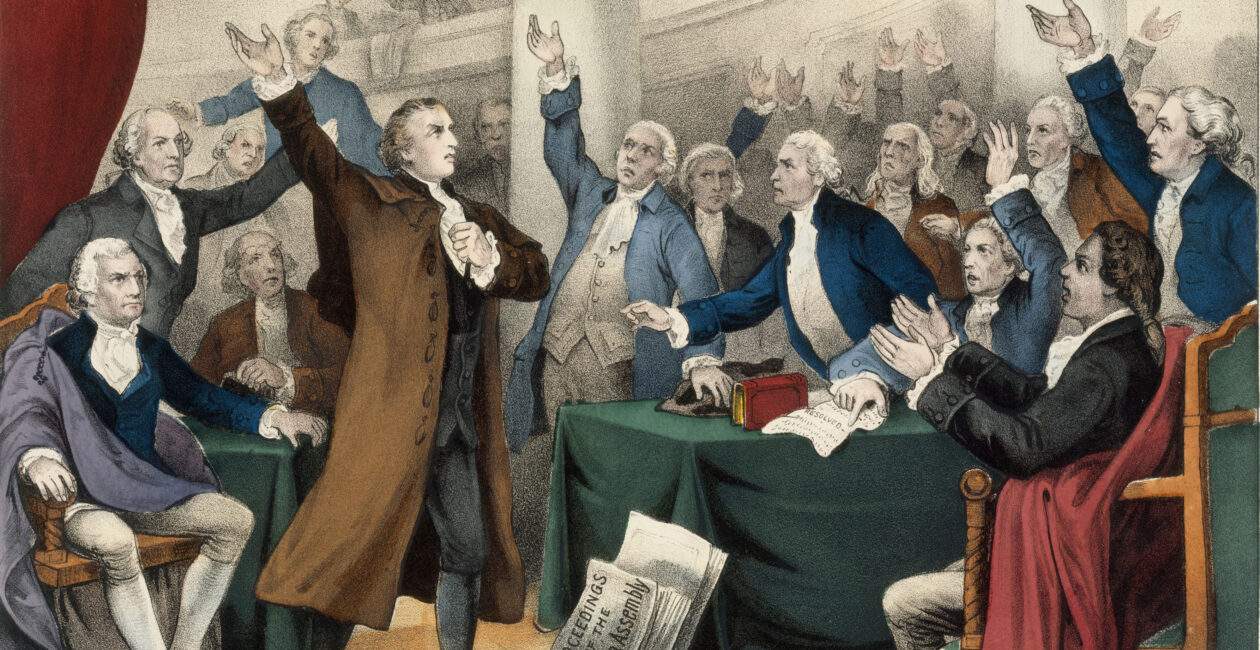
    “Give me liberty or give me death!” So proclaimed Patrick Henry in delivering his great speech on the Rights of the Colonies, before the Virginia Assembly, convened in Richmond on March 23, 1775, as re-created in this artwork by Currier and Ives. (Photo: Heritage Images/ Hulton Archive/Getty Images)

    by Joseph Postell

    Itโ€™s common for Americans on July 4th to read and discuss the Declaration of Independence, and to reflect on its principles and ideas. Those principles and ideas are often attributed solely โ€” though wrongly โ€” to Thomas Jefferson, the primary author of the draft of the Declaration.

    Jeffersonโ€™s draft was modified in two stages: first, by a โ€œCommittee of Fiveโ€ composed of Jefferson, John Adams, Benjamin Franklin, Roger Sherman, and Robert Livingston; and second, by the entire Continental Congress.

    The Congress discussed Jeffersonโ€™s draft for three days, and made significant changes (according to Jefferson, โ€œdepredationsโ€) to his work.

    In short, the Declaration was the work not of a single person, but of the representatives of the American people. Jefferson was the author of the draft, but it was an American Declaration.
    (more…)


  • Supreme Court Decision on Racial Preferences in College Recruiting Should Doom Much of DEI in State Institutions of Higher Learning

    by James C. Sherlock

    It is the day to celebrate Americaโ€™s freedoms. ย It is also a good day to enforce them.

    United States Constitution, Amendment XIV, Section 1.

    All persons born or naturalized in the United States, and subject to the jurisdiction thereof, are citizens of the United States and of the state wherein they reside.

    No state shall make or enforce any law which shall abridge the privileges or immunities of citizens of the United States; nor shall any state deprive any person of life, liberty, or property, without due process of law; nor deny to any person within its jurisdiction the equal protection of the laws.

    Supreme Court decisions in the Harvard and UNC cases make unambiguously unconstitutional many elements of the way Diversity, Equity and Inclusion (DEI) is currently implemented in colleges and universities.

    For example, clearly there is no legal space between unconstitutional processes in the recruiting of students and the same processes in the recruiting and promotion of faculty.

    None. (more…)


  • We Hold These Truths to be Self-Evident….


  • What’s Good for the Goose….

    The logical next shoe has dropped in the fight over college admissions. A civil rights organization has sued Harvard University, alleging that its practice of giving preference to legacy applicants and applicants whose parents are big donors discriminates against applicants of color. The complaint even quotes the recent Supreme Court majority opinion: “A benefit provided to some applicants but not to others necessarily advantages the former group at the expense of the latter.”


  • Culture Wars about College Admissions Tend to Ignore Guaranteed Entry from Virginia Community Colleges

    by James C. Sherlock

    Much angst has accompanied the Supreme Courtโ€™s decision banning overt racial preferences in admissions to colleges as violations of the Equal Protection Clause of the 14th Amendment to the Constitution.

    The conversations in the comments to Jim Baconโ€™s article on admissions were as split philosophically/politically as is anything else these days.

    I will not rehash them.

    But many of the comments seemed based on an unwritten assumption that a kid is blocked from higher education if not admitted into a four-year college out of high school.

    That, if true, would indeed be a cruel fate. And headline-seeking race hustlers who tell such kids they have been permanently disadvantaged would have a point.

    But such a tale is objectively and observably not true. Anyone who tells a kid that is lying, and lying unforgivably.

    There are 250,000 Virginia students who prove the story false. (more…)


  • Whites Under-Represented in UVa’s Entering Classes

    by James A. Bacon

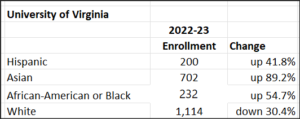
    As the debate unfolds about how to apply the U.S. Supreme Court ruling restricting the use of race as a factor in college admissions, it would be helpful for the discussion to be rooted in reality. At the University of Virginia, any dialogue should be based upon the recognition that admissions policies have transformed the racial/ethnic profile of the undergraduate student body over the past 10 years.

    According to enrollment data published by the State Council for Higher Education in Virginia (SCHEV), the racial/ethnic make-up of students entering UVa for the first time (as first-year students or community college transfers) has changed significantly between the fall of 2013-14 and the fall of 2022-23:

    Remarkably, the percentage of undergraduate White students has declined from 59.3% of the entering class at UVa to 46.9% over a single decade. Non-Hispanic Whites are now a minority. (more…)


  • A New “Landscape” for UVa Admissions

    Credit: Bing Image creator. College landscape in the style of William Constable.

    by Walter Smith

    With the recent U.S. Supreme Court restricting โ€œaffirmative actionโ€ in college and university admissions, an all-consuming question in Charlottesville is how the University of Virginia might change its policies and guidelines for admitting students.

    While prohibiting the use of race as a decisive factor in admissions, Supreme Court Justice John Roberts allowed for holistic reviews that took into account race as part of an applicant’s sum-of-life experiences. Harvard University announced it intends to drive a truck through that loophole. Likewise, UVa President Jim Ryan and Provost Ian Baucom, whoย last week proclaimed their intent to ignore the ruling as much as possible, have not only lined up a truck but are revving up the engine.

    The admissions process at UVa is opaque. The administration has refused, repeatedly, to provide me data concerning students admitted for the fall of 2023 or to answer my deep-dive questions for admissions in 2022, regarding which the Admissions Office was very cooperative… until it wasnโ€™t. In particular, the Office has not been forthcoming about its use of a tool, “Landscape,” developed by the College Board, the same people who administer the SAT exams. (more…)