
Paul Goldman in the Free Lance-Star on the Abuser Fees, which would not be levied on Virginians but not out-of-staters: “Now we have a new traffic offense called DWV: Driving While Virginian.”
-
Best Line of the Day
-
The Abuser Fee Debate: When All Else Fails, Look at the Facts
“Being for driver safety is a good thing. We need to study it in a deliberate way before we rush into it.”
So said Gov. Timothy M. Kaine during a press conference he held with senior members of the General Assembly yesterday in defense of abusive-driving fees enacted into law this year. (Read Jeff Schapiro’s account of the press conference in the Times-Dispatch.)
Yes, we can all agree that driver safety is a good thing. But where, pray tell, was the “deliberate” study? What empirical basis does Virginia’s political leadership have for stating that highly punitive fines will lead to safer roads?
It just so happens that the Virginia Crime Commission published a study earlier this year, “Effectiveness of Existing Punishments and Recommendations for Additional Remedies for Driving While Intoxicated,” that examined the effectiveness of increased punishments for driving under the influence of alcohol.
Del. David B. Albo, R-Fairfax, the leading advocate of the now-infamous Abuser Fees, introduced legislation in the 2004 session that increased penalties for DUI. Measures included (1) increased minimum sentences for second and third convictions, (2) lower blood alcohol levels to trigger mandatory minimum sentences, and (3) other penalties such as suspension of driver’s licenses, confiscation of cars and a presumption against bail under certain circumstances.
The law went into effect July 1, 2004. The study’s conclusions (my italics):
The data does show that there were fewer convictions for second and third offense drunk driving charges in 2005, as compared to 2004. Because this data reveals recidivism rates for only a one year period, it is possible that other factors are responsible for the lower numbers. Staff has concluded that it is not possible to definitively state, with methodological rigor, that the more severe punishments are causing recidivism for drunk driving to decline. Whether the lower numbers for DUI convictions will continue, or whether 2004 will come to be seen as an unusual year in which the number of DUI incidents was lower than normal, remains to be determined.
Additionally, there are many factors that contribute to the total number of DUI incidents occurring during a given year. The number of law enforcement officers assigned to patrol for drunk drivers, the number of DUI checkpoints established throughout the state, and the number of public service announcements on radio and television cautioning people to avoid drunk driving, all may impact DUI rates. The types of counseling and treatment given to people convicted of a first DUI may have even more of an impact on their future behavior than the amount of punishment they receive. Attempting to objectively discern what precise variables are having the most measurable effects on lowering DUI rates is extremely difficult.
While the initial data for the past year, with the lower DUI figures, is encouraging, it is too soon to draw any firm conclusions as to whether this is due to the changes made to the DUI statutes in 2004. Until data is available for at least four to six years, it is not possible to assess whether those changes are responsible for lowering recidivism rates. Nevertheless, the initial data is promising, and the Crime Commission intends to continue monitoring DUI rates on an annual basis to see if the downward trend continues.
That’s the only relevant report to the General Assembly that I could find in 2007 or 2006. (Someone might want to go behind me and make sure I didn’t miss something.) Fact: No one studied anything related to Abuser Fees “in a deliberate way” before passing the law. Fact: There is no empirical basis for claiming that the higher fees for traffic offenses will translate into safer roads. There are only hints, based on one year’s of data, that increased penalties might reduce recidivism for DUI, but the study insisted that the data were inconclusive and pointed to other possible causes.
If Gov. Kaine, House Speaker William J. Howell and other General Assembly leaders insist upon keeping the the fines, they should, at a minimum, do this: Fund mechanisms to measure and analyze the impact of Abuser Fees on drivers’ behavior. Let us not re-open the debate three or four years from now as ignorant of the facts as we are today!
-
Agree to Disagree
The new “Agree to Disagree” columns from Thad Williamson and some other guy are now online at Richmond.com. Our topic this month is health care reform.
Did I mention I was a high school senior in Colorado when Gov. Dick Lamm made his famous “duty to die” speech?
-
Fire Chiefs Fire Back
In two recent articles, I’ve been critical of local fire chiefs for vetoing design starndards — width of streets, turning radii of street corners — preferred by developers hewing to the New Urbanism school of design. New Urbanists like narrow streets with short turning radii, which are geared to pedestrian traffic. Fire chiefs prefer wider streets with wider turning radii that their big rigs can negotiate. (See “Design by Fire Truck” and “Fire Trucks and Bike Lanes“.)
Now Tom Owens, fire chief for the City of Fairfax and chairman of the Northern Virginia Fire Chiefs Committee, has written, asking me to tell the “other side of the story.” I think he can tell his side of the story better than I, so I will quote him in full:
I read with great interest your article “Design by Fire Truck”, in which you tied community development plans to the design of today’s contemporary firefighting apparatus. There is without question a direct correlation between the configuration of neighborhood streets and the need for safe and effective access for fire and emergency medical vehicles; however, I would encourage you to look deeper into the many other aspects related to a fire department’s strong stance on unencumbered access to neighborhoods.
The “built environment” that fire departments must cope with have changed dramatically over the years. In their legitimate quest to keep housing as affordable as possible, building materials used have become lighter weight, construction techniques have become less substantial, many neighborhoods have homes built with zero lot lines that set the stage for rapid fire spread to neighboring properties, these homes are no longer filled with ordinary wood and paper based furnishings…everything is high density plastic and foam based materials that burn rapidly and generate intense fire spread. The level of heat output experienced today results in early structural failure due to the lightweight construction mentioned
above.Fire Departments have continuously offered THE solution to the majority of these problems. Residential Fire Sprinkler Systems…..yet…..this same community of urban planners and developers resists building fire protection into these homes. They fight us in the general assembly when we propose such building code requirements and then complain when we insist on effective access into neighborhoods.
If you talk to most Fire Chiefs and Fire Marshals, they will tell you that a Fire Department is very willing to make tradeoffs to requirements IF developers will build more fire protection into these homes.
Owens raises legitimate concerns: the increased flammability of contemporary housing and the danger inherent with putting family dwellings so close together, as New Urbanists are wont to do. I’m delighted to bring those issues to light.
Following Owens’ logic, though, it sounds like a potential answer presents itself, and it’s not getting the General Assembly to mandate residential fire sprinklers. Let the marketplace decide on a case by case basis. If New Urbanist developers want pedestrian-friendly streetscapes badly enough, and if the local fire chiefs are willing to go along, let them install the residential fire sprinkler systems in exchange for the desired street standards.
-
Loving the One-Car Lifestyle
Diana Sun has seen the light. She and her husband, Bob Solymossy, used to live in a detached, single-family house with a big garage in the Oakton area of Fairfax County. Never questioning their auto-centric lifestyle, they owned three cars and took long, time-consuming commutes to work. Now they live in an Arlington County condominium and they’ve downsized their automobile fleet to a single car. They’re loving it.
As communications director for Arlington County, Diana rolled out the red carpet for me yesterday. She introduced me to Paul Ferguson, the chairman of the board of supervisors, as well as several senior planners, and she took me on an extended tour of Arlington’s revitalized neighborhoods. (I’ll have a lot to say about that in the near future.) After the work day, Diana, Bob and I strolled through the Clarendon “urban village” and enjoyed some sidewalk dining. Bursting with enthusiasm for their new way of life, they told me all about it.
When they first moved to their condo, Diana and Bob couldn’t conceive of life with fewer than two cars, so they paid to buy an extra parking space to supplement the one that came with their unit. But they hadn’t lived long in Arlington before they realized they didn’t need the second parking space — or the second car. Diana walks to work two or three blocks away. They use the Metro rail service on occasion, and they ride their bicycles a lot. On those rare occasions when they do need a second car, they pay $50 a year to sign up with Zipcar, which allows them to rent one of the cars conveniently stationed around Clarendon for $9 an hour.
The one-car lifestyle saves money. Diana recommends a book, “How to Live Well Without Owning a Car,” that cites the five-year cost of owning a Toyota Corolla as more than $5,000 a year. She spends a fraction of that on mass transit and Zipcar.
The one-car lifestyle saves time. One of Diana’s jobs in Fairfax County consumed three hours a day in the two-way commute. Now she works minutes away. She marvels at how much more time she and Bob have to doing things they enjoy.
The one-car lifestyle is good for your health. Walking and riding bicycles makes people more physically fit than sitting in automobiles. Diana and Bob are both in great shape. They have loads of energy for undertaking their long, strenuous vacations to exotic, Third World countries.
The one-car lifestyle is good for the environment. Fewer cars = less driving = less gasoline consumption = less pollution.
Indeed, Arlington’s one-car lifestyle is such an improvement over their old, Fairfax County way of life that Diana and Bob have contemplated transitioning to a zero-car lifestyle. Having at least one car does does offer significant conveniences, however, so they haven’t been willing to take that step. Yet. But they’re so enamored with their new way of life, don’t be surprised if you read in the Want Ads one day: “For lease, parking space in Clarendon condominium.”
-
We’re No. 1! We’re No. 1! (But Don’t Look Behind — The Competition is Gaining)
Forbes Magazine has once again ranked Virginia as the “best state for business,” but the business pub declares that No. 5, Washington — home to Microsoft, Amazon.com, Starbucks and Boeing — is “the big story.” Washington, whose tagline is, “Innovation is in our nature,” moved up seven notches last year.
As for Virginia, here’s what Forbes writes:
Not that Virginia did badly–it just didn’t dominate the rankings the way it did last year. The state finished in the top 10 in four of the six main categories we examined. But in 2006, it finished in the top 10 of all of them. Virginia’s top attributes include an incentive environment that is the fourth-best in the country, according to Pollina Corporate Real Estate, a commercial real estate consulting firm, as well as an unemployment rate that’s the third lowest in the nation.
(See Virginia’s category rankings here.)
There was no acknowledgment of Virginia’s diminishing lead in Gov. Timothy M. Kaine’s press release or any of the self-congratulatory quotes from leading legislators. Any state that was serious about maintaining its competitive advantage would closely examine the categories where it lost ground and figure out what to do about it. It’s always possible that the Governor and the General Assembly leadership are doing that, quietly and out of the public eye. But judging by the tenor of the press release, they’re just complacent. (Hat tip to Peter Galuszka.)
On a brighter note, we should acknowledge that Virginia does do some things right. Additional evidence comes from a press release from Attorney General Bob McDonnell’s office, who cites Virginia’s No. 2 ranking in Directorship magazine for its “business liability climate.” Says McDonnell:
“Expensive and excessive litigation leads to higher costs for consumers, less jobs for our citizens, and slowdowns in economic growth. It discourages investment and has a negative effect on the expansion of the free market. Money that Virginia companies spend fighting lawsuits is money not spent expanding facilities, conducting research, and hiring Virginia workers. This ranking is a bipartisan achievement.”
Who’s No. 1, you ask? Nebraska.
-
Coming to an Interstate Near You
 The most important change in Virginia’s transportation policy may be occurring right before our eyes, and we don’t even see it. In typical fashion, the Mainstream Media writes about the individual trees but fails to see the forest. The general public is even more myopic.
But 50 years from now, when some historian chronicles the evolution of Virginia’s transportation policy, the most significant development of the 2000s won’t be the construction of the Springfield Bypass, or the house-cleaning of VDOT finances, or even the Comprehensive Transportation Funding and Reform Act of 2007. It will be the introduction of congestion pricing to Northern Virginia’s major transportation arteries.
There is a grand strategy, and Secretary of Transportation Pierce Homer is the architect. Look at a map of Northern Virginia. There are four major transportation corridors: the Interstate 495 Beltway, Interstates 95/295, Interstate 66, and the Dulles Toll Road. As Bacon’s Rebellion intern Lyle Solla-Yates writes in “Coming to an Interstate Near You,” variable-pricing HOT lanes are planned for the Beltway and I-95/395. Limited service could begin as early as late next year.
But that’s not all. Virginia’s HOT lanes will dovetail with Beltway HOT lanes planned in Maryland. Variable pricing also could be coming to the Dulles Toll Road, and Homer confirms that congestion pricing on the I-66 corridor is in the early stages of discussion. In each case (in Virginia at least), the HOT lane projects will be financed and administered by public-private partnerships. The tolls will add new capacity, and in the case of 95/395 will support Bus Rapid Transit.
Congestion tolls are the future of transportation. They are more than a tool for financing the expansion of transportation capacity: they simultaneously modulate demand. By using the price mechanism to allocate scarce rush-hour roadway capacity, they encourage drivers to seek alternatives — shifting their commuting schedules, changing routes, telecommuting, ride sharing, taking mass transit or pursuing other options.
Virginia needs to upgrade its transportation network, but the state cannot afford to accommodate every uptick in potential demand. We need a transportation system that addresses both the supply and demand sides of the equation. HOT lanes do that, and Pierce Homer will be remembered as the man who championed them.
It’s a shame that the public understanding of Virginia’s grand strategy is so limited because important issues are going unexplored. As huge a fan as I am of congestion pricing, I do have concerns: To what extent will HOT lanes open up new frontiers for real estate development? Will they act as an accelerant to “sprawl” (scattered, disconnected, low-density development) or as a retardant? How expensive will it be to upgrade the winding country roads serving that new development, and who will pay for it? I don’t know the answers. Nobody does.
-
Every Silver Cloud Has a Dark and Gloomy Lining
Let’s see if I get this straight. From a national environmental perspective, ethanol is good: A “green” alternative to gasoline, it burns more cleanly and emits fewer pollutants, including carbon monoxide, volatile organic compounds, toxic emissions, particulates and greenhouse gases.
But from a local environmental perspective, ethanol is bad. Most ethanol is processed from corn, and corn farmers use fertilizers, and fertilizers run off farmlands and into rivers and streams. According to a new study, farmers in the Chesapeake Bay watershed will plant 500,000 acres of cornfields over the next five years.
As the Washington Post summarizes the report findings:
More cornfields could be trouble, the study warned, because corn generally requires more fertilizer than such crops as soybeans or hay. When it rains, some of this fertilizer washes downstream, and it brings such pollutants as nitrogen and phosphorus, which feed unnatural algae blooms in the bay. These algae consume the oxygen that fish, crabs and other creatures need to breathe, creating the Chesapeake’s infamous dead zones.
Governments around the bay have pledged to cut their output of nitrogen by 110 million pounds by 2010. But the study estimated that an ethanol-driven increase in cornfields could add 8 million to 16 million pounds of pollution.
Darn, environmental policy gets complicated! No matter how good an idea sounds, there are always economic or environmental trade-offs.
-
The Next Transportation Crisis
Virginia may have raised taxes and fees for transportation, and enabled its two most populated regions to raise even more, but we have not seen the end of travails for the state’s outmoded transportation financing model. In “The Next Transportation Crisis,” I outline how two developments will conspire to shrink federal transportation revenues paid to Virginia in coming years.
First, beginning in 2010, the federal highway trust fund won’t have as much money to give to the states. Congress goosed spending during the current six-year authorization period by telling the Department of Transportation to draw down the cash balance in the highway trust fund ($13 billion in 2004). That provides billions of dollars a year extra to spread around, but when the money runs out, it runs out. Worse, when there’s no cash balance in the till, DOT won’t be able to smooth out payments to the states — it will be forced to a pay-as-you-go system for dispursing funds, which could cause cash-management issues.
That brings us to the second problem: Federal receipts from the gasoline tax, which increased at 2.7 percent annual clip for more than two decades, actually showed a year-to-year decline in the early months of 2007. People are driving less. The downturn in vehicle miles driven may be temporary, but a case can be made that driving is entering a slower growth curve.
Meanwhile, a primary thrust of both the Bush adminstration and the Congress — one of the few things they can agree upon — is the necessity of cutting gasoline consumption. Over the long run, we will see motorists shift to vehicles that use less gasoline, or none at all. This, too, will cut into gasoline tax receipts.
The Virginia Department of Transportation is well aware of the impending downturn in aid from the federal government, so we shouldn’t be caught flat-footed when it happens. Even so, VDOT’s six-year transportation plan is built upon the assumption that gasoline receipts will continue to rise at the modest rate of one percent annually. That assumption is looking increasingly precarious.
It’s only a matter of time before Virginia’s pols come back wanting more money. Once again, we are reminded of the necessity to put our transportation system on a user-pays system relying upon congestion fees and a road-maintenance fee based on vehicle miles driven.
-
FOIA Fiddle-Faddle
While I’m promoting the musings of regular Bacon’s Rebellion readers (see previous post), I dare not forget the column authored by Becky Dale: “FOIA Fiddle-Faddle.” Becky is devotee of Virginia’s Freedom of Information Act and she keeps everyone, including the Attorney General and the Virginia Freedom of Information Advisory Council on a short leash.
This week’s topic: should the student senates and other student organizations of public universities be subject to FOIA? Becky concludes, “no,” but she would urge them to voluntarily hold open meetings and take minutes, which are good habits of governance.
-
Economic Development and Broadband Connectivity
 In February, Bacon’s Rebellion published a column, “Reforming Regional Government,” by Reid Greenmun, a regular contributor to the comments section of the blog. I did not give his column the build-up it deserved. But I won’t make the same mistake with our second contribution from a regular reader.The blogger who goes by the name of Groveton has penned a piece, “The Commonwealth is Flat,” which explores two interconnected ideas: (1) that the potential exists to “outsource” jobs from growth-choked Northern Virginia to downstate communities, and (2) that a prerequisite to the first goal is lacing the Commonwealth with better broadband connections. Groveton is the chief technology officer of a major Northern Virginia technology services firm, so he knows of what he speaks.The first idea is not entirely novel. A string of Virginia governors has endeavored to interest Northern Virginia’s dynamic tech community in investing downstate, particularly in depressed regions like Southside and Southwest Virginia. Delegations of Northern Virginia luminaries have made the trek to Blacksburg, Abingdon and Danville to see for themselves that downstate is not a total technology wasteland. The Virginia Business Pipeline periodically hosts gatherings to introduce NoVa-ites and Downstaters in similar business fields. Outside of the outsourced state IT facility in Lebanon, however, the yield has been disappointingly small.In what may be the most telling passage of the piece, Groveton suggests that downstate economic developers may not be trying hard enough.
Someone has to organize the people who want to be employed (at a distance) and then sell their services to potential employers. That’s just not happening in Virginia.
I have worked in one or another of those nameless, faceless office buildings in D.C. or Northern Virginia for the last 26 years. Since 2000 or so I have been deluged by people asking me why I don’t outsource some of our work to them. These salesmen come from India, China, Texas, Israel, Oregon, the Czech Republic, the Slovak Republic, Russia, Belarus, Vietnam, Canada and countless other countries and U.S. states. They talk about the energy and the skill of their citizens, their lower wages (and therefore prices), their fluency in English, the stability of their currency relative to the dollar and they talk about their networks, always the networks. They tell me that they will create our PowerPoints, do our secretarial work, test the systems we write, develop the systems we design, read our X-Rays if we’re sick and answer our phones when we’re away.
Through all those years and through all those meetings I have never been approached by a single person from any Virginia jurisdiction with any outsourcing offer. Not one person.
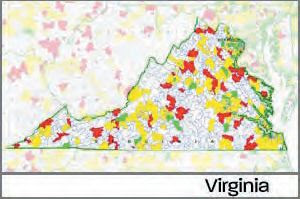
Regarding the second key point Groveton raises, Virginians are kidding themselves if they think they have a world-class telecommunications infrastructure. According to the Speed Matters website, Virginia has only the 11th best broadband connections among the 50 states and D.C. According to the Organization for Economic Cooperation and Development, the United States ranked only 15th among the countries of the world for broadband connectivity. Even more discouraging, the U.S. is falling further behind: The OECD ranked the U.S. 21st in the rate it was increasing connectivity.Gov. Timothy M. Kaine’s newly appointed “Broadband Roundtable,” to be chaired by former Gov. Mark R. Warner, is a positive step, writes Groveton, but way overdue.Image credit: Speed Matters, page 52 in the PDF file. Green shows areas where median download speeds exceed 6 megabits per second. Yellow is between 768 kilobits to 6 megabits, and red is less than 768 kilobits. The median download speed in Japan is 61 megabits per second!)
-
Bringing Light to a World in Darkness
The July 16, 2007, edition of Bacon’s Rebellion is now online, once again inflicting reason upon the irrational, logic upon the illogical, and facts upon the uninformed. To view the edition, click here. To make get a free subscription and ensure you never miss a future issue, click here.
This week’s commentary includes:
The Next Transportation Crisis
The federal highway trust fund has blown through its cash balance, and gasoline tax receipts are down. In the years ahead Virginia will be hard pressed to make up the difference.
by James A. BaconAll in a Night’s Work
The Northern Virginia Transportation Authority is gaining respect with its business-like approach.
by Doug KoelemayHow About Sustainable Logic?
In the community of people who think seriously about economic development and the natural environment, “sustainable” has a specific meaning. In Virginia, that meaning has been corrupted by loose usage.
by EM RisseRecreo Lectio!
The Harry Potter books have done what a nation of parents backed by an army of educators could not do: Inspire a revival of reading among young children.
by Chris Braunlich
A String of Fish
An assortment of political observations as varied as catfish and trout, bass and shad…
by James Atticus BowdenThe Politician Surplus
George Allen, Mark Warner and possibly even Jim Gilmore could be eyeing a race for governor in 2009. Virginians would be better off with fresh faces and fresh ideas.
By Norman Leahy
FOIA Fiddle-Faddle
Not all publicly funded organizations are public bodies. Student governments should not be subject to the Freedom of Information Act — but they should practice good government.
by Becky Dale
The Tax Increase That Dares Not Speak Its Name
Abuser fees are needlessly harsh and will be applied inequitably — all because the General Assembly wanted to raise revenue without calling it a tax increase.
by Publius IIThe Commonwealth is Flat
Northern Virginia has more work than it can handle, and it makes sense to “outsource” jobs to downstate communities. But someone has to build the broadband connections first.
by GrovetonThe Unfair Service Fund
Proposed changes to the federal Universal Service Fund would limit wireless investment in rural Virginia, slowing the deployment of critical broadband access.
by John E. RooneyHalfway to Healthy
The condition of the James River has improved in recent years, but polluted runoff from farms and asphalt threaten the historic waterway’s continued recovery.
by Bill StreetNice & Curious Questions
Crossing State Lines: Virginia’s Neighbors
by Edwin S. Clay III and Patricia BangsRoad to Ruin: Coming to an Interstate Near You
Congestion pricing is coming to Northern Virginia, promising to help with otherwise intractable traffic problems.
by Lyle Solla-Yates
-
A New Dominion Virginia Power? Or Just a Repackaged One?
Dominion, Virginia’s leading electric power company, has launched a major energy conservation initiative designed to dampen consumer demand for electricity. The program complements an commitment, including a major investment in wind power, to generate 12 percent of its electricity from renewable sources by 2022. Stated CEO Thomas Farrell in a Friday press release:
Virginia’s need for electricity is burgeoning. The projected additional demand for power in Virginia in the next 10 years is 4,000 megawatts, or the equivalent electricity to power 1 million new homes.
The only way to meet that demand effectively is through a combination of energy conservation, efficiency and peak-load management along with a systematic program to add new generation facilities. This approach will provide our customers with a balanced and flexible portfolio of reliable, cost-effective energy.
Elements of the program include:
- Load management. Dominion will test programs to encourage customers to reduce electricity consumption during periods of peak demand such as during extreme winter and summer temperatures. Pilot programs include residential and commercial energy audits, an air-conditioning control program, “smart-metering” technologies, and critical peak-pricing plans to help customers shift energy usage to off-peak times.
- Energy Star. Dominion will promote the purchase and use of energy-efficient appliances, energy-efficient building practices for new homes, and energy-efficient improvements for existing homes. The company also will collaborate with retailers to make efficient compact fluorescent light (CFL) bulbs available to customers at a discount.
- Technology. Dominion will accelerate the development of new fuel cell technology through an investment in the Microcell Corp. of Raleigh, N.C. Microcell’s proton exchange membrane (PEM) micro fiber fuel cells have applications in electric vehicles and in distributed generation devices. The power company also will support the Dynamic Energy Management initiative of the Electric Power Research Institute.
There’s more, but those are the highlights. Skeptics will denounce these measures as insincere or insufficient. I regard the initiative as a positive development. Regardless, proof will come not from a press release but from real-world behavior. How vigorously will Dominion, which makes its money selling electricity, follow through on measures to curb those sales?
The timing of the announcement is hardly coincidental. The State Corporation Commission is holding proceedings to determine if a legislative goal of 10 percent savings in electricity consumption through conservation by 2020 can be achieved cost effectively. Here is the question: Is that goal aggressive enough? Should the SCC expect more of Dominion and Virginia’s other power companies?
-
End Women’s Suffrage!
This YouTube video shows a couple of wisenheimers at Chantilly High School passing around a petition to “end women’s suffrage.” Such is the ignorance of history in Virginia, like the rest of America, that the jokesters had no trouble finding young women to fill up the petition page.Chantilly was listed in Newsweek in 2004 as the 94th top public high school in America. Presumably, that makes it one of the very best in Virginia.
(Hat tip: Joe West.)
-
An Important Part of the Political Dialogue
The Daily Press and the Virginian-Pilot covered the Blogs United conference that I missed because I can’t keep my schedule straight. I’m still kicking myself. As reported by the DP’s Kimball Payne, here’s the money quote from Del. Brian Moran, D-Alexandria:
[Moran] told bloggers that they have morphed from a fringe group into an important part of the political dialogue – especially for elected officials looking for instant, unfiltered feedback. “It’s an exciting phenomenon. … Politicians who ignore it do so at their own peril.”




