• Now For Something a Little Left of Center

    Just to show what a broad-minded guy I am, I’m going out of my way today to promote a column that skewers Bacon’s Rebellion. Peter Galuszka, a regular contributor to our Road to Ruin transportation news coverage, criticizes blogs generally, tossing a few barbs Bacon’s Rebellion’s way, in his opinion piece this week, “Plato’s Cave.”

    Peter objects to the triumphalism that blogs display regarding the slow-motion demise of the “Mainstream Media.” His main point is undeniable: Traditional media such as newspapers, magazines and television provide the news content that blogs feed off. Few blogs conduct much first-hand reporting. Without the Mainstream Media, bloggers would have little to comment upon.

    The decline in journalistic coverage is especially marked overseas — foreign correspondents are being laid off in droves. That’s of particular concern to Peter, who ran the Moscow bureau for BusinessWeek during the transition between Gorbachev and Yeltsin. Americans are ignorant enough of foreign politics, economics and culture as it is, he argues, and the situation will likely get worse.

    (Peter doesn’t care for xenophobia either, a tendency he sees in the reaction of many Virginians to illegal immigration and explores in a previous column, “Virginia Is for Gulags.” He also gets pieved when I use the term “Euro-weenies.” He probably won’t like it when I refer to him as a “Euroweeniephile.”)

    If you’d like to see more left-of-center commentary in the Bacon’s Rebellion e-zine, give Peter some positive reinforcement in the comments section.


  • Raise Them Pitchforks High! The Rebellion is Back!

    Bacon’s Rebellion’s rebels are back, branding their metaphorical pitchforks and gesticulating alarmingly! You can read the Oct. 15, 2007 edition here. The website contains archives of five years’ worth of back columns, profiles of our contributors, and a search tool.

    Make sure you don’t miss an issue of our in-depth columns and articles — sign up for a free subscription here.

    If you’re too darned lazy to click over to the website, well, we still aim to please. Here are today’s featured columns:

    Taxes, Government and Prosperity
    Virginia can’t tax its way to prosperity, but starving critical assets like roads and schools won’t create wealth either. The solution: Demand productivity and innovation from state and municipal government.
    by James A. Bacon

    A Bottle of Exhaust
    An innovative Virginia could use a state R&D tax credit and a global view.
    by Doug Koelemay

    Tulips and the Maritime Highway
    Moving goods on water rather than roads can be a good thing, but it’s only a tiny part of the solution. Creating a sustainable trajectory for civilization requires shipping goods shorter distances.
    by EM Risse

    There They Go Again
    The Fairfax County staff used every trick in the book rebutting the Thomas Jefferson Institute’s analysis of the county budget, but there’s no hiding the fact that spending needs outside oversight.
    by Michael Thompson

    Election Pre-Mortem
    It’s looking grim for General Assembly Republicans in this November’s election. Here’s why they’re likely to lose — and how losing can be the best thing that happens to them.
    by Norm Leahy

    Plato’s Cave
    Some may rejoice at the decline of the “Mainstream Media” but cuts in news staffs threaten to leave us ill informed about what’s happening around the world. No number of blogs can make up for it.
    by Peter Galuszka

    Nice & Curious Questions
    Anglers in Virginia: From Roanoke Bass to Green Sunfish
    by Edwin S. Clay III and Patricia Bangs


  • Metro Needs to Come Clean on Deferred Maintenance

    How much does the Washington Metro system spend on maintenance, how much maintenance is it deferring, and how big are the liabilities that are accumulating? If Metro officials know the answers, they aren’t saying.

    According to Examiner.com, Metro budget director Richard Harcum noted back in 2004 on the Metro Matters website that the transit agencyโ€™s annual maintenance budget was only one percent of the total value of the infrastructure, instead of the three percent needed to keep the system in tip-top shape. Writes Examiner.com: “How long maintenance has been seriously underfunded is anybodyโ€™s guess.”

    Harcum’s comment prompted Fairfax County taxpayer gadfly Arthur Purves to ask for the cumulative cost of Metro’s deferred maintenance, which he speculates is on the order of $5 billion — comparable to the cost of building the proposed Rail to Dulles extension. Despited repeated requests for information, Purves has yet to receive an answer.

    Virginians are being asked to raise $5 billion (including federal funds) to build the Metro extension through the Dulles Corridor. We need to know what we’re getting into. With more miles of track, it stands to reason that we’ll be taking on a larger share of the cost of maintaining the system. The true cost of the Rail to Dulles project entails more than the up-front capital cost of construction: It includes ongoing obligations for operations and maintenance. We need to know what those obligations will be.

    If Purves is anywhere in the ballpark and deferred maintenance for Metro approaches $5 billion, what’s Virginia’s share under current funding agreements? And how much will Virginia’s share increase if Rail to Dulles gets built? Does anybody know? Does anybody besides Purves, Examiner.com and Bacon’s Rebellion care?


  • THIS JUST IN

    The United States Supreme Court by a vote of 6 to 3 has overturned the decision of the Norwegian Nobel Committee and awarded the 2007 Peace Prize to George W. Bush and the US of A Environmental Protection Agency (EPA). The Courts decision turned on the fact that Bushโ€™s calling and performing at the September climate change “Summit” together with EPA granting exceptions and waivers for coal fired Big Grid power plants has done more to energize citizens concerning Global Climate Change than any slideshow, book or world-wide research report could accomplish.

    On a related note: the Nobel Committeesโ€™ attempt to further raise the profile of Al Gore after he had already won an Academy Award and an Emmy demonstrates how the massive hurdle to overcome Business-As-Usualโ€™s media campaign to obfuscate the real causes for concern about the trajectory of contemporary civilization. The success of the MainStream Media efforts sponsored by supporters of Mass OverConsumption is documented by the September 2007 WaPo-ABC News poll that found less than one percent of US of A voters thought Global Climate Change was an important issue for the 2008 presidential election.

    In our column tomorrow at Baconโ€™s Rebellion (“Tulips and the Maritime Highway”), we list 18 (there are more) reasons why Fundamental Change in human settlement pattern, Fundamental Change in governance structure and the overarching need for Intelligent Management of Civilization are imperative. Global Climate Change is only one of the 18 key issues. As Jim Bacon likes to point out, there are far better reasons to be concerned about the reported causes and effects of Global Climate Change than the oft oversold direct impacts.

    EMR


  • Virginia’s Native Wildlife in Jeopardy

    While Virginians get increasingly worked up over the impact of Global Warming on Virginia’s climate and coastlines some 70 to 80 years from now, cricical environmental problems demand our attention right now.

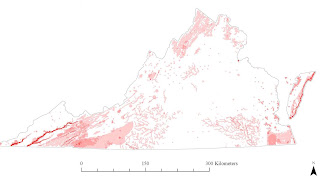
    The Virginia Department of Inland Game and Fisheries has published the State Wildlife Action Plan, the most comprehensive investigation into the status of Virginia wildlife ever conducted. The encyclopedic, 900-page plan assigns 925 species of mammals, fish, birds, amphibeans, reptiles and other creatures to one of four tiers of conservation need — critical, very high, high and moderate — and maps the locations of their habitats.

    The plan, the culmination of a Warner administration initative, identifies two major threats to native Virginia species, as well as several deficiencies in wildlife conservation programs. The threats are:

    Unprecedented fragmentation and development of habitat. This is one of the most frequently identified problems facing wildlife. To address it, those responsible for land planning will need to be more fully engaged in wildlife conservation efforts.

    Invasive exotic plants and animals negatively impacting native wildlife and habitats. Even though they are already widespread, the prevalence of invasive species is increasing in both aquatic and terrestrial communities. From exotic common reed (Phragmites) in coastal marshes to crayfish introduced through the bait trade, this is a crucial statewide conservation issue.

    You see, folks, we don’t have to wait for global warming to witness the widespread extinction of native species. Five species of mammals, 15 of birds, 11 of fish and countless more are designated Tier I, facing “an extremely high risk of extinction or extirpation.”

    So, what can we do? Combatting invasive species is incredibly difficult — foreign marauders don’t respect state lines. The challenge of invasive species can be addressed systematically only at the level of the federal government. On the other hand, Virginia can do a lot to preserve wildlife habitat.

    And that raises an interesting issue — the prioritization of Virginia’s conservation easement tax credits. Demand for the tax credits has taken off, but for reasons of fiscal prudence the General Assembly has clamped a lid of $100 million a year upon the program. I’m not sure what the criteria are now for awarding the credits, whether applicants join a queue and wait their turn, or whether some other factors come into play. But it strikes me that not all conservation easements are created equal. Easements that preserve vital wildlife habitat, I would suggest, should have a higher priority over easements that preserve significant viewsheds, which should have priority over easements that preserve some random property owner’s farm land.

    Inland Game and Fisheries has published a map (see above — click on the image for greater detail) that shows where the most critical habitat is located. If Virginia is going to expend $100 million a year in tax credits, some portion of that sum should be used to secure the habitat of Virginia’s threatened species. The greater the threat to the species, the higher the priority for habitat conservation.

    Additionally — and this was a major point raised during a meeting in Prince William County I attended recently on the topic of land conservation — local governments should integrate the Inland Game and Fisheries data into their comprehensive plans. We know where the threatened species live now. There is no excuse for waiting until a developer blunders upon a piece of critical habitat to do something about it.

    Finally, Virginia needs to look at the full panoply of its land management practices. States the report:

    Pollution, sedimentation, and nutrient overloads are causing changes in water quality that negatively impact aquatic wildlife and habitats. Such aquatic degradation is caused mainly by certain agricultural and forestry practices, industrial and municipal development, and certain industrial practices, such as mining. Rivers in southwestern Virginia experienced degradation from certain mining practices, certain agricultural practices, and creation of downstream dams.

    Virginia’s wildlife constitute one of the state’s most precious and irreplaceable assets. This superb study gives us a powerful tool to conserve this heritage. The Department of Game and Inland Fisheries deserves praise for a job well done.


  • CNU Takes Virginia’s Public Pulse

    Education, health care, illegal immigration and crime are the areas that Virginians would most like to see the General Assembly address in the 2008 session, according to a new omnibus poll conducted by Christopher Newport University. Picking from a list of pre-defined topics, respondants ranked the issues as follows (by the percentage who identified it as the No. 1 or No. 2 priority):

    Public Education (40)
    Health Care (29)
    Illegal Immigrants (25 )
    Crime (25)
    Jobs (18)
    Property Taxes (14)
    Higher Education (16)
    Veterans (12)
    Abortion (7)
    Virginia Tech Mental Health Recommendations (6)

    The poll also identified a high level of discontent in Hampton Roads over taxes — 62 percent believe that “Virginia’s overall level of state taxes” is too high, and 72 percent believe that property taxes are too high. Northern Virginians were the most complacent about their tax level. If these poll results are any indication, Republican candidates running on tax-cutting platforms should enjoy a significant advantage in Hampton Roads but find their appeals falling flat in Northern Virginia.

    In dealing with the current budget shortall, 58 percent of Virginians supported holding the line on taxes, differing mainly on where to cut spending. Remarkably, 37 percent of the population appears to be believe, even after two rounds of tax increases since 2004, that Virginians aren’t taxed enough.

    P.S. Notice what’s not on the list? Transportation. Refreshing, huh?


  • AREVA Ponders Monster Investment in Lynchburg

    The rising price of uranium may lead to more than a renewed interest in mining North America’s richest uranium reserves in Pittsylvania County. AREVA, the French nuclear power giant, is “talking with Virginia officials” about a location for the uranium enrichment plant, according to the Danville Register & Bee. And Lynchburg is at the top of the list.

    According to a “Walter Cole,” identified only as a resident of Chatham, โ€œAREVA has visited Virginia and theyโ€™re interested in building an enrichment plant, and it would be the second one in the United States, and itโ€™d cost $2 billion to $3 billion.โ€ Not only is Lynchburg located just up U.S. 29 from the Chatham uranium deposits, AREVA’s Framatome ANP already fabricates nuclear fuel rods there.

    This story is huge: It’s looking increasingly likely that nuclear power will become the catalyst for the economic revitalization of Central/Southside Virginia, a region whose traditional mill-town economy has been devastated by globalization and the decline of the tobacco/cigarette industry. (See “Virginia: A World-Class Player in Nuclear Power?”) Let’s hear it for nuclear power, electric cars, energy independence and a reduction in fossil fuel pollution!


  • Divest Iran? Ehhhh, Maybe. But Maybe Not

    California Gov. Arnold Schwarzenegger has signed a bill that would require the state’s public retirement pension fund to divest itself of holdings in foreign companies that invest in Iran. Said the Governator shortly before signing: “California has a long history of leadership and doing what’s right with our investment portfolio. Last year, I was proud to sign legislation to divest from the Sudan to take a powerful stand against genocide. I look forward to signing legislation to divest from Iran to take an equally powerful stand against terrorism.”

    While the Iranian regime arms Iraqi militias with deadly roadside bonds and ships weapons to the Taliban in Afghanistan, argues Christopher Holton, director of the “Divest Terror” initiative at Center for Security Policy, it makes no sense for an American to invest in companies that do business with Iran.

    Which brings us to the question, well, what’s happening in Virginia? According to “The Terrorism Investments of the 50 States,” the Virginia Retirement System has invested $4.3 billion of its $24.7 billion in equity assets in some 213 companies with ties to terrorist-sponsored states. The largest exposure was Iran, with 154 companies. Other such states, according to this 2004 document, which is based on 2003-2004 data, included Sudan, Libya, North Korea, Syria and “Saddam’s Iraq.”

    Sample holdings included Alcatel SA (French), BNP Paribas (French), ENI (Italian), Hyundai Heavy Industries (Korean) and Total SA (French). Companies with terror ties contituted more than 17 percent of the VRS equity portfolio.

    This January, Sen. Ken Cuccinelli, R-Fairfax, sponsored legislation that would have required VRS to divest itself of companies with active business operations in the Sudan, on the grounds that they directly or indirectly enabled the genocide in Darfur. As I interpret the General Assembly bill tracking, the House and Senate passed separate bills but conferees could not reconcile the two versions. No one, to my understanding, has yet proposed ordering the VRS to divest itself of companies doing business in Iran.

    I’m of mixed minds on whether Virginia should follow in California’s footsteps. On the one hand, I approve of any measure designed to punish Iran economically. Not only is the Mullahcracy killing American soldiers, it is developing nuclear weapons and the means to deliver them long distances, oppressing its people and exporting instability to neighboring states like Azerbainjan. Furthermore, economic sanctions would have an effect. More moderate elements of the regime (if you can call them “moderate,” perhaps it would be better to say, “less odious”) want to dial back tensions with the United States and other western countries on the very grounds that its confrontational diplomacy is isolating the country.

    On the other hand, I am reluctant to set a precedent for requiring the VRS to pursue socially conscious investing. Today the Sudan and Darfur, tomorrow Iran. What’s next? Divest companies that do business with Israel, as some leftist groups are agitating for? Divest from companies that pollute? Divest from companies that fail to pay a “living wage?” Divest from companies that peddle alcohol, smut and rap lyrics? At some point, you’ve narrowed the field so much that the VRS has very few companies to choose from. Then investment returns suffer — and taxpayers are on the hook to make up the difference.


  • Good, We’ve Got the Metrics, Now Give Us the Numbers.

    Gov. Timothy M. Kaine’s “Transportation Accountability Commission” has issued its final report, detailing 34 performance measures to rate the effectiveness of Virginia’s transportation system. The measures cover such topics as safety, maintenance, mobility, environmental stewardship, economic vitality, program delivery, and coordination of transportation and land use.

    Compiling metrics won’t patch potholes or build new roads. But they may help guide Virginia policy makers in their decision making. Without answers to basic questions — are roads getting safer or deadlier? Is congestion getting worse or better? Are we catching up on our maintenance backlog or losing ground? Are people driving more or less? — we are fumbling in the dark.

    As Commission Chairman James A. Squires said in a press release: โ€œA set of overarching goals and performance measures … are critical to a transportation program that not only delivers high-quality projects, but the right projects.โ€

    There isn’t anything earth-shaking in the report, but the effort was worthwhile. My only frustration: While the report recommends a set of metrics, it doesn’t provide the actual numbers. At some point, someone will have to gather and format the data. When that happens, I’ll report back to you on this blog.


  • Putting the Squeeze on State Travel Expenses

    Good things are happening behind the scenes in state government. Operational review teams, chaired by members of the General Assembly and staffed by area experts in the Kaine administration, are focusing on ways to cut operational expenses of state government. These teams report to an Operational Review Oversight Committee comprised of Del. Christopher B. Saxman, R-Staunton, Sen. Emmett W. Hanger, Jr., R-Augusta, and Secretary of Finance Jody M. Wagner.

    One of the committee’s latest initiatives is scrutinizing state travel expenses (including those of state colleges and universities), which amounted to nearly $1 billion over the past four and a half years. After extensive consultation to review the practices of industry leaders, the travel team issued the following recommendations:

    • Automate the travel reimbursement process
    • Expand the use of computer-based training modules for state employees
    • Increase the use of teleconferencing for training
    • Establish stricter limits on conference travel
    • Implement a statewide travel contract to leverage state buying power

    Read the full report here.

    What’s encouraging about this approach is that it isn’t arbitrary and capricious — no 10-percent-across-the-board cuts, regardless of the consequences. The participants are looking for ways to do the business of government more efficiently. It’s also nice to know that there is a limit to partisan politics. When it comes to efficiency in government at least, some Democrats and Republicans are willing to put the public interest first.


  • Who Is Ethically Challenged Here?

    What is it the Mainstream Media says about bloggers — they’re not journalists, they’re careless with the facts? They don’t live up to journalism’s high ethical standards? Hmmm. An interesting case study sheds some light on MSM posturing.

    Read what Washington Post reporter Sandhya Somashekhar wrote Oct. 10:

    A state Senate candidate in Virginia has been improperly receiving a tax break on a home she owns in Northwest Washington, according to D.C. land records and interviews with city officials.

    Since 2005, city records show Jill Holtzman Vogel (R) and her husband have received a homestead deduction on the property taxes they pay on a condominium they own near Washington Circle. To get the $60,000 annual deduction, the owner must declare the home as their primary residence.

    The Post ran the story even though Vogel and her husband denied having any knowledge of the tax break and openly acknowledged that they did not live in the District. Somashekhar added an extra dig, describing Vogel as “an attorney who specializes in ‘ethics, campaign finance and tax exempt organizations,’ according to the Warrenton firm’s Web site.”

    Here’s the follow up story posted the next day:

    D.C. tax officials said yesterday that it was their fault that a state Senate candidate from Virginia got an improper tax break on her Washington Circle condominium.

    The candidate, Jill Holtzman Vogel (R), and her husband never applied for the city’s homestead deduction, said Natalie Wilson, a spokeswoman for the Office of Tax and Revenue.

    Note how the article blames the D.C. officials for the error, taking no responsibility for running the story before checking out all the facts.

    (Hat tip to Joe West.)


  • Lawsuit Filed Against Prince William Seeking Recission of Immigration Resolution

    Today saw the filing of the first of what will likely be many lawsuits challenging poorly conceived and largely unconstitutional local and state immigration policies being urged on cowed politicians by an increasingly vehement minority whose demands will impose significant legal and other costs on their fellow citizens without meaningful corresponding benefit.

    Here’s the press release describing today’s actions:

    Latinos in Prince William County and the Woodbridge Workers’ Committee filed a lawsuit against Prince William County, its Board of Supervisors, the County Executive and the Police Chief seeking declaratory and injunctive relief to halt its implementation and enforcement of its recently passed anti- immigrant resolution, Resolution 07-609.

    The lawsuit was filed by the Puerto Rican Legal Defense and Education Fund (PRLDEF), Howrey LLP, and the Washington Lawyers’ Committee for Civil Rights and Urban Affairs.

    On July 10, 2007, the Prince William County Board of Supervisors passed Resolution 07-609 which grants local police broad authority to inquire into the immigration status of individuals, authorizes county-level employees to gather, maintain and share information regarding the immigration status of individuals seeking public
    benefits, and may limit county services that immigrants receive.

    The lawsuit, filed today in the United States District Court for the Eastern District of Virginia, claims violations of the U.S. Constitution, federal statutes, and the laws of Virginia and requests declaratory and injunctive relief to halt its implementation and enforcement. The complaint was brought on behalf of 16 individuals and their minor children as well as the Woodbridge Workers’ Committee. The complaint alleges that the Resolution is an unconstitutional attempt to circumvent the federal government’s authority to regulate immigration and that it enacts a discriminatory scheme in violation of the Equal Protection Clause to the United States Constitution.

    “This ordinance, which expresses the worst instincts of a few in the county, is destroying the basic fabric of community life,” said Cesar Perales, PRLDEF President and General Counsel. “Latino children should be taught to trust police. Not to fear they might take their parents away.”

    Howrey LLP is one of Washington, DC’s top firms noted for its strong litigation practice. Partners John Nields, former President of the DC Bar and Christina Guerola Sarchio, incoming Vice President for External Affairs of the Hispanic National Bar Association and immediate Past President of the DC Hispanic Bar, will lead the effort.

    Commenting on the case, Sarchio said, “the governing body of Prince William County has taken it upon itself to devise a way to handle immigrants in their community in a way that goes against the U.S. Constitution and federal law. It infringes upon Congress’ power to regulate immigration, a power unquestionably reserved to the Federal government. Putting aside the fact that all of our ancestors were immigrants at one point, the action the PWC Board of Supervisors has taken here is discriminatory and illegal.”

    “This Resolution demonstrates a disturbing animus toward immigrants that contradicts what America is, a nation of immigrants,,” said Laura E. Varela, Director of the Immigrant and Refugee Rights Project at the Washington Lawyers’ Committee for Civil Rights and Urban Affairs. “The Resolution promotes racial profiling and is causing a great deal of fear and unrest among both U.S. citizens and immigrant residents who live in Prince William County.”

    The Washington Lawyers’ Committee, which joins Howrey in the suit, has for more than 35 years provided legal services to address issues of discrimination in the areas of equal employment, fair housing, public accommodations, public education, asylum and refugee rights, and disability rights. The Committee often teams with Howrey on community matters.

    PRLDEF has previously brought legal challenges to such legislative acts and ordinances based on violations of the U.S. Constitution’s Supremacy Clause, the Due Process and Equal Protection Clauses of the Fourteenth Amendment, and, long-standing federal preemption principles.

    Almost every lawsuit brought to date challenging such local ordinances and resolutions has ended in a decision against the locality (or a settlement) that cost tax payers substantial sums in legal fees.

    All of these localities,including Prince William, would have done better to put money spent on lawyers into lobbying Congress for meaningful immigration reform and hiring additional staff to increase code enforcement for housing violations, increase culturally competent community policing and other actions designed actually to address the problems identified by some of their local citizens as adversely affecting their quality of life.

    Instead, they’ve embarked on a course which is nothing more than a lawyers’ full employment policy and a prescription for community division that has done little more than earn them a reputation for ethnic hostility that will haunt them for decades to come in our increasingly diverse 21st century America.


  • Watch Out for the “Fully Funding Our Schools” Ploy

    The debate over this year’s $641 budget shortfall may be a mere prelude to a bigger budget wrangle next year over education spending. Timothy M. Kaine has stumped all over the state for a modest expansion of pre-K programs in Virginia, but that’s chump change compared to the real driver of educational spending: the Standards of Quality.

    Hints of the debate to come can be gleaned from a recent letter from House Minority Leader Ward Armstrong, D-Martinsville, to House Speaker William J. Howell.

    “Next year,” Armstrong wrote, “we will have to re-benchmark the Standards of Quality to ensure that our primary and secondary schools remain fully funded. Prominent members of your caucus have said they are opposed to the re-benchmarking of the SOQs, which would significantly jeopardize our schools and childrens’ future.”

    Later in the letter, he wrote: “I am asking that you pledge that we do not shortchange our children’s future by cutting primary and secondary education and that we will fully fund our schools.”

    Refresher course: The SOQs, or standards of quality, are the auto-pilot mechanism by which the standards for educational inputs (student-teacher ratios, number of guidance counselors, that sort of thing) are relentlessly ratcheted higher, and also by which $5.8 billion in state aid to K-12 education program is used to redistribute wealth from Virginia’s wealthy municipalities to its poorer municipalities. (See my treatment of this cost driver in “The ABCs of SOQs.”

    Each “re-benchmarking” according to the dictates of an all-but-indecipherable formula raises the mandated level of funding by hundreds of millions of dollars. Supporters of the educational status quo run around squealing that schools aren’t “fully funded” and that “the children” are being short-changed, creating political pressure for ever-higher, and utterly unaccountable spending.

    Any increase in K-12 funding next year should be tied to a reform of the funding system. Lil Tuttle with the Clare Boothe Luce Policy Institute, has argued for a new, transparent formula for allocating state aid to public education. The state would provide one “Student Funding Allotment” (SFA) for each student, weighting the allotments for special needs, as follows:

    1.9 SFA for severely disabled
    1.2 SFA for poverty
    1.2 for limited English
    1.2 for learning disabled

    Such a system would help local school systems cope with lots of poor, disabled and foreign-language kids without the auto-escalator effect of the current formula. What’s more, it’s so transparent that anyone can understand it. That’s precisely why the political class will never change the formula. But it’s nice to know that some one in the General Assembly appears to be taking a closer look.


  • Green Roofs Take Root in Virginia

    The green roof movement in Virginia is spreading. Plant-covered roofs are popping up in Richmond, Charlottesville, Norfolk and Northern Virginia, reports Carlos Santos for the Times-Dispatch. Virginia is hardly in the forefront of the international trend, but at least it’s taking part in it.

    Green roofs seem to be a case where marketplace economics and environmental sensitivities dovetail nicely. Green roofs generally cost twice as much as conventional roofs to install: They require additional layers of root barrier, gravel, topsoil and, of course, the ground cover. But they do provide a financial payback. The roofs last twice as long, and they reduce roof temperatures as much as 40 degrees from the ambient air temperature, which eases the strain on air conditioners and cuts electric bills. As a side benefit, the roofs help insulate against outside noise.

    The social benefits are significant, too. Green roofs don’t just mean cooler rooftops, they also help reduce the urban “heat island” effect. In effect, each green roof makes a tiny contribution to lower temperatures for everyone. Even more meaningful, the plants and topsoil help manage storm water run-off by absorbing thousands of gallons of rainwater. Water that filters through plants and soil tends to be cleaner than water that runs off normal roofs, down downspouts and across parking lots. Water filtered through green roofs also is cooler, with less disruptive impact on aquatic life in streams.

    How can Virginia accelerate the building and retro-fitting of green roofs? I’m not a big believer in income tax credits — our tax code is riddled with too many holes as it is. But I do think that buildings with green roofs should receive some kind of credit on its water-sewer bill to reflect their beneficial impact on storm water drainage. Perhaps the General Assembly could pass enabling legislation that allows municipalities to extend such a credit.

    (Photo credit: Richmond Times-Dispatch. Photo shows a lower-level roof top of the SunTrust Bank building in downtown Richmond.)


  • House Spots $170 Million in Unspent Balances

    The House of Delegates leadership has identified $170 million in unspent balances by state agencies, calling further into question the necessity of tapping the state’s Rainy Day Fund to address $641 million in revenue shortfalls this year.

    Stated House Speaker William J. Howell, R-Stafford, and Vincent F. Callahan Jr., R-Fairfax, at a press conference today:

    “It took just 30 days for the Kaine Administration to identify nearly $100 million in efficiency measures โ€“ things we should have been doing all along โ€“ to address slower, but still growing state revenues,โ€ declared [House Finance] Chairman Callahan. โ€œShortly after the Governor announced his savings proposal last week, House Appropriations and Senate Finance Committee staff learned that the Administrationโ€™s plans did not reflect an additional $170 million in unspent balances, most of which will revert back to the General Fund.”

    “These unspent balances โ€“ coupled with the as-announced $300 million in immediately curtailed spending already approved by the Governor โ€“ produce approximately $470 million in identified savings against the anticipated $641 million revenue shortfall. With each passing day, it is becoming more evident that using the Rainy Day Fund at this time and in this circumstance is clearly unwarranted.โ€

    The House leadership simultaneously attacked on another front: noting that the Rainy Day fund “protects Virginia’s AAA bond rating.” Tapping the reserve fund for a couple hundred million won’t come close to jeopardizing the state’s gold-gilded bond rating this year, but it is an interesting rhetorical gambit. Gov. Timothy M. Kaine joined former Gov. Mark R. Warner and other Democrats in using the pretext of a bond rating downgrade to justify a tax increase in 2004. If the AAA bond rating was sacrosanct then, how come it isn’t now?

    Kaine can probably provide a plausible explanation of how “it’s different this time,” but the House’s rhetorical thrust does put him on the defensive. It will be interesting to see how he responds to the House’s latest sally.

    Update: As promised, here is Kaine’s response, through his spokesman Delacey Skinner (as reported by Warren Fiske with the Virginian-Pilot). Skinner called the Republican charges spurious, concocted to create an issue for the Nov. 6 legislative elections.

    “If they had been paying attention to the budget instead of being so focused on campaigning and hurling political grenades, they would have heard that these balances are already part of the governor’s plan,” she said.

    Skinner said Kaine counted on carrying over $166 million from the last budget year to this one. Kaine said in a news release last week that he planned to use “unspent balances” to help address the shortfall, but did not put a dollar amount on them.