
No more blogging for a few days. I’m off to North Carolina to visit the in-laws, and my laptop has died on me. Everybody enjoy the holidays!
-
Blog Vacation
-
CALL CENTER JOBS II
(This is a repeat of a prior post that was contaminated by a spammer.)
It seems that more and more one must deal with tired and incompetent call center workers.
On the web yesterday and in WaPo today (“Indians Trade Health for Jobs: Disease, Weight Gain Likelier for Outsourced Workers” page D-11 behind Spots) there is an interesting perspective on what is happening among the 1.6 million call center workers in India.
This data may provide insight into the future of Balanced Communities on an ever more Flat Earth.
If these trends continue more and more in India will seek other ways to use their education and language skills and as the quality level declines Enterprises in the US of A will find it less and less effective to outsource across time zones. The falling value of the Dollar will accelerate this trend.
It may turn out that only sustainable alternative is Balanced Communities in sustainable New Urban Regions, here or there.
EMR
-
Education for the 21st Century
After a brief hiatus, I’m back to the Economy 4.0 series. It’s a truism that building our human capital — educating and training our citizenry — is the single most significant challenge that Virginia faces in the early 21st century. In the latest column, I take it for granted that our efforts to date have been largely unsuccessful. Expensive… very, very expensive… But not terribly effective. Compared to national norms, the educational achievement of Virginia’s students has barely budged; compared to international norms, the achievement of American students is slipping.
As I’ve argued before (See “The Tofflers on Education“), American educational institutions evolved to meet the requirements of the agricultural and industrial eras of development. Unfortunately, we have reached a stage of such institutional ossification — a gridlock of unyielding special interests — that our educational institutions are incapable of evolving to meet the demands of the knowledge era.
One reason we cannot bust this institutional gridlock, I believe, is the inability to imagine what a knowledge-era educational system might look like. I don’t pretend to be an expert in this field, but I do have some ideas — or seeds of ideas — of how a post-industrial education system might change. In this week’s column, “Education for the 21st Century,” I suggest that we’ll eventually see the following:
- The end of age segregation in schools. No more age cohorts marching in lockstep through 12 distinct grades. Each child will progress at his or her own pace.
- The end of nine-month school years. Why should children waste three months out of the year? To help their parents with the harvest? The time off is mostly wasted. Children need to spend more time learning.
- The end of “schools” as distinct buildings or campuses were education takes place. Home schools (or collaborations of home schoolers) and distance learning will show the way.
- The rise of free-lance teachers and professors. Teachers and professors valued for their ability to teach (as opposed to publish) will find the freedom to connect directly with parents and students without the intermediation of schools and colleges.
- Just-in-time education. The divisions between “school years” and “work years” will blur, as people learn what they need to learn, when they need to learn it and apply it. Instead of acquiring high school degrees and college degrees, which are increasingly meaningless credentials, people will acquire the competencies, skills and knowledge they need to perform on the job or pursue their self fulfillment.
Unless the process is blocked by the educational-industrial complex, the logic of evolving technology and the demands of the marketplace make these changes more or less inevitable. The real question is whether we ultimately build an educational system for the 21st century in the 21st century, or whether the process of institutional change is so slow that we won’t get there until the 22nd century… if then.
-
Your Holiday Rebellion
You’ve been eating too much, drinking too much, going to too many parties, staying up too late, and racking up too much debt on your credit cards. Thankfully, holiday season is in a lull right now until the final blast hits on New Year’s Day. It’s the perfect time to sit down in front of your PC and enjoy a little holiday Rebellion.
In an ideal world, you would subscribe to the Bacon’s Rebellion e-zine, which you can do here, so the e-zine will be sent to your in-box and you won’t miss a single edition. In the imperfect plane of existence in which we dwell, you can always hope to catch the e-zine when it pops up on the blog. Here’s the Dec. 27, 2007, edition to nourish your brain back to health:
Education for the 21st Century
As Virginians embrace lifelong learning, children will no longer progress in chronological lockstep, study a mere nine months a year and confine their education to school buildings.
by James A. BaconThe Rise and Fall of Journalism
The age of traditional journalism is ending as media Enterprises lose their grip on information markets and advertising revenues decline. The big question: Can citizen-generation information take its place?
by EM RisseWhy Metro-to-Tysons Is a Mess
The reason the Metro-to-Dulles project is in danger of collapsing can be traced to unbalanced development, conflicting interests among landowners and developers, and the politics of Business As Usual.
by EM RisseMaking Government Work
Innovation in state government is not an oxymoron. The Productivity Investment Fund acts like an in-house venture capitalist to underwrite projects that spur superior efficiency and service.
by Michael ThompsonThe Rhetoric of the Tax Debate
Mark Warner knew how to beguile Republicans lawmakers who didn’t like to raise taxes. Tim Kaine doesn’t have the same knack: He’s just getting them mad.
by Norm LeahyRethinking North Anna
Sure, Dominion’s third nuclear unit would have a small carbon footprint and be politically correct. But there are plenty of unanswered questions, from safety, to unproven new technologies, to cost, to fuel.
by Peter Galuszka
Cleaner, Cheaper, Better
Simple changes in rate-making philosophy could encourage Virginia’s natural gas utilities to promote conservation of their clean, efficient fuel — helping consumers and the environment alike.
by Jim KiblerNice & Curious Questions
Timing Is Everything: Stoplights in Virginia
by Edwin S. Clay III and Patricia Bangs
-
The Solution to Chronic Indebtedness: Personal Thrift, Not Credit Controls
A Virginian-Pilot editorial quotes a recent study by the Center for Responsible Lending in support of a proposal to cap payday loans at annualized interest rates of 36 percent. That study takes on the argument of the payday industry that the vast majority of payday loans are used only for emergencies. That fact is, states the study, many borrowers are caught in an indebtedness trap.
- Over 60 percent of loans go to borrowers with 12 or more transactions per year
- 24 percent of loans go to borrowers with 21 or more transactions per year
- One of every seven Colorado borrowers have been in payday debt every day of the past six months
- Nearly 90 percent of repeat payday loans are made shortly after a previous loan was paid off
I find those numbers totally plausible. Millions of Americans live from paycheck to paycheck. All it takes is one big unexpected bill — a medical emergency, a car repair — and their credit cards get tapped out. There’s nowhere else to turn. And once you fall behind, it’s darn hard to ever catch up.
What I’m not comfortable with is the idea that legislation can protect people from their financial folly or misfortune. I don’t pretend to be an expert in this field, but it stands to reason that small, short-term loans are very expensive to make. Moreover, people who need payday lends tend not to be the best credit risks. If the General Assembly caps lending rates in Virginia, payday lenders may find it very difficult to make a profit and, I would hypothesize, curtail their lending significantly — if they don’t shut down operations in Virginia entirely.
In the absence of payday lenders, where would people go for short-term loans? Presumably, their credit cards are already maxxed out, or they wouldn’t be patronizing payday lenders in the first place. One thing they do, as pointed out in “Payday Lending, Do-Goodism and Unintended Consequences,” is bounce checks. Each bounced check carries a $30 fee.
How does that $30 charge compare to payday loan charges? Are the advocates of interest rate caps willing to cap bounced-check fees as well?
Another option is for borrowers to stop payments on their cars, furniture or appliances — until they are repossessed.
Are the advocates of interest rate caps willing to curtail the circumstances in which lenders can repossess collateral on unpaid loans?
Chronic indebtedness stinks. I don’t wish it on anybody. That’s why I charge everything to my debit card. If the money’s not in the bank, I don’t spend it. But you don’t solve the problem by restricting lenders. You solve it by changing peoples’ economic behavior. Americans — yes, even poor ones — need to be more disciplined about saving money. People in societies far poorer than ours do it somehow. The Chinese, whose incomes average about one twentieth the level of the United States, manage to save so much money that they can afford to lend us tens of billions of dollars every year.
The poor and the chronically indebted would be a lot better off if the Do Gooders preached economy and thrift rather than meddle in markets.
-
Merry Mass OverConsumption
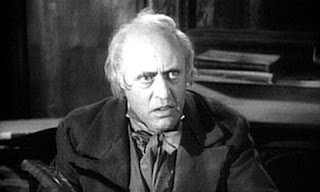 While a number of people still celebrate Christmas for the nativity of Jesus, most regard it as an occasion for partying, over-indulgence, the ritual exchange of gifts and mass overconsumption. The gift-exchange aspect of Christmas becomes ever more prominent as the holiday spreads beyond its Christian origins and insinuates itself into cultures all around the globe.
Around this time every year, my inner Scrooge comes out and I think, Christmas is simply out of control. We buy way too much stuff, giving presents to people who don’t really want or need the stuff, who in turn give us stuff we don’t want or need. I literally have 25 or 30 woolen sweaters piling up in my closets, shirts I don’t need, pants I don’t need, jackets I don’t need. Why? I tell people, don’t buy me more stuff, I can’t use it, I don’t have anywhere to put it, I’ll have to give it away, but they do it anyway.
Bah, humbug!
How many million tons of Christmas wrapping winds up in the landfills around the country? How many closets, basements and attics are crammed with stuff we can’t use but don’t dare get rid of because Aunt so-and-so gave it to us and her feelings would be hurt? How much square footage do we add to our houses to hold all of this stuff? How much more are we paying on our mortgages for that square footage? How much do we expend in BTUs to heat that space? How much are we racking up debt on our credit cards?
Bah, humbug!
To what degree can the endemic balance-of-payments deficit and plummeting value of the U.S. dollar be attributed to our Christmas mania for buying more stuff? To what extent will future historians trace the decline of American power to indebtedness brought on, like those villagers in South America you read about in first-year anthropology classes, by our inability to reel in our propensity for exchanging gifts?
Bah, humbug!
How much energy is consumed producing, packing, transporting and disposing of all this stuff? How much pollution is emitted as a result? What irreparable damage are we doing to the environment? I shudder to contemplate.
We need to resurrect Ebenezer Scrooge — the authentic, skin-flint Scrooge, not the wimpy, spread-the-Christmas joy Scrooge he became after the Christmas ghosts scared the bejeebers out of him — and make him the new national icon.
(Photo credit of Alistair Sim as Scrooge in the 1950 movie “Scrooge”: Mudsugar.)
-
Bay Worse off than We Thought
Everyone knows the Chesapeake Bay has problems, but it’s a comfort to think that some $3 billion invested in clean up since the 1980s are slowly healing what was one of the world’s most biologically productive estuaries. But maybe not. A University of Maryland professor has issued a downer of a report arguing that the Environmental Protection Agency has overstated progress, relying on formulas that exaggerated improvements in pollution, according to a new scientific review.
The Washington Post reports that Tom Simpson concluded that a computer model of the Chesapeake, used by the EPA’s Chesapeake Bay Program to gauge improvements in the estuary’s health, tended to inflate the impact of some cleanup measures. Bottom line: We’re further behind than we thought.
Merry Christmas.
-
Economic Development: the Best Welfare
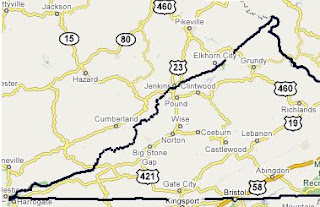 Many Virginians still think of Virginia’s six coalfield counties in far Southwest Virginia as a bastion of unemployment and poverty in an otherwise robust state economy. The stereotype was true as recently as 10 years ago, but it no longer applies. As Rex Bowman writes for the Times-Dispatch, unemployment levels have reached lows not seen in decades — since the coal boom of the 1970s — and welfare roles are down dramatically. The key: Former Gov. George Allen’s welfare reform and well-funded regional economic development programs.
A rebound in the coal economy has helped the economy somewhat, but the main credit for job creation goes to sustained efforts to diversify the region’s industry base. Unemployment in Dickenson County, which stood at 14.2 percent in 1997, has fallen to 5.2 percent. The changes have been almost as dramatic in Wise and Buchanan Counties, the other two jurisdictions where coal mining once constituted an economic monoculture.
Said Gary Hale, manager of the Virginia Employment Commission in Norton: “I’ve got more jobs available than I’ve got people to fill them, and I never thought I’d say that.”
While job creation has been critical, so have sustained efforts to break the culture of welfare dependency. Bowman describes the strategems to ease the difficult transition from welfare to work. For the coalfield region, the number of people on welfare has declined from 6,o61 a decade ago to 3,614 today — a decline of 48 percent, compared to 43 percent for the state as a whole.
Statewide, the decline in welfare roles is saving the federal and state governments $957 million a year. But the benefit of reviving peoples’ independence and pride is incalculable. Kudos to the Times-Dispatch for highlighting this success story.
-
Stacking the Deck
Gov. Timothy M. Kaine has appointed a 32-person task force, the Commission on Climate Change, to provide guidance on how to address the challenge of Global Warming. The group has a broad-based membership that, according to the governor’s press release, “includes state legislators; scientists; economists; representatives from the energy, transportation, manufacturing, development, and agriculture industries; representatives from environmental organizations; and local government representatives.” (My italics.)
Kaine is certainly correct to include scientists in the mix: One would hope that the Commission will be informed by the latest scientific findings relating to climatology, as opposed to, say, the latest cover story on Newsweek — especially when a stated goal of the administration is “to reduce greenhouse gas emissions by 30 percent by 2025, bringing emissions back to 2000 levels.” The stakes are massive.
So, it’s worthwhile to ask, who are the scientists on the commission, and what are their fields of expertise? It turns out that there are two scientists:
- Jack Gibbons, of Fauquier County, was trained academically in mathematics and physics, worked in a research capacity in energy and the environment, and served in a high-ranking technology policy-making capacity in the Clinton administration.
- Roger Mann, of Mathews County, is director of research and advisory services at the Virginia Institute of Marine Sciences.
That’s it: two scientists, neither of whom is a career climatologist. While both men undoubtedly can speak authoritatively about the impact of climate change on the environment, neither one is accomplished in the actual field of climatology.
It so happens that Virginia has a state climatologist (or its close equivalent). I’m not referring to Patrick Michaels, the former state climatologist and high-profile Global Warming skeptic. I’m referring to Philip J. “Jerry” Stenger, who took over the position after Michaels departed and the office was re-named the climatological office of the University of Virginia. Stenger, a 25-year-veteran, is not, to the best of my knowledge, ideologically suspect.
I can understand that the Kaine administration wouldn’t want to burden itself by including Michaels in the commission. He’s no wall flower, he’s media savvy, and he disputes many aspects of global warming orthodoxy. Indeed, a perusal of his blog, World Climate Report, will show just how much disagreement there is among climatologists. (A quote from his most recent entry: “Rarely does anyone seem to question the quality of the temperature data, and yet, articles appear regularly in the scientific literature showing that the near-surface air temperature measurements are fraught with errors, gaps, and any number of inhomogeneities.”)
If Michaels were appointed to the Commission, Michaels would end up as the story. But why not appoint Stenger, or someone else, who is familiar with the scientific aspects of the Global Warming debate and has a command over Virginia’s meteorological history? As the commission now stands, outsiders cannot be blamed for fearing that its agenda will be driven not by science but by the ideology and self interest of its members.
-
A SECOND TEST FOR INSANITY, SMOKING OUT HUMPTY DUMPTY
Doing the same thing over and over and expecting a different result – for example, building more roadways and expecting traffic congestion to go away – is often cited as a threshold test for insanity.
There is a second test that is useful to apply in the Blogosphere. This test is:
Attempting to describe, discuss or arrive at a well-considered public judgement on complex topics in cases where:
1. Key words / phrases are known to have different meanings to different people, or
2. A person or group of persons uses the same word / phrase to describe different places, actions or conditions
According to Lewis Carroll, Humpty Dumpty, when challenged on the confusing use of Vocabulary stated: “That word means exactly what I want it to mean, nothing more, nothing less.” In fact, Alice’s Wonderland is the only place such use of Vocabulary is appropriate.
Failure of the Vocabulary test of mental capacity is especially prevalent in discussion of human settlement patterns. Why is this failure to understand the need for a functional Vocabulary so prevalent in the realm of human settlement patterns?
First, and most obvious, the offending participants do not want to “understand.” Often this is because they fear an understanding will require abandonment of ideas and theories with which they have organized their lives.
The unfounded actions were often thought to have been taken in pursuit of the actors best interest. No one likes to find out that they have been acting in ways which turns out to harm their long-term self-interest and those of their Household.
Adherents of The Big Yard Myth and The Private Vehicle Mobility Myth are often in this category. Believers defend their pet Myths with religious tenacity.
Second, most of the commentators deem themselves to be experts “because they live there.” They apply their observations and experience in the context of the Myths they so want to believe.
Third, there are those who do not want to understand because they profit (or hope to profit) directly or indirectly from continuing confusion, debate and failure to reach a consensus on the most intelligent course of action for the majority.
This class of Humpty Dumpty adherents often know their statements are at best uninformed opinion and at worst deceptive.
Finally there are those who are offended that someone – anyone – would suggest they need to change their Vocabulary in the consideration of topics that they believe they understand as well as anyone.
Doctrinaire defense of “simple” language with respect to human settlement pattern discussion is a sure-fire way to identify Humpty Dumpties.
A great Holiday pastime is to see how many Humpty Dumpties you can identify at the gatherings you attend.
Happy Holidays.
EMR
-
HOT Lanes on the Capital Beltway Only Five Years Away
This is a great day for Virginia. The Kaine administration has finalized all the agreements needed to start construction in the spring on the $1.4 billion HOT-lanes project on the Washington Beltway. The public-private partnership will add two lanes in each direction along the 14-mile stretch of the Capital Beltway, increasing capacity from 8 lanes to 12, upgrade 12 interchanges, and invest $250 in upgrading bridges, overpasses and signs. Construction is scheduled for completion by 2013.
Virginia will partner with two companies, Fluor and Transurban, under an 80-year agreement in which the partners will collect tolls from motorists using the HOT lanes. Toll prices will vary according to traffic volume, set to levels that will ensure the free flow of traffic. Rush hour fares could reach $5 to $6, reports Tim Craig with the Washington Post.
The lanes will be free for carpools of three or more people and make bus service practicable. Buses don’t serve the Beltway currently because traffic jams make scheduling impossible. If bus ridership on the Beltway reaches the same levels as on Interstates 95/395 (see “Interstate 95: Kissing Good-Bye to the Solo Commuter?”) the project could do even more to relieve traffic congestion than implied by the 50-percent increase in the number of lanes.
The federal government will contribute $209 million towards the project, and the state another $200 million. The Commonwealth of Virginia will continue to own the Beltway, while Fluor-Transurban functions as a private contractor. “It is a very, very complicated project and a very, very complicated financial transaction,” said Secretary of Transporation Pierce Homer. “There are now hard financial commitments. This is a construction and a financing contract.”
Bacon’s Bottom Line: This project represents one of the signature achievements of the Kaine administration. Although the idea originated in the Warner era, it took enormous work to hammer out the details. The Beltway HOT lanes will provide the first major expansion of Interstate capacity in Northern Virginia in many, many years. More importantly, the project acknowledges that the Commonwealth cannot address the increasing number of cars on the road through open-ended increases in highway capacity. The deal uses congestion pricing to allocate scarce highway capacity while also encouraging people to carpool, ride in vans or take the bus.
-
SCC Approves Highland Wind Farms
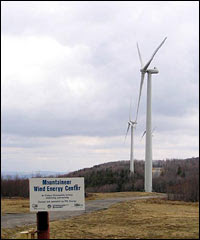 Highland New Wind Development can proceed with its $60 million, mountaintop wind farm, ruled the State Corporation Commission, on the condition that it develop a “post-construction bat and bird mitigation plan.”
The project calls for building 19 windmills reaching 400 feet tall in Highland County — enough to power 20,000 homes. The whirring blades are expected to be deterimental to flying wildlife, however. The SCC order will require Highland New Wind to spend roughly $2 million over 20 years on monitoring, roughly $50,000 a year on measures to minimize the impact on wildlife, and fines of up to $1,500 for the death of rare or endangered birds.
Bacon’s Bottom Line: If we want more renewable energy, we can’t let NIMBYs kill every project that threatens their aesthetic sensibilities. If the windmills can been seen in the far distance from Rt. 250 in the hamlet of Monterey, well, I’m sorry. But wildlife protection is another matter entirely. The SCC has struck a reasonable balance.
Read more details at the Times-Dispatch and Roanoke Times.
(Photo credit of West Virginia windmills: NPR.)
-
More Budget Rumbles
The escalating war of words between GOP legislators and Gov. Timothy M. Kaine over Kaine’s proposed budget is getting some attention in the press. Garren Shipley at the Northern Virginia Daily and the editorial writers at Washington Examiner focus on the $180 million in transportation spending that Kaine wants to defer. The issues don’t appear to have evolved much since we covered them in this blog, but the differences are getting aired.
Meanwhile, Chelyen Davis at the Free Lance-Star gives ink to the unease that GOP legislators have with Kaine’s two-year revenue forecasts.
In a letter to the govenror, House Speaker William J. Howell, R-Stafford, and House Appropriations Chairman Del. Lacey Putney expressed concern that the Governor’s revenue forecasts are not based on the most current expectations of economic performance. Since the November 19 meeting of the Governor’s Advisory Council on Revenue Estimates (GACRE), “the national economy has continued to see wild swings,” while “the sustained decline in the housing and subprime mortgage markets further affect consumer and financial confidence.” The lawmakers continue:
Subsequently, the Commonwealth’s economic and forecasting consultant Global Insight has updated their forecast based on more recent economic data, including assumed GDP growth of less than 1 percent over the next three quarters. In turn, these financial experts have raised the probability of a recession from 30 percent to 40 percent.
Howell and Putney called upon the Governor to reconvene a meeting of the Advisory Council in January to update the budget projections on the basis of the most current data.
According to Davis, Kaine spokesperson Delacey Skinner responded that GACRE met in November, and agreed then to stick with the revenue forecast from August, which reflected the weakening economy. The governor’s office has a regularly scheduled review of the forecast in mid-February, and that it wouldn’t be prudent to call another meeting of GACRE just a month beforehand. Said Skinner: “Calling a special meeting would send a message to the public that we’re panicked, and that would be an unwise message to send.”
Bacon’s bottom line: So, Skinner doesn’t want to send a message that, “We’re panicked.” Personally, I think it would send a message that, “We’re prudent.” Instead, Skinner prefers to send a message that the Kaine administration is content for budgetary deliberations to rely upon what will be, by January, five-month-old data. Given the volatility of the economy, I think the Howell/Putney proposal makes sense.
-
Mini Nuclear Reactors for All?
Via Instapundit, comes an item sure to make some scream, and others cheer:
Toshiba has developed a new class of micro size Nuclear Reactors that is designed to power individual apartment buildings or city blocks. The new reactor, which is only 20 feet by 6 feet, could change everything for small remote communities, small businesses or even a group of neighbors who are fed up with the power companies and want more control over their energy needs.
Now that’s cool. Or hot. Or at least fissionable.
-
Home (Zones) Alone
 Members of the Greenbriar neighborhood in Chantilly would like to strike a sensible balance between the rights of drivers and pedestrians. The community gets a lot of cut-through traffic, but, as the Fairfax Times puts it, “The use of random, time-consuming, and expensive traffic calming measures on a case-by-case basis is only a Band-Aid to a serious wound in Virginia’s current approach to resolving residential neighborhood traffic problems.”
Robert Mason, a member of the neighborhood’s traffic calming committee, has asked Del. Chuck Caputo, D-Chantilly, to introduce legislation developing Home Zones in Virginia. The idea comes from zones in European countries for streets shared equally between pedestrians and motorists. Caputo says he has asked the General Assembly staff for recommendations that can be introdued as legislation.
From the Home Zones website in the UK:
Home Zones work through the physical alteration of streets and roads in an area. These alterations force motorists to drive with greater care and at lower speeds. Many countries support this with legislation allowing the Home Zones to enforce a reduced speed limit of 10 miles an hour. The benches, flower beds, play areas, lamp posts, fences and trees used to alter the streets and roads offer many additional community benefits to the Home Zones and are considered to enhance the beauty of an area and increase the housing prices.
Home Zones, while on the surface offer substantial benefits to an area, are the source of some controversy. It has been reported that such schemes have delayed the response rates of the emergency services to the streets within the Zone. Other reports describe local authorities being inundated with complaints from residents demanding that the road humps and chicanes be removed as they are causing huge tailbacks through the streets. People have shown concern that encouraging children to play in roads, even specially adapted roads such as Home Zones, has introduced a danger which was not previously there. It has also been reported that the residents of a home zone in America are actively campaigning to have the road alterations removed as they can no longer park near their houses.
(Credit for photo of a Danish home zone: Picasa.com)



