
by James A. Bacon
It’s a shame that the United Campus Workers of Virginia (UCW-VA) are such insufferable leftists. I could almost sympathize with their aims. Universities in the United States treat their graduate students and adjunct faculty abominably. Thousands of these employees lead an insecure, ill-paid existence and probably could benefit from a union capable of negotiating with university administrators.
I quickly sour, however, when I see the union lobbying for patently political causes such as solidarity with Palestinians, opposition to “militarism” in higher education, and supporting “social justice” movements. These people are just neo-Marxists who want a bigger paycheck.
If the Campus Workers dropped their militant leftism and stuck to bargaining for better pay, benefits and working conditions, I expect they would recruit a lot more members. But political activism is their schtick, and they could not give that up any more than zebras can change their stripes.
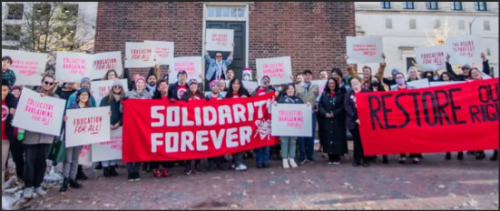
The Commonwealth Times, a Virginia Commonwealth University student newspaper, recently profiled the UCW-VA, which has chapters at VCU, the University of Virginia, Virginia Tech, and the College of William & Mary.
“VCU has fired a record number of faculty members, increased class sizes, raised tuition and even canceled Federal Work-Study programs,” said Kristen Reed, an assistant professor at VCU and a founding member of the VCU chapter. “We are facing unprecedented challenges in public education, free speech and accessibility. But we are also standing up and fighting back.”
It is apparent from this statement that Reed, whose doctoral research focused on “mid-20th century political poetry,” has little appreciation for the challenges facing a university like VCU, which has carved out a niche appealing to first-generation college students.
After years of expansion, colleges and universities are staring into a demographic abyss of a shrinking pool of college-age students as well as unprecedented skepticism of the value proposition offered by higher-ed. VCU jacked up tuition & fees to what the market would bear, making it one of the more expensive public universities in Virginia, but in recent years has had to rein in its increases. It has no choice but to cut costs, which may entail — assuming the accuracy of Reed’s statement — laying off faculty members and/or increasing some class sizes.
Before drawing any hard-and-fast conclusions, though, I would like to see the numbers, and I would like to know the context of VCU’s management decisions. Unfortunately for someone like Reed who teaches liberal arts, a growing percentage of students are looking for tangible skills that will land them good jobs in exchange for the $120,000+ they’ll be spending for a VCU sheepskin. English, history, anthropology and other liberal-arts degrees don’t offer much in the way of marketability, and enrollments are shrinking. Universities have an obligation to reallocate resources from low-demand majors to high-demand majors, and I suspect that that’s what might be occurring at VCU.
The number of B.A. degrees in English awarded by VCU in 2023-24 was 94 — down from 145 in 2013-14. The number of M.A. degrees was 10, down from 15.
To pick another example: The number of Religious Studies degrees granted has declined from 20 to seven over the same period.
The number of anthropology degrees awarded tumbled from 39 to 22.
By contrast, the number of degrees in Computer and Information Science surged from 44 B.A.s and 7 M.A.s, in 2013-14 to 133 B.A.s, 16 M.A.s, and 5 PhDs in 2023-24.
VCU would have been derelict not to have let some humanities faculty go in order to hire some computer-science profs.
I do have considerable sympathy for lecturers and instructors — the low men and women on the academic totem pole — who get paid less, enjoy less job security, and do more of the teaching than tenure-track faculty, especially the full professors. Likewise, my heart goes out to graduate students who share the teaching and research load of their professors in exchange for reductions in their hefty tuition and fees. They often pay tuition to universities for course credit in which they perform grunt work that teaches them nothing. It’s remarkable how institutions so closely aligned with “progressive” ideology are so willing to oppress the most powerless members of their own communities. It’s so much more rewarding to decry racism, sexism and homophobia! Those at the bottom of the academic hierarchy arguably do need a union to give them bargaining clout to improve their condition.
What the academic helots get instead is a union that fixates on left-wing causes. According to the Commonwealth Times, Reed “addressed the disruption of civil liberties on campuses, pointing to the use of riot police against peaceful student protests.” What kind of disruptions? The breaking up of pro-Gaza solidarity encampments. If a student militant group wants to do its lefty thing and fight for the right to violate universities’ restrictions on the time, manner and place of rallies and demonstrations, well, that’s their right. But that’s not what labor unions are set up to do.
The Commonwealth Times did quote a UVA graduate worker, Gabriel Costello, who had a beef with what she described as UVA’s “systemic late payments to university employees.” That sounds like the kind of thing that a labor union should address. It’s good to see that UCA-VA has latched onto a legitimate workplace issue.
But tying labor rights to broader struggles, in the words of VCU faculty member Mark Wood, to broader struggles “for justice, including solidarity with Palestinians and opposition to militarism in higher education”? Nope. Sorry, you sound like a throwback to the Wobblies of the early 20th century who never got their socialist revolution. The AFL-CIO, which fought for workplace issues, left them in the dust.
Leave a Reply
You must be logged in to post a comment.