
Virginia Republicans have a lot to consider as they select their new RPV Chairman.
by Shaun Kenney
First things first — if you haven’t watched Ken Burns’ American Revolution on PBS, I hope you have a few history books at your side to confirm whether or not the good guys actually won the war, because if you are new to the thing, you might be excused for wondering whether or not the Americans were actually the good guys.
By the third episode, the postmodern historians begin to drive their knives into General George Washington — effectively stating that he was not a great man, that he was deeply flawed, and that we have no “marble men” in our pantheon of American heroes.
Oddly enough, we get very little of the religious temperament of any of the Founding Fathers. Wedged between two Great Awakenings, the American experiment was most certainly borne out of the Scottish Enlightenment and a revival of classical era thought. Yet significant to the entire project was that the Founding Fathers were indeed deeply religious and Protestant men — and they gave us a republic and not a theocracy.
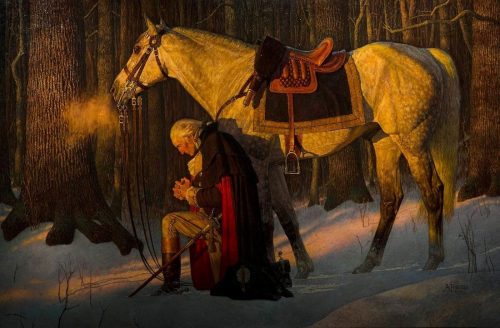
Which gets us back to Washington himself. The scene you see above at Valley Forge never happened. Much like Washington and the cherry tree at Ferry Farm, the hagiography of the great man was intended to illustrate his actual character and not actual events. Those who want a true understanding of Washington need to go three generations back to the life and times of the Duke of Marlborough, whose leadership style, imitated by Churchill’s lieutenants and brought to America by men such as Spotswood and Parke, helped forge the leadership class the American colonists came to recognize as leadership — imitated by the Hanoverians themselves as British America continued to define itself against la belle France and her Catholic autocrats before defining themselves against Parliament and finally King George III himself.
Which is a long way of saying that if you spent time this weekend in Williamsburg, you are perhaps discovering that the Republican Party of Virginia is presently at its own Valley Forge.
Leadership: the capacity to translate vision into reality
Fun fact — the Continental Army that fought in 1775 was not the same army that emerged from Valley Forge in 1778. In fact, that army had entirely dissolved, and only the true believers were left. Making matters slightly more complicated, the Continental Army that emerged in 1778 was not the same army that fought Cornwallis at Yorktown in 1781 — though its leadership cadre was essentially the same, the enlisted men were entirely new and mostly militia, with many of the Virginians having been captured at Charlestown the year prior.
Much of the focus of the conversations around the RPV State Central Committee have been focused on its lead volunteer — the new RPV Chairman. Most are aware that the role is unpaid, yet there are several items on the wish list for what people want to see out of a new leader:
- Financially capable and financially independent. Someone who knows how to raise money and is financially stable enough so as to refuse to siphon away resources from RPV itself.
- Executive qualifications. Someone who has led organizations before and understands what the role requires.
- Fundraising experience. This is perhaps the hardest task of all, because RPV as a brand is presently under siege from within.
- Strategic litigation. This would be a new and innovative feature, but one that should reflect the financial independence mindset (i.e. those advocating the role will be donating their time and talents and not expect remuneration).
- Communications. Also a difficult task, as RPV will be expected to perform two opposite tasks simultaneously: (1) support our nominees and elected officials and (2) call them out when the grassroots demands the sacrifice. This is probably 80% of the infighting that has plagued the state party since the 1990s.
- Not a springboard for higher office. There is a strong expectation that the RPV Chairman is neither an elected official nor aspires to become one.
- Not a member of the consultant class. No part of their income can be derived from the election or defeat of a candidate.
- Someone who actually loves the grassroots. I don’t think I need to press too hard here, but this is probably the most important quality. As the party grows, the leadership and values will change — and a good leader will listen to those voices and adapt the party to where it needs to go accordingly.
- Someone who views the unit chairs as the core of the party. The whole reason the state apparatus exists is to support the local apparatus — all of whom also serve as unpaid volunteers and are elected by their communities to lead.
- An impartial leader — but with a backbone. One of Morton Blackwell’s Laws of the Public Policy Process is that a builder can build faster than a destroyer can destroy — but being able to work with factions is just as important as a William F. Buckley Jr. discernment about which factions should never become part of the conservative coalition.
- Understand that the Republican Party of Virginia is weak by design. Not all of the ills can be laid at the foot of McCain-Feingold, nor can they be laid at the feet of Virginia’s campaign finance laws where PACs and candidates who enjoy unlimited contributions no longer need an institution to warehouse and spend the remainder.
Don’t read this as a job application form where a series of checkmarks have to be marched off if the individual in mind is “qualified” for the role. Read these as something any Republican should bring to the table at any level of public service — with appropriate adjustments, we should expect this of candidates and chairmen alike — and most certainly of our party leadership.
Of course, there’s the more dangerous question. Are we worthy of this kind of leadership? Leaders are often as good as the individuals with whom they surround themselves — what sort of staff does the new chairman bring along? More than all of this — is State Central willing to support this leadership? For how long?
Coalition building: being right vs. winning elections
A membership driven Republican Party of Virginia could achieve many of these goals, provided an independent state party is what we want. 10,000 Republicans at $9/mo is a $1 million state party. There are 8.6 million Virginians — are there 20,000 Republicans in Virginia? 40,000?
We don’t know quite yet.
This is perhaps the toughest question to answer for State Central and the grassroots writ large, because the execution of any plan to grow the party means that we are all collectively making ourselves obsolete. Growing the party means bringing in more than just new voices but new leadership, and that leadership may very well take the party in a different direction than we may be able to see in front of us.
Therein lies the trouble. The demographics of Virginia have changed a great deal over the last 20 years, to be sure. Yet there were 500,000 Republicans who stayed home in 2025 — which way does the conservative movement go? The temptation will be to pilot to the center by sloughing off parts of the conservative movement — all light but no heat — which never works, but we do it anyway. There will be an equal temptation to go even further to an extreme in the hopes that heat will replace light — but also rarely works because it drives away future conservatives.
Coalition building is hard, for two reasons.
First, it is very easy to define what we are against. Virginia Democrats are going to give Republicans all those reasons and more on a wide spectrum of values and fronts. The second part is a bit harder — what precisely are we for? Perhaps it isn’t particularly helpful to dive into the question too deeply quite yet, but I think Professor Robbie George gives us a solid view on what should be first things:
There is, of course, more to American conservatism — belief in the rule of law; in the nation’s republican civic order; in accountable and limited government; in marriage and the family; in the importance of flourishing institutions of civil society; in traditional moral values, personal responsibility, and rewarding effort and achievement; in the constitutional principles of federalism and the separation of powers; in basic civil rights and liberties; in the market-based economy; in a sensible system of legal immigration, and in opposition to illegal immigration; in maintaining a healthy physical environment for everyone and a moral ecology suitable for the rearing of children; in a strong national defense and a sensible understanding of America’s leadership role in the world.
At the foundation, however, is the basic commitment to inherent and equal dignity and natural rights. If conservatism doesn’t stand for conserving these values, it stands for nothing. Everything else conservatives believe — about politics and government, education, ethics, culture — stands upon those foundational values. Any viewpoint that denies those values cannot be conservative.
Conservatism’s core commitments provide the framework within which we debate the best means — the best policies — for effectuating our vision of the common good. These commitments don’t resolve every political question, even among conservatives, but they set certain boundaries.
I don’t think any of that violates the RPV Creed. Yet it is important to remember that there is a balance between being right and winning majorities. The former is important, but it will have no oxygen at all if we are right at the expense of the latter — and that will be the first task of the Republican Party of Virginia in 2026.
Remember: all pendulums swing
Planck’s Constant instructs us on how this goes. Heat comes first, then light. The Republican Party of Virginia has a creed that embraces free minds, free markets, free enterprise, free ideas, and a free society.
We don’t have much time. The referendum on redistricting is all but guaranteed, and it will be grassroot conservatives who will have to do the heavy lifting to prevent it with a state apparatus at its weakest point since the 1970s.
It is notable that as Virginia Republicans find themselves at our own Valley Forge that former RPV Chairman Don Huffman passed away at the ripe young age of 98. Huffman was a gentleman par excellence whose partnership with Dick Obenshain — the leader who graces the name of our headquarters — has defined the conservative coalition in Virginia for five decades running. Within this coalition was room for a broad spectrum of Republicans who perhaps differed in details but rarely in foundations.
The good news at least is that Virginia Republicans were able to at first cobble and then construct coalitions and eventually majorities from worse positions than we find ourselves in today.
I’ll give you this example. In 2006, U.S. Senator George Allen lost his senatorial re-elect by just a whisker — a man who still largely defines what it means to be a leader in Virginia Republican circles today. In 2007, Virginia Republicans nearly lost the House of Delegates and lost the Virginia Senate entirely. In 2008, not only did Barack Obama trounce John McCain in Virginia, but Republican strongholds such as VA-05 and VA-02 were surrendered into Democratic hands. VA-11 long held by Tom Davis was given over to Gerry Connolly.
Three long years of decline — and then in 2009 the trio of Bob McDonnell, Bill Bolling, and Ken Cuccinelli swept the lot while the House of Delegates was firmly placed in Republican hands under House Speaker Bill Howell.
Now we may kick the dirt in 2026. We might even kick the dirt a bit more in 2027 and 2028 — but as the late British Prime Minister Benjamin Disraeli reminds us, it is the opposition’s duty to oppose. Sure — work with Democrats when they are working for the common good, but the moment they work for advantage, cruelty, or coercion? Take a page from their playbook and oppose them as best you can.
Who knows? Maybe we might even win a round or two. But the infighting only helps the grifters — it doesn’t help the cause.
In short, we could use a few more happy warriors right now. What we don’t need are more “paid volunteers” or more campaign-by-clipboard types who make fun of the grassroots as rubes or idiots. Fire those clowns on the spot.
Bring on more of these:
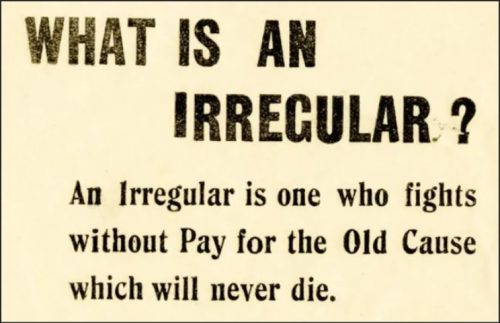
Without pay and for the cause and then respect them when they do.
A very short plan of action
Of course, organizations reflect their leadership. If you want a mercenary party, then hire a mercenary. If you want a party built on volunteers, then bring on a volunteer who respects both the sacrifice of other volunteers and the conservative movement they believe in enough to sacrifice for. A party of grifters? Hire grifters — and see how that works out.
Key things to watch for any future RPV Chairman are these:
- Can they do the job and do they believe in the conservative movement? Heat first, light second. If they don’t have the relationships and can’t articulate why they believe what they believe? Move on. Bridge builders with a backbone who can do the job with zero minus ambitions for higher office — that’s it.
- Hire a good Executive Director. Their job should be little more than executing the fundraising plan and giving unit chairs everything they need to be successful doing the volunteer work they are doing.
- Hire an excellent Communications Director. Give them as free a hand as we are able to get out there and communicate. No more press releases — articles, stories, interviews, press clips, and an ecosystem.
- Hire a good Finance Director. This is perhaps the only role where I would hire a consultant to work alongside this person, as large dollar donors are a political ecosystem of their own.
- Hire a damn good Political Director. Someone who loves the grassroots and is never found in their chair but is going around meeting people and making connections. Someone who can work with RNC for field teams, someone who understands data that doesn’t reduce people to data.
The last three should all be hires that the executive director, the chair having the veto on any bad hires. That’s it — that’s the staff. No more and no less. Everything else is volunteer driven.
Bear this in mind as well. There are very few people left in the Virginia Republican Party who can perform this sort of leadership role. We should be patient both with the process and those who step into the role. No complaint should come without a solution. The very first question asked of any grumbler should be “Are you an active dues paying member of the Republican Party of Virginia?”
If the answer is no, have them scan a membership link and become a due paying member on the spot. Bridge builders, ladies and gentlemen, but with a backbone and a firm belief that we are stronger together. Then let’s hear folks out — but there’s plenty of work to be done and it doesn’t take a state party to do it. Just a few good volunteers who are appreciated and not abused.
Find that leadership and we are good to go. That’s it — that’s my pitch.
Shaun Kenney is senior advisor to Attorney General Jason Miyares but the views expressed here are his own. This column has been republished with permission from his blog The Republican Standard.
Leave a Reply
You must be logged in to post a comment.