
by Dick Hall-Sizemore
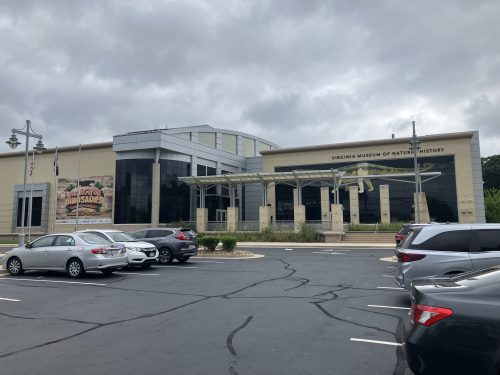
In Southern Virginia, where the Piedmont region begins to become the Blue Ridge, is the city of Martinsville, the home of the Virginia Museum of Natural History.
The building and its contents are impressive. The museum’s mission is “to interpret Virginia’s natural heritage within a global context in ways that are relevant to all citizens of the Commonwealth.” To accomplish this mission, there are exhibits ranging from ancient dinosaurs to modern mammals. There are fossils, many from Virginia locations. There is a long wall mounted with many antelope species from Africa, demonstrating the diversity in nature. The exhibit, “How Nature Works: Life”, contains a large taxidermy selection of animals from Virginia, as well as from around the world.
There is a separate area on “Uncovering Virginia.” A diorama takes a visitor from a present-day coal mine in Buchanan County to how the same site looked 300 million years ago. What is now Virginia was then part of the supercontinent Pangea and was located near the equator. This was a landscape comprised of club mosses the size of oak trees, which were eventually compressed into the coal that was mined there hundreds of million years later.
Then there are the insect fossils from the Solite quarry in Pittsylvania County. This site is the only one anywhere in the world with numerous complete insect fossils from the Triassic Period (about 225 million years ago).
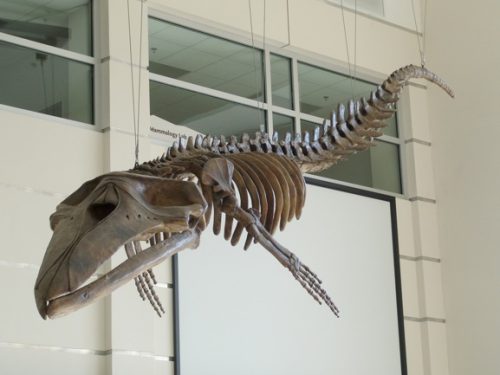
In more “recent” times (about 14 million years ago), Pangea had been long broken up and what is now North America was mostly in its current position, but the eastern portion of Virginia was covered with oceans. A quarry in Carmel Church in Caroline County has one of the largest collections of marine fossils in the country. It was at this location that VNMH paleontologists discovered numerous bones of an ancient relative of modern-day whales. It was designated Eobalaenoptera harrisoni. The cast made from those bones hang from the ceiling of the museum’s Great Hall.
Even more recently, (14,000 years ago) mastodons and mammoths roamed Virginia during the last Ice Age, when the climate was colder and drier. Many of their fossils and casts are housed and displayed at VMNH.
Accompanying each exhibit are placards and other signage explaining the science behind, and the story told by, the exhibit in easy-to-understand terms.
VNMH is a state agency with an annual general fund appropriation of $3.6 million. Approximately 25,000 people visit it annually; two-thirds of those visitors come from beyond the immediate area of Martinsville and Henry County. The museum annually stages a two-day Dinosaur Festival, which attracted 4,100 visitors this year, many from surrounding states.
VMNH is a Smithsonian Affiliate, which entitles it to exhibit materials from the Smithsonian, such as the Stegosaurus currently in the VMNH lobby and displays of ants in its Education Center. Each summer, paleontologists from VMNH conduct digs in the Green River Formation in the western United States, which is one of the most important fossil sites in the country. Another current project is the production of comprehensive catalogs of ants and spiders of Virginia. Already, VMNH scientists have discovered species new to Virginia and previously unknown to science.
A satellite facility, to be located in Waynesboro, is in the planning stage. Backers are hoping that Gov. Glenn Youngkin will include construction authorization and funding in the budget bill he will present to the General Assembly in December. That facility will focus on the geology and other natural history of the Blue Ridge Mountains.
Leave a Reply
You must be logged in to post a comment.