
by James A. Bacon
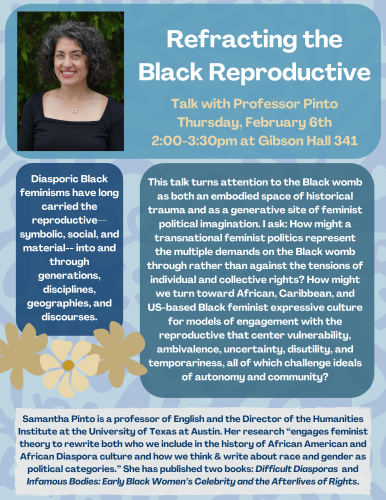
I bring to your attention a flier promoting an event — “Refracting the Black Reproductive” — held at the University of Virginia last week. My intent is not to critique the substance of what Samantha Pinto, an English professor from the University of Texas at Austin, had to say. To discuss her thinking, I would have to understand her… which I do not. Rather my point is to illustrate how the language of academic leftists has gotten so inbred and arcane — and Ms. Pinto is a teacher of English, mind you — that it has become incomprehensible to ordinary Americans.
Here’s how Pinto described what she planned to discuss:
I ask: How might a transnational feminist politics represent the multiple demands on the Black womb through rather than against the tensions of individual and collective rights? How might we turn toward African, Caribbean and US-based Black feminist expressive culture for models of engagement with the reproductive that center vulnerability, ambivalence, uncertainty, disutility, and temporariness, all of which challenge ideals of autonomy and community?
In case you had difficulty deciphering the meaning, the flier contains this helpful context:
Diasporic Black feminisms have long carried the reproductive — symbolic, social, and material — into and through generations, disciplines, geographies, and discourses.
Clear now?
I have no doubt that there is a clique of radical feminist theorists in academia who read each others’ esoteric articles, books, and book reviews and who actually understand each other. But by employing such terms as “the reproductive” and “the Black womb,” the meaning of which only they comprehend, academic feminism today resembles the mystery cults of the ancient world which perpetuated a secret knowledge intelligible to insiders… but only to insiders.
People should be free, of course, to engage in whatever form of bizarre and convoluted philosophizing that they wish. I would go so far as to say — and I’m sure some of my conservative friends would disagree — that there is a place for some such fringe thinking in academia. It is a sign of intellectual health and vigor when ideas from a wide range of viewpoints collide in a university setting.
The problem comes when universities fail to recognize that fringe thinking is, well… fringe thinking. (Especially when nearly all of fringe thinking emanates from the leftist side of the ideological spectrum.) Not all ideas are equally worth entertaining, and some thinking is relegated to the intellectual margins for a reason. When some bodies of thought are so steeped in obscurantism that they are inaccessible to the broad mass of the student body, there is a real problem. Governing boards should perk up, pay attention, and ask if such programs are worth the resources they consume.
Ms. Pinto’s speech was promoted by UVA’s Department of Women, Gender & Sexuality (WGS). The WSG website lists 13 faculty members (including tenure-track and postdoctoral fellows) and one administrator, which is not a large department. But nearly 50 faculty members from other departments are listed as “affiliated,” which means that majors can count courses given by those professors toward their WSG degree requirements.
For all the resources devoted to the program, only 41 students graduated from UVA in 2021-22 (the most recent year for which data is available) with a degree classified as “women’s studies” by the State Council for Higher Education in Virginia (SCHEV).
It has not escaped the notice of the people running the WSG department that some students might worry if a degree in women, gender and sexuality has value in the marketplace. Put more indelicately, after spending $120,000+ on a UVA education, will the bearers of a WSG degree be able to find a job in their field?
The WSG website assures visitors that, no, expertise in such topics as “women’s political participation,” “body politics, “lesbian/gay parenting” and “transgender concerns” won’t make them toxic in the job market. WSG provides the following helpful list of jobs that a WSG major might fill:
- Marketing Assistant for National Museum of Women in the Arts
- Lobbyist for the ACLU
- Public Relations Associate for Girls Ink online magazine
- Development Associate for non-profit organizations
- Employee for International Centre for Missing and Exploited Children
- Screenwriter
- Employee for American Bar Association, working on CEDAW issues (Convention on the Elimination of All Forms of Discrimination Against Women)
- Lawyer
- Legislative Assistant on Capitol Hill
- Analyst for Democratic polling and consulting firm
- Fundraiser for domestic violence shelter
- Communications Director for Greenpeace
- Social worker
- Director of Communications at United Way
- Staff at a battered women’s shelter
- Affirmative Action Officer
- Family counselor
- Women’s health coordinator
- Clinical therapist
Apparently, a demand does exist for such credentials in the government and the nonprofit advocacy worlds (although it must be noted that the number of jobs will likely diminish once the Department of Government Efficiency (DOGE) finishes squeezing the grift out of the federal budget).
While jobs might continue to be available, it remains an open question whether mastering the arcane vocabulary of WSG studies helps graduates in the performance of those jobs. Does WSG jargon actually facilitate communication with ordinary people? I have my doubts. But one never knows. Academic speak has a way of slipping into the national discourse. Perhaps one day in the not-too-distant future we’ll all be debating the refracting of the Black reproductive.
Leave a Reply
You must be logged in to post a comment.