
No, Coal Did Not Save the Grid in January
Share this article
ADVERTISEMENT
(comments below)
Comments
Comments
25 responses to “No, Coal Did Not Save the Grid in January”
-
We human’s always look for silver bullets. We always think we are smarter than we really are. We always think the world is far more simple, far more reliable, and far more understandable than it is, and ever will be. As a result, we are wrong, sometimes terribly wrong, far more often than we ever expect, especially so when we can call ourselves experts. And we chronically fall into the hubris trap even thought and indeed more often and with far worse results, when we do so much so incredible well, another fact that we often overlook because we have forgotten, or never learned, how bad and screwed up the world use to be even a few generations ago, much less a century or two or three ago, and how much of that bad is inherent in the world, including in our own genes, and cognitive processes, despite our genius.
For example, thanks to us and our incredible ingenuity, gas for energy right now is great and dominant. But that can change in an instant, terrorists blowing up pipelines for one of endless examples. So we need backups galore. We cannot risk losing our electric power. Here, for once, only zero tolerance works. The loss of electric power far too easily can destroy us all. No risk is acceptable here, none whatsoever. We are not God.
-
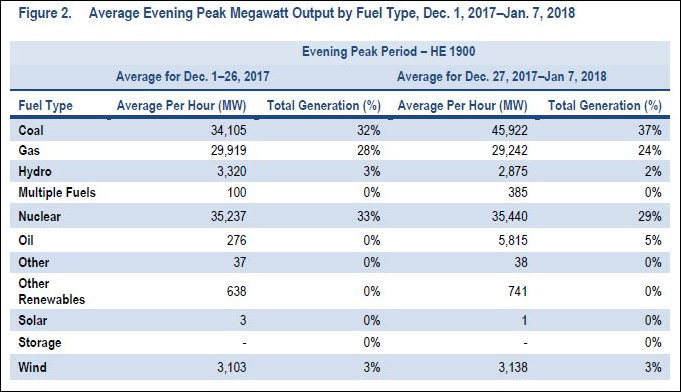
Interesting chart. Reliance on coal has declined and will continue to do so, and that’s good. Mining is dangerous and causes problems, burning it produces too much pollution, and now we are faced with the tons of ash that has everybody’s underwear in a knot. The economic handwriting is clear. We just need to avoid being stupid by shutting plants down willy-nilly and without replacement generation.
But that chart is also a clear indication that renewables won’t be picking up the slack in the near future. Look at the totals for wind, solar, hydro and “other renewables” whatever that means (wood biomass?). What does that add up to, 6 percent at most? I didn’t realize those sources were so minimal, given they are virtually worshiped by so many faithful adherents (many of whom also would oppose more hydro).
-
As we’ve discussed here, PJM can accommodate up to around 30% renewables before reliability and operational dispatch of the grid become significantly negatively impacted. So yes, 6% provides some margin! If everyone really got behind distributed (customer owned) solar generation and simultaneously pushed easily achievable energy savings through building design etc., that number could climb rapidly, but that isn’t happening yet anyway. As for coal versus natural gas, natural gas units are a lot easier to cycle and USUALLY run cheaper due to fuel costs, but the higher cost of gas in PJM during the extended deep freeze is not surprising. Nobody would build a coal unit today just for that brief, one week long price advantage, but as long as they were already there, it’s not surprising that they were dispatched to the max.
-
-
Right now today – under normal conditions – a substantial amount of electricity is still generated by coal. The so-called “war on coal” , depending on who you talk to and their political leanings is different.
For some, the “war” is on the older, much more heavily polluting plants that SHOULD go away. The newer, less polluting plants HAVE TO STAY because grid reliability and resilience WOULD BE compromised.
some on the further left/green side dispute this but some on the farther right side never had a problem with coal in the first place and they see the “war on coal” as part of the Global Warming controversy.
Most reasonable folks want coal to go away altogether – SOME DAY – because it’s not just the CO2.. it’s MERCURY and air pollution that does harm humans – kids, the elderly and those with compromised immune systems… that’s NOT a “war on coal”.. that’s just simple common-sense reason to reduce it if we can…
But we’re not there yet.
We also should ALSO be entirely skeptical whenever proponents of fossil fuels generate “reports” that uses phrases like “system collapse”.
-
One of the more significant aspects of the PJM analysis is the fact that coal was brought online – not because there was not enough gas but because the higher demand for gas drove it’s price higher than coal and that has some serious implications for the future – if/when gas plays out and becomes scarce.
So 20-30 years… if the frack gas starts to decrease – does that mean we’ll be back to relying on coal plants as a cheaper way to generate electricity?
PJM is agnostic on fuel-type. They are neither proponents or opponents of gas , coal or renewables.. they just operate a “market” auction and buyers get he cheapest power they can – regardless of how it was/is generated.
Sure, renewables are going to be the lowest cost – WHEN they are AVAILABLE. But when they are not available – and power is needed over and above what the NUKES are putting out – we are back to fossil fuels – and the cheaper of them.
The only way this changes is when we find a way to cost-effectively STORE renewable-generated electricity in the PJM region, and – that’s at a price point that is much, much less than we’d see in places like California or some of the worlds islands that are now starting to use storage. Stored renewable electricity would have to compete economically against coal and gas, right?
-
Good summary — yes on all counts. Except you are leaving demand reductions (increases in customer energy efficiency) and customer self generation (DG) and paid customer demand reduction on request (load management) out of the equation, and I think they will also prove to be significant.
-
-
“The reason PJM dispatched so much electricity from coal-fired units was that it was cheaper than electricity generated by natural gas, the price of which surged during the cold spell — not because there were inadequate supplies of gas.”
Bwahahaha, PJM, Dominion’s overlord, outs Dominion and its lackeys. For those not paying attention during the last legislative sessions lackyes led by Sen Wagner (Stooge-Dominion) preached incessantly that the “bomb cyclone” underscored the need for the various gas pipelines at any cost as retail consumption had used up all of the capacity and there wasn’t enough left for power generation during the cold snap.
Of course he then demeaned any and all who dared to question his omniscience. I hope someone can spare a few minutes to tape a copy of that response the arrogant Senator’s office door.
-
Well, as one of those thus demeaned (in front of witnesses in the Pocahontas building one day), far be it from me to rush to Wagner’s defense. But the price of gas did shoot up in part due to constriction on the existing lines, something that additional sources of supply might be able to address, and plenty of industrial or residential gas users cannot do what PJM does for the grid – quickly switch to another fuel. There were users who were ordered to curtail.
-
The price of gas went up… it WAS …STILL available..
do we actually know that users were told to curtail for a lack of gas?
But the primary point is – that we got through it without a shortage or availability of natural gas – if you believe PGM.
That sort of pokes holes in Dominions claim that a new pipeline is needed… CLEARLY that pipeline is, in fact, a for-profit venture not a “we’re all gonna die without it” need.
ALSO – Hampton Roads did not implode for lack of electricity or natural gas – either…
The “bomb cyclone” just turned out to be a wonderful “we’re all gonna die without coal” message for the pro-Trump, pro-coal folks.. until of course PJM spoke with truth and power… or some such.
Oh.. and it won’t be long before Trump and company decide to “re-organize” PJM… I bet.
-
Welcome to Sen. Wagner’s shit list, as a long time member and head of the welcome committee, I will send you your new member gift bag.
-
Yeah, less than a year ago I posted on his blog encouraging people to vote for him in the primary. Silly me.
Yes, Larry, plenty of natural gas customers were told to curtail because demand for gas exceeded the pipelines’ abilities to deliver it and the storage was draining. It wasn’t widespread or devastating, but it happened. It happens from time to time. Large customers can choose a price based on whether or not they are willing to be interrupted, and pay more to guarantee supply in a tight market. Gas supply can be shifted around a bit but it is not nearly as flexible as the PJM grid. Industries that use gas know the risks.
-
Steve.. I’m still a little bit of a skeptic on the claim that users are denied gas … I can see where someone gets a cheaper rate – but in doing so – it can be interrupted or at times of high demand it costs a
lot more – which is essentially what PJM was saying.But I’m not a believer that we saw widespread shortages of gas… I’ll change my mind if I see some
evidence.And I continue to say that people should not be forced to sell their land because gas is “too expensive” or it costs more during high demand periods. That’s a private sector issue.
PJM pretty much destroyed the idea that we’d have electricity outages if gas was “short” but it worked great as a PR strategy for Dominion until now.
-
-
-
I don’t know about this winter storm, but in past ones the restrictions on gas availability have been mainly due to limited STORAGE in PA and the Northeast. The long distance pipeline capacity to move it fast enough to replenish existing storage from the plains states and southwest is limited and can’t handle the usage associated with a huge regional deep freeze. That has nothing to do with getting it from PA to Virginia customers. Of course when there is limited supply, the demand for heating homes takes precedence over power plants, IF the gas that’s available has to be rationed. Maybe with additional gas supplies available locally in the Marcellus area there is no longer a transportation bottleneck getting more gas to PA from Kansas and Oklahoma and Texas.
-
-
-
So, the NETL report was a little agenda driven after all. I guess they could have more accurately titled it “How Coal Saved the Electric Grid Some Money”
-
My bet is that as we speak .. the Trumpsters are trying to figure out how to muzzle PJM….. to keep them from screwing up the DOE and Dominion PR tripe.
Good and bad news depending on your perspective.
Bad News. We still have to burn coal at times AND
WORSE NEWS – if gas gets expensive.. we’re gonna burn EVEN MORE coal and
TERRIBLE NEWS: if gas gets depleted and scarce – we’re gonna burn a LOT MORE coal!
Right now – we have little choice but to burn coal for about 1/3 of our electricity. That’s just the reality. Whoever things we gonna stop burning coal needs a ammonia capsule – left or right politically.
If we start exporting Natural Gas -it probably will result in burning more coal as it becomes less plentiful and more expensive.
Good News – getting the truth out – is gonna put a hitch in the giddyup of the false PR narratives about the “need” for more gas pipelines… There apparently was plenty of gas available.. it just got expensive.
PJM operates on free market principles. It works much like the airlines and Uber does – which means the price is determined by demand… all of us should like that…
-
-
Jim – I don’t know if Va. is going to join (Regional Greenhouse Gas Initiative) RGGI or not. I know Gov McAuliffe appointed a committee basically to propose that. Might be worth a separate article on the status of that.
-
It’s striking to me that we are spending time debating the appropriate mix of future generation types for the grid, here. That is something that markets are supposed to sort out. And they will, here; generation has been deregulated by the FERC’s actions creating PJM and its competitive wholesale markets. Yes, there are old grandfathered units that haven’t been spun off by their owners, but no more generation should be placed in rate base by ANY electric utility attached to the competitive grid.
Dominion is free to build all its new generation as “merchant” plants; the only reason it hasn’t is because it can make more money with far less risk of obsolescence putting these plants in its regulated electric retail rate base, and even the VSCC has allowed that, just as the FERC has allowed the ratebasing of the ACP for pipeline transportation rates — both quite wrongheadedly, in my opinion. Retail access has been made easily feasible by the FERC’s unbundling policies and those same wholesale markets and the large number of independent generation owners that operate in them — and Virginia adopted all the legal and regulatory provisions required to implement it; but Virginia reversed course and now (since 2007) forbids retail access as a matter of State law, except for a few loopholes currently being fought over; again, this is is wrongheaded, although forbidding retail access probably has a lot less impact on retail rates than Dominion’s continued rate-basing of new generation, again in my opinion.
The far more important question for us, as retail electric customers in Virginia, is who is going to regulate the retail rates of Dominion — the GA, through partisan political committees whose members are paid political donations by Dominion and preoccupied by everything else going on in our brief legislative terms — or a Commission assigned by the State Constitution to regulate utility rates, with a full time staff with the expertise and the time to do the job professionally, and with open hearings and appellate review by the Courts? If the public is going to have input about Dominion’s rates and what costs are included there, going forward, we need the Commission’s involvement. Not that the VSCC is immune to political pressure — but it’s far better positioned to resist it — IF the GA stops micromanaging utility rates and gets off the SCC’s back and lets it do its job.
-
“We are spending time debating the appropriate mix of future generation types for the grid, here. That is something that markets are supposed to sort out.
Acbar, the markets won’t have much to sort out if CO2 emission caps kill what’s left of the coal industry and Dominion can’t re-license its nuclear units.
I’m not prejudging — I’m not saying that coal should be burned or that the nukes should be re-relicensed. I’m concerned about regulatory action that takes these fuel options off the table, leaving the market nothing to sort out between gas, wind and solar.
-
IMHO coal is already off the table for market reasons — mainly due to the cost of the raw fuel relative to the current competition, and the clean air and ash disposal costs that pre-date the CPP and will long outlive this Administration.
Nuclear, too, is falling off the table for market reasons. The only thing that ever justified the huge up-front capital cost of a nuclear unit, plus its back end liabilities, was the incredibly cheap (per kWh) fuel cost. But that’s just not that true any longer, due to international competition for raw uranium and the spiraling cost of processing.
What’s left? Just what is being built: natural gas cycling, and renewables, and reserves mainly consisting of the older units that may be less efficient or have higher labor costs but can be cycled, plus baseload nuclear if not faced with imminent relicensing/modernization. Someday cheap batteries will help.
If grid generation costs rise — e.g., if natural gas prices start to climb — I think you’ll start to see a lot more distributed generation begin to appear on business and industrial sites and on homeowner rooftops. A State tax incentive for solar wouldn’t hurt but ultimately won’t tip the scales; that is the future anyway. A State policy not to let Dominion rate base new generation (except experimental units like those offshore wind turbines) would definitely promote more innovation, but, again, I don’t think that will change where the grid is headed, where the electric industry is headed, anyway for market reasons.
-
-
-
I think Acbars commentary is compelling…
but I question Jim’s premises about coal and nukes being phased out and the grid only being left with gas and renewables.
That mindset is certainly out there and the specter of it being drum-beat by those who are Conservative and opposed to policies that are theoretically designed to cease all emissions associated with climate change.
That’s part of a much larger philosophical fight but no one – no reasonable people – independent of the politics, are advocating shutting down all coal and nukes – forthwith.
It’s a longer-term phaseout – with major caveats. We close the older , higher polluting, end-of-lifespan plants as we bring on more gas and renewables over decades-long time frames.
Right now we still use coal for about a third of our electricity and there is no alternative to it right now. Sane people will prevail in this – hopefully.
At any rate – PJM would be the very first to sound the alarm and their voice – at least to this point is considered non-partisan and not aligned pro or con with the climate debate.
PJM receives no campaign donations from Utilities and hopefully are immune from the Trumpster idiocies..
What might make a good blog post – is to explore how PJM iis actually funded… eh? Are they govt? Are they funded from fees to the members? How is the leadership selected? etc?
-
PJM is funded by its members. The organization also is very collaborative, involving a wide array of members and stakeholders in its deliberations. I would say that PJM has a high degree of credibility.
As for your statement here: “I question Jim’s premises about coal and nukes being phased out and the grid only being left with gas and renewables.”
I don’t presume anything. I’m saying that there are people who want to shut down all the coal plants, and to block the re-licensing of nuclear, etc., and that we need to consider the long-term fuel mix in our long-term reliability planning. I made no predictions of what will happen.
Please don’t impute views that I do not hold.
-
re: ” I’m saying that there are people who want to shut down all the coal plants, and to block the re-licensing of nuclear, etc., and that we need to consider the long-term fuel mix in our long-term reliability planning. I made no predictions of what will happen.
Please don’t impute views that I do not hold.”
Jim – you are making these statements guy. You are the one who IS SAYING that there are “people” who want to shut down coal. Well.. of course there are – just like there are other people who want to do the opposite.
Is there a serious threat of this actually happening or is this just more throwing up boogeymen?
We have lots of uninformed people who have all kinds of views and share them at the drop of a hat – but we also have organizations like PGM – unlike NTEL – that tells it like it is – and my bet is that far more people are rational and reasonable and if they know that 1/3 of our electricity is generated by coal – they are not going to sign on to any effort to close them – without some realistic path forward.
yes.. there are “people” who blather all kinds of nonsense – from the left and the right but highlighting them as a threat to grid reliability is largely hyped up blather…
For ever loon on the left – we have numbskulls on the right.. no need to point at either as “people who want to do something”…
My only real fear is that PJM WILL be co-opted like the SCC has by FERC and other corrupt influences from the Trumpsters and their supporters in Congress.
-
-
Re PJM funding: there three two main sources of income to PJM: 1. sales of electricity services: PJM sells network transmission service, collecting from LSEs and paying transmission owners. PJM sells energy from the grid and both dispatches and pays generators selling into the grid; these transactions are imputed after the fact as the wholesale energy market. And PJM sells capacity, short and long term, and a number of “ancillary” services such as reactive power, in separate operational markets. All of these transactions are basically a wash. (2) PJM runs the generation interconnection queue for applicants who want to connect new generators to the grid, and coordinates/oversees the transmission owners’ grid planning, for fees that also are basically a wash. (3) PJM collects an administrative charge that pays for everything it does; this charge or tax is levied on the energy that flows through the grid and paid by the LSEs (they and their retail consumers are the “customers” for whom the grid exists). The amount is proposed by the PJM members committee annually and fixed by FERC. Yes, there are also annual membership fees and application fees but they are trivial in the scheme of things.
Peter’s question about spot pricing is hard to answer. In one sense, every electron that moves through the PJM grid from a generator to an LSE does so at the spot energy price at that moment, where “spot price” is defined as the locational marginal price (LMP) at the location where the sale or purchase takes place. As a practical matter, when loads are light this spot price is fairly uniform across PJM, but as loads increase and congestion increases, the locational price varies more from place to place (it’s adjusted for transmission congestion and losses between generation and load). And this is only for energy; the capacity and ancillary and netwwork service markets are separate. You may see a PJM average spot energy price for a moment in time reported and that’s a useful number but just part of the picture. A PJM average spot price over an extended time is, well, just a number.
-
-
When comparing weather-related natural gas price spikes versus coal, I think it is important to make sure you’re not talking only about spot prices. It would seem to be wrong to extrapolate spot market activity connected to short term weather events with longer term price trends.
I don’t know the answer, but it would be useful to know how much of the PJM generation is based on spot pricing.
I looked up Henry Hub pricing activity
https://ycharts.com/indicators/natural_gas_spot_price
and saw that during the early part of January, spot gas prices jumped to $6.24 per mm/BTU before easing back down to #2.78 mm/BTU. This has to cove the period of the bomb cyclone (such a dramatic name!)
But if you look at 2014, gas spot prices spiked to an even higher $8.15 mm/btu before falling to a low $1.76 mm./BTU
One would assume that utilities get most of their gas (and coal) on long term contracts. If this is so, then making all kinds of projections on staying with coal are specious. Coal can’t become that competitive anyway unless gas goes way about $8 mm/BTU or so.
So, it might be silly to make all kinds of energy mix observations based on a few, short-term weather events. I am sure that Dominion, the sponsor of this blog, would like that to be the case, but unless you can differentiate between spot and contract prices, the arguments are really weak.
-
“It might be silly to make all kinds of energy mix observations based on a few, short-term weather events.
The issue isn’t the spot price of natural gas for a few days of intense cold. The issue is whether there will be enough fuel at any price to handle extreme weather events 10 to 20 years from now. I don’t see how the differentiation between spot and contract prices has anything to do with it.
By the way, I have no idea if Dominion shares my concerns. They don’t tell me what to write.


Leave a Reply
You must be logged in to post a comment.