

New Fed Policy Would Hide CMS Data on Patient Safety Records of Hospitals
Share this article
ADVERTISEMENT
(comments below)
Comments
Comments
13 responses to “New Fed Policy Would Hide CMS Data on Patient Safety Records of Hospitals”
-
Please post the comment you made on the proposed regulation.
-
I certainly will. I made no comment. But you should check to make sure I am telling the truth. And if I did not mention it, go away.
-
Clearly, your self-convincing presentation is self-gratifying and certainly truthful to you.
-
-
-
Another way of thinking about this is that without the Feds involvement, virtually none of this information would be available from the hospitals which actually was the case for a long time before CMS started requiring collection of the data and releasing it.
I’m not shocked that there are some who believe that what happened during the pandemic may not be as wonderful as we’d like it to be and releasing the info might not reflect the overall normal performance of a facility.
This is more looking back in the rear-view mirror from the usual suspects, the folks who like to hammer the govt over it’s failings and lack of “transparency” using the data the govt has released!
Just like with the SOLs in Va where Conservatives bang the heck of our public schools -using the very data the public schools provide AND they want to use that data to justify private schools – that won’t provide such data!
As long as CMS continues to require hospitals to provide data in the days ahead – I just see this as not near the outrage that some do.
Yes, we’d like to have the data but we also know who would then use that data to hammer the hospitals and govt for really no good purpose in my mind.
-
Larry, this is not backward looking. The proposed rule will deny the public the data going forward. The “no good purpose” is patient safety, which the government and private non-profits have been working to try to improve for decades. Again, try to keep up.
-
Is this about long term data or just data associated with the pandemic?
I’ve re-read it twice and what I get out of it is data about the pandemic, not the normal data collection that will continue.
Perhaps you should take some efforts to make this clear and not muddle it?
oops… ” Seema Verma, who served as CMS administrator under President Donald Trump,”
IF the “proposal” is to stop collecting data altogether -[ long term – data they have been collecting – then I’m with you.
If however, you’re just playing more conservative gotcha games, shame on you – again.
-
Here’s how the reference communication from CMS starts off:
how about extracting what you’re talking about?
-
How dare you suggest muddling. Holmes has pledged to publish his own comment on the matter as soon as I go away. The self-convincing material presented is self-explanatory and self-contained. A few more readings and – voila- the wizard behind the curtain.
-
It’s a 600 some page proposal that has a number of things in it including a proposal to continue to change some data collection that was initiated under Trump.
It’s not clear to me if CMS waived some data collection during the pandemic and now wants to continue it or exactly what.
I’d be opposed to cease collecting the data longer term but am fine with it not collected during the pandemic when hospitals were under tremendous stress and no surprise that they had some issues.
What’s the point of looking back on that anyhow?
One thing that is being overlooked by the critics is the fact that when CMS makes changes – they don’t do so in secret and arbitrarily – they put out a proposal for comment and comments can and do cause changes to the original proposals.
All in all, what CMS has done over the years has resulted in dramatic and widespread improvement in hospitals collect data , to provide it transparently and to holw the hospitals accountable.
Not perfect by a long shot and subject to some industry pressure to pull back but on balance a benefit to all consumers.
It’s the usual two steps forward, one step back process of bureaucracy not something to get bowels in an uproar over IMO.
-
-
“Conservative gotcha games”.
Larry, the article was about the proposed federal rule to continue suppression of patient safety data. I oppose that portion of the rule.
Do you honestly think that is a “conservative” or “liberal” position? Would you not like to know whether the hospital closest to you has a relatively good or relatively poor record on patient safety?
As for extracting what I am referencing the rule, you could look it up yourself. Or trust me. Since neither of those work, here you go.
The law on Star Rating is Title 42 Chapter IV Subchapter B Part 412 § 412.190 Overall Hospital Quality Star Rating.
(b)Data included in Overall Star Rating –
(1) Source of data. The Overall Star Rating is calculated based on measure data collected and publicly reported on Hospital Compare or its successor site under the following CMS hospital inpatient and outpatient programs:(i) Hospital Inpatient Quality Reporting (IQR) Program – section 1886(b)(3)(B)(viii)(VII) of the Act.
ii) Hospital-Acquired Condition Reduction Program – section 1886(p)(6)(A) of the Act.
(iii) Hospital Value-based Purchasing Program – section 1886(o)(10)(A) of the Act.
(iv) Hospital Readmissions Reduction Program – section 1886(q)(6)(A) of the Act.
(v) Hospital Outpatient Quality Reporting (OQR) Program – section 1833(t)(17)(e) of the Act.The part of the Executive Summary of the proposed rule you published below that references the suppression of data in the text of the rule is:
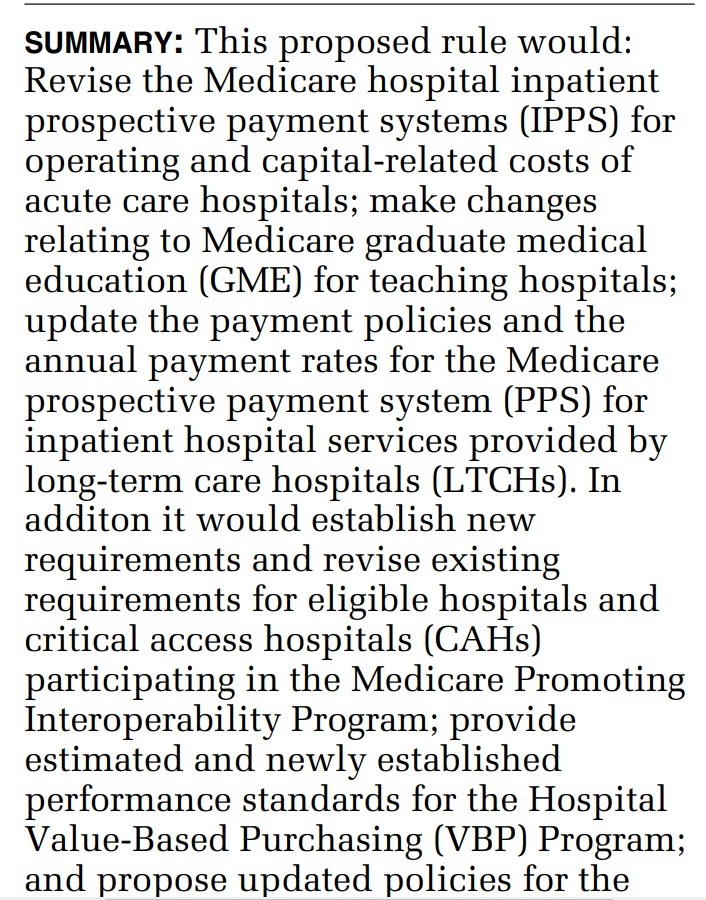
“provide estimated and newly established performance standards for the Hospital Value-Based Purchasing (VBP) Program; and propose updated policies for the Hospital Readmissions Reduction Program, Hospital Inpatient Quality Reporting (IQR) Program, Hospital VBP Program, Hospital-Acquired Condition (HAC) Reduction Program, PPS-Exempt Cancer Hospital Reporting (PCHQR) Program, and the Long-Term Care Hospital Quality Reporting Program (LTCH QRP).”
In other words, they are changing the rules for reporting data for those patient safety programs, including Hospital Inpatient Quality Reporting (IQR) Program – section 1886(b)(3)(B)(viii)(VII) of the Act and Hospital-Acquired Condition Reduction Program – section 1886(p)(6)(A) of the Act.
From my article:
“The metrics that CMS wants to suppress appear on Medicare’s Care Compare website, formerly known as Hospital Compare. The site allows consumers to view a broad range of quality metrics for hospitals, including mortality and readmission rates. Those scores would continue to appear under the CMS proposal, but the site would not report data from what’s known as the PSI 90, or “Patient Safety and Adverse Events Composite,” including how often patients had serious complications from potentially preventable medical harm, such as falls and sepsis.” Medicare Care Compare website is at https://www.medicare.gov/care-compare/
Psi 90 is at https://innovation.cms.gov/files/fact-sheet/bpciadvanced-fs-psi90.pdf”Under that same law, Title 42 Chapter IV Subchapter B Part 412 § 412.190 Overall Hospital Quality Star Rating, quoted above:
“Hospital summary score. A summary score is calculated by multiplying the standardized measure group scores by the assigned measure group weights and then summing the weighted measure group scores.”
(i) Standard measure group weighting.
(A) Each of the Mortality, Safety of Care, Readmission, and Patient Experience groups are weighted 22 percent; and
(B) The Timely and Effective Care group is weighted 12 percent.”CMS, under that law, may suppress Overall Star Rating
“If a Public Health Emergency, as defined in § 400.200 of this chapter, substantially affects the underlying measure data.”That definition is as follows:
“Public Health Emergency (PHE) means the Public Health Emergency determined to exist nationwide as of January 27, 2020, by the Secretary (of Health and Human Services) pursuant to section 319 of the Public Health Service Act on January 31, 2020, as a result of confirmed cases of COVID-19, including any subsequent renewals.”The United States remains under that public health emergency extended by the administration every 90 days. It has been extended again for 90 more days past July 15.
Note that a Public Health Emergency declaration gives the Secretary extraordinarily broad authorities that he does not have absent such a declaration. See https://www.phe.gov/Preparedness/legal/Pages/phedeclaration.aspx
He certainly has the authority, based on his own extension of the emergency, to do what he is doing with the proposed rule. That is not in question. The question is whether the rule is wise and supportive of public’s right to know.
The penalties that I wrote that CMS wants to waive are issued annually through the Hospital-Acquired Condition Reduction Program, which was created by the Affordable Care Act. See that reference at https://qualitynet.cms.gov/inpatient/hac
The Secretary has the authority under his self-declared public emergency to do that as well. Again, not a question of authority, but rather of wisdom.
I will also point out that it is extremely unlikely that the Secretary will ever declare the emergency over and end his emergency powers.
You can perhaps see why I did not include all of this information above in my article. Some of it is in the article I reprinted, along with some of the links. Much of it is not. This answer itself is nearly 1000 words long.
I usually take your questions seriously, Larry. I just sometimes don’t wish to prove to you that I know what I am talking about.
It is exhausting.
I end with the absolute assurance that this will not prove to be enough information for you and you will pose more questions. You will have to excuse me as I move on to the next time in another column.
-
-
-
-
You should sort through the comments if you can to find any from the Virginia hospitals or hospital chains. Would be fascinating. One thing we will never find out is how many folks acquired a COVID infection at the hospital, having arrived without one. That’s among the things they don’t want counted or revealed. But it is the same with the much older issue of MRSA.
-
Good call. Virginia Hospital and Healthcare Association submitted a 17-page letter of comment. On this issue, the VHHA wrote, unsurprisingly:
“VHHA and its members are supportive of the proposed suppression (of data) in the HVBP program” but encouraged it to also suppress pneumonia mortality measure because of the potential overlap with COVID- related pneumonia.
The only way that could happen since CMS is already suppressing data with a primary or secondary COVID diagnosis is if there was no reported COVID indication.
-
In yet another VHHA letter, the association told CMS that hospitals are not primarily responsible for patient outcomes, and should not be graded on them. Such a concept would eliminate reporting on hospital performance. Every one would get a trophy for trying.
“Health care providers in Virginia and across the nation have found that the factors outside of the care of an inpatient facility have a greater impact on an individual’s psychological health and their opportunity for optimum wellness. The American Academy for Family Physicians cites that 80 percent of a patient’s health is determined by social and environmental factors. With that in mind, the metrics and data used to evaluate hospital and health system performance related to addressing health care disparities should be linked to the work they do to directly address patients’ health-related social needs rather than on outcomes and data that health care providers do not impact.”
That can all be true, but it does not mean that CMS should mask from public view the differences in patient outcomes from inpatient treatment.
-


Leave a Reply
You must be logged in to post a comment.