
by Todd Truitt
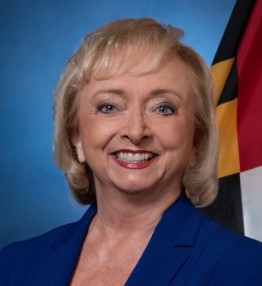
Carey Wright
Much attention has been paid lately to what’s being called the “Southern Surge” in K-12 education on the National Assessment of Education Progress (aka, the nation’s report card or NAEP). Misinformed statements made during the recent New Jersey gubernatorial debate about Mississippi and Louisiana’s educational results have shed new light on the dearth of attention paid to it by the press and education scholars. Contrary to the statements made, Mississippi and Louisiana have been showing consistently stellar improvements on the NAEP the past decade, especially for the least advantaged
demographics.
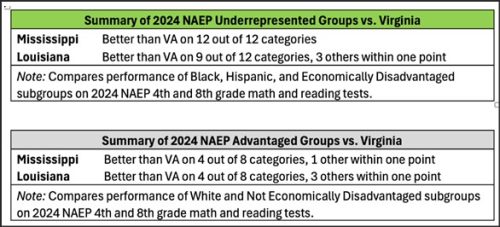
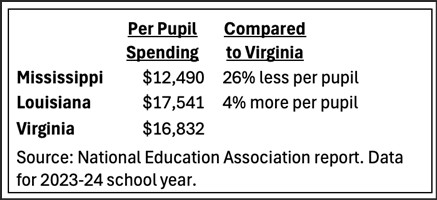
After education expert Chad Aldeman analyzed the demographic subgroup data showing both Mississippi and Louisiana outperforming New Jersey, I dug into that 2024 NAEP data for Virginia (administered in January 2024). Both Mississippi and Louisiana are outperforming Virginia with not only the least advantaged demographics (Black, Hispanic, and Economically Disadvantaged), but also the most advantaged demographics (White, and Not Economically Disadvantaged) — more detailed data is at the bottom of the article. And both states are doing it while spending less money per pupil (Mississippi) than, or a comparable amount per pupil (Louisiana) as, Virginia.
Mississippi’s and Louisiana’s main education policy architects have attributed their success to their states raising the bar on academic standards and greater state oversight of academic outcomes (after the federal government stepped back 10+ years ago).
A recent study (co-authored by George Mason University professor David Houston) demonstrates school boards’ failure to properly monitor academic outcomes. Moreover, national voices on the left are calling for greater state oversight.
Mississippi’s and Louisiana’s results also disprove the argument that “we’re for accountability too, but funding demands must be fully met first.” School divisions continuously allege that their funding is insufficient, no matter what amount is received (e.g., Arlington Public Schools spent $25,175 per student in the 2024-25 school year, the most in Virginia, yet still claims that it’s underfunded). And as seen in the national results, accountability seldom arrives after funding is increased. Meanwhile, the least advantaged kids in Virginia and elsewhere have paid the price for the accountability that never arrived.
Mississippi and Louisiana Are outperforming New Jersey.
Democratic New Jersey gubernatorial candidate Mikie Sherrill said the following in a recent debate against her opponent:
He keeps citing places like Louisiana and Mississippi, I think some of the worst schools in the entire nation. If that’s where he wants to drive us to, I think voters should be aware of that.
Aldeman dug into the 2024 NAEP data, looking at demographic subgroup
performance (instead of overall raw scores) for Mississippi and Louisiana vs. New Jersey. He found both states outperforming New Jersey on various metrics for both the least advantaged and the most advantaged subgroups.
But what about the money? Here’s Aldeman:
According to the NEA, New Jersey spent $24,831 per student in 2023-24 while Louisiana spent $17,541 and Mississippi spent just $12,490. In other words, I think Mississippi and Louisiana have a strong case to be made that their schools are performing considerably better than New Jersey’s are at a much lower cost.
Mississippi and Louisiana Are Outperforming Virginia
You find similar results for Virginia in the demographic subgroup data: both
Mississippi and Louisiana are outperforming Virginia on NAEP for the least advantaged subgroups and the most advantaged subgroups. Further, Mississippi spends less money per pupil than Virginia (26% less per pupil) while Louisiana spends a comparable amount per pupil as Virginia.
Virginia also has school districts achieving results like in Mississippi and
Louisiana. Wise County Public Schools (WCPS) spent $11,517 per student (37% less than the state average) and had Virginia’s third-best overall standardized test pass rate in the 2023-24 school year. WCPS hadn’t ranked lower than eighth since 2013. WCPS is in a Southwest Virginia county that has a high poverty rate, suffers from a meth epidemic and has a high incarceration rate. Educational leaders there attribute WCPS’ success in part to its focus on setting high expectations at the local level.
One former Virginia education leader recently told me that Virginia’s standards of learning exam system and former accreditation system (retired in 2024 after the NAEP exam was administered) were successful for the most advantaged kids, but they failed to incentivize districts to educate the least advantaged kids to their full potential. I believe the data speaks to that, but even many of the most advantaged kids are not
achieving their full potential.
I do think a state of Virginia’s wealth should be providing more money to schools (i.e., an “all of the above” approach). But the data shows that Virginia students are not getting all potential educational benefits out of what Virginia spends now.
Nationwide Decline Since 2015 Demise of NCLB
Virginia and New Jersey are not alone. Academic scores have been trending down nationally since the federal government stepped back from its active oversight of academic outcomes in 2015. The 2015 U.S. Every Student Succeeds Act (ESSA) replaced the 2001 No Child Left Behind Act (NCLB) after fierce advocacy by strange political bedfellows — teachers unions, school boards, and local and state superintendents on the Democratic side, and defenders of local and state control on the Republican side.
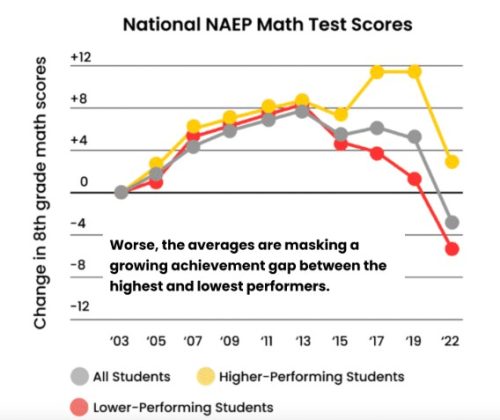
During the NCLB era, students made broadly shared academic gains. As noted by Aldeman: “In eighth-grade math, for example, the lowest and highest performers both improved about 8 points — close to a year’s worth of progress — on NAEP … from 2003 to 2013.”
Academic progress has gone the opposite way since NCLB. Aldeman analyzed the data last year for the 2024 8th grade NAEP math results, which showed growing achievement gaps since the NCLB era. Nat Malkus of American Enterprise Institute found achievement gaps similarly increased for reading, history and civics. Aldeman theorized that the declines occurring since the demise of strong federal accountability under NCLB have been a result of states not stepping into the void to properly manage academic outcomes.
What then has caused the failure of school boards in properly monitoring
academic outcomes? As stated in the foreword of a new national study of school boards, school boards “focus more on facilities and labor issues than on academics.” School board members give their districts much more favorable marks than the rest of the public. American Enterprise Institute scholar Robert Pondiscio found the study’s results demonstrate “not evidence of corruption or malice. It’s something more subtle and insidious: institutional capture.”
National Voices on Left Calling for Greater State Oversight
National education thought leaders on the left are increasingly calling for greater state oversight based on equity. For instance, the leading educational civil rights group, The Education Trust, issued a hard-hitting report last year, finding many states have failed to hold districts accountable for academic outcomes as was intended by ESSA, hurting the least advantaged kids. Notably, the head of The Education Trust is Denise Forte, a former long-time aide to Virginia Congressman Bobby Scott, a co-author of ESSA.
New York Times editorial board member Brent Staples was more blunt: “The federal government made a disastrous choice a decade ago when it abandoned an accountability system (known as No Child Left Behind) that required schools to focus intently on helping the lowest-performing students catch up with their peers. Since then, the already alarming achievement gaps that separate poor and wealthy children have
only widened.”
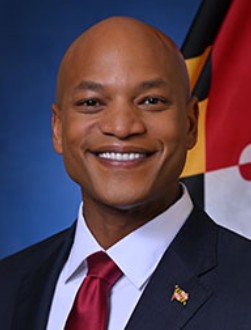

Maryland Democratic Governor Wes Moore is looking to copy Mississippi’s success in raising the bar, with national implications as a possible future presidential candidate. Moore demonstrated his commitment to this initiative by appointing Carey Wright as Maryland State Superintendent in 2023 based on her success as state superintendent in Mississippi.


Todd Truitt is a parent of two school-age children in Arlington County, Virginia and a Democratic education advocate. He is a business transactions attorney.
Leave a Reply
You must be logged in to post a comment.