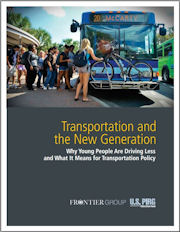
Millennials, Cars and Smart Phones

by James A. Bacon

Several years ago, I gave a speech at a Virginia Department of Transportation event calling into question travel-demand forecasts based upon the extrapolation of past trends endlessly into the future. Among the looming changes I mentioned, as I recall, were the retirement of the massive Baby Boomer generation (retirees drive less), the rising price of gasoline (speaks for itself), and the saturation of automobile ownership in the middle class (when every member of the family drives his or her own car, the rate of automobile ownership levels off).

That was before the Great Recession of 2007-2008, and little did I imagine how soon my prognostications would prove accurate. Vehicle Miles Traveled (VMT) proceeded to plummet. While proponents of ever-expanding road and highway spending argue that the fall-off is due mainly to the Great Recession and slow recovery and that the growth in travel will resume as the economy regains its old mojo, the evidence is overwhelming that the recession overlays long-term, secular shifts in behavior.

As brilliant as I recall having been at the time, I must confess that I did not fully appreciate the magnitude of the shift. I did not predict the impact of new technology and changing cultural mores upon the habits of the younger generation. As it turns out, the Millennial Generation is leading the national move away from automobile dependence. I have mentioned this trend on Bacon’s Rebellion in recent months, but it is only now that I have discovered a superb report, “Transportation and the New Generation,” by the Frontier Group, that I fully comprehend the magnitude of the change.

From the introduction:

The open road that once beckoned to an earlier generation of young people has been slowly replaced by congested highways traversing a landscape of suburban sprawl. Once a symbol of freedom and America’s can-do spirit, the automobile has become for many a financial straitjacket that limits life options. … The emergence of the Internet, mobile technologies and social networking has upended the way Americans, especially younger Americans, interact with each other and the world.

The Millennial Generation is leading the decline in driving. Between 2001 and 2009, the average VMT for 16- to 34-year-old decreased from 10,300 miles to 7,900 miles per capita — a drop of 23% and more than for older generations. Young drivers took 15% fewer trips and their trips were 6% shorter on average. At the same time, according to federal data, they walked more, biked more and took more mass transit.

The roots of this shift run deep. Historically, the number of cars on the road has increased relentlessly. Since 2006, automobile ownership has plateaued. The trend is especially pronounced among young people. Between 2000 and 2010, the share of 14- to 34-year-olds without a license increased from 21% to 26%.

There are a number of possible explanations. One is that every state in the U.S. but one has enacted Graduate Drivers’ Licensing laws that require young people to take more behind-the-wheel training and fulfill other requirements before being allowed to drive. The process of getting a license is longer and more expensive — up to 60 hours of driving practice with an adult and $600 for driving courses.

At the same time, the advent of GPS-enabled smart phones has made alternatives to automobile ownership more attractive. Real-time data accessible by smart phone eliminates the uncertainty of train and bus arrivals, thereby reducing wait times. Smart phone apps also have enabled car-sharing services such as Zipcar and bike-sharing programs, allowing users to reserve, pay for and locate free cars (or bikes) easily at any time of day.

Meanwhile, the crackdown on texting and talking on cell phones while driving cars makes mass transit a more attractive alternative. Social media junkies can Tweet, text and peruse their Facebook pages while riding a bus a lot more safely  than while driving a car. It’s no surprise, then, according to surveys by multiple organizations, today’s young people prefer to live in walkable, transit-oriented communities where automobile ownership is not a prerequisite for going about one’s daily routine.

The counter-argument is that we are experiencing an ephemeral  phenomenon. And perhaps we are. Automobile manufacturers see what’s coming, and they are innovating like crazy, converting automobiles into mobile communication and social-media centers. And who knows what will happen when driverless vehicles become a reality, as some think they will by 2025. It is impossible to know how these developments will scramble the demand for different transportation modes.

What we can safely say is this: The transportation sector is undergoing the most rapid and far-reaching transformation since the introduction of the Interstate highway, perhaps since the Model T rolled off the Ford assembly line. All forecasts based upon the extrapolation of past trends are worthless. We really don’t know how it’s all going to shake out.

Whichever way we end up going — more walking, biking, Zipcars and mass transit or more smart roads and driverless cars — it will require a massive shift in infrastructure investment to support it. And that infrastructure will look very different than the kinds of mega-projects that Virginia seems to prone to build. If Virginia is going to spend an extra $800 million a year on transportation projects, let’s make sure we build a system that anticipates tomorrow’s needs, not yesterday’s.


ADVERTISEMENT

(comments below)


Comments


Comments

70 responses to “Millennials, Cars and Smart Phones”

  1. DJRippert Avatar
    DJRippert

    “Itโ€™s no surprise, then, according to surveys by multiple organizations, todayโ€™s young people prefer to live in walkable, transit-oriented communities where automobile ownership is not a prerequisite for going about oneโ€™s daily routine.”.

    Virtually everyone prefers these kinds of communities. However, few can afford them. And, the unmarried millennials who can afford them will find that they can’t afford them once they get married and have children.

    Your best argument is that the retired baby boomers (with money and no children at home) will drive demand for these communities. Of course, these people may well decide that the less expensive walkable community of Charlottesville is preferable to the expensive walkable community of Old Town Alexandria.

  2. DJRippert Avatar
    DJRippert

    Uh oh ….

    While “wasted hours” definitely dropped between 2005 and 2010 (recession induced), not a singly very large metropolitan area declined between 2010 and 2011. Why not?

    http://d2dtl5nnlpfr0r.cloudfront.net/tti.tamu.edu/documents/ums/congestion-data/national/national-table9.pdf

  3. DJRippert Avatar
    DJRippert

    Deflating the Boomer argument ….

    Jim – see page 2. Yes, the population distribution is expected to change. However, there are expected to be more Americans at every age level between 2010 and 2050.

    The fact that the Boomers are retiring does not prove that there are fewer people in their “heavy driving” years. In fact, this projection from the US Census concludes just the opposite. The number of Americans in their “heavy driving” years will continue to grow for the next 40 years.

    http://www.census.gov/prod/2010pubs/p25-1138.pdf

    1. Don, Basically, you’re saying that the population is increasing. No secret there. But if people drive less per capita, it represents a se change from the trend of 1945-2005, when they steadily and consistently drove more.

      1. DJRippert Avatar
        DJRippert

        Agreed. I think there is a general misconception that when the boomers retire there will be fewer people in the workforce. This is probably true in Japan but not in the United States. Our workforce will continue to grow even as the boomers are retiring.

        Will the presumed decrease in VMT be enough to make up for the growth of people in the workforce?

        1. Compare and contrast: the growth in the size of the workforce (in decadal increments, if you’d like) between 1950 and 2010 on the one hand, and from 2010 forward. Will tomorrow’s workforce grow at the same rate as in the past? No? Well, then, my case rests.

          1. DJRippert Avatar
            DJRippert

            As long as it grows at all we need more roads. You want to stop building roads while we see how the demographics play out. I contend that such a plan would be folly. We will have more people in the workforce. Whatever congestion problems we have now will only get worse as the workforce grows. Sitting on our hands in a fit of indecision will guarantee that we lack the necessary transportation infrastructure for the growing workforce.

            Jim, you say …

            Several years ago, I gave a speech at a Virginia Department of Transportation event calling into question travel-demand forecasts based upon the extrapolation of past trends endlessly into the future. “.

            All well and good to criticize the use of past trends to predict the future. However, you don’t offer an alternative. We know the workforce will grow. We know they will need to get to and from work. We know we have high levels of congestion in many metro areas.

            What is YOUR plan to set transportation goals?

          2. Part A of my “plan” is to address problems that we know exist — like the congestion on Interstate 66, for example — rather than hypothetical problems that we think might exist a couple of decades from now, like the proposed north-south corridor. Part B of my plan is to stop pouring money into mega-projects without ranking projects of all sizes by Return on Investment. There’s no lack of projects that could use funding. We need to be more selective. Funding speculative projects doesn’t make sense to me.

          3. here’s is the view of a toll operator in the business:

            ” When capacity (i.e., new lanes) is added to a roadway it is immediately occupied by the existing latent demand in the rush hour(s). Or, the existing rush hour time period compresses and consumes the new roadway capacity. When new transit service is added in a corridor, roadway capacity that becomes available by that modal shift is again consumed by latent roadway demand. In other words, there is no capacity building strategy that can fully solve congestion, and even if there was, it is not affordable or sustainable. The only strategy that can solve for congestion is an operational strategy using the congestion pricing concept with deployment strategies like priced managed lanes. Not only do priced managed lanes provide a mobility option for automobile customers, they also provide a reliable transit corridor for buses at a much lower cost than traditional fixed-rail transit.”

            ….
            “All trips on a roadway are not the same, therefore, all lanes on a roadway should not be the same. Motorists value their time differently โ€“ whether driving to a job, getting to the airport to catch a plane or picking up a child at day care, versus more leisurely trips for shopping or movies. Urban corridors need to provide choices for motorists who can evolve into customers of priced managed lanes, a mobility option available to motorists when they need it.”

            http://www.tollroadsnews.com/node/6526

            what’s the argument to rebut his?

  4. DJRippert Avatar
    DJRippert

    Yet another dubious claim:

    ” Between 2001 and 2009, the average VMT for 16- to 34-year-old decreased from 10,300 miles to 7,900 miles per capita โ€” a drop of 23% and more than for older generations. “.

    While this might be mathematically true, the shape of the curve over those years is critical to determining whether there is anything to conclude.

    If the distribution among that wide age range was slanted toward older drivers in 2001 but shifted toward younger drivers in 2009 the decrease might be nothing more than a temporary demographic trend. Nobody doubts that 30 year olds drive more than 16 year olds. However, the vast majority of 16 year olds go on to become 30 year olds.

    This looks like a case of cherry picking data.

  5. DJRippert Avatar
    DJRippert

    “Whichever way we end up going โ€” more walking, biking, Zipcars and mass transit or more smart roads and driverless cars โ€” it will require a massive shift in infrastructure investment to support it.”.

    Zipcars?

    Zipcars congest roads just like personally owned vehicles.

    Zipcars do not belong in the same evaluation class as walking, biking and mass transit.

    1. Zipcars substitute for automobile ownership. When people rent Zipcars and pay by the hour, they drive a lot less than if they own their own car and they walk, ride-share and take transit a lot more.

      1. DJRippert Avatar
        DJRippert

        Alternately, a city dweller who doesn’t own a car wouldn’t drive at all until ZipCars come along. Now, that city dweller drives 50 miles, 10 times a year.

        1. Are you serious? Would you like to wager whether Zipcar takes more cars off the road than it adds?

          1. DJRippert Avatar
            DJRippert

            I have been with a number of people who have used Zipcars to get to meetings. All of them are urbanites who don’t own cars.

            I guess you could look at where the ZipCars are getting the best uptake. My bet is places like Boston and Manhattan. I’d further wager that they are being used by people who haven’t owned cars in years.

            Beyond that, it’s irrelevant as to whether ZipCars take cars off the road. What matters is whether they take VMT off the road.

            Jim, have you ever used (or even been in) a ZipCar?

          2. No, does that disqualify me from having an opinion about Zipcar?

            Here’s my thinking. Arlington County wouldn’t be pushing Zipcars so hard if they thought the rental service was adding VMT. They’re pushing it because they think it will reduce traffic. I defer to their expertise.

  6. Kids change everything. Where are the best schools? Where are there safe streets so my kids can ride their bikes to their friends house? How does Mom/Dad get the kids to Scouts, soccer practice, music lessons, etc.? These questions trump the ones about the availability of transit.

    The demand continues to increase until the kids obtain their driver’s licenses, then many get their own car so that Mom & Dad can take a break from the taxicab business.

    “However, few can afford them. And, the unmarried millennials who can afford them will find that they canโ€™t afford them once they get married and have children.” How true! And those people who want to live in Manhattan, tend to do so.

    1. Yeah, kids do change the equation, no question. Now, let’s talk about how Millennials are delaying child birth.

  7. well… good dialogue and I’m in DJ’s corner primarily because “congestion” is still said to be unrelenting and “costing” people.

    A short trip to NoVa during the rush hour ought to convince Bacon that somethings not quite right with the “data”.

    I’m always suspicious of “studies” that happen to coincide with an organization’s basic agenda anyhow and of course that includes VDOT and Smart Growth “studies” also.

    Here’s a basic problem and Darrell and TMT have brought it up before.

    you get move to an urban area (usually with a beltway or similar) to get a job and then you go find the closest “good” neighborhood with “good” schools. Then your job goes away and you have to go find another one.

    okay.. here’s the key part – how far do you look for another job? Do you limit it to close to where you live or do you consider all or part of the beltway within “range”?

    this is even true of people without kids, even single people if they find a place to live that they like and are invested in it financially and emotionally.

    over and over, I’ve heard people say they’d LOVE to take mass transit or carpool …but…. BUT… their personal or professional/workplace circumstance won’t allow it.

    the drop in VMT was likely related more to the economic downturn than anything millennials are doing (or not).

    So.. I’m skeptical although I do agree that as GPS becomes more “connected” and can not only show traffic data for your route but re-route you if your route is dorked…. is going to happen and when it does it may change commuting.

    1. reed fawell III Avatar
      reed fawell III

      I tend to Larry’s point of view, especially as regards the growing tendency to overstate the decline and even the alleged demise of the auto. I fear this tendency is veering to the obsessive, shading into a variant of religious zeal. Once it hardens into ideology, much harm can be done all around.

      1. I don’t think anyone is talking about the “demise” or even the “decline” of the auto. I’m certainly not. I’m just saying that the extraordinary increase in VMT experienced since the end of WWII has run its course and that the trend line is flattening out.

        1. Maybe…. but if you ask the folks that commute to NoVa and environs, I doubt that they’ll characterize rush hour as ‘flattening out”!

          and if the economy starts to pick up – all this talk is going to be like yesterdays TP in the toilet….

          ๐Ÿ˜‰

          I mean – Jim Bacon – have you been listening to the dialog about Hampton Roads tunnels?

          do you think they don’t need more tunnels and bridges down that way?

          but SAY.. come to think of it – Darrell’s been saying it’s going downhill fast and turning into Va own rust belt town.. but then on alternate days Darrell says the congestion is “horrible”…

          hmmm…

          Oh.. and YES.. .. QUESTION – are 18-20-23 years old sailors “millennials”?

        2. reed fawell III Avatar
          reed fawell III

          Fair enough.

  8. DJRippert Avatar
    DJRippert

    I think the biggest basis for a decline in driving is affordability. Median salaries have been pretty stagnant (in real terms) since the late 1970s. Families overcame this in two ways. First, women entered the workplace and changed households from single income to double income. Once that played out people started using their homes as “piggy banks” by borrowing against the growing equity value and spending the proceeds. Both of these approaches helped pay for the escalating cost of automobiles and gasoline (among other things). However, both of those approaches have played out. Now what? If median wages remain basically flat and the cost of driving continues to increase (in real terms) drivers will get squeezed out.

    Of course, we all hope that median wages will start growing again. If that happens – more cars, more miles.

    http://finance.yahoo.com/news/cars-increasingly-reach-many-americans-145957880.html

  9. DJRippert Avatar
    DJRippert

    “Hereโ€™s my thinking. Arlington County wouldnโ€™t be pushing Zipcars so hard if they thought the rental service was adding VMT. Theyโ€™re pushing it because they think it will reduce traffic. I defer to their expertise.”.

    Arlington’s big problem is parking rather than congestion. A ZipCar that is driven 20,000 miles per year by four people takes less parking than four cars being driven 5,000 miles per year each. However, the VMT is the same.

    If you want to play psychological roulette you might think a person who has given up their personal car in favor of a ZipCar will naturally drive less. There are certainly a lot of people in Arlington who own cars that only get driven on the weekends. Arlington presumably wants enough ZipCars in the county for people to feel confident that they can get one when they need one. If that’s the case, people will drop their personal automobile. That saves on parking. However, extrapolating that to mean a decrease in driving is debatable.

    1. DJRippert Avatar
      DJRippert

      “Zipcar has a way of doing things that is particularly appealing to the young, hip urbanites who walk, bike and use public transportation most of the time and donโ€™t own a car.”.

      http://www.washingtonpost.com/blogs/wonkblog/2013/01/02/how-avis-will-ruin-zipcar/

  10. I agree with DJ on the zipcar. It has nothing to do with less VMT. In fact, if Zipcar is going to succeed – their cars have to be in use for a lot of the 24/7 day/week.

    the reason Millennials don’t have cars – is because they simply cannot afford them given the realities of the job market for that generation.

    More than a few have moved back home … and are on their parents insurance policies, health and auto.

    which, by the way, Zipcar is likely a bit too pricey for Millennials anyhow except on some kind of emergency basis.

    If you take a millennial who is making good money – chances are they have a car.

    but it is curious that we have this narrative that VMT is “flattening” but NoVa is going to shrivel up and blow away if we don’t fix their congestion.

  11. Let’s pool some resources and start a competitor to Zipcar. How about Dipcar -a combination of Zipcar and Rent-a-Wreck?

    The lack of growth in personal income is behind an awful lot of problems in the U.S. It is, however, been a boon to the R-B Corridor. Tysons, not so much.

    1. DJRippert Avatar
      DJRippert

      How has it been a boon to the R-B corridor? That whole corridor seems populated by the relatively small percentage of people who are seeing their incomes rise nicely – no?

  12. I’m not sure that Zipcar is a viable business. Let me give a scenario. You rent a Zipcar and then turn it in by parking it. Later.. some idiot nails that car in it’s parking place and leaves the scene. next thing you know, Zipcar is saying you wrecked their car..and are going to charge your credit card.

    The rental car companies make a big “F-ing” deal about quickly checking the care you return stem to stern to make sure you have not damaged it.

    And if you rent a car, you better check it carefully before you take possession of it.

    Zipcar, OTOH do what?

    looks like you’d have to take a cell phone photo of the car with a time stamp to prove the car was rented and left parked in undamaged condition …. but maybe this is already worked out.

    one thing is for sure – the average person over 50 these days is getting hopelessly left behind on the world of Smartphone Apps or for that matter.. the world of smartphones. Hopelessly left behind on technology in general.

    most folks do not know how GPS works nor that their phone is a GPS receiver.

    1. reed fawell III Avatar
      reed fawell III

      Zip car is the smart growth equivalent of Green Energy, and electric car. The latter foolishness being horrible flops and scams that now have been going on 35 years, ripping off the taxpayers since that first oil crisis in late 1970.

      1. reed fawell III Avatar
        reed fawell III

        Correction “1970’s”

  13. Darrell Avatar

    I don’t understand this whole zipcar idea. Parked over by Pentagon City is a Ford Focus named the Fisherman. Zip wants 10 bucks an hour or 75 bucks a day to use this car. You can get the same model car at a known rental store for 25 bucks a day.

    Now, about those jobs… The labor participation rate is now back to 1978 levels. Think about that for a minute. Back then, women weren’t a large part of the labor force. Today the number of people who have dropped out of the labor force is reportedly 90 million. Subtract 75 million kids and we have 150 million active workers including boomers. And a good percentage of those workers are under employed or getting ready to retire.. Yet there are rose glassed optimists out there who think we are on the verge of the Great Recovery.

    I’m not one of them.

    The name of the game for me is travel and gig apps. I collect them like some people collect coupons. The goal is to live out of a backpack and be able to work only if necessary. I’ve been doing a lot of pre-testing by taking vacation and traveling to different places at dirt cheap prices. The apps find deals or I dump them. There are lots of gigs but not a lot of apps yet. Not all gigs pay a wage but offer other amenities like room and board. I’m basically practicing being a hobo with money.

    1. reed fawell III Avatar
      reed fawell III

      Darrell, your incisive genius grows ever more apparent.

  14. re: ” The labor participation rate is now back to 1978 levels. ”

    and the “congestion rate” is at what year level?

    thank GAWD, we’re not at normal employment levels – NoVA would be GRIDLOCKED!

  15. At a meeting last evening on the proposed LCOR rezoning application (the Commons Apartments surrounding Anderson Road in McLean, I asked about price and size. The builder, which owns the Commons, plans c. 2500 units over time, with the bulk of them being efficiencies and one-bedrooms, with some two-bedroom apartments. Average size will be c. 800 sq ft, with efficiencies at around 550 sq ft, renting for $1700 per month. The Company needs average rents in the range of $2000 per month.

    The development, which needs retail, will have parking at 1.2 spaces per unit, unbundled from apartment rent. Lots of parks and open space. Fairfax County zoning law seeks 100,000 square feet of retail to serve 5000 residents. The LCOR development is basically single use — residential. More pressure needs to put on LCOR to add space for retail.

  16. “affordable” housing is a bit misleading and “workforce housing” is more precise.

    specifically, what can service folks who essentially make NoVa “work” for the better off “afford” for a place to live ?

    $10 an hour for a 40 hour week will not buy you a $1700 a month apt.

    so where do these folks live?

  17. “….rose glassed optimists out there who think we are on the verge of the Great Recovery.”

    Darrell might be on to something:

    ” $2 Trillion Underground Economy May Be Recovery’s Savior”

    http://www.cnbc.com/id/100668336

  18. reed fawell III Avatar
    reed fawell III

    TMT above says:”At a meeting last evening on the proposed LCOR rezoning application (the Commons Apartments … in McLean, I asked about price and size. The builder, which owns the Commons, plans c. 2500 units over time, (most) efficiencies and one-bedrooms, with some two-bedroom apartments. Average size will be c. 800 sq ft, with efficiencies at around 550 sq ft, renting for $1700 per month. The Company needs average rents in the range of $2000 per month.”

    Note that this are typical wall up low rise garden apartments.

    In Sept. 2011 a tenant at Commans posted this” Recently, I received a notice from management regarding my lease renewal. To my utter shock, they are raising my rent by 25%. Come to find out, the ownership/management are *trying* to price out the existing tenants. The plan is to remodel these units and upgrade them with all of the fancy amenities that have become “standard” for supposed “luxury” apartments in the Metro DC area. Once those renovations are complete, they’ll put them back on the market and fill them up with more “attractive” residents. (Attractive = More Affluent)

    I realize that it is completely within the management/owners’ rights to make this change. However, they are destroying one of the few apartment communities in the heart of Tysons Corner which caters to people who want the convenience of living in McLean without the hefty price tag and prerequisite snobby attitude so frequently found here. Such a shame, really.
    (Read more: http://www.apartmentratings.com/rate/VA-McLean-The-Commons-of-McLean-1313833.html#ixzz2RZX7t8vB)”

    Another tenant posted this on same website only two week ago: “I have stayed at Commons of Mclean for about a year now. … I have small kids at home and for the past one week the temperature outside has been more than 85. … People with kids stay out. I am serious.”

    Current website makes no mention of kids that I can find. Dogs are allowed at a monthly additional rent of $50 a month. (see commonsofmclean.com)

    Now drive up the Dulles Toll Road to Reston Virginia; Here’s April 16 letter to the Editor: “Monday evening the countyโ€™s Department of Transportation (DOT) staff presented the Master Plan Task Force its latest analysis for traffic in Reston in 2030. The presentation was based on the task forceโ€™s current planning proposal for Reston near the Dulles Corridor, called โ€œScenario G.โ€

    This scenario was necessitated by the abysmal failure of an earlier office-focused development proposal, โ€œScenario E,โ€ to handle traffic at Restonโ€™s intersections.

    The traffic impact analysis, using sophisticated traffic engineering modeling, shows that we can routinely expect morning and evening โ€œpeak periodโ€ traffic at intersections along Restonโ€™s major streets near the corridor to earn a grade of โ€œF.โ€ Amazingly, thatโ€™s actually a modest improvement (8 percent) over (earlier) scenarioโ€™s grade that can only be
    described as โ€œF-.โ€ … And, yes, for all practical purposes, that grade is very much like the one you, I, and our children experienced going through school. An โ€œFโ€ means that an intersection fails to handle its traffic; traffic is gridlocked. It is a โ€œlevel of serviceโ€ (LOS) metric that is part of a national urban transportation standard most recently updated in 2010.”

    (See connectionnewspapers.com/news/2013/apr/16/reston-traffic-difficult-impossible)

    So now we have a snapshot of the direction that Fairfax County is headed.

    1. reed fawell III Avatar
      reed fawell III

      correction – “Note these are typical low rise garden apartments.”

  19. reed fawell III Avatar
    reed fawell III

    Two things strike me concerning this Common’s project. The decline of the family, and the standard of living even in affluence areas of this country.

    In the very early 1940s Metropolitan Life built almost 1700 walk up garden apartment units in Alexandria off what’s now I-95 for the huge influx of civilian workers into wartime DC. After the war these apartments were flooded with returning veterans and their families. (my earliest memories date from Parkfairfax.) By the late 1970’s an unmarried secretary could afford to rent a spacious one bedroom apartment in ParkFairfax. Many of the larger units of two and three bedrooms were filled with young families.

    In late 1970’s I represented Met. Life in the sale of Parkfairfax. The buyer, builder of DC Watergate, upgraded the fixtures and common areas of Parkfairfax and then converted the units into condominiums. Many (but not all) of the then current renters could afford to buy their units.

    Much the same thing is now about to happen at the Commons of McLean, but without the conversion, the families, and indeed the ability of large numbers of people to be able to continue to live in these garden apartments.

    Only new affluent young millennials without children or dogs, save those willing to pay $50 a month dog rent, need apply. What a sterile world.

  20. reed fawell III Avatar
    reed fawell III

    “Only new affluent young millennials without children or dogs, save those willing to pay $50 a month dog rent, need apply. What a sterile world.”

    This seems to be the theme of much of our new urban world. Indeed it seems to be much of the theme of our suburban world that becomes urban. To my mind, this is one of the great challenges of Smart Growth – how do we accommodate it to families. And how do we accommodate families to it.

  21. reed fawell III Avatar
    reed fawell III

    If Tyson’s corner allowed the proper ratio of residential in its mass transit zones, there not be the demand to convert low rise low density walk up garden apartments outside Tyson’s Corner into faux urban residential.

    So this is yet another example of how bad planning in Fairfax serves to twist the urban and suburban market out shape and thus creates bad results for its citizens.

    1. reed fawell III Avatar
      reed fawell III

      Translation – Murderously high rents, particularly those that target adults in their twenty and thirties, do grievous harm to them and our society. Far too often this harm is a direct consequence of bad land use planning, and/or incompetent (and sometimes corrupt) local government. It’s rampant today.

      1. reed fawell III Avatar
        reed fawell III

        Far too often this direct harm is also caused by the Not in My Back Yard mentality of local activists and local government’s unwillingness or inability to deal with intransigence posed by this NIMBY plague. This locks down the ability of local government to deal with their local problems. This plagues the DC government in particular.

        1. reed fawell III Avatar
          reed fawell III

          So, for example, the murderously high rents of apartments in upper NW Washington DC is a direct result of NIMBY refusal to allow apartment construction along Wisconsin Ave.. This is despite 2 Metro subway stops and the spectacular success of its sister street, Connecticut Ave. with its thousands of apartments a few blocks away to the east. The DC government should have resolved this years ago, given its waste of two Metro stops that shifts their costs onto innocent parties.

    2. Not sure this fits with LCOR. CityLine owns the real estate between the McLean Metro station and LCOR’s property. Much, but not all, of LCOR’s land is within 1/4 mile of the rail station. LCOR’s CDP (and FDP for one building) puts the tallest, most dense buildings nearest to the station and tapers backwards. The overall FAR is 2.87. Part of that comes from LCOR’s decision to have 9+ acres of parks and open space, which reduces the FAR. If LCOR is to develop, it must remove the Commons Apartments. And since much of the property is within the TOD area, it’s going to develop.

      The LCOR proposal’s deficiency, in my view, is a lack of sufficient retail space.

      The County Architectural Review Board opposed the LCOR project to protect Goodman’s design of the Commons. In response, LCOR is looking at incorporating some of the original design into the open space and the big, important rectangular field.

      1. reed fawell III Avatar
        reed fawell III

        Perhaps I was thrown off by the current website that advertizes a shuttle bus service to Falls Church Metro. Still, is this not an area with far less density that planned for Tyson’s Corner? Is it not now zoned suburban rather than urban? If they’re now asking for up-zoning giving them a huge bunch of new mid and high rise single use residential without much else, its feeding off lack of sufficient residential in Tyson’s Corner transit zones. And its low rate of new mixed use tends to compound rather than solve problems, as you suggest.

        1. Glad it’s Friday afternoon. I looked up the LCOR CDP submission to Fairfax County. There is a total of almost 21 acres in the project. Of this, 6.4 acres is within the TOD (0-1/4 mile); 10 acres is within 1/4 to 1/3 mile and gets up to 2.5 FAR (plus any bonuses, such as for workforce housing); the remaining land gets no additional bump from the 1994 Comp Plan, which is at 2.0.

          LCOR proposes three buildings in the TOD and four outside that area, along with more streets, a long, narrow park, misc. open space and the very important full-size rectangular field.

          LCOR is located “behind CityLine property at the McLean Metro station and in “front of” the new Safeway store.

          I hope this helps.

          1. reed fawell III Avatar
            reed fawell III

            Thanks. That info moderates my view. Original builder was absolutely first rate, so these existing garden structures are surely sound. But if they are now in Tyson’s TOD or close, more urban density is better if all else is equal or can be accommodated elsewhere.
            Much is in the details. I’ll try to look at submission over weekend.

          2. reed fawell III Avatar
            reed fawell III

            PS –
            The theory behind heavy residential density here is that increased density if done right, will drive down tenants’ rents and region’s traffic, saving its residents and their neighbors time and money while it also enhances everyone’s quality of life.

            This critical point is often lost in the debate, especially by local citizen opposition. Recall that upper Connecticut Ave. DC traffic is roughly same as upper Wisconsin Ave. despite former having 15 times more apartments. And that B/R Corridor traffic in Arlington is roughly same as it was 30 years before.

      2. I still think the amount of retail is capped by whatever the residential demand might be.

        the residential is only going to generate a certain amount of demand and at the end of the day – the only thing you’re really accomplishing is capturing tax revenues that ostensibly will help pay for whatever services the residential requires – which, in turn, is paid for by residential property taxes, captured sales taxes, and what else?

        In the end – this is a bit of a game to try to balance what it costs to provides services to residential with what other things might be able to generate – revenues in excess of the services they require.

        commercial that directly serves the residential will essentially function as a tax collector via the sales tax but commercial that sells to other, external markets will be penalized by taxes and will leave if they can find locations with less taxes.

        You have to look at any/all proposals not in terms of what they offer but how the balance of revenues vs cost of services ends of – IMHO of course.

        the goal of developers and businesses is to make a profit – independent of whether the local govt is collecting enough revenues to pay for services.

        if the local govt accepts development that ends up imposing most costs for services than it recovers in revenues, then it ends up looking for more businesses to pay taxes… and I think that’s what has happened to Fairfax.

        they have been unable to reconcile the cost of services to residential so their strategy has been to attract more businesses and to discourage the kind of residential that requires more in services than it generates in revenues.

        show me where I’m wrong.

      3. reed fawell III Avatar
        reed fawell III

        TMT –

        I looked at LCORโ€™s CDP. You are right. I was off target. Here I suggest the more density the better. This is urban. The goal is to reduce everybody’s traffic, drive down rents for as many people as possible, increase everyone’s convenience and connectivity, and their ability to earn a good salary and enjoy good life without commuting 3 hours a day.

        So DON’T GET SENTIMENTAL. This is not the place for Big Green Spaces, and Historic Preservation. (I speak as an ardent historic preservationist who’s restored and put two downtown DC office buildings on National Register of Historic Places.) Don’t let people use these typical tricks as tools and excuses to drive down other peoples living spaces, drive up other peoples rents, and increase other peoples traffic, particularly where huge amounts of other peoples public and private monies are being spent to build a METRO STOP for everybody.

        It should be criminal to waste these HARD EARNED METRO monies or any part there on big greens spaces and somebody’s vision of Garden Apartments as historic structures or design when they are as common a potted plants in Northern Virginia suburbs. What is not common and what needs to be preserved in Northern Virginia are METRO STOPS.

        People need to stop stealing other peoples METRO STOP MONIES to make themselves feel good, and/or cover up their hidden agendas. (We’ve got noisy, fume ridden, crime breeding bus maintenance depots in DC up for historic preservation. Why? Because they sit over Metro Stops, and local folks don’t want other people to have apartments there)

        TMT – What’s web citation for the County Architectural Review Board’s reasons for opposing LCOR project due to “Goodman’s design? Is it available?

        1. Reed,
          I’ve only seen hard copy of the Fairfax County Architectural Review Committee’s document.

          Parks & open space. According to Fairfax County’s analysis, the McLean area has fewer parks and less public open space than many other parts of Fairfax County. Unless sufficient park space is developed in Tysons, its residents will be heading to McLean and Vienna via cars, creating negative impacts on local residents. Plus, a lack of parks, recreation facilities and open space in Tysons makes it less attractive for landowners to rent and sell property. The Borough of Manhattan has 25% open space, parks and recreational facilities. Much of the open space and parks near rail stations is within the RPAs of streams. CityLine plans to have residential buildings facing a stream park. I think that adds considerable value to what they will be offering to the public.

          1. reed fawell III Avatar
            reed fawell III

            TMT-

            Thanks for pointing that out. Sometimes I overstate a case in order to make a point, particularly when I’ve seen or am reminded of certain counter productive things happen or tactics used to carry out a hidden agenda. As you point out, every case is different. And all of them depend on all sorts of variables particular to each, so my various long distance rantings aren’t necessarily applicable.

            I read a recent Wash Post article on the nearby Scott’s Run approval. I seems things are headed in the right direction mixed use wise, based on the little I read about that case.

          2. Reed,
            Landowners in Tysons are submitting rezoning applications that are generally compliant with the Comp Plan. They are putting density within the TOD areas; proposing mixed use (LCOR is not compliant here); making the appropriate proffers; and working with each other, the County and, to a reasonable degree, other stakeholders, including nearby communities. Because of the excess office space in the County, most developers are starting with FDP proposals that include substantial residential. They are proposing attractive buildings with amenities. In sum, they are working very hard to be successful. That is praiseworthy.

            Having said this, growth at Tysons will also produce crushing increases in automobile traffic. From what I’ve observed, Fairfax County is at the cutting edge of traffic modeling. The 527 Transportation Impact Analysis law forced Fairfax County to do an honest look at traffic. But the County went well beyond that level when it conducted three Consolidated TIAs (CTIAs) that looked at not just one project, but every potential project within three major subsets of Tysons together; all three subareas together; and Tysons in conjunction with other growth in Fairfax County. Modeling was done at the extreme level – assuming everything is built. Thus, we know the best/worst case.

            It is important to note that the previous 527 TIA submitted by law to VDOT became incorrect because the Supervisors approved approximately 30% more density for Tysons than was modeled by FC DOT and submitted to VDOT. I know the landowners were frustrated with the additional analysis (some of which continues) required by the CTIAs. But, for the first time, we all know the real traffic consequences of developing Tysons into an urban center. We know how much development can occur before triggering the need for more roads and non-rail transit. We know what level of development breaks the network.

            I also believe that this knowledge will, over time, push the landowners into new areas of TDM. When faced with traffic failure, I suspect landowners will take new steps to avoid additional auto trips into and out from Tysons. For example, one or more landowners might agree to subsidize transit trips for their tenants’ employees to make their TDM goals. They might sign leases that require tenants to agree to limits on the number of their employees’ cars that can be parked within Tysons. Etc., etc., etc.

            Still, the analysis shows Tysons will always be a traffic nightmare.

          3. re: Consolidated TIAs (CTIAs) and increased density – shows MORE auto traffic not less, right?

            TMT – do you know when they do these analyses how many trips per day they use for residential and whether or not the number of trips per day goes down or stays the same for more density?

  22. I’m not convinced that the free market, sans govt “planners” will generate Smart Growth. Our friend Accurate who lives down Houston way has pointed out the very limited involvement in planners and zoning, etc in that area and the direct result is Uber Sprawl – because IMHO – it’s what people will willingly choose if they have an unfettered choice and so that’s what the market will provide if govt gets out of the way.

    1. reed fawell III Avatar
      reed fawell III

      In general, Larry, I believe you are right. All concerned in most case will take the easy and cheap way out – build things this way because it shortens time, reduces complexity, lowers risk, and increases profits.

      That said, there are enough wonderful developments built out of whole cloth by developers who have gone far beyond what was required of them, save for their own ethics and sense of responsibility. Of course, you find this in all human endeavor. Thankfully, it keeps our faith in human nature alive.

  23. Reed, are you talking about developer-built things that are essentially totally self-sufficient with regard to the mix of commercial and residential such that they pay in full for their services and do not impose addition service burdens on the county?

    If this is true, why not make those the required models for all development?

    1. reed fawell III Avatar
      reed fawell III

      No single development is “essentially” self-sufficient. But many put together right can drive and support, and feed off, a much larger whole. Witness B/R Corridor. And typically, like much else in life, you know quality when you see it. Thus for only one example see Eakin Youngentob projects. See eya. com.

      1. reed fawell III Avatar
        reed fawell III

        PS – for some Eakin Youngentob project results see:
        eya.com/blog/index.php/2013/04/22/study-measures-impacts-of-smart-growth-developments/

  24. don’t mistake my views of this as “we are doomed” or “gloom & doom” in general.

    My basic orientation on most issues is that if we are serious about dealing with issues – we are to be dead honest about them. We have to seek the truth and resist the temptation to become cheer-leaders for something we like because in doing that we start to move away from pragmatism.

    On some thing, we may well end up with no good answers and there may well be a recognition that there is no way to, for instance, deploy a METRO that does not lose money or to build development that does not impose negative externalities on a region.

    but we do owe ourselves the honesty to actually understand and deal with the actual facts – and not gloss over things that undermine our own preferred biases.

    this kind of thing – has a name – it’s called Confirmation Bias and it’s big business now days..

    we have a plethora of different organizations and “think tanks” that now generate studies that CONFIRM their organizations own Agenda!

    SHOCKING! ๐Ÿ˜‰ this is why, for me, the most compelling studies and analyses come from organizations that either have no overt agenda or even better – their study actually contradicts their previous position on something and they change as a result.

    and of course, when you have two opposing entities that AGREE on something that they’d normally disagree on – that’s worth taking a look at.

    Roads are not evil. Smart Growth is not dumb and developers are not greedy charlatans – and planners are not idiots.

    it’s a fabric of many people and institutions who believe they are doing the right thing – but as is so often true – that nasty old habit called subjective reasoning creeps into the realm.

    If you read the fundamental purpose of NEPA EIS – it says this: the goal is to take the “hard look” at something in sufficient detail and scope to help foster good decisions.

    and this has to be the goal of development reviews also.

    there needs to be a systematic approach that is used for all proposals that shows the pros and the cons which are themselves based on “findings” which are basically facts…not prejudices.

    Locally, our process requires a financial analysis of a development – two ways – first the capital costs to include impacts on schools, roads, water/sewer, etc.

    then second, does the project pay for itself operationally from taxes on the properties?

    this is a tall order when you consider than a child costs the county about 5K a year to educate and few residential properties generate that amount of taxes.

    that number in NoVa is more like 8-10K per kid by the way.

    so the kid cost is the elephant in the room that few will actually talk about openly when development is proposed and considered. the developers tend towards residential that is not “too” – “kid friendly” – i.e. less bedrooms, no “yards”, etc…. and this in turn creates development that, in general is not particularly “family friendly” nor friendly towards low wage workforce housing either.

    if we actually want to deal with the issues – we have to be willing to admit that they exist and are involved in development decisions.

    1. reed fawell III Avatar
      reed fawell III

      I agree generally. In particular, we’ve to often been slow in finding ways to measure, predict, and inform the public in a meaningful and persuasive way what the impact of alternative kinds of development will have on lives and livelihoods. Often those best able to do this are poor story tellers. This failure opens a void easily filled by mythology or agenda driven claims and counter claims. Those best able to clear the air then duck for cover instead.

      Perhaps planning departments should better recognize the need for these skills by high level staff and give them the tools and systems they need to drive good results by more forceful presentations of the consequences of alternatives. This is a very hard job. I’ve been to many meetings where the planner were overrun and overwhelmed by the process. It’s painful to watch. Often more serious citizens whose input and support are critical to good results walk away in frustration, saying life is too short. This too often leaves to an open field open for the poorest ‘solutions” to carry the day.

      1. reed fawell III Avatar
        reed fawell III

        In addition, political leaders need to support the senior planners. Too often the reverse occurs. Political leaders use their planners as human shields. This is the sure sign of corrupt political process. It should not be tolerated by the public. Unfortunately the public too often does the reverse, like Roman’s turning planners into Christians fed to the lions.

        1. larryg Avatar

          well.. you’re talking about human nature… and some folks have scruples and some don’t and they work for the govt as well as private industry.

          When we blame govt, we are essentially blaming people but that’s the way the human condition is….

  25. our planners down this way – had devised rules that required each development to have some percentage of commercial – often a strip that would have pizza, pharmacy, grocery, haircuts, etc.

    the idea was to “capture” both sales taxes and what they called “captured auto trips” – the idea that of the 10 trips a day that a residence generates that about half are for getting bread, milk, etc and if they went no further than the edge of the subdivision – it would keep extra trips off of local roads.

    but it soon became clear that the scale of the development had a lot to do with what kinds of commercial were viable or not and that approach got “relaxed” a little.

    My view is that planners do try. They’re more likely to acquiesce to a strong BOS than try to drive the issue although if the BOS is asking them for guidance, they will do that also – and sometimes it’s more the viewpoint of the planner than anything else.

    Personally, I like planned development that have “stuff” that can capture auto trips. I LIKE access management on roads so that the roads are prioritized for transportation not commercial interests and I like requiring businesses to use intra-parcel connections and sharing curb cuts.

    I think the reality is that people are going to drive cars – even millennials if they can and the failure to properly deal with traffic ends ups causing existing residents to oppose more growth.

    when someone talks about ‘congestion’ – they treat any/all “congestion” as if it has the same economic impact and in fact, one of the interesting things about access management is that they actually – in effect – move ‘congestion’ to the left lane or if already in commercial – to wait for the light.

    that frees up the main road for through traffic. So the “wait” is basically moved from the through traffic to the side entering or side-turning traffic.

    is it still congestion ? is it inconveniencing others?

  26. reed fawell III Avatar
    reed fawell III

    Regarding TMT’s april 28 1:33 pm comment “Landowners in Tysons are submitting rezoning applications that are generally compliant with the Comp Plan. They are putting density within the TOD areas; …”

    This is good news. Seems like there are major psychological breakthroughs going on in Tyson’s. That folks there are coming to feel that everyone in is in it together, and that at the stage failure for one is likely failure for all. And so folks are getting ever more serious about building what works, and finding ways to better insure that happens, so that 2 + 2 =6.

    You know a really good developer needs a big array of skills, talents, and experience. He or she has to pull together the vision, ideas and insights that go into a creating a project out of thin air, one that’s never existed in that time and place, yet one that once it’s built has what it takes to work on many levels, and satisfy many different needs of many different people.

    Then the developer needs what it takes to gain the confidence of, and pull and hold together and get going in the same direction, all the people with the talents, skills and money needed to design the vision and build the project on time, on budget, and on target time, price and product wise, to satisfy and sell to the unmet desires of many other people in the market.

    Plus developers need fortitude and energy to keep at those tasks in all their incredible detail, despite Murphy’s Law that the only sure thing in the project’s future is that stuff will go wrong and must be overcome if the project is to work for those critical to its success: bank, partners, buyers or tenants, the community, local government, guy next door and developer too.

    With all this said, developers to succeed must be humanists. Only then do they have a good shot at creating what serves in all its many aspects the deepest and most fundamental needs of those who use what they build. People who will for many years live there, work there, commute there, raise families there, learn there, shop there, make friends and find spouses there, play there, grow up, grow old and die there with memories worth living.

    I say all this because truth is everyone the community – whether residents, planners, neighbors, merchants, or whatever their stake – have a roll to play, and obligation to fulfill, as a developer in the community. The more people appreciate this and take it seriously the more likely is success. Indeed, only then will a community know for sure that their “Developers” will built the right things there, and do it for everyone who lives and works there.

    1. reed fawell III Avatar
      reed fawell III

      Correction – “That folks there are coming to feel that everyone IS in it together, and that at THIS stage failure for one is likely failure for all.”

    2. reed fawell III Avatar
      reed fawell III

      TMT –

      PS – Surely the quality of your commentary on this website proves my point.

Leave a Reply


ADVERTISEMENT