
by Jon Baliles
While running for Mayor in 2024, candidate Danny Avula’s top priority in the “Thriving neighborhoods and affordable housing” section of his platform stated:
As Mayor, he will:
- Fight displacement of long-term residents and expand the supply of deeply affordable housing for low-income and working residents.
His third bullet point in that part of his policy platform claimed he would “strengthen protections and resources available for our most vulnerable residents.”
Somewhere between that lofty rhetoric and today’s reality, Mayor Avula has pushed back against any type of relief for property owners since taking office. Last year, he fought successfully against a four-cent reduction in the real estate tax rate that he said would be a disaster and favored targeted tax relief. Last week, however, the administration once again professed their opposition to relief in general. This time, it is opposition to a proposed ordinance that would provide targeted tax relief and disrupt the pace of gentrification and offer a deferral to those who qualify and help people stay in their homes until they decide it’s time to sell instead of being driven out by ever increasing assessment and tax bills.
The administration spoke out against 4th District Councilwoman Sarah Abubaker’s plan at the April Finance Committee meeting, according to Sarah Vogelsong at The Richmonder. They claimed this one program alone would cost too much and require 20 new financial analysts in the Department of Finance. The entire department currently employs 20 such analysts (including management). At one point during the discussion, the city’s director of revenue administration Ken Martinez also said, “we don’t feel this is really a core function of the Department of Finance.”
Abubaker’s plan would allow those who qualify to defer payment of a portion of their real estate taxes if their bill is more than 105% of what they paid in the prior year. When the property owner sells the house, the amount owed would be paid to the city plus 2% annual interest. Applicants would have to live in the dwelling, not be delinquent on property taxes, and the property would have to have an assessed value less than or equal to 200% of Richmond’s median assessed value for residential property — about $650,000 in 2026, according to The Richmonder. The plan also has an introduction date on January 1, 2028, and requires Council and the administration to jointly develop a plan of implementation by December 2026 which allows a full year to prepare and implement.
“I cannot continue to stress enough that we have to do something for the citizens of Richmond,” Abubaker said at the meeting.
As an example, a house worth $200,000 would owe $2,400 in annual real estate tax. If that assessment rose 10% (as many are expected to do after the two year freeze on real estate taxes to align the budget and assessment calendars), the tax bill would jump to $2,640. An eligible participant would be able to defer the amount above 105%, so in this case, they would owe $2,520 in tax and $120 would be deferred, and the plan has a $50,000 cap on total deferred taxes on any single property. If the assessment goes up 15% or 20% (which many neighborhoods have experienced), they defer and save even more.
Even though it’s a small first step, the administration’s memo opposing her plan claims it would function “primarily as a financing mechanism rather than true tax relief.” Which leads to the question — what is the Mayor’s idea or definition of “true” tax relief? Why has he been opposed to it in all forms? Just about anywhere these days, most people are cutting back on all kinds of things and saving another $120 or $240 would be welcomed. This type of targeted relief is one of many needed tools in the fight against gentrification and allowing people who have lived in neighborhoods for decades to leave on their terms and not the tax man’s. The Mayor should consider upholding his campaign promise to help those neighbors he mentioned during the campaign with targeted relief and give them a helping hand instead of a shove out the door.
So far, the Mayor has not offered relief of any kind, and his administration’s memo complains it’s just too much work. It reads: “Implementing such a program within Finance would require new workflows, specialized program administration expertise, sustain customer service capacity and long-term case management capabilities that do not currently exist within the department.”
Maybe those things should exist in the department? We know they didn’t under Mayor Avula’s predecessor, but why can’t that be an aspirational goal for the Department of Finance to improve and handle more tasks that help people instead of saying we can’t do it because it is just too much work? Avula inherited a mess in all kinds of ways, but his goal should be to clean them up (which he campaigned on), not use them as excuses as to why things can’t be done.
He also argues deferring taxes delays cash receipts “potentially for decades.” So, the Mayor is opposed to targeted tax relief that would defer a small amount of taxes but has yet to unveil or even talk about some kind of plan to collect the $93 million in delinquent taxes that are owed to the city, including $32 million owed in delinquent real estate taxes. Deferring taxes to help people who need it and staunch gentrification is apparently bad, but ignoring tens of millions in uncollected revenue is quietly ignored (not to mention, Abubaker’s plan does not allow anyone who owes real estate taxes to participate).
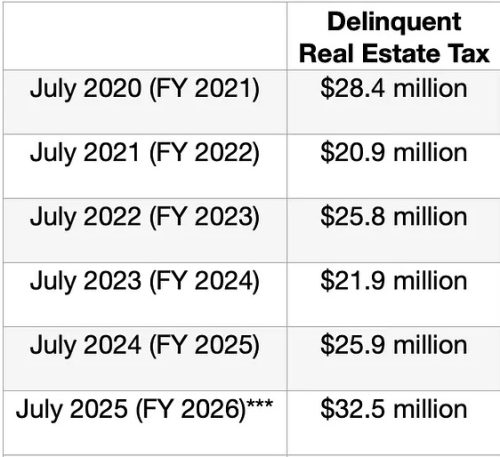
Mayor Avula is simply following the same playbook and using the same lines and excuses to block any type of tax relief as his predecessor – we can’t afford it, it’s not real relief, it’s only for the rich. If you recall the tax debate last October, the Mayor opposed a four-cent rate reduction that would have saved the average homeowner about $150 and the administration said it would put a $17 million hole in the city budget. They called that rate reduction a “potentially catastrophic decision.” A month later, the city announced a $22 million surplus.
During that same debate, the Mayor said tax relief should be targeted so it “actually helps that population is what we should be working to craft, as opposed to something that goes across the board and doesn’t actually help our most vulnerable residents the most.”
At an October 2024 forum when he was running for Mayor, Avula said housing affordability was the biggest crisis facing the city “and many of my low-income neighbors getting pushed out of the neighborhood” because of rising rental rates and assessments. “It’s actually the reason that I decided to run for mayor.”
Fast forward to May 2026 and now there is a plan that comes along to take small first step, but the administration says it’s just too much work and not worth upgrading the Finance Department to be able to handle the basic tasks and also help a small, targeted group of residents who don’t want rising taxes to push them out of their neighborhood. They claim between 6,000 and 12,000 people could sign up for the program which would require 20 to 40 new analysts to manage it and cost the city between $700,000 and $2.1 million in temporarily deferred real estate revenue. Abubaker has a much lower estimate of applicants and Council staff estimated the cost between $400,000 and $1.5 million in deferred revenue. That’s a drop in the bucket in a $1 billion budget but it could be all the difference for someone faced with a decision to stay in place or sell due to taxes.
Forget for a moment that the city’s general fund real estate tax collections alone has almost doubled, from $237.8 million in 2018 to $470 million in 2025. Also put to the side the city’s budget shows that the Finance Department added 35 positions in Fiscal Year 2025 that ended June 30, 2025 and employed 151 personnel the last two years. For Fiscal Year 2027 that starts on July 1, Finance is budgeted for 144 total positions, but they did increase the number of management analysts that Martinez mentioned to 26 (including 4 new senior level positions).
The Avula administration told The Richmonder that in estimating costs and staffing, it had looked at “similar local programs” like Richmond’s Older Adults and Persons with Disabilities (OAPD) program and the Gap Grant initiative. The OAPD program offers up to 100% tax relief or a freeze for those who qualify who are 65 or older or totally disabled and it had 2,292 participants last year. The city’s Gap Grant program, a Stoney-era program hastily unveiled to ostensibly help renters with payments but realistically was proposed in October 2024 to stop Council from lowering the tax rate. That program was a mess from the start and handed off and fumbled by the new administration when it was inundated with applications for assistance. By early 2026, they had only distributed about $732,000 of the $3.9 million set aside for the program and helped 610 people pay their rent. The Avula administration and the Council recently agreed to end the Gap Grant program and the remaining $3.2 million was put back in this year’s general fund budget.
Martinez said that the administration came up with the 20 to 40 new personnel estimate for this new program based on the four to 6 hours per application it took in the OAPD and Gap Grant programs. The administration maintains that the proposed program, which they do not support, would be better placed in housing or human services. However, Abubaker pointed out that the OADP and Gap Grant applications required more extensive documentation (including banking, stock, bond and mutual fund statements and proof of any income or disability). She said the deferral program “was specifically designed so that Finance has this information. We are only asking for assessed value of the home and owner occupancy and any delinquency,” according to The Richmonder. “Those are things that not only live in City Hall, but live in the Department of Finance.”
5th District Councilwoman Stephanie Lynch, a co-patron of the ordinance, chimed in the conversation with Martinez and pointed out that the Finance Department already has 20 analysts. “So you’re saying you would need to double your entire staff just for that small program?”
Martinez replied, “Yes, I would not agree that it’s a small program. Councilperson Lynch, I would say that currently a comment I made earlier that the current staff we have now is enough to handle what we’re doing now.”
While the administration continues to find ways to fight tax relief for anyone and everyone, it’s a good sign that Council disagrees and believe that some kind of relief is needed. Abubaker already has five co-sponsors (Abubaker, Breton, Gibson, Lynch, and Trammell), which means Council can approve the ordinance despite the protestations from the administration. It will be interesting to see where the other four Council members land. As noted, the plan allows for plenty of time to prepare and an invitation to create an implementation plan, yet the administration is still opposed.
1st District Councilman Andrew Breton said at the meeting, “I was excited to co-patron this paper because it really seems like an excellent opportunity to have targeted tax relief for some of our residents who need it most as an anti-displacement measure without actually having to give up that tax revenue, right? Because we will have access to it upon the sale of the home.”
8th District Councilwoman Reva Trammell said, “It just breaks my heart when I hear the seniors, homeowners, especially tell me that they don’t understand why, you know, every time you turn around, the assessments are going up and up and up, and I have to explain to them because they have to be taxed at their market rate,” adding, “we have to do something for the homeowners to feel like that they are, that they matter, and they want to stay in their homes, and if we can do this for them, I think that would be another way to let them know that we appreciate them. I mean, we want them to continue to live in our city and to stay in their homes.”
Trammell’s repeated attempts in recent years to lower the real estate tax rate for everyone have been valiant but come up short, and this plan is the first step towards tax relief the city has seen in over a decade, and maybe more steps will follow. It’s almost sad it has taken this long to show the first bit of outward commitment and optimism towards tax relief in the face of skyrocketing assessments, even if this plan is aimed at a narrow but important audience. One step at a time, and maybe there are more to come for a larger audience of taxpayers and residents who are looked upon as contributors to funding the operation of this city and not just an endless cash register.
This program will be discussed again at a Finance Committee meeting later this week, but it has already spotlighted the administration’s continued “No soup for you!” approach towards tax relief. The administration memo concludes by saying the city needs to explore “approaches that reduce ongoing housing costs without accumulating deferred debt.” When translated, that is merely an open invitation to doing nothing forever except talk about it and offer zero relief to anyone.
The Mayor has gone from talking about targeted relief during the campaign to opposing across the board tax relief in favor of targeted relief, and is now trying to even stop targeted relief that could help keep people in place and push back on gentrification. Abubaker and Council have stepped to the plate and taken the lead on this one, and hopefully it is just the first step towards helping make this city more affordable rather than less so. The Mayor should get on board this train and ditch the tired and expired excuses in favor of fulfilling one his main campaign pledges.
Jon Baliles is a former Richmond city councilman. This column has been republished with permission from his blog RVA 5×5.
Leave a Reply
You must be logged in to post a comment.