
Incremental Gains on the SOLs

by James A. Bacon

Lipstick on a pig

Virginia’s public schools face a long, hard slog before they reverse the damage done by prolonged school closings during the COVID epidemic. Virginia students made minor gains in Standards of Learning exams taken in the spring of 2024, but still fall far short of pre-COVID levels of achievement, according to data released by the Youngkin administration today.

Putting lipstick on a pig, administration officials credited higher standards, a crackdown on absenteeism, longer school hours, summer programs, and high-intensity reading tutoring for reversing some of what Governor Glenn Youngkin termed “the worst pandemic learning loss in the nation.”

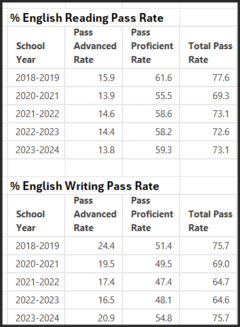
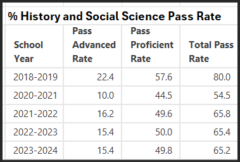
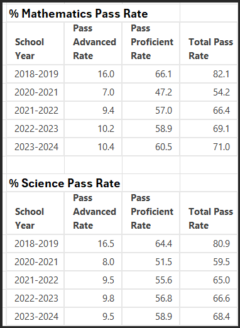
Students showed notable gains in the pass rates for English writing, equaling pre-COVID levels. They scored smaller gains in English Reading, Math and Science but remained significantly below pre-COVID levels. They lost a little ground in History and Social Science.

In a statement made Tuesday morning, Youngkin also blamed previous administrations. Under the Northam administration, he noted, Virginia ranked 46th among the states for reopening classrooms. He also cited “a systematic reduction of expectations,” and an “honesty gap” about how Virginia students’ performance was eroding even before COVID.
What Youngkin could have mentioned but didn’t is that discipline collapsed when students returned to school after COVID. Violence was widespread and classroom disruptions were routine at many schools, compounding the difficulty of helping students regain lost ground. Disciplinary problems eased somewhat last year as adults reasserted control over hallways and classrooms.

“These results show that Virginia students are beginning to recover from the post-pandemic learning loss they suffered after 2020 and 2021. But the results also show that we must continue to focus every day on helping them catch up to pre-pandemic levels and move ahead,” said Superintendent of Public Instruction Lisa Coons in a press release.

Coons said that an emphasis on early reading and the implementation of evidence-based reading research should bring additional gains this year.
Some clouds in the data had silver linings. Having experienced the greatest learning losses during COVID, minority, economically disadvantaged and English-learning kids showed the biggest rebound last school year.

On the other hand, progress was not spread uniformly. Despite overall progress, 19.1% of schools scored declines in their SOL reading scores, and 19.8% declined in their math SOLs.
Team Youngkin used the occasion of the data release to highlight how its policies helped bring about the gains in SOL achievement.

Tackling the post-COVID rise in absenteeism was central to administration efforts. Chronically absent students performed 19 percentage points below their peers in reading and 26 points below in math. However, Virginia’s K-12 schools saw a 16% reduction in students who were chronically absent last year, down from 19.3% in 2022-2023. In total, K-12 students had 1,276,522 fewer absent days, which translated into 8,935,654 more hours of instruction. 

The administration also pointed to the following:

  1. High-Intensity Tutoring: School divisions hired additional tutors, paid teachers stipends, and added more evidence-based tutoring during the school day. 
  2. Extended Time: School divisions added hours before and after regular school hours as well as added time on Saturdays to provide students additional time outside of the school day for tutoring. 
  3. Summer Programs: Some schools added days to the beginning and end of the school year. Many schools added additional at-risk students and expanded hours of programming to support learning recovery.
  4. Resources: Several schools focused on using the state’s free personalized supplemental math and reading resources. One hundred and nineteen of 131 school divisions have signed up to use one or more of these free personalized resources in 2024-2025. 

These are just the highlights. Bacon’s Rebellion will delve deeper into the details in future posts.


ADVERTISEMENT

(comments below)


Comments


Comments

9 responses to “Incremental Gains on the SOLs”

  1. Matt Hurt Avatar
    Matt Hurt

    I would love to see a good example of what you suggest.

    There is a big difference in home schoolers- ask anyone in education. There are some parents who believe that is the right way to go, and they supply the structure and discipline necessary to ensure their kids participate. There are other parents who choose that route to avoid truancy proceedings. Later, when they can’t produce any evidence that their students participated in educational activities and they are forced to return to school, it is obvious to their teachers that nothing happened educationally during that time period.

    There is no silver bullet that would cause the majority of students, on their own volition (without some external prodding), to choose instruction on state standards over other activities.

    1. LarrytheG Avatar
      LarrytheG

      Matt, there are many computer-based instruction programs already in existence of various flavors but the ones I’m advocating are more advanced and they are fewer (and probably not yet “AI”-based), but basically they are interactive in nature and they present questions/scenarios that’s tuned and targeted to a particular kid’s current abilities, and at the same time are collecting data about that student’s performance to assess their current academic ability, and from that provide the next level up content and at the same time capture the results and inform the teacher of the results and allow the teacher to further configure/refine the content to tailor it to that specific kid. THe content will not be lecture but more like “games” , interesting, even entertaining, with goals and rewards. And that content can be on different devices and be offline at home if no internet but once back at school, it will communicate with Wi FI to upload to the teacher the results
      of the session.

      Think of it, in part, as an “APP” that essentially through a series of lessons, administers things like a PALS assessment but in a more complete and comprehensive way, where the software may delve deeper on
      areas where a deficit is seen. The software would be able to get the width and depth of the issue with
      a further series of lessons – things that would not be done on a “every-student” PALS, just where deficits
      are detected on a per kid basis.

      THis is all technological achievable right now but but the actual content (and how it is presented, etc) needs to come from education professionals and consistent with the standards and curriculum of the education system.

      It is a tool only, designed to be used by a professional educator in accomplishing their job.
      It basically automates some of the more administrative tasks and delegates to the teacher the core tasks of what the teacher is trained to do and software cannot. Instead of the teacher having to expend time with each student, the computer does that, under the guidance and direction of the teacher.

      To do this kind of software – it takes very good programmers as well as top-notch educators and if done
      right – kids in homeschool or private schools or confined to homes – would also benefit.

      ON the “prodding”, yes, no question but that’s actually a big part of what teachers do now in the early grades – to keep the kids interested and on task with “fun” things. Properly designed software can do that also but
      yes, at the end of the day, the kid will have to be “prodded” by teachers and parents to do their “work”. Software won’t fix that.

      1. Matt Hurt Avatar
        Matt Hurt

        I'm skeptical that such a thing can take the place of a teacher.

        1. LarrytheG Avatar
          LarrytheG

          It’s a tool, not a replacement.

          It really offloads administrative tasks and frees the teacher to do the things that software cannot do. One teacher can’t possibly deal with the individual needs of all 20-25 kids in a classroom in a timely manner but with the right tools, the individual needs of those kids can be better met with the teacher managing the effort. It would be especially useful for kids who are at-risk, and have more learning disabilities and take longer to learn and need more repetition. It will aid and assist kids who failed to completely master basic reading and writing before they went on to higher grades, and in, turn keep those kids more engaged to finish school rather than become truants and troublemakers.

          For kids that are not able to attend school in person or home sick, or moved, it would be a boon. For schools where staff resources are skinny, it would make better use of scarce resources and still produce good results.

          Public Education needs to adapt and adjust to this or they are likely to end up bypassed as other forms of education that will adapt and evolve.

          1. Matt Hurt Avatar
            Matt Hurt

            This has been tried many times, and to date there is no evidence that this is an effective practice. All of these companies will bring you reams of paper with statistics all over them demonstrating the efficacy of their product, but then when it’s purchased and implemented it fails to produce the intended results.

            This is kind of like the argument that some folks make about communism- it’s the best option, but it’s just never been implemented the right way. Maybe 100 million corpses stacked up in the 20th century wasn’t sufficient evidence.

          2. LarrytheG Avatar
            LarrytheG

            geeze on the comparison!

  2. Matt Hurt Avatar
    Matt Hurt

    Working on it.

    1. James Wyatt Whitehead Avatar
      James Wyatt Whitehead

      Matt I contacted the Fauquier superintendent to point out the districts flat scores. The History and Social Science scores were 29%. Here is what he had to say. He seems to be satisfied with the current trajectory. Good guy. I have known him for a long time. What do you make of it?
      "I am actually really excited about the direction that our trending SOL data, the directives coming out of Richmond with All in VA and high intensity tutoring, we feel good that both reading and math are up from last year and our writing scores across the division are strong.ย  You are correct, there is always much work to be done.ย  As it pertains to the Social Sciences, the division made the decision to go down the performance assessment path years ago, and while I do think the benefits to kids and staff are plentiful, one of the unintended consequences, is that it has impacted the pass rates for the traditional SOL test, very few students across the division opt to take the SOL test, and therefore the low SOL scores for HSS are an indirect result of using the Performance Assessments as a replacement to SOL testing program.ย  Our students can earn Locally Awarded Verified Credit through the VDOEโ€™s Performance Assessment program, a decision previously made and at the moment difficult to undo.ย  ย FCPS1 students who do not take the Performance Assessments, or who failed them are forced to the take the SOL test instead.ย  So in the end I will say, that while the number of students attempting the SOL test is low, the pass rate is not acceptable."

      1. Matt Hurt Avatar
        Matt Hurt

        I really think those numbers are meaningless, and what he says makes a lot of sense. When you look at their results, they administer tests to 700-800 students in most courses, but less than 50 in any history course. Obviously the kids taking those tests traditionally struggle, that’s why they failed their performances tasks and take the SOL test. Their results may actually be good (although we can’t say for sure) when you consider that they’re only SOL testing the weakest 5% (give or take) of their student population. What do you think?

Leave a Reply


ADVERTISEMENT