
by Dick Hall-Sizemore
Eye exam
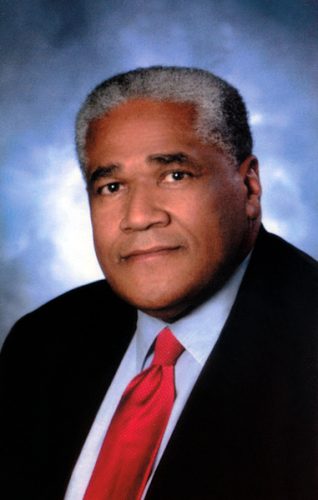
Many years ago, I went to Benny Lambert for my regular eye examinations. His optometry office was in a small building in Jackson Ward across the way from downtown Richmond. No one was ever in the small waiting room when I got there. There was one receptionist. Behind the receptionist’s desk, there was a large room, which comprised Benny’s office and his examining room. There was one chair for patients, surrounded by the usual optometry equipment.
Benny had no assistants. He conducted the entire eye exam himself; having me look through the special lens apparatus and telling him which image looked sharper, image no. 1 or image no. 2, for example.
Benny was also a Virginia State Senator. He was always friendly and talkative. He and I had first met when I worked for county governments. Although I had moved on to the Dept. of Planning and Budget, he seemed still to view me in that former context. All during the exam, we talked about the legislature and state politics.
After some time, probably after Benny retired, I found other optometrists. For various reasons, I have settled on one at the Virginia Eye Institute, a large practice, which has offices all over the Richmond area, quite different from Benny’s little office.
This past week, I went in for my annual eye exam. After signing in with one of several receptionists, I was directed to one of several waiting areas. After a short wait, a young technician summoned me to a little alcove in a hallway and had me look into some equipment at a multi-colored balloon that was at first fuzzy and then sharp. He directed me back to the waiting area where I was quickly summoned by another technician who took me to a room in which I looked into another apparatus. This one had a blue cross and red line running through it. He told me that he was scanning my retina. After that, he directed me back to the waiting area. Shortly, the first technician fetched me and took me to another examining room in which I looked through an apparatus and told him which lines I could read, and then which image was the sharper. He measured the pressure in my eyeballs to check for glaucoma. He put drops into my eyes to dilate my pupils and left, telling me the doctor would be in shortly. (I thought about the epic fights in the legislature long ago between ophthalmologists and optometrists over who should be authorized to put drops in patients’ eyes. Now, a technician was doing it.)
Pretty soon, the doctor himself came in. He did shine a bright light in each eye and told me to look at his ear while he looked inside my eye. Then, he told me that my scan looked good and everything was fine and sent me on my way.
Colonoscopy
Because I have a family history of colon cancer and multiple polyps (father and grandfather), I have had a colonoscopy every three years since many years ago. Dr Pizzani was my gastroenterologist. He also was a solo practitioner.
Dr. Pizzani never converted to electronic records. When it was time for another colonoscopy, I would make an appointment to see him. While I was seated in his office, he would pick up the file folder bulging with the records and pictures from my previous colonoscopies and leaf through it. Then he would direct me to a small examining room across the hall. There I would lay on a table while he pressed around on my abdomen, making sure all my organs were in the right place. After that, I made an appointment for the procedure.
His office was in a building owned by St. Mary’s Hospital (Bon Secours). He performed colonoscopies in the hospital’s outpatient Endoscopy department. After being I had been prepped for the surgery and was waiting in the procedure room, Dr. Pizzani would come in, chat with me, and then I was out for a nice sleep. After I had awakened in the recovery room, he would come in and discuss the results of the procedure with me.
After Dr. Pizzani retired, I decided to turn to VCU Health (MCV) for a gastroenterologist. When I told the receptionist over the phone that I wanted a colonoscopy, I expected her to set up an appointment with one of their doctors. Instead, she said OK, but first I needed a referral from my primary care doctor. That was no problem. I e-mailed my PCP, explaining the history of colon problems in my family and a referral was soon delivered.
I scheduled my colonoscopy over the phone and was directed, not to the hospital, but to an outpatient facility that VCU Health had in an upscale shopping center in South Richmond. On the email confirmation I received was the name of a doctor whom I had never seen. On the day of the procedure, all the nurses were very nice. An anesthesiologist came in to talk to me about what anesthesia would be administered. In the procedure room, just before I slipped into unconscious, I saw a man and he said a few words to me. I later realized that he was the doctor. I never saw him again. The nurses told me briefly the results of the procedure and told me the results would be posted in my portal.
Internal medicine
For many years, I went to an internal medicine physician who was in a two-man practice. During my annual physical, he would spend a good deal of time with me, asking me questions about my health and listening to my heart and lungs, looking into my throat and ears, feeling my organs in my abdomen, and even checking my reflexes. Sometimes, I would be hooked up for an electrocardiogram. After he finished, I would stay in the room and a nurse would come and take some blood and give me a cup for my urine.
I would get the results of the lab tests in the mail about a week later. They usually had some sort of note from the doctor on them, often telling me I needed to lose weight.
He left his practice to join a practice affiliated with one of the national hospital chains. During my next appointment, upon my asking why he left, he said that they were paying him much more than he could make in his former two-man practice. His exam was not as thorough and, while he answered my questions, I got the feeling that he was constantly moving toward the door to leave. Instead of allowing me to stay in the exam room to wait for a nurse to come take my blood, I was told to sit out in the hall and wait for a nurse in another office to call me in to provide a blood sample. I felt like I was on an assembly line.
He soon left that practice. I don’t know where he ended up. After a couple of other doctors, my PCP now is a young doctor in a large practice, but not one affiliated with a hospital chain. My physical exam now consists of a nurse, and then the doctor, sitting with me in the examining room and looking at my medical history on the computer screen, while asking me questions on a check list and recording my answers. The doctor listens to my heart and lungs, asks me if I have any questions, and then sends me to another room where a phlebotomist draws a couple of vials of blood. That’s it. (I have a feeling that this is a standard Medicare “maintenance” exam.) I can access the lab results in my portal on the internet.
I do not doubt that I am getting just as good medical care as in the past; likely better, considering the advance of technology. And it is certainly efficient. But I miss the personal touch.
My hope lies with my dentist and dermatologist. They are both solo practitioners. Notice a pattern?
Dentist
I have been going to this dentist for at least 30 years. Her office is within walking distance of my house. She lives in my neighborhood. She knows my teeth. We are on genuinely friendly terms. I know about her various physical ailments, joint replacements, etc. I know about her husband’s medical condition. I used to know most of her staff by their first names, but COVID resulted in a lot of staff turnover, which is still occurring. Her presence provides stability.
Dermatology
Not only is my dermatologist a solo practitioner, he has given up his office suite and his office now consists of one room in a suite of offices occupied by doctors practicing other specialties. They share a reception desk. It is quite similar to the arrangement depicted in the old Bob Newhart Show.
He has an unusual personality for a doctor. Many years ago, my wife insisted I get an annual “skin check”. (She was somewhat obsessed about skin cancer.) So, I got a referral to this dermatologist from someone. My first impression was that he was an aging hippie. He does not come into the office every day. His first morning appointment is not until 9:30.
The actual exam does not take long. I take my shirt off and he carefully eyes me all over, even briefly running his hands through my hair to feel my scalp. Occasionally, he will remove a cyst or some benign growth, the name of which I can’t pronounce. Once I asked him why he does not use a scanning device like the one my wife’s dermatologist used. Sounding slightly offended, he replied that he had been practicing dermatology for more than thirty years and he knew how to detect skin abnormalities. So far, he does not seem to have missed anything.
Although the actual examination does not take long, the actual office visit often lasts much longer. He likes to talk and nothing is beyond his interest. All during the examination and when I am sitting next to his desk as he records his findings in my chart, we are talking about something. Sometimes, it is about some obscure subject that he has an interest in. Often, he complains about the government and the records he has to submit. Another favorite subject was how he could reduce his office expenses (hence, the downsizing of his office). He does not use electronic health records due to the cost of installing a system. I have heard about his ex-wives. About his old house in rural Hanover. And, most fascinating, about the apartment he owns in a small English village where he spends several months a year.
I am looking forward to my next appointment.
Leave a Reply
You must be logged in to post a comment.