
(Last in a series of articles)

by Dick Hall-Sizemore
The United States, including the Commonwealth of Virginia, has a demographic problem. Luke Rogers, chief of the Census Bureau’s Population Estimate Branch explains,“The first Baby Boomers reached 65 years old in 2011. Since then, there’s been a rapid increase in the size of the 65-and-over population, which grew by over a third since 2010. No other age group saw such a fast increase. In fact, the under-18 population was smaller in 2019 than it was in 2010, in part due to lower fertility in the United States.”
The National Center for Health Statistics (NCHS) uses two measures of fertility rate:
- General fertility—number of live births for 1,000 women in their child-bearing years (15-44) in a given year.
- Total fertility—estimated number of births that 1,000 women would have over their lifetimes based on the age-specific birth rate in a given year. It is used in connection with the replacement rate—the level at which a given generation can exactly replace itself (2,100 births per 1,000 women),
As the graph below shows, both the number of births and the general fertility rate in the United States has been generally decreasing since 2007. In 2023, the number of births declined 2 percent from 2022 and the general fertility rate was down by 3 percent, to a historic low.
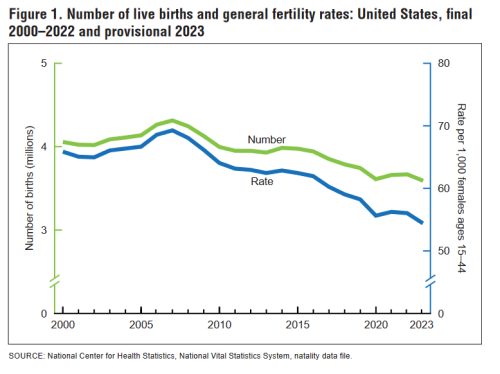
Furthermore, the total fertility rate decreased by 2 percent to 1,616.5, considerably below the replacement rate of 2,100. “The rate has generally been below replacement value since 1971 and consistently below replacement since 2007.”
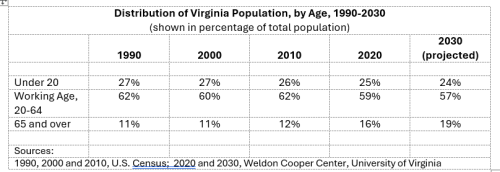
The Commonwealth of Virginia faces the same demographic dilemma. Its general fertility rate (number of live births per 1,000 women aged 15-44) declined from 64 in 2005 to 55.6 in 2022. Furthermore, its population is getting older. Using the age categories utilized by the Weldon Cooper Center at the University of Virginia, the table below shows the aging of Virginia’s population. Until 2010, the percentage of Virginia’s residents in the working age population remained steady, around 60 percent. By 2020, that percentage had decreased to 59 percent, the result of Baby Boomers beginning to retire. Also, in 2010, about one in eight Virginians were 65 or over. By 2020, that relationship had increased to one in six. The Cooper Center projects that the decrease in the working age’s proportion of the state’s population will continue in 2030 to 57 percent, with one in five Virginians being 65 or over. (The 1990, 2000, and 2010 percentages were derived from U.S. Census data. The source of the 2020 data is a publication by the Cooper Center. The 2030 data is derived from the Cooper Center’s population projections.)
From another perspective, in 2018, 24 percent of Virginia’s workers were 55 years old or older, compared to 19 percent ten years earlier and 13 percent twenty years ago.
The country, including the Commonwealth, needs more immigrants because, quite simply, according to the U.S. Chamber of Commerce, “We have a lot of jobs but not enough workers to fill them.” That organization declares that, even if every unemployed person in the country found a job, there would be at least a million job openings left.
The same situation exists in Virginia. The Chamber calculates that, in Virginia, there are 47 workers available for every 100 jobs. The Virginia Employment Commission concurs, “In December 2023, there was one unemployed worker for every two job openings.” Virginia is consistently included in lists of states with the largest labor shortages.
Two sectors are good examples of current and future labor shortages. One is the construction industry. A major national organization of contractors estimated that the construction industry would need 501,000 additional workers on top of its normal hiring pace in 2024 and 454,000 new workers in 2025. A representative of another national construction trade organization reported that 85 percent of contractors are trying to fill positions and 88 percent of them say they are having trouble doing it. The problem is particularly acute with skilled craft jobs, such as electricians, plumbers and pipefitters, carpenters, and masons. However, the shortages are not limited to those types of positions. One Richmond contractor lamented, “We need drivers; we’ve got to move dirt. We’ve got the trucks, but finding drivers is a problem.”
Another sector that faces future labor shortages is rehabilitation and long-term services and support (LTSS). The journal HealthAffairs reports, “By 2030, one in five US adults age 65 or older will need LTSS, including assistance with personal care activities such as bathing, dressing, or other daily living tasks. However, the supply of direct care workers will fall short of projected demand by nearly 7.9 million jobs from 2020 to 2030.”
Those are just two sectors in which there are labor shortages. The picture accompanying this article is one illustration of shortages in other areas. “Help Wanted” signs are commonplace throughout business and commercial areas. Virgina’s latest unemployment rate is 2.9 percent.
In addition to labor shortages, the demographic changes pose another problem. Social Security is running out of money. The Social Security Administration projects that it will have to start cutting Old Age and Survivors benefits in 2033 unless major structural changes are made or more revenue comes in.
To address these two major issues—labor shortages and weakening of the Social Security system—the United States needs more people, more bodies. As has been pointed out earlier, the birth rates and fertility rates of the nation have been declining. The alternative source of more people is immigrants.
The construction industry is clearly already heavily dependent on immigrants from all sources. It is estimated that “about a third of construction’s trade workers were foreign-born in 2022.” That analysis concludes, “The reality of fewer new immigrant workers has compounded the recovery [of construction trade workers].” Regarding undocumented immigrants in the construction industry, according to the Center for American Progress, “One in 5 undocumented workers are employed in a construction-related sector; more than 1 in 10 construction workers are undocumented.” Indeed, if one has had work done on his house, replacing a roof or installing siding, for example, the chances are great that most, if not all, of the workers were speaking a language other than English. Talk to workers, generally, such as those doing tree work or working on roadways or sewer lines, and one will likely encounter foreign-born individuals.
There is widespread agreement among economists that increased immigration is good, overall, for the United States economy. As Michael Clemens of George Mason University explained, “New people joining the American economy are a cornerstone of economic growth.” Harvard economist Jason Frum is more specific. “We’ve had 3 percent real [gross domestic product] growth, which is extraordinary for this stage of a business cycle. We’ve been adding more than 200,000 jobs a month, on average. That’s way higher than anyone thought could be sustained. A lot of the job increase has been in undocumented workers. It could never have happened without a large inflow of immigrants.” (For other similar analyses and conclusions, see here, here, here, and here.)
Nevertheless, there are frequent charges that immigrants, particularly undocumented immigrants, are detrimental for certain aspects of the economy. Some of these specific charges will be examined in the following paragraphs.
Decrease wages. It is claimed that a supply of workers who are willing to work cheaply decreases the overall general wages in an area. This seems intuitive. Indeed, many analyses found that the presence of undocumented immigrants resulted in generally lower wages. However, they all say that the effect was a short-lived one and that, over the long term, the effect of immigrants on wages was very small. Furthermore, the effect was not consistent over all sectors of the economy. Those most affected by the arrival of new immigrants were prior immigrants and native-born high school dropouts.
In addition, some economists take issue with earlier studies showing that immigrants might suppress wages. Along these lines, Peter Morici of the University of Maryland points out, “In some situations, adding immigrants might suppress wages a lot. But right now, we have such a labor shortage for restaurants and so forth, that I doubt closing the shortage is going to have much of an effect. We’re in a very different place now—we simply don’t have enough young workers coming into the system.”
For additional sources discussing the minimal effect of immigration on wages, see here and here.
Take jobs away from Americans. Closely related to the issue of depressing wages is the charge that undocumented immigrants take jobs away from Americans. Actually, this is a minority view. According to a poll conducted by the Pew Research Center, more than three-quarters of Americans said they believe that undocumented immigrants fill jobs that “U.S. citizens do not want.” A lower percentage had the same opinion of legal immigrants. That majority opinion prevailed across racial and ethnic groups, as well as partisan lines.
Rather than taking jobs from American citizens, a report from the St. Louis Federal Reserve Bank notes that “when workers are complementary, an increase in immigrant labor can increase job opportunities and wages for native-born workers.”
Immigrants are consumers, just like the rest of the residents of Virginia, as well as the nation. Those 11 million undocumented immigrants in the country buy a lot of stuff. As an analysis of the Wharton School at the University of Pennsylvania declares, “This increased demand, in turn, generates more jobs to build those homes, make and sell food, and transport TVs.” In a report published by the National Bureau of Economic Research, analysts found that “legalization [of undocumented immigration] has a positive employment effect for natives” because it “stimulates firms’ job creation by increasing the total number of immigrants and stimulating firms to post more vacancies, some of which are filled by natives.”
Increase housing costs. Recently, immigrants have been blamed for high housing costs. As with wages and jobs, the relationship between the two is not as clear-cut as some portray it.
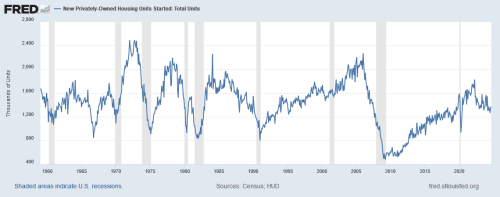
Jerome Powell, chairman of the Federal Reserve System, placed the blame for the high costs elsewhere. “The problem with housing is that we have not had enough housing.” In other words, it is a supply problem. The data backs him up. The graph below from the St. Louis Federal Reserve shows the precipitous decline in housing starts in new privately-owned housing units from 2005-2010 during the Great Recession and the slow and uneven increase since then. The latest numbers are still lower than the pre-Great Recession data.
Undocumented workers are not a significant factor in the rise in the cost of owner-occupied housing. Most of them do not have the money for a down payment and cannot afford the mortgage payments and, for those that could, it is very difficult to obtain mortgage financing.
The vast majority of undocumented immigrants are renters. Many economists conclude that having a large number of immigrants could result in general increases in rents. (See here and here.) Nevertheless, the picture is murky. For example, a large proportion of undocumented immigrants live with legal immigrants or U.S.-born residents. That is, they live with relatives who were already in the United States, rather than in their own, separate apartment. Even Steven Camarata, Director of Research for the Center for Immigration, one of the leading anti-immigration organizations, conceded, “Much more detailed analysis would be necessary to confirm this relationship [between immigration and rent affordability].”
Any analysis of the relationship between immigration and housing costs needs to factor in the fact that, as Moody’s put it, “immigrants form the backbone of the construction workforce.” As a result, reducing immigration “would tighten the job market in construction [and] delay project deadlines.” With fewer immigrants, the construction industry would have produced even fewer housing units, thereby likely increasing their cost. This is what the Wall Street Journal has called a “double-edged sword.”
Drain on public resources. Many raise the objection that immigrants cost taxpayers too much. Taxpayer money spent on immigrants, they contend, should be spent on American citizens. As is the case with the other objections, this one is more complex than it would seem.
Undocumented immigrants are a boon to the U.S.Treasury, but they do put a strain on state and local government budgets, although the negative effect is not universal.
The nonpartisan Congressional Budget Office (CBO) projects that the federal revenues from taxes paid by undocumented immigrants will total $788 billion from 2024-2034, while the increases in mandatory spending related to this population will be $177 billion, resulting in a $611 billion decrease in the national deficit. If one includes changes in the overall economy related to this population, CBO projects the total increase in federal revenue ascribed to undocumented immigrants over this period will be $1.2 trillion and result in a net decrease in the federal deficit of almost $900 billion.
The eligibility of undocumented immigrants for federal programs is limited. To be eligible for Social Security benefits and the premium tax credits provided with the Affordable Care Act (Obamacare), undocumented immigrants must:
- Have had an application for asylum pending for at least 180 days and either (i) have been granted a work permit on the basis of that application or (ii) be under the age of 14, or
- Have been granted temporary protected status, or
- Have been granted deferred action.
Otherwise, the only federal benefits they are eligible for are child nutrition and emergency medical care. CBO estimates that 8.7 million undocumented immigrants will have entered the United States in the 2021-2026 period. Of that amount, only 35 percent will be eligible for Social Security and ACA premium credits. Other than those exceptions, the Congressional Research Service reports “unauthorized noncitizens…are not eligible for most federal benefits.” That includes assistance following natural disasters, such as the flooding in North Carolina from Hurricane Helene.
The situation with state and local governments is different. Generally, studies have found that the cost to state and local governments for the provision of services to undocumented immigrants exceeds the revenues collected from them. The primary services are education, health care, and housing, but many states have chosen to provide additional services. (See here and here and here.)
The imbalance in the tax receipts and cost of services for undocumented immigrants has not been true in all states. A recent study by the Rice University Baker Institute for Public Policy found that “for every dollar the Texas state government spends on public services for undocumented immigrants…the state collects $1.21 in revenue.” Similar studies in Florida and Arizona report that total state tax revenue attributable to noncitizen immigrants exceeded the cost of public services consumed by them.
In addition, undocumented or temporarily protected immigrants have had a significant positive impact on many localities. One such locality is Buffalo, N.Y. As described by Rob Leteste, of the regional economic development organization, “Our refugee and immigrant community, starting in the ‘90s, has been a strength for the city, revitalizing the neighborhoods on the West Side to increase values and bring back a lot of people who were living in the suburbs. A lot of the jobs that our refugee community is taking are more of the entry-level, production base, manufacturing, health care—that the employer has not been able to fill with the typical talent pipeline that we have in town.” Similar results have been reported for other cities in upstate New York such as Rochester and Syracuse.
Then there are the much-maligned Haitians in Springfield, Ohio. In an op-ed piece in the New York Times, Mike DeWine, the governor of Ohio, strongly attested to the value of that population to the city:
“Springfield is having a resurgence in manufacturing and job creation. Some of that is thanks to the dramatic influx of Haitian migrants who have arrived in the city over the past three years to fill jobs….They are there to work….As one [business owner] told me, his business would not have been able to stay open after the pandemic but for the Haitians, who filled the jobs….There have been language barriers and cultural differences, but these Haitians come to work every day, are fitting in with co-workers and have become valuable employees.”
In summary, the National Academies of Sciences, Engineering and Medicine issued an extensive (618 pages) report on The Economic and Fiscal Consequences of Immigration. It concluded:
“the long-term impact of immigration on the wages and employment of native-born workers overall is very small, and… any negative impacts are most likely to be found for prior immigrants or native-born high school dropouts. First-generation immigrants are more costly to governments than are the native-born, but the second generation are among the strongest fiscal and economic contributors in the U.S. This report concludes that immigration has an overall positive impact on long-run economic growth in the U.S.”
My Soapbox

The United States has a long history and tradition of openness to immigrants, to being “a beacon of hope.” The immigrants coming to our borders today are fleeing government and gang violence, along with grinding poverty. They have endured great hardships in search of a better life for themselves and their children. They are human beings, with the same hopes and aspirations of native-born Americans. As a group, they pose no threat to this country’s safety or security. Finally, the United States needs them for the country to grow and prosper. With exceptions related to health, violent behavior, and national security risk, we should, for humanitarian and pragmatic reasons, lower the barriers and let them come in.
To gauge the current impact of immigration on Virginia’s political landscape, it is enlightening to examine the journeys and legacy of three sets of relatively recent immigrants:
- She came to the United States “running from the socialist regime that overtook my home country of Cuba. The oppression and persecution toward anyone who did not agree with the regime’s policies and ideology became intolerable. The United States was a beacon of hope, a country where everyone could dream of achieving their goals with hard work and determination.”
If the policies in effect today had been in effect when Miriam Miyares, mother of Virginia’s Attorney General, Jason Miyares, left Cuba, she would not have been able to enter the United States so easily, if at all. Chances are she would have had to traverse the Darién Gap; travel 2,000 or more miles to the United States border under constant threat of being robbed and raped; and then have to wait indefinitely at the United States border to present her case for asylum, which likely would not be granted.
Those coming to the border now are also fleeing oppressive regimes and violence and they also regard the United States as a “beacon of hope.” Why shouldn’t they have the same chance that Miriam Miyares had?
- She was six years old when “my father came to America from Jamaica with $1.75. He took any job he could find, put himself through school with that money, and started his American dream.” She later exclaimed, “From the time my family arrived in America from Jamaica, we have realized and appreciated the opportunity that the US provided us.”
I couldn’t find any information regarding the circumstances under which the father of Winsome Sears, Virginia’s current Lieutenant Governor and announced candidate for governor in next year’s election, was able to immigrate to America. It is unlikely he would be able to do so today. He may have been able to get her over the border as an unaccompanied minor, however.
Why shouldn’t those who come to the border today with their children and looking only to work and “start their American dream” be allowed the same opportunity as Winsome Sears’s father had?
- His parents brought him to the United States as they were fleeing the fall of Vietnam. Their son was a member of the inaugural class of the Thomas Jefferson School of Science and Technology and went on to the Naval Academy. He served in the Navy for 25 years and retired with the rank of captain.
Recently, Hung Cao, a candidate for a Virginia U.S. Senate seat, said, “When Vietnam fell, we had nowhere to run to, but this country called the United States took us in, gave us opportunity, gave us life.” Earlier this summer, he told the delegates at the Republican National Convention, “America saved my life.”
If his parents had had to leave Vietnam under the conditions current today, Hung Cao may not have been able to enter the United States. There are likely kids like Hung Cao who have traveled thousand of miles with their parents fleeing violence and persecution who have “nowhere to run to” and are now waiting in Mexico today for a chance to come to the United States. Why doesn’t the U.S take them in, give them opportunity, and save their lives as it did for Hung Cao?
Leave a Reply
You must be logged in to post a comment.