
How Much Will This Bill Cost?
Share this article
ADVERTISEMENT
(comments below)
Comments
Comments
34 responses to “How Much Will This Bill Cost?”
-
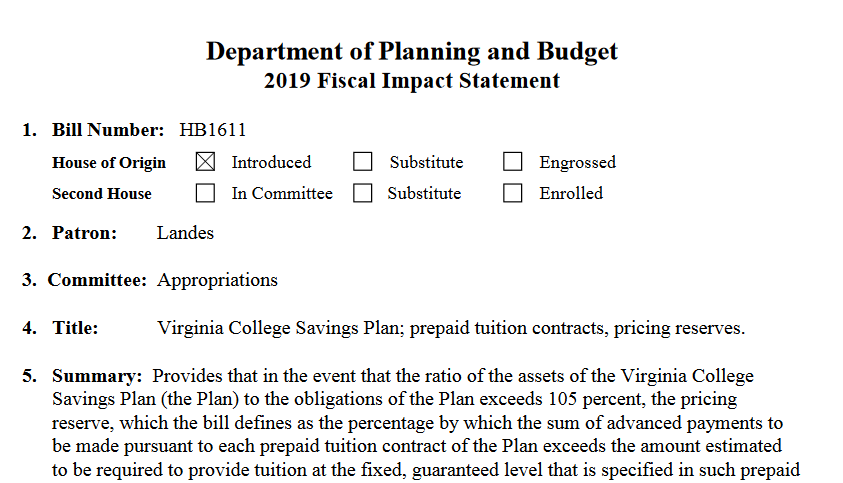
re: ” The FIS can be an important factor in determining the fate of a bill. The projected cost of a bill can be used by its opponents as additional ammunition in their efforts to kill it. Similarly, projected increases in revenue or savings can be used by the advocates of a bill to help advance it.”
Of course, the word on the street is that the “liberals” are going to shoot the entire process in the butt and proceed “recklessly” to screw Virginians!
🙂
Thank you for explaining how things works. Seriously. I doubt seriously than 1 in 100 had a clue as to the process you just described.
I thought also , possibly wrongly, that the Auditor of Public Accounts might have some role in this…. no?
Also – with the MedicAid Expansion – did the DPB process show a net savings or an increase the Medicaid budget?
-
Nicely done!
There are times when these cannot be much more than a guess.
-
There are times when a good guess would be an improvement! As Dick noted, agencies do many of them and the size of the cost estimate is about 150 percent correlated with whether or not the agency wants the bill to pass. I will neither confirm nor deny doing that when I wrote FIS forms for the Attorney General’s Office. A fat cost estimate kills hundreds of bills per year, because they often then lead to the need for a budget amendment. The FIS is like most products of modeling, never accurate but sometimes useful. Smart lobbyists, and I know one or two, worry more about getting a helpful FIS first and then go looking for votes on the floor.
-
-
Thanks for an inside look at the legislative process that we never read about anywhere else.
-
I second that.
-
-
okay, so how/why the “budget process” is different/separate from the FIS process. I would have thought they were one and the same.
If Medicaid Expansion was NOT FIS – but it was still a new “bill” then how was it’s financial impact analyzed different/separate than FIS?
-
So, you really want to get into the weeds, don’t you? OK. I enjoy doing it.
Unfortunately, a lot of legislating is done in the budget bill. I say, “unfortunately”, because the practice is not as transparent as having separate bills. There are several reasons for doing it, which I won’t go into, but, suffice it to say that both the Governor and the GA has done it and both parties have engaged in it.
The Medicaid program is governed by the State Plan, which has to be approved by the feds. I am assuming that, when the program first started, the GA was not content to let the Governor make changes in the plan without GA approval. After all, changes usually ending up costing money. Because the plan needs to be changed every year, it seems, and those changes are often technical and they directly affect the budget, the budget bill was chosen, rather than regular legislation, to be the vehicle for the GA to authorize changes to the plan. There is one Item in the budget bill that encapsulates all the authorized changes to Virginia’s state Medicaid plan. It is a cumulative item, added to each year. It is the longest Item no. in the Appropriation Act, taking up 26 pages of technical language and federal acronyms. It was here that the provisions to expand Medicaid were enacted. Only someone familiar with the terms and references would understand it. The term “Medicaid expansion” is not used anywhere.
The authority for DMAS to levy a provider payment assessment, the so-called “hospital tax “, was buried in the back of the Appropriation Act, in Part 3: Miscellaneous.
Finally, in the 2018 Appropriation Act, there was included a separate “enactment clause” at the end of the Act whereby the GA enacted two new Code sections creating the Health Care Coverage Assessment Fund into which the revenue from the provider payment assessment was to be deposited.
In summary, Medicaid expansion was carried out through the budget bill to which the FIS process is not applicable.
-
well, that possibly explains why Steve often see’s one medicaid – not the original then the expansion as a separate program.
okay – so next question –
we know that the bills are submitted by “patrons” who have at least some involvement in changes made to “their” bill – although perhaps in the process other hands can touch it.
But who are those folks who make decisions in the budget items and process? Is it a small select group or an ad hoc appointed group?
who makes the final decision as to what is in the bill that is presented for Assembly vote?Do the other folks in the GA actually know the specifics of the budget before they vote… you spoke of the Hospital Provider tax as if it was not very visible… do the other elected know of these not obvious changes? i.e. did the GA members KNOW that they were voting on a hospital provider tax?
-
Gotta go right now. Will try to provide some answers tomorrow, unless Steve wants to take this one on.
-
The folks who make the decisions on the budget items are the staff of the money committees (House Appropriations and Senate Finance) and the Delegates and Senators on those committees. And to narrow it even further, it is the staff and members of the subcommittees of those entities. And the final decisions are made by the members of the conference committee that meets to reconcile the differences between the House and Senate versions of the budget bill (in recent years, 7 members from each house). Finally, there are subcommittees of the conference committee who meet to reconcile the differences in each area (public safety, education, etc.), 2-3 members from each chamber, along with a staff member from each side.
As to whether other folks in the GA know the specifics of the budget bill, no, they do not. Each house’s version of the budget bill is revealed on a Sunday afternoon, just before bill cutoff (when both houses have to finish up their own bills, so a very busy time), with the vote scheduled for the following Thursday. There are staff briefings and floor explanations and debate, so members can learn whatever details they are interested in, if they are willing and able to put in the time. As far as the conference bill is concerned, sometimes there are just a few hours between the time the conference report is produced and when the final vote is taken.
Another factor to consider is that all the attention is focused on changes to the Governor’s introduced bill that are recommended by the money committees. The changes included in the Governor’s introduced bill that were accepted by the money committees are hardly ever considered by the full houses.
In the end, I would say that the only GA members who understood the specifics of the entire budget bill were the chairs of the money committees, but I have some doubts about the Senate side. It would be a safe bet to say that the only GA member who understood the specifics would have been Chris Jones, the chair of the House Appropriation Committee, who was defeated last fall.
Notwithstanding all that, for major policy issues such as Medicaid expansion, there are detailed briefings for the members prior to the bill being considered on the floor and explanations of the issues on the floor during debate. Each member certainly had the opportunity to know that he/she was voting on a hospital provider tax when voting on the budget bill. They probably did not know where in the budget bill it was located, but they knew it was part of the package. If anyone did not know, then they were not paying attention.
-
-
-
The budget is one giant FIS. The main document provides the outlines on programs (revenue sources, total spending and in some cases a fair amount of explanation.) And behind the document, the bill itself, is a mountain of detail on each item maintained by the Department of Planning and Budget. Once upon a time those documents were hard to get, but now much of them are on line, too. How many personnel of what kinds, operating costs, travel costs, etc. Its all in the supporting documentation.
The FIS process Dick was writing about is for other bills, not part of the budget, but with financial impacts. You want to add a new program or agency or benefit. You want to create a new category of crime. You want an agency to tackle some new task. If passage of the bill may/will have a fiscal impact, an FIS should be done. Many, many bills have no FIS prepared and many others read “this can be done within the current appropriation.” (That’s what the agency says when it likes the bill!) If you propose to eliminate a program, that has a positive FIS maybe. Propose a new tax and there should be an FIS on the revenue expected.
If you do a budget amendment to cover the new program, often required, that will include needed personnel, overhead, etc….so a budget amendment and an FIS are really the same thing. Medicaid expansion was done in the budget.
Shall we mention “The Clause” Dick and really confuse them?
-
This is a good answer to Larry’s first question, which I overlooked in my explanation of how Medicaid expansion was handled within the budget (see below).
“This can be done within the current appropriation.” This is not usually what the agency says. An agency almost always wants additional money. It is what DPB says, much to the agency’s dismay, when it knows that the agency can take on whatever the bills requires without any additional appropriation. At least, that was my experience when I was doing FIS.
As for “The Clause”, I think they have enough to mull over without confusing them more.
-
-
-
Well.. I’d like to know though it’s starting to smell like sausage…….
😉
I guess I would have thought that the Medicaid Expansion was a MAJOR change/addition to the budget – with fiscal impacts…and surprised that it was handled ‘inside’ the budget rather than as a new program with an FIS.
talk about inside baseball!
-
re: ” The FIS can be an important factor in determining the fate of a bill. The projected cost of a bill can be used by its opponents as additional ammunition in their efforts to kill it. Similarly, projected increases in revenue or savings can be used by the advocates of a bill to help advance it.”
Of course, the word on the street is that the “liberals” are going to shoot the entire process in the butt and proceed “recklessly” to screw Virginians!
🙂
Thank you for explaining how things works. Seriously. I doubt seriously than 1 in 100 had a clue as to the process you just described.
I thought also , possibly wrongly, that the Auditor of Public Accounts might have some role in this…. no?
Also – with the MedicAid Expansion – did the DPB process show a net savings or an increase the Medicaid budget?
-
First question: No, the APA is not involed in the FIS process.
Second question: Medicaid expansion was dealt with in the budget and the FIS process is not used for the budget bill itself. The administration’s estimates of the overall impact of Medicaid expansion was set out in formal presentations to the GA. Steve Haner has a better grasp of those presentations than I do. -
First question: No, the APA is not involed in the FIS process.
Second question: Medicaid expansion was dealt with in the budget and the FIS process is not used for the budget bill itself. The administration’s estimates of the overall impact of Medicaid expansion was set out in formal presentations to the GA. Steve Haner has a better grasp of those presentations than I do. -
Nicely done!
There are times when these cannot be much more than a guess.
-
There are times when a good guess would be an improvement! As Dick noted, agencies do many of them and the size of the cost estimate is about 150 percent correlated with whether or not the agency wants the bill to pass. I will neither confirm nor deny doing that when I wrote FIS forms for the Attorney General’s Office. A fat cost estimate kills hundreds of bills per year, because they often then lead to the need for a budget amendment. The FIS is like most products of modeling, never accurate but sometimes useful. Smart lobbyists, and I know one or two, worry more about getting a helpful FIS first and then go looking for votes on the floor.
-
-
Thanks for an inside look at the legislative process that we never read about anywhere else.
-
I second that.
-
-
okay, so how/why the “budget process” is different/separate from the FIS process. I would have thought they were one and the same.
If Medicaid Expansion was NOT FIS – but it was still a new “bill” then how was it’s financial impact analyzed different/separate than FIS?
-
The budget is one giant FIS. The main document provides the outlines on programs (revenue sources, total spending and in some cases a fair amount of explanation.) And behind the document, the bill itself, is a mountain of detail on each item maintained by the Department of Planning and Budget. Once upon a time those documents were hard to get, but now much of them are on line, too. How many personnel of what kinds, operating costs, travel costs, etc. Its all in the supporting documentation.
The FIS process Dick was writing about is for other bills, not part of the budget, but with financial impacts. You want to add a new program or agency or benefit. You want to create a new category of crime. You want an agency to tackle some new task. If passage of the bill may/will have a fiscal impact, an FIS should be done. Many, many bills have no FIS prepared and many others read “this can be done within the current appropriation.” (That’s what the agency says when it likes the bill!) If you propose to eliminate a program, that has a positive FIS maybe. Propose a new tax and there should be an FIS on the revenue expected.
If you do a budget amendment to cover the new program, often required, that will include needed personnel, overhead, etc….so a budget amendment and an FIS are really the same thing. Medicaid expansion was done in the budget.
Shall we mention “The Clause” Dick and really confuse them?
-
This is a good answer to Larry’s first question, which I overlooked in my explanation of how Medicaid expansion was handled within the budget (see below).
“This can be done within the current appropriation.” This is not usually what the agency says. An agency almost always wants additional money. It is what DPB says, much to the agency’s dismay, when it knows that the agency can take on whatever the bills requires without any additional appropriation. At least, that was my experience when I was doing FIS.
As for “The Clause”, I think they have enough to mull over without confusing them more.
-
-
So, you really want to get into the weeds, don’t you? OK. I enjoy doing it.
Unfortunately, a lot of legislating is done in the budget bill. I say, “unfortunately”, because the practice is not as transparent as having separate bills. There are several reasons for doing it, which I won’t go into, but, suffice it to say that both the Governor and the GA has done it and both parties have engaged in it.
The Medicaid program is governed by the State Plan, which has to be approved by the feds. I am assuming that, when the program first started, the GA was not content to let the Governor make changes in the plan without GA approval. After all, changes usually ending up costing money. Because the plan needs to be changed every year, it seems, and those changes are often technical and they directly affect the budget, the budget bill was chosen, rather than regular legislation, to be the vehicle for the GA to authorize changes to the plan. There is one Item in the budget bill that encapsulates all the authorized changes to Virginia’s state Medicaid plan. It is a cumulative item, added to each year. It is the longest Item no. in the Appropriation Act, taking up 26 pages of technical language and federal acronyms. It was here that the provisions to expand Medicaid were enacted. Only someone familiar with the terms and references would understand it. The term “Medicaid expansion” is not used anywhere.
The authority for DMAS to levy a provider payment assessment, the so-called “hospital tax “, was buried in the back of the Appropriation Act, in Part 3: Miscellaneous.
Finally, in the 2018 Appropriation Act, there was included a separate “enactment clause” at the end of the Act whereby the GA enacted two new Code sections creating the Health Care Coverage Assessment Fund into which the revenue from the provider payment assessment was to be deposited.
In summary, Medicaid expansion was carried out through the budget bill to which the FIS process is not applicable.
-
well, that possibly explains why Steve often see’s one medicaid – not the original then the expansion as a separate program.
okay – so next question –
we know that the bills are submitted by “patrons” who have at least some involvement in changes made to “their” bill – although perhaps in the process other hands can touch it.
But who are those folks who make decisions in the budget items and process? Is it a small select group or an ad hoc appointed group?
who makes the final decision as to what is in the bill that is presented for Assembly vote?Do the other folks in the GA actually know the specifics of the budget before they vote… you spoke of the Hospital Provider tax as if it was not very visible… do the other elected know of these not obvious changes? i.e. did the GA members KNOW that they were voting on a hospital provider tax?
-
Gotta go right now. Will try to provide some answers tomorrow, unless Steve wants to take this one on.
-
The folks who make the decisions on the budget items are the staff of the money committees (House Appropriations and Senate Finance) and the Delegates and Senators on those committees. And to narrow it even further, it is the staff and members of the subcommittees of those entities. And the final decisions are made by the members of the conference committee that meets to reconcile the differences between the House and Senate versions of the budget bill (in recent years, 7 members from each house). Finally, there are subcommittees of the conference committee who meet to reconcile the differences in each area (public safety, education, etc.), 2-3 members from each chamber, along with a staff member from each side.
As to whether other folks in the GA know the specifics of the budget bill, no, they do not. Each house’s version of the budget bill is revealed on a Sunday afternoon, just before bill cutoff (when both houses have to finish up their own bills, so a very busy time), with the vote scheduled for the following Thursday. There are staff briefings and floor explanations and debate, so members can learn whatever details they are interested in, if they are willing and able to put in the time. As far as the conference bill is concerned, sometimes there are just a few hours between the time the conference report is produced and when the final vote is taken.
Another factor to consider is that all the attention is focused on changes to the Governor’s introduced bill that are recommended by the money committees. The changes included in the Governor’s introduced bill that were accepted by the money committees are hardly ever considered by the full houses.
In the end, I would say that the only GA members who understood the specifics of the entire budget bill were the chairs of the money committees, but I have some doubts about the Senate side. It would be a safe bet to say that the only GA member who understood the specifics would have been Chris Jones, the chair of the House Appropriation Committee, who was defeated last fall.
Notwithstanding all that, for major policy issues such as Medicaid expansion, there are detailed briefings for the members prior to the bill being considered on the floor and explanations of the issues on the floor during debate. Each member certainly had the opportunity to know that he/she was voting on a hospital provider tax when voting on the budget bill. They probably did not know where in the budget bill it was located, but they knew it was part of the package. If anyone did not know, then they were not paying attention.
-
-
-
-
Well.. I’d like to know though it’s starting to smell like sausage…….
😉
I guess I would have thought that the Medicaid Expansion was a MAJOR change/addition to the budget – with fiscal impacts…and surprised that it was handled ‘inside’ the budget rather than as a new program with an FIS.
talk about inside baseball!
-
Dick, thanks for the good explanation. It strikes me that this has become a formality designed to help or hinder a bill through the legislature. It somewhat reminds me of the Regulatory Flexibility Act analyses that federal agencies must prepare when they adopt rules.
All in all, I understand the realities but it would be nice if the government actually tried to be honest with the public.
-
Wait… I thought this would surely be WaPo’s and the rest of the lame-stream media for not doing their job!
I’d be the first to admit that the machinations of the GA are anything but “transparent” but I also think there is a certain amount of laziness on the part of most of the public who also don’t understand how health care or transportation of education actually works …
We are really, really fortunate in BR – We now have two fairly astute fellows with direct knowledge of how the GA and Govt works and we probably both agree – they are a resource and asset to readers here.
-
Laziness on the part of the public, especially intellectual laziness. In spades. We see it every single day in Fairfax County.
-
-
-
Dick, thanks for the good explanation. It strikes me that this has become a formality designed to help or hinder a bill through the legislature. It somewhat reminds me of the Regulatory Flexibility Act analyses that federal agencies must prepare when they adopt rules.
All in all, I understand the realities but it would be nice if the government actually tried to be honest with the public.
-
Wait… I thought this would surely be WaPo’s and the rest of the lame-stream media for not doing their job!
I’d be the first to admit that the machinations of the GA are anything but “transparent” but I also think there is a certain amount of laziness on the part of most of the public who also don’t understand how health care or transportation of education actually works …
We are really, really fortunate in BR – We now have two fairly astute fellows with direct knowledge of how the GA and Govt works and we probably both agree – they are a resource and asset to readers here.
-
Laziness on the part of the public, especially intellectual laziness. In spades. We see it every single day in Fairfax County.
-
-


Leave a Reply
You must be logged in to post a comment.