
by James A. Bacon
I can’t believe Governor Glenn Youngkin signed House Bill 18 yesterday, reaffirming his commitment in the words of his press release, to keep communities safe by combating “bigotry.” Even Attorney General Jason Miyares signed on. What a disappointment.
“We come together as Virginians to sign legislation that builds the framework to take action because hatred, intolerance, and antisemitism have no place in the Commonwealth,” Youngkin said. The bill, Miyares added, upholds “the principles of equality and justice in Virginia.”
The Youngkin press release frames the issue as protecting members of Virginia’s Jewish community from antisemitism. “As the grandson of Holocaust survivors and a Jewish parent whose kids have confronted antisemitism, I know how important it is that all Virginians are safe regardless of their ethnicity,” said Delegate Dan Helmer, D-Clifton.
I oppose antisemitism and “bigotry,” too. Just one problem. One man’s bigotry is another man’s truth. Who defines bigotry? Who defines what constitutes a hate crime? Who decides whether a particular act — vandalism, a threat, a shove, a spitting, a sucker punch, or a vicious beating — is motivated by bigotry and warrants additional punishment? Will some types of bigotry be deemed worse than others? Will media-fed hysteria panic law enforcers into panicked overreactions?
Here’s what the legislation summary says (with italics added for emphasis):
Hate crimes and discrimination; ethnic animosity; penalties. Provides that it is the policy of the Commonwealth to safeguard all individuals within the Commonwealth from unlawful discrimination in employment and in places of public accommodation because of such individual’s ethnic origin and prohibits such discrimination. The bill also adds victims who are intentionally selected because of their ethnic origin to the categories of victims whose intentional selection for a hate crime involving assault, assault and battery, or trespass for the purpose of damaging another’s property results in a higher criminal penalty for the offense. …
By way of background, “hate crimes” are on the upswing in Virginia. Indeed, according to the Crime in Virginia 2023 report, the number of hate crimes jumped an alarming 51% between 2022 and 2023. The count of 275 hate crimes was the highest in 15 years.
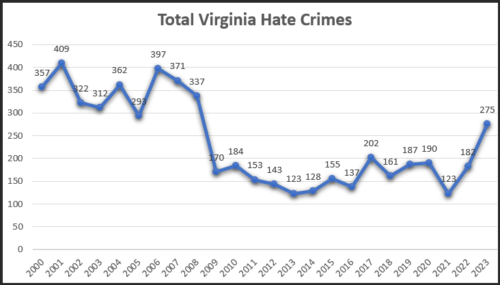
One might think that the surge in hate crimes was related to the wave of pro-Palestinian/anti-Israeli protests across many Virginia universities campuses. And one would be partially correct. The number of hate crimes reported against Jews was 33 last year, compared to 11 the previous year. The count of anti-Muslim hate crimes was nine compared to two the previous year.
The biggest jump by far, however, was the number of reported hate crimes against Blacks — 127 in 2023, up from 94 the previous year.
The number of hate crimes against Whites was 23, up from nine the year before.
Remember the great media-generated hysteria of anti-Asian hate crimes from a few years back? There were 13 anti-Asian hate crimes reported in Virginia last year, up from eight the year before and three the year before that.
One could hold an interesting side discussion about the dynamics of hate-crime statistics. To what degree do they reflect reality? Are they goosed by random media hysterias? Are they by changing partisan priorities within local police departments or commonwealth attorney’s offices?
One could hold another debate about what kind of offenses should be considered hate crimes. As far as I’m concerned, people who burn the American flag are motivated by hate. But they can commit their act of hatred with impunity because it’s protected as free speech. So, one form of hate can be punished with imprisonment while another enjoys impunity.
Let us not be detained by such side questions, however, and let us instead ask: If there were 275 hate crimes reported in 2023 in a state of 8.6 million people, does that suggest we are being submerged in a wave of hate and bigotry? Is that wave of hate and bigotry so enormous as to justify punishing people for what are — let’s call them for what they are — thought crimes?
The hate/thought crimes are accompanied by real crimes. For last year, Crime in Virginia broke them down by these categories:
Simple assault — 128
Vandalism/destruction of property — 98
Intimidation — 58
Aggravated assault — 22
All other offenses — 19
Yes, if someone paints a swastika on a synagogue or hangs a noose from the rafters of a Black church, they should be arrested and convicted — for the underlying criminal offense. Does it really matter what the motivation was? They committed a crime and should be punished.
It strikes me that Youngkin and Miyares are legitimizing the concept of thought crimes as hate crimes. As long as they are running the show, I’m not worried about the law being abused. Moderately conservative Republicans like them do not have expansive visions of what constitutes hate crimes. But look to our college campuses, incubators of so many of the furies that beset the nation, to see how offensive thoughts might be construed as such.
There is a widespread sentiment in university campuses that if speech causes psychological distress to someone, it constitutes harm. Thus, the assertion that “speech is violence.” Conservative, libertarian and even old-school liberal speech is frequently tarred as “hateful” or bigoted. If one opposes subjecting minors suffering from gender dysphoria to hormone treatments and surgery, for instance, one is routinely tagged as hateful and a bigot.
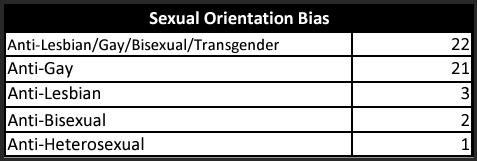
Take note of the following categories of hate-crime incidents reported last year:
Imagine what would happen if law-enforcement authorities began adopting the logic of campus militants! That won’t happen as long as Youngkin and Miyares are around. But I fear that Virginia’s two top elected Republicans have greased the skids for those who follow them.
The way to combat hate and bigotry is using our free speech (at least while we still have it) to condemn it — not to criminalize the thoughts of people we dislike.


Leave a Reply
You must be logged in to post a comment.