
By Steve Haner
To avoid the financial penalties included in the Virginia Clean Economy Act, Dominion Energy Virginia has sometimes sold solar energy at a loss to earn the related renewable energy credit. It has been paying the regional PJM wholesale energy market to accept the electrons, rather than PJM paying it for the power.
This practice of selling solar power even when the market value is negative is revealed in testimony on file at the State Corporation Commission, part of Dominion’s pending application to add additional solar and battery energy assets and to increase the monthly charge for them imposed on consumers. Dominion files an application for new assets annually to meet the renewable mandates in the VCEA.
As previously explored, the key element of the Virginia Clean Economy Act (VCEA) is its requirement that a covered utility must meet certain renewable energy production targets, a renewable portfolio standard. If it does not do so with its own assets, it must either purchase outside renewable energy credits or pay a fine. The RPS target percentage of its annual electricity sales goes up year after year (26% now, 41% in 2030.)
The sales of solar at a negative price was revealed in testimony filed by the environmental activist group Appalachian Voices, which has hired a former SCC expert now in the private sector. Gregory Abbott’s recommendation to the SCC is that Dominion’s stockholders, not its customers, cover the financial losses incurred.
I recommend that the Commission put Dominion on notice that, going forward, if the Company dispatches its solar units at negative hourly LMP energy prices that exceed the proxy value of RECs … or, alternatively, the deficiency payment, then the excess costs above the REC proxy value or deficiency payment will be recovered from shareholders instead of customers.
The goal of this recommendation is not to punish shareholders but rather to properly incent Dominion to establish operational protocols and to develop the technical capabilities to overcome the operational constraints that are allowing this to happen.
As is all too common, Abbott’s testimony includes long passages which are redacted, and he even has filed a separate fully confidential document. Just how often these negative sales have happened and how much money is involved is probably hidden behind the black ink. Have ratepayers actually covered a loss that exceeds the REC costs or fine amount? Abbott teases us:
Dominion’s response to Appalachian Voices Interrogatory 3-2(a) provided a confidential Excel spreadsheet titled “Attachment APV Set 03-02 (LTG) CONF” that identified the number of hours with negative hourly LMP nodal prices experienced at each of the Dominion-owned solar facilities from January 1, 2023 through December 13, 2024. The confidential table below provides a summary by year for each solar facility that experienced negative hourly LMP nodal prices over this period.
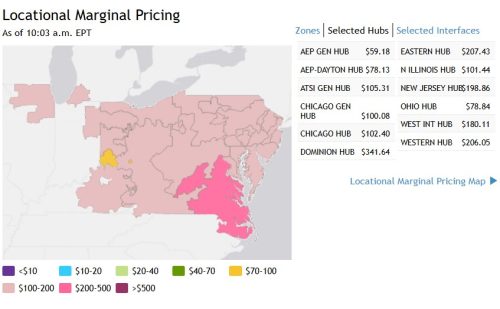
A bit of background. The PJM locational marginal price (LMP) is set in various “nodes” within Dominion’s territory and the rest of the multistate marketplace and fluctuates based on supply and demand within those zones. The availability of transmission capacity also drives the price. During this cold snap, with demand skyrocketing, the prices can be hundreds of dollars per megawatt. It is easy to watch the overall prices, but the many nodes are distinct within those larger zones.
Then there are times when so much energy is available that it greatly exceeds demand and the LMP is negative. That’s when some plants just turn off, if they can, or the generation output is simply lost. But the generator can pay PJM to take the power. Given that Dominion could face either a $45 deficiency payment or some unknown cost for an outside REC for a renewable shortfall, there is logic in selling at the negative price.
Abbott’s testimony seems to accept that as long as the negative price is not too low, ratepayers should cough up.
When confronted with negative hourly LMP nodal prices for a solar unit. Dominion faces a decision: (i) dispatch the unit into the grid and sell the energy at a loss in order to obtain the RECs, or (ii) curtail production and forgo the RECs in order to avoid selling the energy at a loss. To the extent that the price of a replacement REC (or the deficiency payment, if applicable) exceeds the negative hourly EMP nodal energy price, it may make economic sense to dispatch the unit into the grid that hour because the value of the RECs exceeds the loss realized…
His client, of course, is strongly in support of VCEA and its REC mandates. For those who consider RECs to be just virtue signals, the utility losing the ratepayer’s money makes a bit less sense.
The key point of Abbott’s public testimony is that these factors make it imperative that the utility be very careful where it places the new solar and battery assets. And he makes the point that the strategic placement of coming battery assets could reduce this problem, as the excess energy could sometimes go to them. Then he looks at the impact of huge power production facilities like the offshore wind and the nuclear plants.
If the full potential 7,640 MW of offshore wind comes to fruition and enters the grid in Virginia Beach, this could lead to very low or even negative hourly LMP nodal energy prices during those hours of high offshore wind generation, especially if the Surry nuclear units are generating simultaneously.
Negative energy prices are possible because offshore wind generation remains economic until the negative energy price exceeds the price of the replacement RECs or the deficiency payments. Further, to the extent that Dominion selects the production tax credit (“PTC”) option for offshore wind, which is based on energy production, then the offshore wind resource will still be economic at even more negative energy prices.
Because the Surry nuclear units cannot readily cycle off, Dominion would have to pay PJM to take energy from the Surry units during periods of negative hourly LMP nodal energy prices. Substantial solar resources locating in that LMP nodal area without appropriately paired energy storage would further exacerbate this situation.
This is indeed the hard stuff, high level physics, engineering and economics. The VCEA’s unintended consequences (and some of them were intended by the authors) continue to emerge. It is also essential background to understand why the solar industry is working so hard at the 2025 General Assembly to override local opposition to its facilities.
Leave a Reply
You must be logged in to post a comment.