
by Paul Goldman
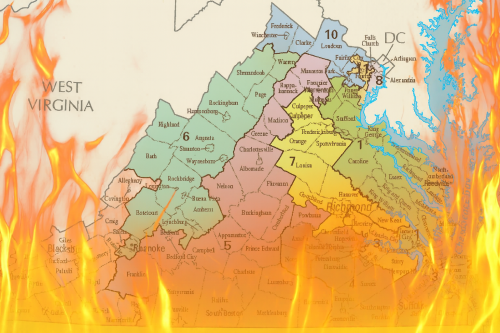
The legal experts who say yesterday’s decision on Texas redistricting allows Virginia to do mid-decade redistricting are wrong. I warned months ago the Supremes would okay Texas but not Virginia. Those experts who think otherwise need to read prior election law cases.
There is a long history of the High Court rejecting major electoral changes enacted after the campaign season is in full swing. Starting on January 1, the 2026 Virginia congressional campaign officially begins under the existing district boundaries. By my calculations, the earliest the proposed new districts can become law would be around May 1.
Thus, the campaign will have been ongoing for 4 months in the old districts. The districts put in place by a non-partisan process. The districts voters have become accustomed to.
Let’s assume the required 3-Judge Court approves the new Spanberger districts on June 1. The Republicans will appeal directly to the United States Supreme Court as the law allows in redistricting cases. We can assume the Supreme Court will stay the lower court order. This means the old districts will still be in effect.
Let’s further assume the Supreme Court rules takes up the case and on July 1. Election day is barely 5 months away. In this five-month period, the parties must conduct their nomination processes, independent candidates must be allowed to collect signatures to file to be on the ballot, and a myriad of other mandatory actions must be taken as required to ensure fair elections and informed voters.
Most importantly, all this needs to be done prior to early voting starting in late September.
Meaning: the Supreme Court would have to approve new districts less than three months before the voting actually starts.
The same six justices who approved the Texas redistricting will turn around and reject the Virginia district. They will say the fundamental change is too close in proximity to have fair and informed elections given the approaching early voting window. Read their opinions. Indeed, it wouldn’t surprise me if at least one of the dissenting judges likewise agrees.
The state went to non-partisan redistricting in 2021. The people made this choice by a 2-1 majority. Governing is choosing. Whether the public made the right choice or not is irrelevant. This is what the people of Virginia wanted. There are consequences when you choose. One of them is to make it hard to have partisan districting.
Let’s face it folks: As I’ve said, we’re in the midst of another Civil War between political and cultural philosophies. So far, it has not been an armed conflict. But you’re all dreaming if you think this will not end badly for America if we don’t get leaders who put the interest of the country first.
This country was founded only when people found the way to compromise temporarily on the fight between state rights v. federal rights. The fight between what’s good for any particular state v. what’s good for the country as a whole has remained ongoing.
Contrary to popular belief, the Civil War did not resolve that issue. A good legal case can be made the contest actually made it worse in the end. If you look at the 1877 compromise giving Republicans the presidency, a legal case can be made that the Old Guard running the South actually won the Civil War.
Unlike Texas, Virginia needs to first amend the state constitution before we can have mid-decade redistricting.
Democratic Governor Spanberger will lead the fight for Virginia’s mid-decade partisan redistricting in her role as party leader. In my view, the required statewide constitutional referendum to allow mid-decade redistricting could be defeated, despite the heavy odds favoring its passage. But I suspect Spanberger will remain popular enough in those early days to get majority approval from the voters.
This will not matter to the Supremes.
The bigger issue of course is the fact the Supremes have been gutting election laws for many years now. Their legal view is leading to the intense state rights v. federal rights argument rearing its constitutional head once again. The more things change, the more they remain the same as someone once wisely observed
Given the demographic trends in America, and the culture view of Trump Republicans, It seems to me a second succession movement is becoming inevitable.
But this inevitability is still in the future. Right now, the legal issue is mid-decade redistricting. The Virginia Constitution is what it is. Gov. Spanberger has the political muscle to add the first April constitutional change in state history.
However, in my view, the legal rationale in the Texas case dooms whatever she might be able to accomplish at the polls.
Paul Goldman is former Chair of the VA Democratic Party, a former candidate for mayor of the City of Richmond, and author of “Remaking Virginia Politics.”
Leave a Reply
You must be logged in to post a comment.