

by Jon Baliles
There have been a lot of embarrassing moments in the history of city government, but one that will soon be in the Hall of Fame is taking place before our eyes, with the latest edition occurring last Tuesday in the John Marshall Courthouse. A trial that began more than 18 months ago has turned into a full blown circus with clownish embarrassment as the cost to the city has already gone through the roof with the Mayor claiming what you are reading about from reporters (who are actually in the courtroom) is not true.
The truth is that under the big top, the city is being represented by a third- party legal team led Jimmy Robinson, Jr. of the Ogletree Deakins law firm. Robinson was confrontational with Judge Claire Caldwell on Tuesday because she called him out for making statements that directly contradicted what he had told both the court and Graham Moomaw from The Richmonder concerning a motion filed on November 5th (and she read his emails aloud to the court).
It got to the surreal moment that when Robinson began to admonish Judge Caldwell and raised his voice towards her, the Sheriff’s Deputy serving as bailiff moved from her position on the side wall of the courtroom into a position between the lawyer’s table and the judge, and at one point told Robinson to calm down. The judge also at one point told Robinson to “lower your voice.”
If your legal strategy includes sparring with the judge to the point and volume where the bailiff gets concerned enough to take a defensive position, then you’re no longer making a solid or coherent legal argument; you don’t need to be a lawyer or stay at a Holiday Inn Express to figure that out. Before we get to more of Tuesday’s fireworks however, rewind to the last hearing in September.
The plaintiff in the case, Connie Clay, was the city’s Freedom of Information Act (FOIA) officer and fired by Director of Strategic Communications Petula Burks in January 2024 during the height of the meals tax fiasco and the tsunami of FOIA’s coming into City Hall. Clay filed a lawsuit in March 2024 claiming she was wrongfully fired after being vocal about what she said was the city’s failure to properly administer and abide by the FOIA. The city says Clay was fired because she was not a good fit for her position.
The plaintiff’s legal team had been asking for text messages from Burks’ phone for months and the city maintained they had provided everything they had, which apparently was not much. Even when Judge Cardwell asked for the phones in September to review them herself, she found little on them. The city’s legal team gave them to her without ever telling her the phone they gave her was a replacement phone Burks’ received after she told the city she “lost” the original in June 2024 in a New York airport a week before she stopped working for the city. The city’s legal team never told the judge the phone had been lost at any point in the trial until September, and Cardwell reiterated on Tuesday, “No one ever told me that,” in reference to reviewing the original device’s replacement.
The city also maintains they replaced Burks’ phone with a blank one without putting any prior emails, apps, texts, or other communications on the phone of the woman who was the city’s Director of Strategic Communications and whose job was to call, text and email dozens if not hundreds of people daily.
After the lost phone revelation, Cardwell asked the city’s legal team to provide answers by October 31 as to whether or not the city was able to recover any information from Burks’ lost phone (which had been under a litigation hold since March 2024 but was never backed up). The city’s team filed their motion indicating they could not recover anything and were “not withholding any relevant documents or information” related to any of the unresolved disputes over evidence. Clay’s attorney’s filed a spoliation motion a few days later on November 5th asking the judge to sanction the city for destroying or failing to produce evidence because those texts were directly relevant to Clay’s lawsuit; they attached a copy of the city’s October 31 filing by the city’s lawyers.
On November 6th, Robinson sent three “emergency emails” to Cardwell’s clerk marked “urgent” and accused Clay’s team of improperly filing their motion and attaching documents the media would be able to see on the court web site; Robinson claimed what he had filed the week before was for the judge’s eyes only. The judge responded in-between cases and said she tried to arrange a conference with both parties to discuss the issue but, because there was no immediate time that worked for everyone, she decided to seal the motion until she was able to hear arguments on it.
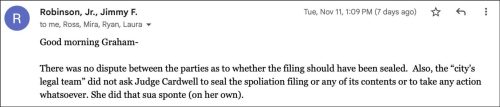
Moomaw downloaded a copy of the plaintiff’s motion before it was sealed and then sent an email to Robinson asking for comment; he received no reply but he did get a call from Robinson asking him how he knew about the filing. Later, Robinson did send an email to Moomaw and claimed the city’s legal team did not ask to remove the document from the public domain.
“There was no dispute between the parties as to whether the filing should have been sealed,” Robinson said in a Nov. 11 email to The Richmonder. “Also, the ‘city’s legal team’ did not ask Judge Cardwell to seal the spoliation filing or any of its contents or to take any action whatsoever. She did that sua sponte (on her own).”
Judge Cardwell read aloud in court parts of the emails from Robinson about the sealing, and asked him directly why he thought the motion should not have been public. Samuel Parker at the Times-Dispatch wrote that Robinson told the judge that he believed the motion would be submitted “in camera” — meaning for private review by the judge in her chambers. Pressed for a reason as to why he thought that, he said, “It was our understanding from the last hearing we had.”
“Based on nothing, Mr. Robinson,” Cardwell said, noting that she had not instructed Clay’s attorneys to file the motion privately. “If it’s filed, it’s public record, counselor.”
She ordered that the motion be unsealed immediately.
Cardwell also told Robinson that he had “made a statement to the press … that, in the court’s view, is directly contradictory to the statement you made to the court.”
Robinson told the judge he didn’t lie to the press because, technically, he sent the emails to Cardwell’s clerk and not the judge to seal the motion.
“If you read the email where I wrote to you, your honor, we ask that the clerk’s office seal it. We didn’t ask this court to take action,” Robinson said.
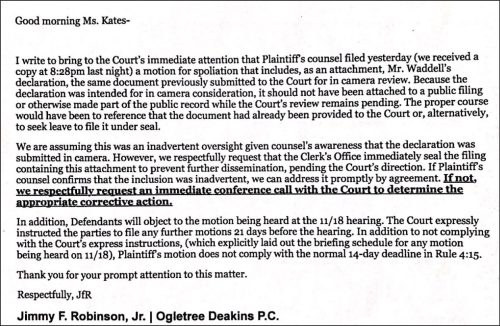
Cardwell replied, “You asked my law clerk, and she’s conveying to me, number one. Two, I think you know, as experienced counsel, that the clerk has no authority to seal public records.” (Virginia law says only a judge can order records sealed).
“I don’t know that,” Robinson said.
He continued his rant and then accused Clay’s team of leaking the filed documents to the press and said in court Tuesday, “They already provided it to the press anyway.”
But Cardwell shot back and said the city’s legal team had become “indignant” about an alleged breach of confidentiality when she never asked for the document to be filed confidentially. The city’s assumption the document was supposed to be private was, she said, “based on nothing. If it’s filed, it’s public record.”
When Robinson continued berating the judge and opposing counsel as too inflexible to pin down for scheduling changes and conferences, Cardwell was having none of it. She told Robinson he was “always deflecting” and being deliberately avoidant of her.
“When you call and you have an emergency that you need to be attended to immediately, it’s interesting to this court that you’re always available, but if we need you to come for some hearing for anything else, you’ve got to be out of town and you and your co-counsel are never available,” she said.
Once the volume and temperature in the courtroom began to cool off, the next order of business was to schedule the next court hearing, which was set for February 18th. There was also a discussion and dispute about a second deposition of Burks’ that had been scheduled for the day before Tuesday’s hearing. Clay’s attorneys filed a motion the prior Wednesday delaying it again because the sudden discovery that Burks’ phone was a blank replacement altered their strategy approach (and one would imagine including a few more questions). Robinson became animated about the delay and said he was ready for it and did not know about the delay and had to rush to Roanoke that weekend because his father-in-law suddenly became ill and passed away. He said he returned to Richmond on Sunday evening to prepare only to find later the deposition postponed.
Ironically, Burks’ second deposition had been scheduled in September before anyone (except the city) knew her phone had been lost and had been replaced with a blank one. That session ended before it began because Robinson escorted Burks out of the deposition because a scheduling mix up with the court reporter had her arriving a few minutes late. Moomaw reported two months ago on that exchange:
Cardwell told Robinson Wednesday that he had acted unreasonably by telling Burks she could leave the deposition without even waiting an hour for the court reporter issue to be resolved.
Robinson protested that he had not improperly cut off the deposition because it was never underway to begin with. He said Burks shouldn’t be “punished” or “penalized” because a court reporter didn’t show up to a deposition run by Clay’s lawyers.
Cardwell was unswayed.
“You terminated the deposition. And you did so without consulting with the court,” Cardwell said. “The inconvenience to your client is because of you.”
Tuesday’s hearing adjourned, but the drama didn’t stop with the gavel. In the lobby after the hearing, Robinson completely denied to Moomaw that Cardwell had just minutes earlier called his statement contradictory and he accused The Richmonder of “twisting my words” (the judge, in fact, called Robinson’s statements “directly contradictory”).
“She didn’t say that,” Robinson said. “You can get the transcript.”
For people that were in the courtroom, the transcript is not necessary to find out what the judge said a few minutes earlier and people heard with their own ears.
In addition to the courtroom circus, the real clown show is that no one at City Hall knows how much this trial is costing taxpayers — not the Mayor, City Council, the City Attorney’s office, or the public. The first three on that list seem to possess an incurable lack of curiosity about how much Ogletree Deakins is charging the city because they have not sent the city an invoice since May 31st, when the bill was $234,000
Robinson has not sent a single invoice despite a half dozen hearings, depositions, trial prep (it was scheduled for September but postponed to next summer), etc. Moomaw wrote in September that Robinson’s excuse was an “internal administrative issue” that prevented his bills from going out. That apparently did not prevent him from billing Virginia State University for legal services this summer.
City officials seemed to go along with that explanation, saying in late September that they expected the invoices to resume soon. Through a FOIA request, The Richmonder obtained an invoice Ogletree submitted to Virginia State University dated Aug. 4, which was during the period that the firm suggested it was unable to bill the city. The VSU bill covered work one of the lawyers working on the Richmond FOIA officer case had completed in January.
When asked for an explanation of how Ogletree was able to bill VSU but not the city, Robinson did not respond. When city spokesperson Mira Signer was asked why the invoices are still not being filed, Signer indicated she could provide no new information. She referred The Richmonder back to the city’s response in September.
Second verse, same as the first. It’s hard to imagine any attorney on Earth other than Atticus Finch (no offense, attorney friends) going six months with their team spending hundreds or thousands of hours on a case without billing a dime; but apparently the city’s legal team is the most benevolent and generous in town, if not on the planet — or maybe they just don’t want the public to know how much this is really costing.
The Mayor seems content to allow these bills to skyrocket and the circus to continue instead of settling and ending the case. It is a hangover from the Stoney administration that has nothing to do with the new administration and their supposedly new attitude toward transparency, but now they own it. Avula told Moomaw on October 1st, “…I very much want the situation resolved in the best interest of the city as quickly as possible. I understand there is strong public interest in the specifics, and the attorneys are in a better position to respond to questions. In time, I intend that more details will be shared.”
Also on October 1st, Rich Meagher asked Avula on the RVA’s Got Issues Podcast (which was likely recorded the week prior), “Why not just settle and move on from it?” The Mayor replied, “If what is being publicly reported was actually the truth, then know that this would be solved a long time ago.”
Of course, if the trial we have been witnessing with our own eyes and hearing with our own ears being argued in court is not true, what possible reason would the city’s lawyers continue such a disjointed argument, chastise the judge, castigate reporters and “forget” to tell the judge a phone they gave her was a blank replacement? Maybe, after 18 months, there’s still some brilliant legal strategy the city has yet to argue to win the case that no one has seen yet, but so far, it’s just been a circus. If this case were so clearly open and shut in the city’s favor, it would have been won by the city a long time ago (the city’s motion to dismiss the case in February failed).
If the Mayor were to actually read the room (or read the transcripts), he would realize he is all out of aces with no cards left to play; another eight months of hearings plus the trial next summer could easily cost the city upwards of a million dollars or more. The meter is running and no one knows what the tab will be (or currently is, since the lawyers won’t send invoices). Avula should know (or have figured out) by now he shouldn’t be walking away from this case, he should be running. You’ve got to know when to fold them, as they say, and he has a chance to do just that because there is a settlement hearing scheduled for December 11th that could bring this circus to a close. Doing so would be a great Christmas present for everyone involved, especially the bailiffs at the courthouse.
Jon Baliles is a former Richmond City Councilman. This column has been republished with permission from his blog RVA 5X5.
Leave a Reply
You must be logged in to post a comment.