

Budget Maneuvering
Share this article
ADVERTISEMENT
(comments below)
Comments
Comments
47 responses to “Budget Maneuvering”
-
Youngkin has also promised to cut the sales tax on groceries.
Did Northam try to sandbag Youngkin or was this the plan no matter who won?
This will not only eat up a lot of that surplus but it is a triple -whammy on local govt because the state-funded raises for teachers and public safety only cover SOQ positions for teachers and state-mandated public safety positions if not mistaken. If the localities have employees over and above the state-funded positions, they have to cover the entire cost including their health care and pensions.
That makes me wonder if Youngkin will try to keep the localities “whole” and probably affect Youngkins thinking on reducing state income taxes and sales taxes on groceries.
-
You are correct about the effect on localities. The details are not available, but, historically, salary increases for deputies were funded only for those approved by the Compensation Board. Many localities provide additional funding for deputies in addition to those approved and funded by the Compensation Board. As for teachers, that was not my area, so I don’t know if there is money for raises for all teachers or just for the ones required by the SOQ. But, in either case, the localities have historically been required to pay some of the costs of the increases.
-
For teachers, called SOQ positions… that’s primarily the ones that the state funds… and most schools except for the most poor, layer on additional personnel – like assistant principals, para-instructors, even nurses and music that are over and above what the state will pay for.
https://www.nvic.org/cmstemplates/nvic/pdf/state-legislature/soq-funding-presentation-3.pdf
-
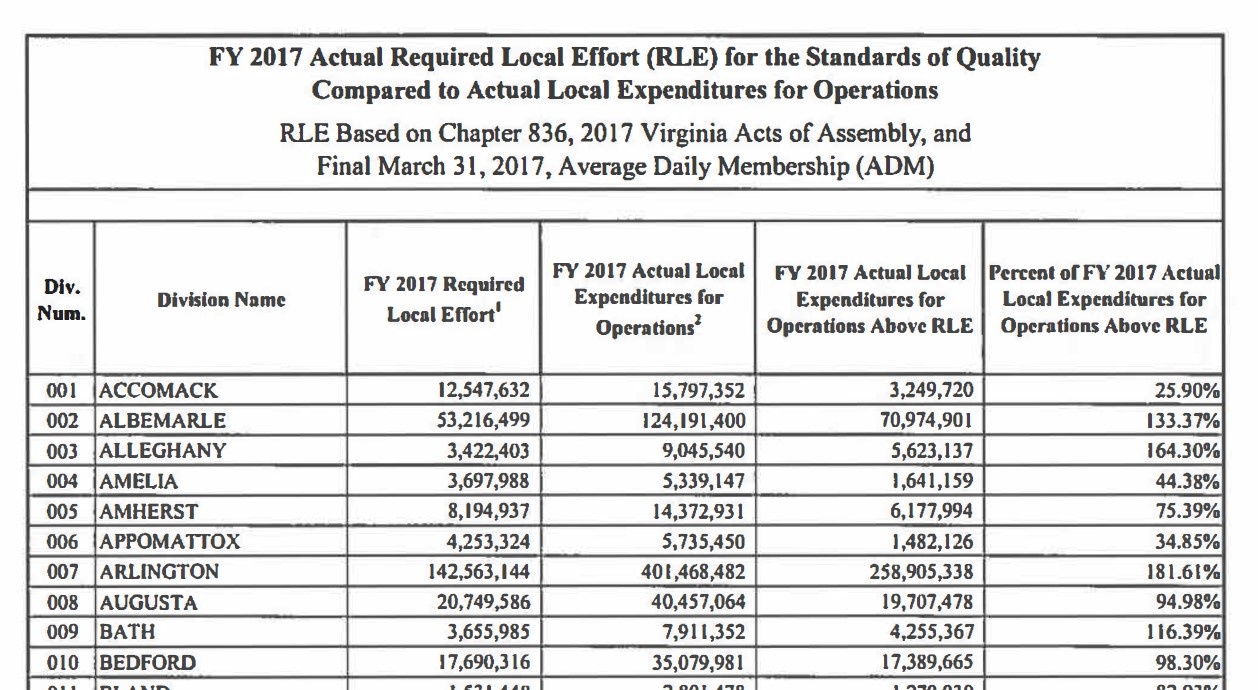
Here’s an example. The state REQUIRES a local match for the SOQ positions but then many school systems actually spend more than that on positions that the state does not fund at all:
-
OK. You made me stop being lazy and to do a little research. The funding for the salary increase for teachers included in the budget for the current year was for “funded SOQ instructional and support positions.
Funded SOQ instructional positions shall include the teacher, school
counselor, librarian, instructional aide, principal, and assistant
principal positions funded through the SOQ staffing standards for each
school division in the biennium.” In addition, the funding is for the “state share” of those costs, which is based on the local composite index for each locality. I assume those same conditions will apply to the new salary increases being proposed. Therefore, localities will have to give salary increases to all instructional personnel, but will get partial state funding for only those positions required by the SOQ.-
not all schools get all staff since VDH funds some positions on a number of enrollments which leaves some small schools short of things like assistant principles, full time nurses and music, etc.
And when/if enrollment drops, SOQ positions are lost and also happens when the numbers in the composite index get more “wealthy”.
So a locality has to fund the required local match AND 100% of the additional positions that are not SOQ.
It’s a big deal at budget time usually.
-
-
-
-
-
Thanks for the cogent analysis. Too bad that paying teachers more won’t change educational outcomes or improve the teaching talent pool.
-
why wouldn’t it improve the talent pool?
-
1) Because paying poor performers more only encourages them to stick around and,
2) the pay increases won’t be sufficient to draw a significant number of talented people to the profession. Most people with better options will take them. They’d still rather be doctors, lawyers, investment bankers, small business owners, IT professionals. And,
3) In most places, firing a bad teacher is a career, not a simple personnel decision.-
re: ” Because paying poor performers more only encourages them to stick around”
true for most professions? police? fire/rescue, even doctors/nurses?
2. – you seem to be saying that teaching as a profession is not equivalent to other professions… no?
3. – do you mean firing a teacher is, in effect, ending their career?
I just don’t see teaching as that different from many other professions… where ‘weeding out'” is not that easy when the employee needs improvement but there are no guarantees a replacement will do any better.. even after the training investment…
-
He’s a “them that can, do” type. Teachers are not proficient in anything but teaching to him. Like Matt A. who claimed math teachers are not mathematicians, just teachers.
-
yup. teachers are highly compensated but glorified baby sitters and by GAWD they need to babysit and not claim COVID excuses…
-
“Nancy Naive LarrytheG • 18 hours ago • edited
He’s a “them that can, do” type. Teachers are not proficient in anything but teaching to him. Like Matt A. who claimed math teachers are not mathematicians, just teachers.”If you’re going to invoke my name, you should at least quote me correctly instead of making up my statement.
That’s not even close to what I said, nor does it detract from you being wrong in that conversation and reverting your standard reply when wrong.
“A mathematician is someone who uses an extensive knowledge of mathematics in their work, typically to solve mathematical problems. Mathematicians are concerned with numbers, data, quantity, structure, space, models, and change.”
-
-
-
Seems contradictory that teachers really only want high paying jobs, like being an investment banker, but raising salaries won’t do any good.
Either way I’ll disagree that teachers are only motivated by salary, and I’ll also disagree that, by your insinuation, that the quality of the overall teaching pool is poor. I will agree that getting rid of poor teachers is difficult or rarely happens, and that’s really unfortunate.
-
The bigger problem is finding qualified teachers who will teach a low-income neighborhood schools. Good teachers have a lot of flexibility where to teach and administrators cannot force them to teach at low-performing schools without risking them going to another school or school system.
That leave low-performing teachers and newbies to staff the problem schools. You can fire them but who will you get to replace them?
-
Over the last 50 years, the talent pool for those wishing to be teachers has diminished in quality. In 1970, academically talented women had few opportunities beyond the classroom. Now women make up half or more of students enrolled in law, medical and business schools. The average SAT scores for students enrolled in schools of education are among the lowest on campus. Often by a couple hundred points. Increasing an already low salary 10 percent over two years isn’t going to change that. And while there are outstanding teachers in the system, one only has to look at SOL scores across Virginia to conclude that the overall quality of teaching needs improvement and that there is absolutely no way to demonstrate that higher salaries result in better outcomes or attract better teachers. Compare Wise and Loudon counties. I once lived in Alaska where a poor performing teacher was convicted of felony theft for bypassing the electric meter at his house. The School Board fired him. The teacher sued and the courts reinstated him after determining that the theft of electricity was not a crime of “moral turpitude.”
-
re: ” … there is absolutely no way to demonstrate that higher salaries result in better outcomes or attract better teachers. ‘
so what to do?
-
This blog has featured extensive coverage of reforms made in southwest Virginia that have driven significant improvements in student outcomes. And instead of paying teachers more for longevity and earning a master’s degree, perhaps we could tie compensation to performance. There’s an old management maxim that what doesn’t get measured doesn’t get done.
-
So you want teachers salaries tied to performance?
That’s been discussed but how would you measure it on a per teacher basis?
-
Not sure SW pays on performance per teacher. Maybe Matt Hurt knows.
-
You do realize that compared to the school district’s median salary that teachers in SWVA make more than the median and teachers in NOVA make significantly less than their median, right?
It makes a difference to how kids view their teachers, and how teachers live and work.
-
Nancy, that’s the lamest excuse I’ve ever read for the failure of highly compensated Loudon County teachers to meet the needs of poor and minority students. I doubt 1 percent of the kids in Loudon County have any idea how much their teachers earn, or how their incomes compare to those of federal bureaucrats, lobbyists or IT professionals. And to suggest that Loudoun County teachers are “dialing it in” because others make more is far worse than anything I’ve written. Surely, they knew what they were signing up for when they decided to become teachers.
It is also telling that in this long thread that not a single commenter has challenged the assertion that simply paying teachers more will improve outcomes or offered a shred of evidence to hint that is the case.
-
re: ” not a single commenter has challenged the assertion that simply paying teachers more will improve outcomes ”
or police officers, or fast food workers or Amazon Warehouse workers or UPS drivers?
what’s the point?
Nancy’s point was with respect to how teachers salaries related to the cost of living of where they work.
It’s not as much a matter of paying them “more” so they teach ‘better’, it’s offering salaries that are competitive with respect to other employment opportunities in that area.
Would you expect police, for instance, to perform better if we pay them more?
-
Higher salaries might attract better applicants, but that only yields significant near term benefit if coupled with the ability to rapidly weed out poor performers. The other way to yield near term results is to tie higher compensation to better outcomes. That’s true for police, fast food workers, Amazon warehousemen, UPS drivers and, yes, for teachers.
-
The thing about teaching is that there are not prospective teachers waiting in the wings to take over when other teachers are let go.
Schools actually have to recruit to get enough teachers and they end up with part-time substitutes of lower quality when they lose teachers.
The system where I live 50 miles south of DC has to go to other states like Pennsylvania to hire AND they have to pay hiring bonuses just to get them to come here – sight-unseen in terms of performance history.
Most school systems to well for kids of college-educated parents. The deficits come from the same teachers who do well with kids of college-educated kids, don’t do as well with kids of lesser-educated parents…
Teachers that can successfully teach these harder-to-teach kids are hard to come by and most of them have their pick of where they want to teach.
Lower performing teachers often leave and are replaced by newbies who are not high performers right out of the box. It takes time for most teachers to get real good at their job and it’s not a job for most people… it’s a tough job.
-
Larry, it’s an honest argument to contend that market forces indicate that higher pay is necessary to overcome a labor shortage as you have above. It’s not so honest to contend, in the absence of any proof, that paying teachers more improves student outcomes. In the absence of a labor shortage, one might argue that hiring more teachers and reducing class sizes would have a bigger impact than an across the board 10 percent raise.
-
Well, no, it’s not dishonest to ask for evidence and not accept a premise that has no supporting data.
I’m a “show me” guy.
Surely in a country this large, what you’re advocating has been done. Right? How about private schools? One would think it would be a practice there, right?
Evidence?
-
Private schools, where compensation is often less than that offered public school teachers in the same community, are paid for performance. That’s because if they fail in the classroom, they are dismissed. I would also note that compensation is only one factor influencing employee performance and often one of the least important. Other factors — 1) does the worker believe his or her work is important to society, 2) is the work environment positive and conductive to accomplishing the worker’s goals, 3) is the worker trusted to get the job done with minimal oversight and interference, 4) is the worker appreciated by those he or she works with and for. This explains why some teachers take pay cuts to work in schools where they are trusted but held accountable, where students are interested and parents are involved. Most people look at their pay advisory once or twice a year, after they’ve gotten a salary adjustment. It’s not a constant source of positive reinforcement. The other factors I’ve described — praise, appreciation, the feeling that you’re trusted to do your job, the knowledge that you’re making a difference provide constant positive feedback.
-
If a teacher succeeds in getting 80% of the class to perform at high levels but 10 are mediocre and the final 10 fail – is that acceptable? Would you fire that teacher?
-
I’d work with each teacher to assess each student at the start of every school year, establish mutually agreed goals for student success, measure progress and discuss every failure to determine why those kids failed and what, if anything could have been done to achieve a better outcome. Then I’d make an informed decision about the teacher’s performance. Did the teacher seek help? Alert social workers to an attendance problem? Did the kid belong in that classroom in the first place?
-
Pretty much the way it works now The point being that a pretty good teacher can get most of his/her class to pass but not all and especially the harder to teach, the economically disadvantaged. Teachers are not typically fired because they only got 80-90% to pass.
-
-
-
-
I don’t oppose spending more on education. I just want it to have a positive impact in the classroom.
-
Oh I agree spending more without getting more is a bad deal but, for instance, do we pay police and fire/ems different salaries based on performance?
Even in elementary school , different teachers teach different things and some kids get sent out for extra help for reading , etc.
And SOLs are not given for every grade.
so maybe this?
-
Principals and parents know who the good teachers are. That’s why parents lobby to have their child in Mr. Master Teacher’s class and not Mr. Lets Watch a Movie’s class. Perhaps districts could solicit and make public parental and student evaluations of teachers. Almost anything would be better than what we have now. A world in which Mr. Master Teacher and Mister Lets Watch a Move are paid the same.
-
In the real world though, the teachers that are not said to be “good” by parents and students (small kids?) – do you just replace them? I guess you are aware there is a shortage of teachers.. they are not easy to come by these days.
Even the not wonderful ones are better than no teacher.
I’d like to hear Matt Hurts view on this.
-
I see. The problem is that women have more opportunities today than 50 years ago and the talent pool suffers accordingly.
-
Well, it’s probably true that a teacher has options if teaching is too hard and doesn’t pay enough… and for some reason, yes, the majority is still female at the teaching level but a good number become principals.


Maybe the “Virginia Way” ain’t so dumb after all?
-
Seems inept to me. We know the governor will be a lame duck since he or she can’t run for reelection. Why isn’t the General Assembly session delayed by a month or two in years after a gubernatorial election? This would allow the new administration to be in place and take ownership of the budget.
-
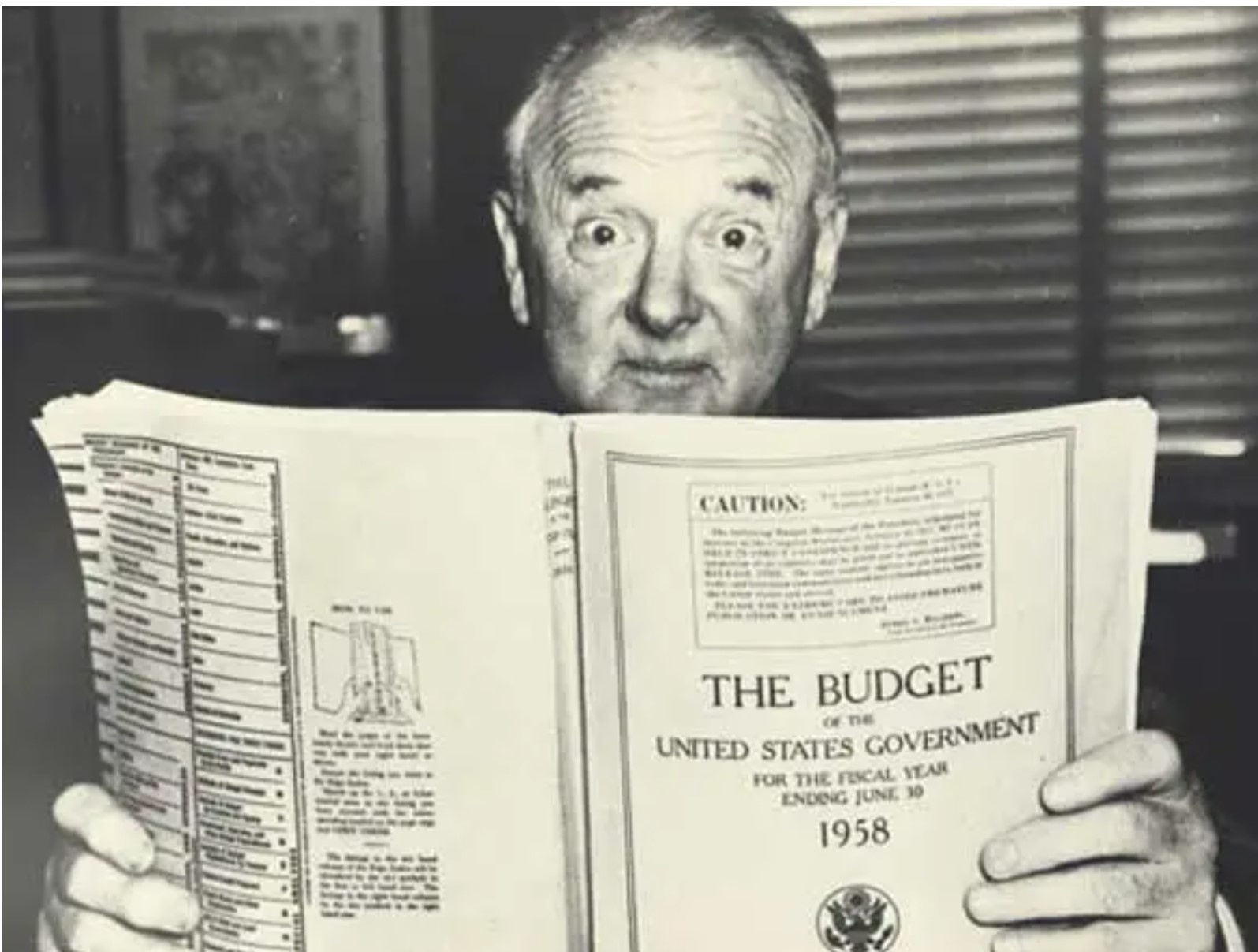
Smells like something Mr. Byrd might have concocted ages ago. https://uploads.disquscdn.com/images/fbf91ebf73678971744eb25d7a98a34af020556eeb6813b5d075b9a0c2d4f2f8.jpg
-
Mr. Pay-as-you-go himself
-
That is a good link. Byrd is a fascinating political figure. I read the part of his argument in the Senate against the 1954 Interstate Highway Act. He sounded like the old governor from 1924.
-
-
-
No administration takes ownership of spending… even after they do it.
-



Where’s the beef? Salary increases for law enforcement were surely on Youngkin’s mind or written on his public policy platform or somewhere. Sometimes, incredibly, Rs and Ds can agree.
-
Should not be one, but we’re gonna find out about Youngkin’s “day one” promises to cut income and sales taxes AND STILL pay raises to teachers and public safety , more to nursing homes and mental health and keep locality budgets whole, do some new charter schools, etc.
I don’t think he can cut all the taxes he promised and still fund all these other things, but we’re gonna find out. He’ll have to compromise… a nasty word these days.

This is hardly a new phenomenon. I even remember some handwringing when Kaine replaced Warner and Northam replaced McAuliffe.

Nice work Dick.
Leave a Reply
You must be logged in to post a comment.