

by James C. Sherlock
This will be the first of a series of reports on the scandalous failures of the Virginia Department of Behavioral Health and Developmental Services (DBHDS) in its stewardship of Virginia’s compliance with the Americans with Disabilities Act (ADA) in matters affecting the safety and health of people with intellectual and developmental disabilities (IDD).
The programs that started in 1991 in response to the ADA serve more Virginians daily than Virginia’s nursing homes do.
Virginia and DBHDS have been subject to a series of federal court orders aimed at improving compliance with the ADA in these programs, beginning with a 2012 settlement agreement. DOJ returned to court to seek enforcement with performance measures in 2020. Settlement-compliant Virginia regulations were enacted that same year. A permanent injunction in 2025 dissolved the settlement agreement and required compliance with the performance measures going forward. Failure continues today.
Readers will see three pieces of evidence against DBHDS and thus the Commonwealth:
- a Fiscal Impact Statement for a bill currently before the General Assembly that reports what DBHDS does not currently do;
- a December 2025 report on unexplained deaths in the system by the disAbility Law Center of Virginia; and
- A report issued that same month by the court-appointed federal monitor showed that, after 14 years since the settlement agreement, DBHDS has met the specified goals for just three of the Consent Decree and Permanent Injunction’s 29 Terms. And that report did not even mention the deaths or the failures to levy sanctions.
The overwhelming impression is malfeasance. The author has no other idea how these things can be true. The scope and details of the betrayal of the court orders, the IDD community, and taxpayers portrayed below are stunning.
Finally, the bill for these programs has been paid entirely by Medicaid since 1991. Most of Medicaid money comes from the federal government. Virginia Medicaid’s stewardship of those funds is clearly in question.
The author expects the Commonwealth to be summoned to federal court in Richmond for violating the injunction. The Attorney General will have to defend. He is also responsible for investigating Medicaid fraud. In this case, it is hard to see how he can do both.
The Orwellian findings of “Every Minute Matters: Oversight and Emergency Response Failures in ID/DD Care”.
Executive Summary.
The disAbility Law Center of Virginia has done an extensive, multi-year review of unexpected deaths of individuals with Intellectual and Developmental Disabilities (IDD) receiving services licensed by the Department of Behavioral Health and Developmental Services (DBHDS).
Concerns about the lack of autopsies and inaccurate death certificates motivated this work with the goal of identifying preventable patterns and strengthening protections for this vulnerable population.
Ultimately, dLCV identified several concerning trends, including misleading death certificates, inadequate emergency response, preventable choking deaths, and staffing and compliance concerns.
dLCV recommends that DBHDS amend its regulations to require emergency medical drills, and that the Commissioner of DBHDS issue stringent sanctions, including punitive civil sanctions, where life-threatening violations are discovered.
Findings and Recommendations.
In the 2022 session, the General Assembly passed a bill requiring DBHDS to convene a workgroup, to include dLCV, to look into cases of unexpected and sudden deaths among people with intellectual and developmental disabilities (IDD). The goal was to come up with guidelines on when autopsies should be done if someone with IDD who was receiving services licensed by DBHDS passes away.
One key issue discussed by the DBHDS Autopsy Workgroup and also identified in dLCV’s investigations is the quality and reliability of death certificates. DBHDS and the Office of the Chief Medical Examiner (OCME) agreed during workgroup discussions that the reliability of cause of death listed on death certificates is a problem. This problem is discussed in greater detail below.
There can be no meaningful discussion of how to prevent future deaths if we do not have accurate information about why an individual died suddenly.
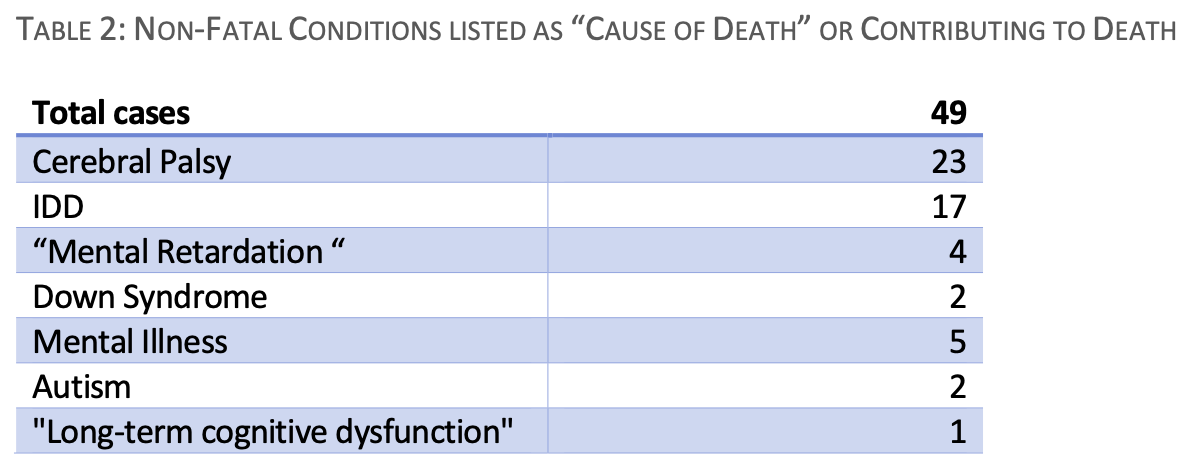
dLCV found that, in 49 cases, a developmental disability or mental illness was listed on the death certificate as the immediate cause of death or the underlying condition that led to death. dLCV reviewed death certificates that list primary causes of death such things as intellectual disability, autism, and even “mental retardation.” None of these conditions are fatal. By ascribing the individuals’ deaths to non-fatal conditions, the medical professionals made it impossible to determine whether the death was preventable, or if further lessons could be learned.
In another 29 cases, the cause of death listed on the official death certificate conflicted with the medical information included in the DBHDS investigation reports. Examples include listing coronary artery disease as the cause of death when the medical records show the individual had no heart conditions, or where the cause of death was listed as seizure disorder when two neurologists had determined in the weeks before death that the individual was NOT having seizures.
Stunning admissions in a fiscal impact statement
The Commonwealth of Virginia and DBHDS, subject to that federal injunction, continue to fail to comply.
Item 62 of the injunction (and common sense) mandates:
The DBHDS Offices of Licensing and Human Rights shall continue to perform quality assurance functions of DBHDS by evaluating provider compliance with regulatory requirements and taking action as warranted to address identified violations.
Delegate Holly M. Seibold, D-Fairfax, submitted House Bill 1380 to implement the findings and recommendations of Every Minute Matters. The Fiscal Impact Statement (FIS) below exposed a long-running scandal.
It reveals, perhaps unwittingly, what DBHDS is not currently doing to “address identified violations.” DBHDS admits that sanctions “are currently rarely implemented and are administratively time-consuming.”
The commissioner does not “penalize providers who fail to comply, (even) if such a violation poses a threat to the life of individuals receiving services or where there are recurring violations that pose a threat to health, or safety”.
DBHDS is thus vulnerable to the accusation that it is failing to comply with the injunction by not issuing at least “1,560 sanctions” annually.
Finally, the FIS warns that sanctions “trigger ongoing enhanced monitoring and oversight responsibilities.” Citizens, and the federal judge who issued the injunction, never expected otherwise.
Department of Planning and Budget 2026 General Assembly Session State Fiscal Impact Statement
Published: 2/4/2026 9:57 AM
Original Bill Number: HB1380 Patron: Seibold
Bill Title: Department of Behavioral Health and Developmental Services; Board of Behavioral Health and Developmental Services; regulations; providers; sanctions; emergency medical drills.
Bill Summary: Directs the Board of Behavioral Health and Developmental Services to adopt regulations requiring providers of services for individuals with developmental disabilities to conduct regular emergency medical drills that prepare employees for situations where individuals receiving services require emergency medical treatment and train staff to perform cardiopulmonary resuscitation.
The bill also requires the Department of Behavioral Health and Developmental Services to impose sanctions on providers for human rights violations if such violations pose a threat to health, safety, or the life of individuals receiving services.
Budget Amendment Necessary: Yes; Items Impacted: 299
Explanation: This legislation will require additional resources at the Department of Behavioral Health and Developmental Services.
Fiscal Summary: The proposed legislation would require the Department of Behavioral Health and Developmental Services (DBHDS) to adopt regulations related to emergency medical drills for DBHDS-licensed providers. The costs of adopting regulations can be absorbed by the agency.
However, the legislation would also require DBHDS to sanction providers who do not comply with certain regulations. (Emphasis added throughout). DBHDS would require additional staff to enforce sanctions, as they are currently rarely implemented and are administratively time-consuming.
General Fund Expenditure Impact: ($643,048 annually)
Position Impact: Agency DBHDS (720) (3 FTEs annually) :
Fiscal Analysis: Currently, § 37.2-419, Code of Virginia, allows the Commissioner of DBHDS to issue sanctions or civil penalties when a provider does not comply with regulations relating to human rights. The proposed legislation would require the commissioner to penalize providers who fail to comply if such a violation poses a threat to the life of individuals receiving services or where there are recurring violations that pose a threat to health or safety. These sanctions are considered a legal matter subject to the Administrative Process Act (APA), which can be a detailed, prescriptive, and time-intensive process. Based on current data, DBHDS estimates that there will be 1,560 sanctions issued in the first year. From a staffing perspective, a single sanction action requires an estimated minimum of 40 hours of time from the legal officer, in addition to preparation and participation by the DBHDS licensing director and the DBHDS Office of Licensing staff in the informal hearing process. Sanctions also trigger ongoing enhanced monitoring and oversight responsibilities, averaging an additional three hours per week per provider. To handle the additional workload that will come with the sanction process, DBHDS projects a need for three additional on-going positions with an annual salary of $96,579, with total costs to include fringe benefits and non-personnel costs of $154,349, for a total cost of $463,048. It is possible that the number of sanctions in successive years will decline as providers change practices to avoid the sanction process.
The Federal Monitor’s Report
The court-appointed federal monitor’s settlement and injunction reports focus on DBHDS’s performance, not on the programs’ performance in the field.
This is the Independent Reviewer’s Twenty-seventh Report on the status of compliance with the requirements of Civil Action No. 3:12 CV 059, which are now delineated in the Permanent Injunction between the Parties: the Commonwealth of Virginia (the Commonwealth) and the United States, represented by the Department of Justice (DOJ). This Period’s studies determined that the Commonwealth met the specified goals for three of the Permanent Injunction’s 29 Terms.
Three of 29. In more than six years.
Even that overstates the progress. The Federal Monitor report linked above makes no mention of unexplained deaths. It was issued in the same month as the disAbility Law Center of Virginia report on that subject.
The monitor reports repeatedly fail to address DBHDS’s hesitancy under existing authorities:
- to reduce a provider’s status to provisional status (currently two in the Medicaid waiver program); or
- to revoke the provider’s license (DBHDS declined when asked to discuss, so the author assumes none).
In short, DBHDS refuses to pull the trigger.
Bottom line
The Americans with Disabilities Act was enacted by Congress in 1990. Since 1991, DBHDS has spent untold billions of Medicaid dollars paying and millions inspecting providers of community services for the IDD community and in preparing and filing detailed reports on violations of Virginia regulations uncovered during those inspections.
Now, in 2026, it uses a fiscal impact statement to announce that it has “rarely” been able to afford to sanction the violators.
And then there are the unexplained deaths. Overall, these poor people have, for decades, been treated as inconsequential, not worth the trouble to ensure their safety or to find out why they died before their time.
That is happening in a state in which Michael Vick was prosecuted in 2007 for two felonies for killing dogs.
This is not systemic incompetence. It represents rather an inexcusable betrayal of both the individuals in these programs and the integrity of the Medicaid expenditures.
The dead victims deserve justice. Three recommendations:
- The Virginia Department of Health Professions inquire into the health professionals who signed the death certificates mentioned in the disAbility Law Center report.
- The Civil Rights Division of the Justice Department investigate once again DBHDS’s compliance with the injunction.
- The Center for Medicare & Medicaid Services investigate the integrity of Virginia Medicaid payments since 1991, including those of Medicaid waiver providers inspected by DBHDS.
(Technical updates to the sequence of court orders made March 13, 2026 at 1700)
Leave a Reply
You must be logged in to post a comment.