
by Dick Hall-Sizemore
The Washington Post recently had a story on the original Bacon who led a rebellion in Virginia, and it was not flattering.
For a long time, Nathaniel Bacon was depicted in Virginia history books and tradition as a romantic figure who led a rebellion against the unpopular English governor and planted the seeds for the American Revolution.
Historians now paint a different picture of Bacon and his rebellion. It seems that he was a spoiled rich kid who had been sent to the colonies by his father “to escape prosecution for defrauding a legal client in England.” He arrived in Virginia at a time when there were tensions between the indigenous tribes and the colonists. There was a rumor that 10,000 warriors had amassed on the frontier and were preparing to attack the colonists. The story was untrue. But that did not prevent many colonists from calling for the elimination of the Indians.
Bacon was charismatic and the colonists followed his lead in calling for stronger measures against the Indians. Governor William Berkeley announced plans to build forts at the headwaters of the major rivers to protect the colony. Bacon and his men did not think that was enough, so they gathered up their weapons and went looking for Indians. Berkeley was so alarmed by this armed band approaching Jamestown that he fled to the Eastern Shore. Bacon’s army burned Jamestown. They did run across a band of Indians, killing seven and enslaving 45. After several months, Bacon died of a disease much like typhus.
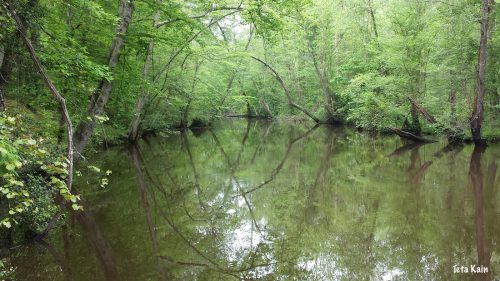
The focus of the story is really not on Bacon, but on why he found so few Indians to kill during his “rebellion.” The answer is just now being pieced together. They knew he was coming and they disappeared into “the Dragon.”
Dragon Run is 140 square miles of wilderness and swamp that stretches for 40 miles in Virginia’s Middle Peninsula in the counties of Essex, King and Queen, Middlesex, and Gloucester. The Post describes how a team of historians, researchers, and archaeologists, working with members of the tribes that still live in the area have pieced together the story of how 700 or more Indians lived in and out of Dragon Run and were able to evade Bacon and his men. Some of the work involved modern technology, such as the use of decibel meters to determine how far sound would travel in the swamp.
The big news and a major part of the story is that Dragon Run still exists today largely as it did almost 350 years ago when Nathaniel Bacon was hunting for Indians in its dense swampy forests. The Smithsonian Institution ranked Dragon Run as the second most pristine of all the watersheds of the Chesapeake Bay on the East Coast.
There is an active volunteer group, Friends of Dragon Run, that works lovingly and diligently to conserve the area. It has acquired a large portion of the land that constitutes the Dragon Run watershed. The remainder is owned by other nonprofit organizations or by private landowners. The area is not easily accessible.
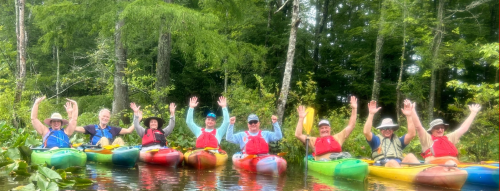
The Friends of Dragon Run sponsor guided kayak trips in the area for several weeks each in the spring, summer, and fall. The trips include experienced and knowledgeable nature guides. Taking the trip (I have done it three times) is like entering another world. In addition to the bald cypress trees that line the banks of the small stream, there are beaver dams and lodges, muskrat dens, flowers blooming each season, and many varieties of birds. The guide will point out a bald cypress tree that is some distance from the water that has been determined to be almost 1,000 years old. Pictured below is a group that recently made the trip. More information about the kayak trips and about Dragon Run itself can be found here.
Leave a Reply
You must be logged in to post a comment.