
by James C. Sherlock
Autism therapy is the wild west of medical qualifications and spending.
Autism is real, but industry professionals and the non-profits who lobby for limitless autism spending have richly earned widespread skepticism of the industry by not policing their own. They have created a closed loop for eternally increased spending:
- The profession describes limitless demand.
- Therapy is thus supply-driven, raising practitioners’ reimbursements. (That increases the demand for online college courses that too often result in debt and a failed professional exam.)
- The Virginia government buys that story unquestioningly, at least in part because the regulatory system here is utterly broken.
- The budget committees of the Virginia General Assembly, whose Health committees designed that regulatory system, allocate new “slots” for kids each year in the Medicaid budget and raise the payment rates in the same session.
- There are long waiting lists – see above for limitless demand.
- Slot access depends on the severity of the diagnosed need.
- As diagnosed by the profession.
- That describes the demand as limitless.
Autism spectrum disorder (ASD) was not defined until 2013. ASDs are a group of developmental disabilities characterized by impairments in social interaction and communication as well as by restricted, repetitive, and stereotyped patterns of behavior.
This article will discuss autism in Virginia, specifically:
- The widely diverging genders of patients and therapists,
- The education of Board Certified Behavior Analysts (BCBAs), the top tier of treatment specialists, and
- The exploding spending on treatment.
An autism diagnosis for a child is typically made by a pediatrician, a child psychologist, a child neurologist, or a child and adolescent psychiatrist. The populations of both autism patients and therapy providers have exploded, making Applied Behavioral Analysis (ABA) the fastest-growing and most troubled program in both Medicaid and private health insurance.
According to Behavioral Health Business
Medicaid spending on core Applied Behavioral Analysis (ABA) autism services increased by 403% from 2019 to 2024. The number of provider entities delivering these services to Medicaid recipients increased 346%. This suggests that much of the increase in spending is driven by new providers opening their doors.
So autism treatment growth actually is supply-driven, not demand-driven. The Wall Street Journal has been on top of the ugly side of that story. Virginia’s troubles have been discussed in this space and will be again.
Autism Demographics
Autism is diagnosed in boys at four times the rate of girls. The American Psychiatric Association blames chromosomes for the difference. We note that Borderline Personality Disorder (BPD) is diagnosed predominantly in women and girls—historically making up about 75% of clinical diagnoses.
Experts don’t know what to blame that on.
Profession Demographics
The genders are reversed in autism treatment.
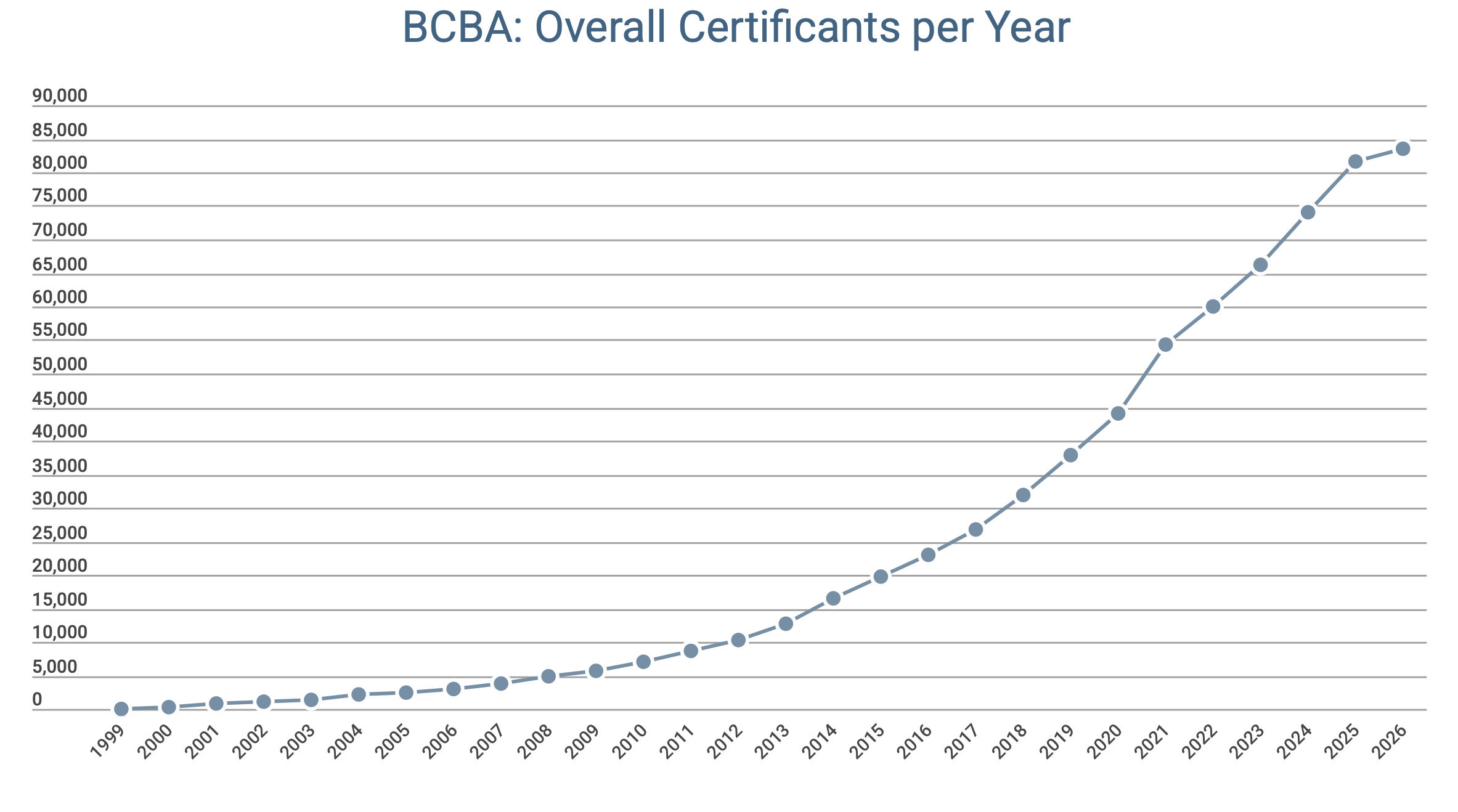
ABA practitioners licensed in Virginia must be certified by the Behavior Analyst Certification Board (BACB). The hierarchy of certifications and numbers nationally is:
Board Certified Behavior Analyst® (BCBA®) requires a Master’s degree and the passing of the national exam.
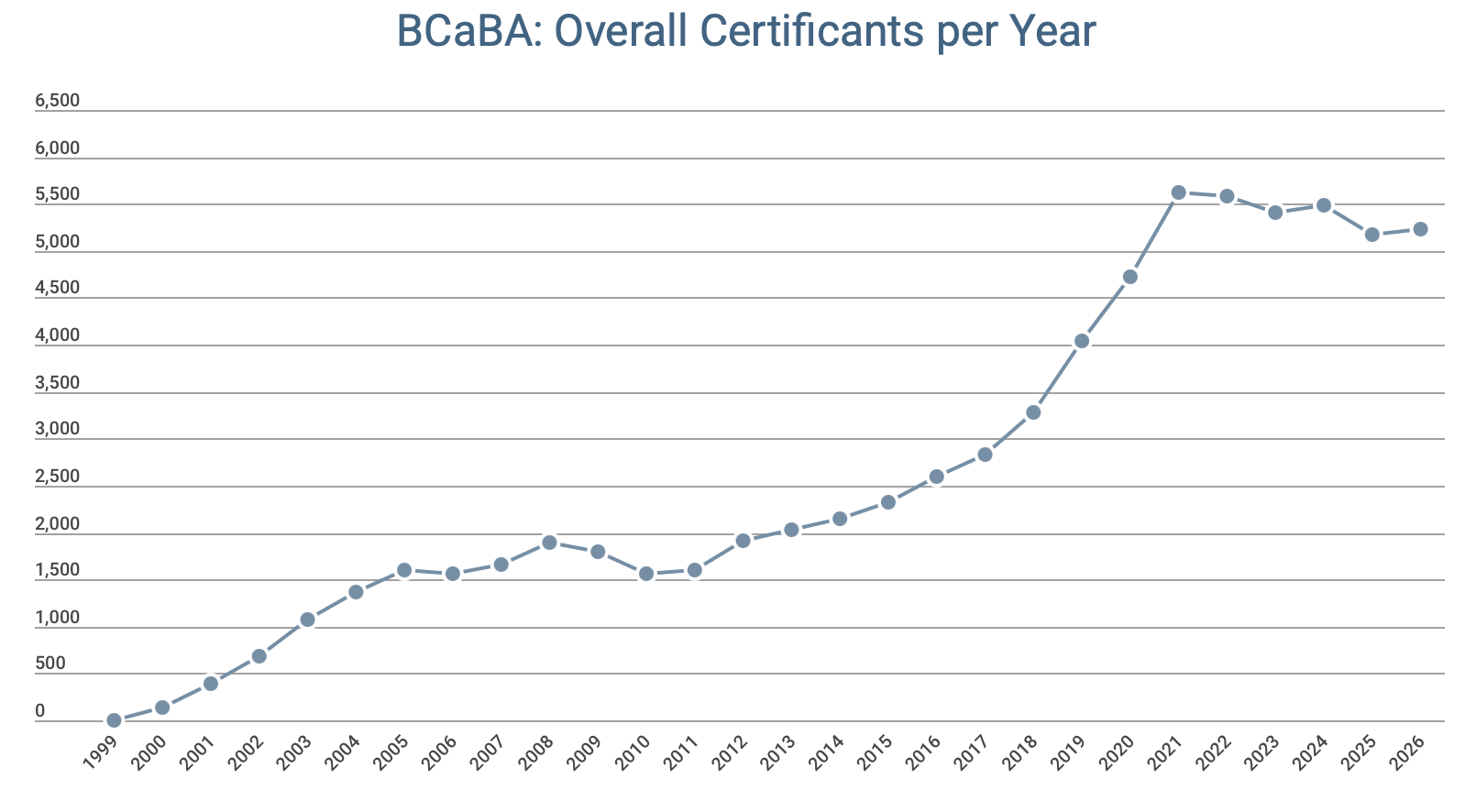
The Board Certified Assistant Behavior Analyst® (BCaBA®) is a professional with an undergraduate-level certification in behavior analysis who has passed the national exam required by the BACB. A BCaBA may only provide behavior-analytic services under the supervision of a BCBA.
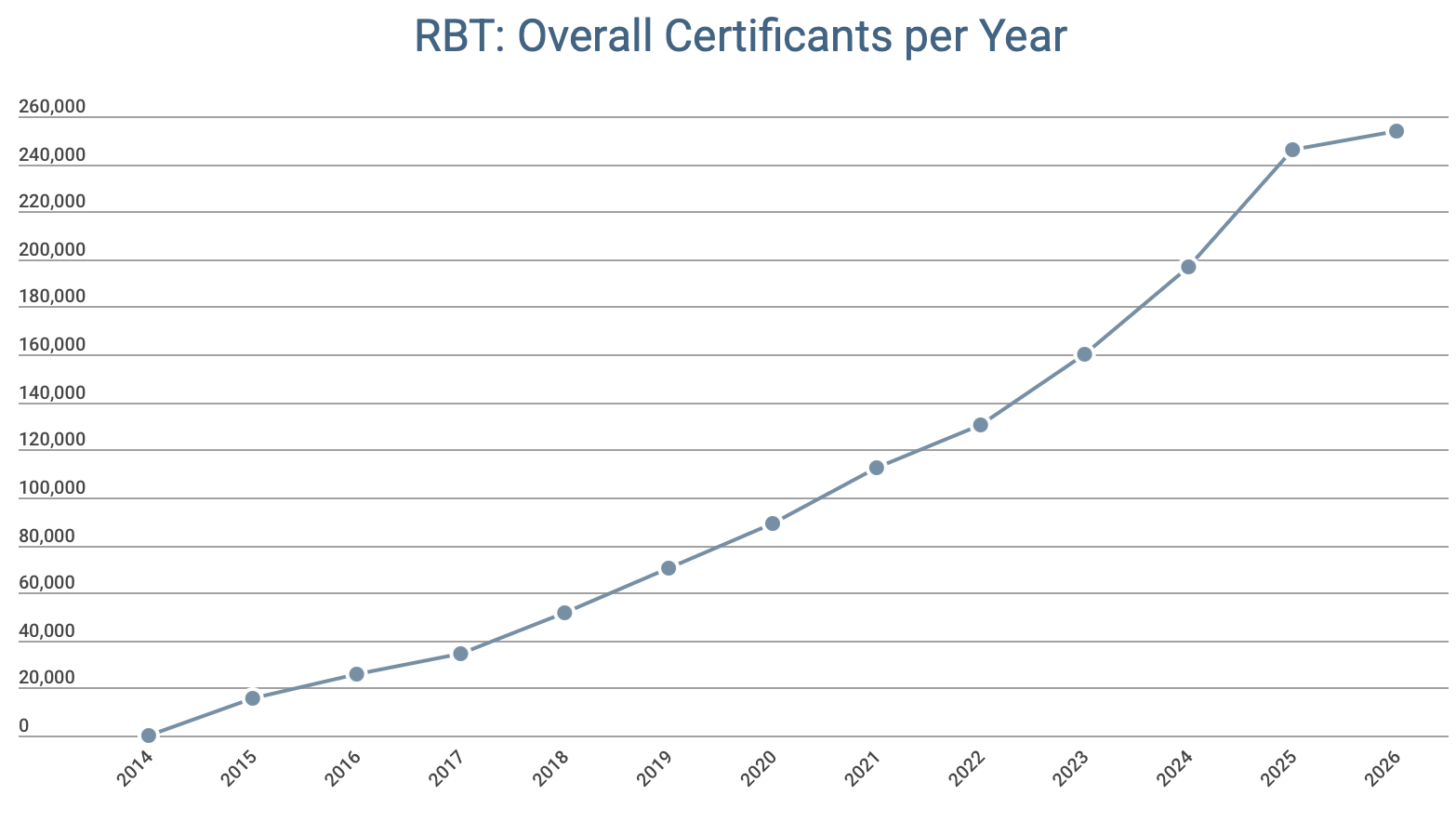
BCaBAs may supervise the work of Registered Behavior Technicians® (RBTs®)
Roughly 88% of credentialed Board Certified Behavior Analysts ® (BCBAs) (Master’s degrees) are women. Depending on the survey, the broader workforce, which includes Registered Behavior Technicians (RBTs) and uncredentialed therapists, shows that approximately 71% to 85.6% of ABA therapists are female.
Where are all the new BCBAs coming from?
There is a school of thought that the BCBA certification test is hard. There is another that thinks that much of the college-level education is bad. Both things can be true at once.
The Board Certified Behavior Analyst (BCBA) exam is a graduate-level credentialing test required for independent practice in applied behavior analysis. Administered by the Behavior Analyst Certification Board (BACB) through Pearson VUE, it consists of 185 multiple-choice questions to be completed within 4 hours. The overall pass rate for that exam is approximately 56% for first-time test-takers and 25% for those retaking. Candidates must score at least 76% to pass. The low pass rate speaks as much to the quality and modality of instruction at fast-growing university programs as to the difficulty of the test. As with nursing schools, who teaches prospective BCBAs if there are not nearly enough BCBAs?
In 2024,
- University program candidates’ passing averages ranged between 20% and 100%.
- Every school with a student pass rate of 80% or higher produced single- or low double-digit numbers of first-time candidates. Only nine of the 34 programs with those pass rates were taught entirely online.
- But some online programs are huge, and drive the overall pass rate.
School Candidates Pass rate
Florida Institute of Technology 796 71%
Ball State University 832 53%
Arizona State University 1259 49%
University of West Florida 269 49%
Capella University 889 44%
National University 451 42%
Purdue University Global 225 42%
There seems to be a role there for the accreditation bodies and the federal student loan regulators.
Geographic clustering in Virginia
Most of Virginia’s certified ABA professionals practice in major metropolitan and suburban hubs, including Northern Virginia, Richmond, and Hampton Roads. More on that next time.
Equity, of course
CDC, fresh off its triumph with kids during COVID – long-term school closings, masks for 5-year-olds, and six-foot desk separation – took up child autism. A study by the CDC Autism and Developmental Disabilities Monitoring (ADDM) Network (a way to spend money on studies) estimates that during 2022:
About 1 in 31 (3.2%) children aged 8 years have been identified with autism spectrum disorder (ASD)”.
That was followed by a word salad:
Increased identification of autism, particularly among very young children and previously underidentified groups, underscores the increased demand and ongoing need for enhanced planning to provide equitable diagnostic, treatment, and support services for all children with ASD. The substantial variability in ASD identification across sites suggests opportunities to identify and implement successful strategies and practices in communities to ensure all children with ASD reach their potential.
Translation: autism is vastly under-tested and underdiagnosed in most of the country. We’d better hope they are wrong and that it is instead overdiagnosed in urban areas. It is hard to tell how we will ever find out, because autism diagnosis and treatment is a closed-loop system that pays a lot of people a lot of money.
In this case, it is hard to tell what “equitable” means about race, because black kids are diagnosed with autism at twice the rate of white kids. Does equitable mean fewer or more Black children should be diagnosed as positive? But the use of equitable” here may be what it often is, victim-oppressor terminology meant to quash all debate. “Equitable” in that usage means “we will tell you how many kids have autism, what it will cost, and you will pay it, without discussion.”
We are going to continue discussing it in this space anyway.
Spending in Virginia
If those “opportunities” materialize as forecast, Virginia will need to spend up to 14 times what it spent last year on Medicaid ABA services “to provide equitable diagnostic, treatment, and support services for all children with ASD.”
Nationally, Medicaid spent $2.2 billion on autism in 2023. If the CDC is right and 3.2% of children have autism, the bill should have been $17 billion. If the CDC is right and the true percentage is much higher than that (among the evidence they put forth was a California site’s 5.5%), the sky is the limit.
In FY 2025, Virginia Medicaid spent $31,216 per member diagnosed with and treated for autism for a total of $243 million. Virginia has 1.88 million residents who are under age 18. At the projected 1 in 31 occurrence rate, autism would affect 60,645 Virginia youth. At the 5.5% ratio, the number would be 103,400.
That would mean the actual demand is between
- $1.9 billion from Virginia Medicaid alone, 7.8 times what we are spending today, and
- $3.23 billion, 13.2 times current Medicaid expenditures for autism services in Virginia. Virginia’s total Medicaid expenditure in FYE 2025 was $24.3 billion.
Private insurance, which is mandated in all 50 states to cover the costs of autism treatments and is estimated to cover 35% of the total number of patients, spent even more per patient. Christopher Weaver and Anna Wilde Mathews, in an excellent recent article in a series in the Wall Street Journal, explain why.
Bottom line.
Autism is real, and there are true professionals in the industry who know what they are doing and do it ethically. But the private equity-owned chains that are beginning to dominate the industry perhaps have different motivations and business models.
We have previously published evidence that, like the private insurers, the Commonwealth struggles to control fraud even at current spending levels. As recommended in more detail there, the federal government needs to reform the NPI system, and the Governor and the General Assembly need to get to work redesigning the regulatory system.
Next time, we will examine the enormous variations in Medicaid ABA spending per autism patient across Virginia cities and counties using South Hampton Roads as the example. We will also demonstrate how to use NPI data to choose a competent provider for your child while avoiding many of the risks associated with new providers and out-of-state chains.
You see, I don’t hate your autistic kid, just the risks that some professionals, incompetent politicians, bad education programs, and fraudsters are putting him in, while effectively setting fire to much of the money that should go to his support.
Revised June 8 at 1600 with the addition of the graphs of certifications
Revised June 8 at 1723 to update the first sentence under “Bottom Line.”
Leave a Reply
You must be logged in to post a comment.