
by Dick Hall-Sizemore

Virginians for Safe Communities needs to broaden its outlook.
In a recent article on this blog, the organization pointed out that the number of offenses against persons in Arlington/Falls Church and Fairfax Co/Fairfax City had increased significantly from 2019 to 2025. It linked those increases to the policies of the Commonwealth’s attorneys in those jurisdictions, claiming they had “legalized crime.”
The organization went on to claim that, while crime increased in those Northern Virginia jurisdictions that happen to have Democrat Commonwealth’s attorneys, “it fell everywhere else.” That’s not quite true. As shown in the table below, the number of offenses against persons increased quite significantly in three traditionally conservative, Republican counties. If Commonwealth’s attorneys are to be blamed for increases in crime, the prosecutors in those jurisdictions have some explaining to do.
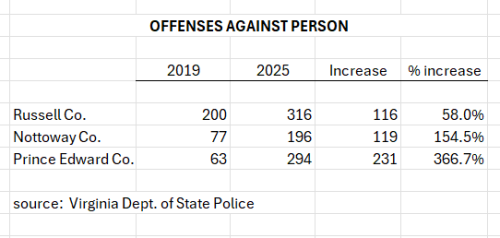
The headline of that article is misleading. It refers to “crime rates”, while the data in the table presented deals with numbers of offenses. Nevertheless, crime rate is the measure preferred by criminologists to compare crime across jurisdictions. An examination of crime rates in selected jurisdictions demonstrates that Arlington and Fairfax County are safer than many conservative jurisdictions in the state.
In addition to its annual report, Crime in Virginia, the Dept. of State Police maintains a Virginia Crime Statistics dashboard, which provides a significant amount of information for each jurisdiction and is easy to use. However, the dashboard reports offenses differently than are reported in the annual report. Instead of the category “Offenses Against Person”, that is used in the annual report, the dashboard uses “Violent Crime.”
The “Violent Crime” category differs significantly from the “Offenses Against Person” category. The two main differences are:
- Simple assault—Simple assault is defined as: “an unlawful physical attack by one person upon another where neither the offender displays a weapon, nor the victim suffers obvious severe or aggravated bodily injury involving apparent broken bones, loss of teeth, possible internal injury, severe laceration, or loss of consciousness.” It involves mostly minor altercations. Simple assaults are included in “Offenses Against Persons” and is the item with the largest number of offenses. It is not included in the “Violent Crime” compilation.
- Robbery—Robbery is defined as “the taking of anything of value from the control, custody, or care of another person by force or threat of force and/or by putting the victim in fear of immediate harm.” Often, it is referred to as “armed robbery,” although, technically, the offense does not have to involve the use of a firearm. In the Crime in Virginia report, robbery is not included in “Offenses Against Person”. Rather, it is included in the “Crimes Against Property” section. In the Virginia Crime Statistics dashboard, robbery is classified as a violent crime.
In summary, “Violent Crime” encompasses murder and nonnegligent manslaughter; aggravated assault; rape (including sodomy and sexual assault with an object), and robbery. Because it does not include many of the “lesser” offenses that are included in “Offenses Against Person,” it is regarded as a measure of the most serious crime in a jurisdiction.
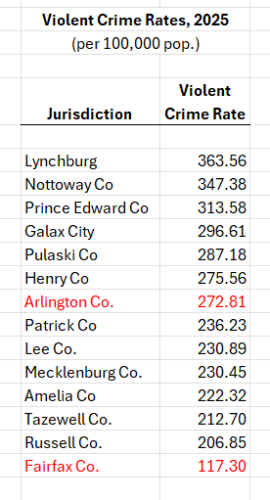
The following table compares the violent crime rate of Arlington and Fairfax County with those of various conservative jurisdictions of the state. A person living in Lynchburg is about three times more likely to be the victim of a violent crime than someone living in Fairfax County where Steve Descano is the Commonwealth’s attorney and about 30 percent more likely to be the victim than someone living in Arlington, whose Commonwealth’s Attorney is Parisa Dehghani-Tafti. As the comment on the article attests, it does depend on where you live.
Leave a Reply
You must be logged in to post a comment.