
by Ken Reid
I attended Gov. Youngkin’s address to the Northern Virginia Transportation Alliance Friday Oct. 24 in Fairfax.
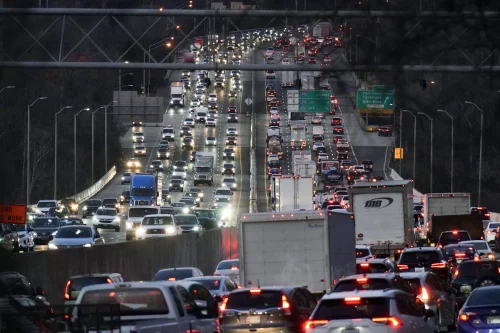
There, for the first time that I can recall, he addressed the horrendous traffic on the American legion Bridge (ALB-495) and the fact Virginia’s extension of express toll lanes to the Potomac River will be open by early February – but there will be no corresponding increase in lane capacity on the Maryland-controlled Legion Bridge and 495 Beltway and I-270 connection, called “The Split.”
That’s because Maryland Gov. Wes Moore, upon election in November 2022, announced the public-private-partnership his predecessor, Larry Hogan, worked out with former Virginia Gov. Ralph Northam was “not equitable.” This, despite the fact, the $6 billion project won approval from the Federal Highway Administration and Maryland Board of Public Works that very month, and the winner of the bid, Transurban, was ready to break ground to meet up with Virginia’s “495 Next” project.
The neophyte Moore, who never held elected office before, was pretty much conned by environmental groups and politicians like socialist Montgomery County Executive Marc Elrich into thinking using toll lanes was bad for poor people – although they do exist on other roads in Maryland
You can read the details of this saga in this Virginia Mercury article I wrote in September:
Youngkin and his Transportation Secretary, Shep Miller, never intervened when Moore made his intentions known in December 2022, nor before March 2023 when Transurban pulled out of the project, in part because Moore denied them an extension to get things ready to build.
But at the NVTA breakfast Friday, Youngkin announced he was going to send a team of experts to Annapolis to try to convince Moore that the P3 approach is the only way to provide new capacity on 270/495. The Free State faces a $3 billion deficit due to poor fiscal policies and a loss of jobs and people, and there is not $6 billion available from the feds to build this without tolls.
Some 250,000 vehicles travel the Capital Beltway and Legion and Wilson bridges every single day and face considerable backups even on weekends. In contrast, the collapsed Key Bridge in Baltimore, which became Maryland’s highest priority in March 2023, carries just 38,000 vehicles, and was never congested, yet got $1.9 billion from Congress in the closing days of the Biden administration.
I am told Moore is “coming around’ to restarting the P3 – but that remains to be seen. Perhaps motorists and the media will start putting pressure on Moore in February when they see the Virginia lanes open, and no corresponding capacity in Maryland.
But it gets worse.
On Oct. 16, I told WJLA-TV (Channel 7) that by 2030, Maryland DOT might need to close lanes on the ALB to rebuild it. The overpass on MacArthur Blvd in Maryland is crumbling.
Shutting lanes down when there is already insufficient road capacity will only make the traffic in the Washington region worse. A 2025 study by “Consumer Affairs ranks” the DC region No. 1 in traffic congestion, ahead of Los Angeles, with an average one-way commute time of 33.4 minutes adding up to approximately 71 days a year lost in traffic PER commuter.
Moore’s decision not only hurts D.C.-area residents, but any person using I-95 along the East Coast. The Legion and Wilson Bridges are now among the worst bottlenecks on the I-95 corridor.
It would not be this way had the political leaders in the D.C. area stuck with a 1966 plan to build an Outer Beltway, featuring an interstate bridge north of the Legion and south of the Wilson – but NIMBY opposition prevailed, and only Maryland 200 and the Fairfax County Parkway were built on the old Outer Beltway right of way – no connection over the Potomac.
In 2000, I led a group of Montgomery Conty residents called Marylanders for a 2nd Crossing to advocate for a 2nd bridge between Montgomery and either Fairfax or Loudoun Counties. Then, at the behest of Virginia interests, Rep. Frank Wolf put money into the FhWA budget to study the project, only to pull it in May 2001 when NIMBYs in the Potomac River communities in this district breathed down his neck due to agitation by the Warrenton-based Piedmont Environmental Council.
Since then, the concept of new Potomac River crossings has been a hot potato few politicians want to touch. And so, Larry Hogan’s Beltway/270 widening came to fruition, only to see it shelved by enviros and NIMBYs in Montgomery County, Md.
As much as I curse Wes “Moron” for what he did each time I see his name on a “Welcome to Maryland” sign, Glenn Youngkin has done no better for mobility in Northern Virginia.
Other than attending ribbon cuttings and ground breakings for projects begun by PREVIOUS governors, Youngkin has not initiated any significant transportation projects for Northern Virginia except a $1.7 billion Amtrak expansion, which helps very few people and does not decongest I-95 and other roads.
Shep Miller comes off as a good ol’ boy gladhander especially when he makes flattering remarks to elected officials at meetings of the Commonwealth Transportation Board, where he served under both Republicans and Democrat administrations. And he donates money equally to politicians of both parties. I think this helped him get the job, plus donating $10,000 to Youngkin’s inaugural.
So, now in his final months as governor, Youngkin has finally discovered he’s done little for Northern Virginia transportation and wants to restart the P3 with Maryland – a real uphill battle given the dominance of Leftist environmental groups and NIMBYs in the ruling Democratic Party.
In Youngkin’s 2021 campaign, traffic congestion was never raised as an issue – the first time in decades.
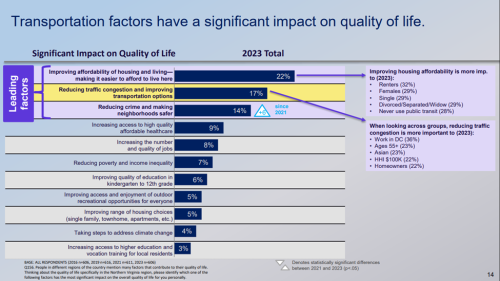
A 2023 survey by the Northern Virginia Transportation authority says the No. 1 concern to Nova residents is cost of housing, followed by transportation. See the chart
Have you heard either Winsome Sears or Abigail Spanberger discussing this? No, the campaign is all about Trump, transgenders in high school bathrooms and locker rooms or Jay Jones’ texts.
Neither candidate’s web site mentions traffic congestion AT ALL, though Spanberger does address housing affordability – in vague terms.
The reason socialist Zohran Mamdani is surging in the New York City mayoral elections, and Jack Ciattarelli is surging in the New Jersey governor’s race, is they are both addressing substantive kitchen table issues – energy costs in N.J., and the high cost of housing and dearth of grocery stores in many low-income neighborhoods. You may disagree with their respective solutions, but at least they are talking about real issues while Sears and Spanberger are not.
For failing to offer voters substantive ideas in this campaign, Sears is likely to lose Nov. 4.
But the real losers are the people of Virginia who want Richmond to solve real problems – like transportation.
The only good news if Spanberger wins is she might not reappoint Shep Miller as transportation – unless, perhaps, he donates big to her inaugural, too.
Ken Reid is a former Loudoun County supervisor and Leesburg Town Council member who was the GOP nominee for State Senate in District 37 in Fairfax County in 2023. He also is a journalist by trade, and published newsletters in the FDA field for 30 years.
Leave a Reply
You must be logged in to post a comment.