
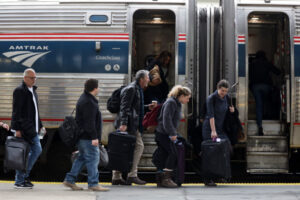
All Aboard!
Share this article
ADVERTISEMENT
(comments below)
Comments
Comments
49 responses to “All Aboard!”
-
While where I live we would be happy to get a traffic light at a busy intersection before someone gets killed . . .
-
“The cost of the ten-year program is projected to be $3.7 billion. ”
Can we start placing bets now as to the ACTUAL cost when all is said and done?
-
In my view the train line with bridge is neither daring nor ambitious proposal. We have been building train lines with bridges since the mid-19th century.
This project is long, long overdue.
If past be prologue in Virginia, then through greed, crony capitalism, and gross over regulation, the costs of this project’s overruns will soar out of sight.
-
Alas, ’tis true.
-
-
“The administration projects that, when completed, the rail expansion will remove five million cars and one million trucks from Virginia highways each year. ”
Can we start placing bets now as to the ACTUAL number of vehicles which the project will “remove from the road” after all is said and done?
-
They can call it VAMTRAK.
-
Now, class. Everybody say together: “California” “Central” “Valley” “High” “Speed” “Rail” “Authority”.
Yeah I know, the two aren’t comparable in at least one respect: there is great need to clean up the Northeast corridor, whereas there was/is little if any demand for anything in the Central Valley. Other than that they both involve massive government intervention with all the attendant niceties of same. Can you say DC Metro?
-
No vehicles or trucks will be removed from the road.
It should be better stated, “The projects will absorb as many as five million car and one million truck future trips generated as the population grows to mitigate the severity and expanded hours of congestion along the I-95 corridor.
-
I think you are right. It would be more accurate to say that the program would reduce the projected growth in traffic by 5 million vehicles. But, for political purposes, it seems more dramatic to say that it would remove that many cars from the road. Either way, it would be significant
-
-
“The details of the plan are too extensive to set out in this post. ”
Sometimes my eyes play tricks on me. When I first read that sentence I read it as: “The details of the plan are too expensive to set out in this post. ”
Truth be told, though, both statements are probably true.
-
Anyone who has even casually used the interstates in Virginia, whether I-95, of I-64 or I-81 has to be living in a cave to have not noticed the problem.
Does anyone really think we can fix it with more car lanes only?
-
The bridge needs to be built. Why not let CSX manage the project? They do such things for a living and will have a financial stake in bring it to completion on time and under budget. The biggest hurdle will be environmental permits and associated lawsuits. My personal over/under on the permits is a decade. The lawsuits will go on forever. See the pipelines for reference. The Governor should state his expectations on that point.
-
because we’ve already offered CSX that opportunity and they’ve turned it down – citing the fact that it’s VRE and Amtrak that is using capacity that CSX could use and then not need a new bridge.
The pipeline is a for-profit venture of a company intending to sell natural gas at the best price it can get from for-profit companies intending to use the gas for their own for-profit businesses. – it is a pure corporate venture not one to serve the public.
If the pipeline were to actually be to serve a genuine public purpose – the profits would be limited and the gas would be only for direct public needs for energy.
-
Larry is right, if the private sector were going to do it, it would already have been built. They say, rightly, “it’s not our need.” But in addition to Virginia commuters there is another interest that ought to be at the table offering to pay: the federal government, specifically DOD, which has long identified the Long Bridge as one of the most vulnerable facilities to terrorist attack because of the high volume of critical freight traffic over that link (and military traffic if there were a military mobilization).
-
-
You are right. Highways can only be widened so much.
However, even assuming this project goes off without a hitch, everything comes in on-time and under budget, and we end up with shiny new rail lines and trains that make [fill in a number] round-trip runs per day from Richmond to Washington, D.C., how do you entice people to abandon their personal vehicles and use them?
-
1. Remove the monthly Federal Parking Subsidy.
2. Congestion Charge going into DC.
3. Remove Monthly Parking rates – Daily Parking Rates only
-
So the answer is even more government intervention?
-
If the goal is to reduce the demand and “entice people” to switch modes…the government needs to intervene with new policies.
-
well the govt can and should not incentivize solo commuting.
Is that a real “government intervention”?
-
-
-
Most “Commercially viably project” determinations are highly speculative and illusive.
What is the numerical “commercial benefit of travel by air today?”
Tell me you know the answer, and I’ll know you have not a clue as to what you’re talking about.
-
It’s a chicken/egg argument. Build it and they will come. Works that way in every other developed country on the planet.
Not everyone. Maybe not a majority.
but as the interstates get more and more congested, people are going to consider rail – at least for some trips.
Remember – transportation funding – fully 1/3 of it now comes from sales taxes.
-
-
-
As Dick makes plain, it’s not clear where all the money will come from. Some will come from motorists who pay tolls on I-66, and some undoubtedly come from existing transportation revenue streams (virtually all of which is paid by motorists). So, the question arises, should motorists pay for rail projects?
Dick alludes to the justification for the massive transfer of wealth from motorists to rail riders: the rail expansion will remove five million cars and one million trucks from Virginia highways each year. That’s about 13,700 cars and 2,700 trucks per day.
One needs to compare those numbers to what could be accomplished in the Northern Virginia highway network with $3.7 billion. We have reached the point where the cost of adding new lanes would be astronomical because all the free land is taken up. Once you begin condemning commercial property to acquire more right-of-way, the cost of widening the interstates becomes incredibly expensive. If the $3.7 billion rail project removes more cars and trucks than the highways could accommodate with $3.7 billion in improvements, then the project makes economic sense and benefits motorists, and sticking motorists with the tab can be justified.
To my mind, that is the big-picture question that needs to be asked. Subsidiary questions should include, as commenters have alluded to above, what will the real cost be after the inevitable increases in cost are factored in? Never in the history of mankind has a project of this magnitude not inflated as time goes by. (OK, that might be an exaggeration, but it’s not much of one.)
This will be one of the biggest public works projects in Virginia history, and it deserves to get a lot more scrutiny than it has received so far.
-
What is most telling about this mere proposal to build a rail line with bridge is how grossly incompetent and ineffective we as a society, and as individuals, have become. Just talking about building a rail line and bridge, how bold and ambitious it is, all its perceived problems and uncertainties, ties us all up into knots. Our World War 11 fathers are laughing out loud.
-
In determining benefits of rail vs highways the following need to be considered:
– No more vehicle capacity is being added into DC.
– CSX could cancel VRE at anytime in favor of more freight traffic.
– Limited highway ROW into high density urban areas of NOVA -
re: ” existing transportation revenue streams (virtually all of which is paid by motorists). ”
not true. Fully 1/3 of transportation revenues now come from State sales taxes.
Should 1/3 of transportation revenues go for non-care transportation infrastructure?
Here are the numbers:
Motor Fuel Taxes $911,700
Motor Vehicle Sales and Use Tax 1,032,400
State Sales and Use Tax 1,153,100 <— general sales taxhttps://www.dmv.virginia.gov/webdoc/pdf/tracking_dec19.pdf
Here's a question. If you actually know the FACTS – does it change your opinion?
-
-
Looks like a perfect recipe for cost overruns, incompetent engineering, graft, kickbacks, and additional taxes on motorists. The Rail Czar will be a modern day Billy Mahone. Graft is good right? Just ask Loudoun County commuters about how they have to pay sensational tolls to front the Silver Line. That needs to be rechristened as the Lemon Line. Who gets to line their pockets with newly minted bond money? If Bill’s BBQ was still open I might ride the train from DC to Richmond? Why in the world would anyone ride a train to Richmond or Norfolk? I would much rather catch a train to Union Level in Mecklenburg County! But that train era was a long time ago. I can still hear that wail of the locomotive whistle!
-
I actually ride that train from Norfolk to Richmond, to D.C. and to Manhattan. I am quite capable of driving those trips and have done so for decades.
My assessment is that the trains are a much better value. On the train I sit in a large comfortable seat, read or sleep, and arrive refreshed in the same amount of time that it takes to drive on a good day and time (is there a good time?) on I64 and I95. Anyone driven those trips and arrived refreshed? My safety and peace of mind are worth more than the small fares. Those fares obviate buying gasoline, tolls, highway risks, and parking fees. And, God help us, La Guardia airport. Ride the train. You’ll thank me. -
any more or less than VDOT building roads?
why is the building of rail more susceptible than VDOT roads?
-
-
I’ve been busy elsewhere (he, he) and now join in this. I sat through a brief presentation, and will be in House Finance Monday for the next hurdle toward passage. For the state to be taking direct ownership of that many miles of track and right of way, and basically forming its own medium sized Amtrak, is a huge step into the great unknown. California’s recent efforts (failure) are on their minds, I hope. If this were a commercially viable idea, the state would not need to lend its full faith and credit….Yes, VRE already exists but I don’t think VRE owns track. Yet I too would cheer expanded and more reliable rail around the state.
-
Hire me, and I will develop a fabulous sure fire rail plan for the entire state. Virginia’s future will be assured. We’ll never look back. Go VA rail & bridge!
-
As regards this rail and bridge proposal improving centuries old and long obsolete transportation infrastructures, the real question is what will our losses be (and they will be monumental) if we do not undertake these rail and bridge improvements.
I would be surprised and disappointed had this proposal not been discussed and tacitly agreed to be later proposed by the state, as a part of the Amazon deal.
-
-
” If this were a commercially viable idea, the state would not need to lend its full faith and credit….”
Excellent point.
-
We don’t require highways to be “commercially viable”, yet we issue bonds that do carry some backing of the state’s faith and credit, i.e. the expansion of Rt. 58.
-
I wonder if they ever fixed the hairpin corner on Lover’s Leap Mountain? Rt. 58 is a terrific highway. Straighter than a preacher and longer than a memory.
-
-
Any more or less than highways?
-
-
The bonds would be Section 9(d) bonds, revenue bonds. HB 1414 explicitly provides that the bonds would not be backed by the full faith and credit of the state or any localities.
-
Thank you for the clarification. I missed that when I read the bill.
-
-
I don’t think I agree with you about the state forming its own “medium sized Amtrak”. At least, not completely. That possibility was up in the air with the bill as introduced. I posed the question to the director of DRPT. Subsequently the substitute included a prohibition of the Authority from directly operating passenger train service. Of course, the key work is “directly”. Here is the reply to me from the DRPT director:
“As proposed, the VPRA would not directly operate rail service. Amtrak and VRE would continue to operate passenger and commuter rail service in the Commonwealth utilizing funding from the VPRA. Rather, the VPRA’s role would be to ensure the newly acquired infrastructure and right-of-way are governed and managed in a manner consistent with the Commonwealth’s transportation priorities.
One example would include the VPRA negotiating the terms of passenger service operations and schedules with Amtrak, and then entering into agreements with Amtrak to operate the trains.”The phrases “utilizing funding from the VPRA” and “entering into agreements with Amtrak to operate the trains” need explaining. Is Virginia contemplating subsidizing passenger rail service, as is now done by the feds?
As Jim pointed out, this proposal needs to get a lot more scrutiny than it has gotten. The members have been fixated on annual vehicle inspections and open container restrictions.
-
You haven’t seen an MOU because it hasn’t been done. This piece is a definite pig in a poke….
-
-
I think Dick’s correct: this is an infrastructure project, not a commuter operations project. Particularly as to the new Long Bridge, I say again, this ought to have backing and $$$ from DOD to help pay for it; the bridge today is not only a bottleneck but also an extremely vulnerable (to terrorists and conventional military disruption) pinch point in the defense capabilities of our overall eastern rail network, long identified as exposing our entire economy to substantial risk.
-
That’s a good point.
-
-
-
Some other thing that need to be considered and addressed are operations & maintenance costs and life-cycle replacement costs.
Life-cycle replacement costs are something that has been overlooked and/or ignored on public works projects since… …well, since the invention of public works projects.
The consistent failure by owners of infrastructure to budget for, and set aside adequate funds for, the costs of replacement/renewal of said infrastructure’s at the end of useful life is THE reason we have a nationwide “aging infrastructure” crisis.
-
Thus the idea that a road “has been paid for” is a dumb one?
the biggest cost of a road is not it’s initial construction but it’s operation and maintenance.
Fully 1/2 and more of the States Transportation revenues go to O&M – and it comes off the top. Whatever is left goes to “improvements”.
AND, the MORE roads we build, the bigger the O&M costs!
-
Yes. And as I stated, of equal importance is replacement/renewal costs. No matter how well maintained a piece of infrastructure is, it eventually reaches the point where it needs to be replaced or completely rebuilt/refurbished.
-
-
-
I’m often flabbergasted by opposition to states’ or any form of government involvement in passenger rail, which appears to me to undergird much of the discussion in these comments. The rail companies have successfully brainwashed people into thinking the government has no business putting passengers on “their” roads.
I don’t hear people saying that government ought not be in the business of building roads and highways. Who’s talking about privatizing police patrols on the interstates? Should we leave to the private sector the responsibility to build and operate river locks? Where are the objections to governments building and operating airports?
The fact is that virtually ever transportation sector in the nation is owned, operated, or subsidized by governments. If we ever want to stop, or at least minimize, the inexorable gobbling of countryside to highways, passenger rail needs to be part of the solution.
And by the way, I’ve read a lot about the governor’s proposal. Hall-Sizemore’s explanation in this article is about the best I’ve seen. Well done.
-
Thank you Lawrence Hincker for your excellent comment.
Transportation is one of the key and essential rolls of government. Over privatization of it by the Reagan Administration was one of the few of the great man’s great mistakes.
The brutal abuse by private interests of Dulles Airport and its toll road, as well as the seizure by private interests of control of land use decisions in Northern Virginia, is amply proof of the idea that private interests should not run or dictate, or otherwise seize, these vital rolls and tasks of government.
This rail line and bridge improvement in question is in Virginia’s vital public interest. The state government needs to insure that it happens, and should assume responsibility for it happening in a forceful and cost effective way, as the state of Virginia used to be able to do so effectively in an earlier time.
-
I’ve passed through plenty of privately-owned river locks thanks to the nice people at Viking. Often they are also hydro power producers….Nobody is attacking this idea, but the details will matter and on the new rail authority, the details are conspicuously absent.
-
Like Reed, let me thank you for that. Public-owned, public initiative infrastructure has a long and necessary history in this country — and not just roads. If you look at who built the original Virginia Central RR in Virgina, it was the State. If you look at the investment in the RF&P RR, a lot of it was the State. If you look at who backed (and paid for much of) the 19th c. canals on the Potomac and James Rivers (let alone the more recent Corps of Engineers projects on the Ohio R.) it was the State of Virginia. As was discussed earlier in BR in regard to expanding broadband investment in rural counties today, there is a necessary place for infrastructure built with public funds, at least where the private sector won’t step up to the task.
-
In the Reconstruction Era Virginia was badly crippled by not only the devastation of four years of conflict but the massive load of infrastructure debt (railroads/canals). This debt had piled even higher during the war years. Almost every dollar of Virginia taxes collected went to pay the interest on this debt. There was nothing left over for urgent demands such as public education. The state was virtually powerless for a full generation.
-
-


Leave a Reply
You must be logged in to post a comment.