
by Dick Hall-Sizemore
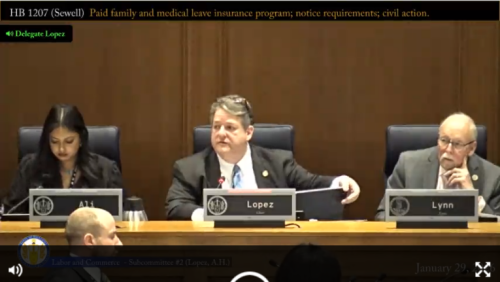
Out of curiosity after reading Derrick Max’s article on the family and medical leave act, I watched the video recording of that subcommittee meeting on HB 1207.
Derrick Max raised legitimate questions and objections to the bill. There were two Republican Delegates on that subcommittee. Neither asked a single question of the bill’s patron nor made a single comment.
Beyond the non-engagement of the minority party, this subcommittee meeting is a perfect example of how the legislative process is broken.
Now I get to play the role of the old fart talking about the good old days.
When I was involved in the legislative process in the General Assembly in the 1970’s and 80’s, both as staff and lobbyist, subcommittees were the venue in which important, complex bills were subjected to a thorough review. There was often a lively debate between proponents and opponents.
That is no longer the case. The patron presents the bill. In some cases, the patron describes the provisions of the bill in some detail; in other cases, not so much so. Then there is the predictable parade of lobbyists and other representatives striding to the microphone, each allotted a minute, introducing themselves and informing the subcommittee members that XYZ (supports) (opposes) the bill. The reasons, if any, given by the supporters are usually largely identical and the same goes for the opponents. There is little or no debate or discussion among the members.
A major reason for this charade is there are too many bills. The General Assembly does not have enough time to spend considering sometimes complex legislation. Another problem is that members have too many committee assignments. To avoid conflicts as much as possible, committee and subcommittee meetings are limited in the number and length of meetings they can have.
Another problem is that each lobbyist feels the need to be able to go back to his or her client or group and report that he or she represented the client or group before the subcommittee or committee on a bill. A more effective approach would be to give each side 10 minutes, with each side choosing a single spokesperson to lay out the arguments for and against the bill. In that manner, detailed arguments for and against could be made and recommendations made without repetition.
In the case at hand of the family and medical leave bill, it might have been that this bill is familiar to members, having been passed and vetoed last year, and its passage is a foregone conclusion this year. Therefore, the attitude of the opponents seems to be one of resignation. A more healthy approach would have been for the Republicans on the subcommittee to come armed with questions and objections such as those raised by Derrick Max and posed them to the patron. Push the patron; don’t give her a free ride. If you don’t like the bill, but know it is probably going to pass, at least offer some reasonable amendments that would make it less bad. Make your proponents of the bill work for it.
Leave a Reply
You must be logged in to post a comment.