
by Carol J. Bova
The Covid-19 pandemic may have faded from public consciousness, but controversy over how best to fight the virus rages unabated.
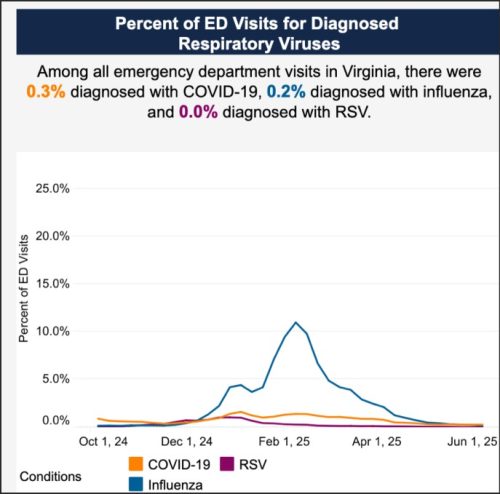
For the week ending, June 7, 2025, The Virginia Department of Health (VDH) reported Covid-19 was responsible for 0.3 percent of emergency room visits — compared to 0.2 percent for influenza visits. In the previous six weeks, there were 16 deaths from Covid-19. In the same report, VDH urges: “Everyone 6 months of age and older is recommended to receive an updated COVID-19 and flu vaccine.”
VDH also reports 1,275,918 doses of vaccine were administered during 2024-2025. But the state agency reports no research showing the efficacy of the vaccines.
To say that the research is in flux would be an understatement.
Recently, conflicting Covid-19 vaccination advice has been flying between the Food and Drug Administration (FDA), the Centers for Disease Control (CDC), the American Academy of Pediatrics (AAP) and CDC’s Advisory Committee on Immunization Practices (ACIP).
The latest round of controversy began when the FDA published a paper in the New England Journal of Medicine on May 20, 2025, calling for studies on the effectiveness of the Covid-19 vaccines by age groups. On May 27, Health and Human Services (HHS) Secretary Robert F. Kennedy, Jr. ended the CDC recommendation for Covid-19 vaccine for children and pregnant women. The CDC fired back continuing its earlier recommendations for the vaccine for children with a few word changes that would guarantee continued insurance payments.
The CDC’s advisory ACIP group showed no indication it would include new effectiveness testing in discussions at their June 25-27 meeting, and Kennedy fired all ACIP members on June 9, 2025. The immediate reactions from various medical groups and agencies were loud and outraged, but so far, all have ignored the testing issue. The first Covid-19 vaccine came out in December, 2020, so these studies are long overdue. Now the question is: what happens next?
Here is the timeline and details about the different agency news releases:
March 15, 2025: CDC posts Guidelines online for individuals 6 months or older.
May 20, 2025: Vinay Prasad, from the FDA Center for Biologics Evaluation and Research, and FDA Commissioner Martin A. Makary published an article in The New England Journal of Medicine titled, ”An Evidence-Based Approach to Covid-19 Vaccination.”
They report that “the FDA will adopt the following Covid-19 regulatory framework: On the basis of immunogenicity — proof that a vaccine can generate antibody titers in people — the FDA anticipates that it will be able to make favorable benefit–risk findings for adults over the age of 65 years and for all persons above the age of 6 months with one or more risk factors that put them at high risk for severe Covid-19 outcomes, as described by the CDC). For all healthy persons — those with no risk factors for severe Covid-19 — between the ages of 6 months and 64 years, the FDA anticipates the need for randomized, controlled trial data evaluating clinical outcomes before Biologics License Applications can be granted. Insofar as possible, when approving a Covid-19 vaccine for high-risk groups, the FDA will encourage manufacturers to conduct randomized, controlled trials in the population of healthy adults as part of their postmarketing commitment.”
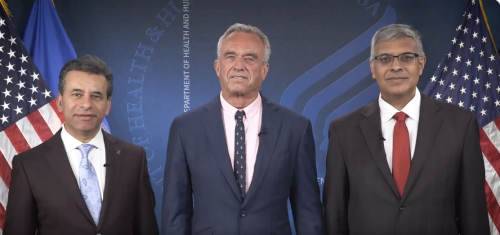
May 27, 2025: Health and Human Services (HHS) Secretary Robert F. Kennedy, Jr. ends COVID-19 vaccine recommendation for healthy children and pregnant women in a video on X where he is flanked by Food and Drug Administration (FDA) Commissioner Marty Makary and National Institutes of Health (NIH) Director Jay Bhattacharya.
May 29, 2025: CDC contradicts RFK, Jr, and adds a section to its immunization schedules notes directing parents to speak to their child’s health care provider on COVID-19 vaccination:
Ages 6 month–17 years who are NOT moderately or severely immunocompromised. Shared clinical decision-making vaccinations are individually based and informed by a decision process between the health care provider and the patient or parent/guardian. Where the parent presents with a desire for their child to be vaccinated, children 6 months and older may receive COVID-19 vaccination, informed by the clinical judgment of a healthcare provider and personal preference and circumstances.
May 30, 2025: The American Academy of Pediatrics (AAP) issued a news statement expressing relief “families will have access to the immunization after confusing and mixed messages. Including the vaccine on the immunization schedule means it will be covered by insurance.”
“This means many children and adolescents can access a vaccine to protect them from some of the serious complications of this disease, including long Covid,” AAP President Susan J. Kressly, said in a news release.
June 4, 2025: > CDC Coronavirus vaccine adviser Lakshmi Panagiotakopoulos resigned as co-leader of the working group that helps the Advisory Committee on Immunization Practices (ACIP) with recommendations on safety and efficacy data of COVID-19 vaccines. She was quoted on Reuters saying she is “no longer able to help the most vulnerable members” of the U.S. population.”
June 6, 2025: The American Academy of Pediatrics (AAP) said in a news release, “The AAP has been critical of health officials circumventing the usual process and rolling out confusing and incomplete recommendations. The AAP Committee on Infectious Diseases will examine the evidence to make its own recommendations about vaccination as it typically does after ACIP has deliberated.”
June 9, 2025: HHS Secretary Kennedy removed all remaining 17 members of ACIP. The Biden administration appointed the chair, Helen K. Talbot, MD, MPH, for a two-year term in February, 2024, eleven others were also appointed in 2024, and three in 2021. Two others were nonvoting members.
June 25-27, 2025 The Meeting of the CDC Advisory Committee on Immunization Practices (AICP) will be webcast live online. The agenda notes that “immunization recommendations of ACIP that have been adopted by the Director, CDC, and appear on CDC immunization schedules generally must be covered by applicable health plans.”
In addition to the Covid-19 vaccines, the discussions will include anthrax vaccines, chikungunya vaccines, cytomegalovirus (CMV) vaccine, Human papillomavirus (HPV) vaccine, influenza vaccines, Lyme disease vaccine, meningococcal vaccines, pneumococcal vaccines, Respiratory Syncytial Virus (RSV) vaccines for adults, and RSV vaccines for maternal and pediatric populations. Recommendation votes are scheduled for COVID-19 vaccines, HPV vaccine, influenza vaccines, meningococcal vaccine, RSV vaccines for adults, and RSV vaccine for maternal and pediatric populations. Vaccines for Children (VFC) votes are scheduled for COVID-19 vaccines, HPV vaccine, influenza vaccines, and RSV vaccines.” Public comments may be submitted through the meeting agenda link.
Leave a Reply
You must be logged in to post a comment.