
by Jon Baliles
At a media event last Friday to talk about transparency, Richmond Mayor Danny Avula admitted that fixing the city’s check register — the one that is supposed to publish all city payments monthly but was turned off by the Stoney administration in 2019 and never restarted despite being required by city code — had not been a top priority.
“I will be perfectly honest to say this fell into the category of important, but not urgent,” Avula told reporters at the media briefing. He also said the “recent press” stories and efforts led by 3rd District Councilwoman Kenya Gibson to at least publish the register from last year had “ratcheted this up.”
Forget for a moment Avula ran for office promising to be transparent, change City Hall for the better and be a different leader and mayor. Yet, his efforts to pretend to be transparent are no different and little better than his predecessor.
“Clearly, this is pretty important to you all,” Avula told reporters last Friday at City Hall, and added he felt there was a “huge chasm” between “what’s getting reported on and how we’re actually thinking about this.”
Actually, there isn’t.
“I feel like this is being positioned as we don’t want to be transparent about things,” Avula continued. “And I very clearly am super aligned with and committed to the intent of the check registry law.”
As they say, the road to you-know-where is paved with good intentions. Avula ran for office saying transparency was a priority, but he has instead chosen a path with less transparency and has proposed an ordinance that is little more than a media gimmick. In reality, if approved, it will prevent public from seeing who gets paid by the city and for what, leaving the only option for the press and public to find waste, fraud, and abuse through filing a Freedom of Information Acts (FOIA) requests (and then have the city bill you thousands of dollars to fulfill it).
Three weeks ago Avula issued a press release praising his efforts to be transparent and criticized the existing 2015 check register law and said his latest “efforts” were “aimed at improving how the City delivers payment registry data, as required” under existing city code. He also said his effort “represents a meaningful move toward improved transparency,” but he then contradicted himself and released a spreadsheet of 2025 city expenditures that did NOT include key information like what city vendors were paid and for what the payment was for. The release three weeks ago was disguised as being transparent and last week’s media gathering was meant to look the same by introducing his new ordinance, except it will provide the public with LESS transparency, not more.
The Mayor’s new “plan” is to limit what information the city publishes and exclude what they deem as confidential or sensitive in order to not publish information that the public has a right to know and can prevent and detect fraud. The existing 2015 payment register requires (note the present tense) publishing payment dates and invoice descriptions that detail the goods or services being purchased. Mayor Avula’s proposed ordinance removes both these categories from being made available to the public. That is a full pivot from an earlier Avula position that the invoice descriptions of what people are paid for was one of the “most relevant pieces of information” of the 2015 ordinance, but now he wants to remove it from public view. Yet, he maintains the façade that he is trying to be more transparent.
“We want good, transparent, open information that helps people understand how their tax dollars are being spent,” Avula said. “If we can’t do it, that’s not accomplishing that mission.”
In other words, the Mayor wants to remove the “Pay To the Order Of” and “Memo” lines on your checks for those of you who remember or still have checkbooks, which removes the purpose of keeping track of expenses or understanding what the city is spending money on. Avula claims, like Stoney did, city staff had to go through thousands of transactions line by line to remove any sensitive information. He also claimed he wants to change the existing law and tried but failed to find ways to outsource or streamline the review process, but was apparently unable to find any modern spreadsheet software in 2026 to help with or handle the task, so his solution is — less information.
In addition, the ordinance is written in a way that gives city officials the power to interpret the law to decide what information should go into the payment register and what should be kept out. These are the same city officials that charged The Richmonder $5,732.40 to get the check register for 2025 which is supposed to be online for free; they also told them it would take until October to get it. These are also the same officials who routinely charge absurd amounts for FOIA requests for simple information (not all FOIA requests are simple) and in this case, the law says it should be free.
The ordinance states, “The Director of Finance, in consultation with the City Attorney, shall determine the appropriate application of exemptions and may withhold, redact, or aggregate information as necessary to ensure compliance with this section and applicable law.”
The definition in the ordinance of “publication required” removes the existing law which states each month’s spending be published “at the time of the close of that month.” Avula’s new ordinance allows the Director of Finance to arbitrarily publish “within a reasonable period following the close of the reporting period to allow for reconciliation and review.” Reasonable is not defined in the ordinance, and in the legal world, that means it means whenever they determine reasonable to be.
Avula was asked last week if he thought his proposed ordinance was more or less transparent than the 2015 register, and he said his register proposal (without any meaningful information) was better than no register at all. He said it was an improvement from the current situation which was a register that was ignored by the last administration and remains ignored currently by his own.
Samuel Parker at the Times-Dispatch reported Avula saying: “There’s no payment register,” he said, referring to the fact that officials removed all historical spending data from the city’s website in 2024. “It’s not happening right now, right? I think what we’re trying to do is find the sweet spot of a registry that provides a level of transparency that the city is not providing that aligns with what other communities are doing, and seems to meet the needs of the masses.”
“So yeah, I think we’re trying to do better than we are right now,” he said.
Translated, that pretzel logic means there is no check register because the last Mayor turned it off and he will not be the mayor to turn it back on as required, instead, he will publish it again only after changing the law to remove the most valuable spending data that by its nature brings accountability and transparency. Essentially, the Mayor believes fake transparency is better than nothing.
Avula’s proposal would not list individual line items but only spending by department. The best example of why the Mayor’s proposal is dangerous is the case uncovered by Samuel Parker at the Times-Dispatch who found that Reginald Thomas, a former Fire Department employee was using fake city purchase orders (and still under investigation) for perpetrating $2 million of fraud. Included in those purchase orders were eight custom cabinets that cost almost $75,000. Surely this check for these amounts for this kind of purchase by the Fire Department would have raised eyebrows (if not alarms, get it?) by someone looking at the check register (had it been available) or a department official monitoring spending and purchasing.
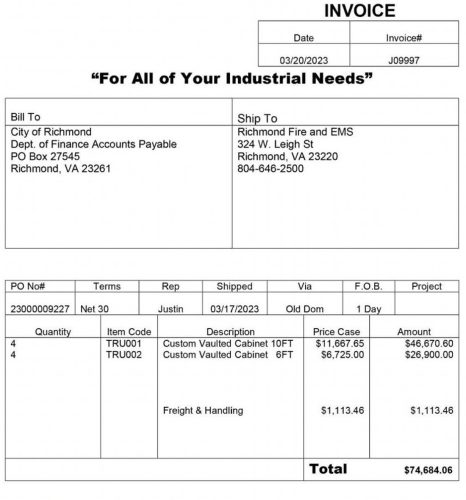
Parker found these records through a FOIA request, but without the check register, it’s a needle in a very big haystack. Parker wrote this week: Under Avula’s proposed check register, the transactions would not appear as individual line items and would not contain Thomas’ name, omissions that would render it virtually impossible to identify the suspicious sums and connect them to the companies in question.
Thankfully, the common-sense virus that is hopefully spreading will also infect this issue like it did with the Mayor’s tone-deaf severance giveaway proposal. 3rd District Councilwoman Kenya Gibson has asked repeatedly for information for Council but has been ignored and/or rebuffed to the point she is considering issuing a subpoena to the Avula administration to provide the information that is required by law.
Avula released his neutered version of a 2025 payment register without any key or transparent information three weeks ago as a ploy to buy time and now he has his less transparent ordinance on the table for Council to consider. The Mayor is betting he can get five Council members to change that law before he is required to follow it. “The vast majority of Council is fine to give us time to work on this,” the mayor said, without identifying who on Council supports the ordinance. Three Councilors who voted for transparency in 2015 (Newbille, Robertson, and Trammell) when it was approved unanimously will now be asked now to vote for less transparency, and the other Council members will too.
At the same time he is courting Council, the Mayor and City Attorney said even City Council is not entitled to see the spending information without the heavy redactions that make oversight and transparency impossible. Mayoral advisor Sarah Carpenter said City Attorney Laura Drewry told the administration that “the same rules apply to Council as would apply to the general publication.”
In other words, no soup for you!
According to Moomaw: Gibson said she’s planning to introduce her own proposal that would allow the Council to look into the matter on its own to better understand whether the redaction challenges are as dire as the administration says.
“Our office is preparing a resolution to determine whether redaction requirements are a legitimate barrier to complying with current law,” Gibson said. “My hope is that a Council majority will support this investigation so we can earn the trust of the residents we’re elected to serve.”
While the City Charter allows City Council to launch “investigations relating to the municipal affairs of the city as it may deem necessary,” and thus order city officials to provide “books and papers,” relevant to an investigation, it’s not the best way to force or resolve the issue (and the administration will just ignore it). The best thing to do (and the easiest) would be to strike the Mayor’s proposal down altogether because it’s an insult to the public, and no matter how many times Avula says “transparency,” his proposal is anything but. The solution is to publish a register with spending data and protect sensitive information, not remove all of it so it is useless.
The 2015 law was not groundbreaking in its mission, and its purpose to be accountable and transparent is successfully accomplished without issue in localities all over the country. If a city of 230,000 people can’t manage and edit a spreadsheet in 2026 of its expenses on a regular basis to be honest with the people that provide the money to write the checks, then we have much bigger problems.
Also at last weeks’ media briefing, Moomaw reported that the Mayor expressed “regret” over the city charging The Richmonder $5,732.40 for the 2025 check register information the city was required to publish by law, but ignored by everyone in charge at City Hall. Moomaw requested the information in a FOIA request on March 10.
The mayor said he wished the city could have engaged in more conversation about the request before sending the cost estimate, saying he didn’t intend to charge for information that should be public anyway. “I would like to have that one back,” Avula said.
The city said after the briefing they would rescind the FOIA charge; however, they did not release the information the city is required to publish of free public inspection and review. When Moomaw asked if the city would release the information without the social services data, the city’s response was it would only reduce the workload by 17%. Last month, the administration told Councilwoman Gibson and Moomaw that supplying the 2025 information would take until October (everyone who believes that, stand on your head).
Moomaw get’s the Olympic medal for digging to get the info as well as answers. He also submitted a FOIA to get the payment information that was available online for four years from 2015-2019 (without any complaints). The day after Samuel Parker broke the story in the Times-Dispatch in 2024 about the check register having been shut off in 2019, it was removed from the city’s website.
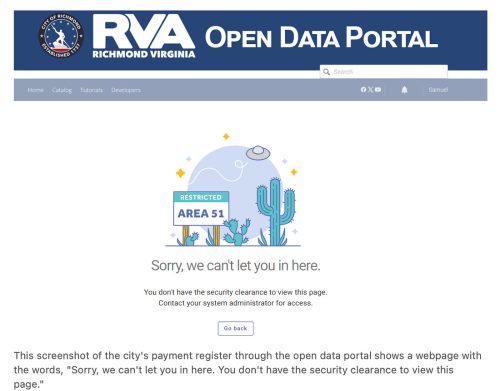
Moomaw wrote about his inquiry: Because the city already posted that data online before taking it down two years ago, it was presumably already reviewed and scrubbed for sensitive information; he also noted his FOIA is still pending — and expect a B.S. Hall of Fame excuse when he does finally hear back and is rejected.
The Mayor could choose to make the check register work and use it as a keystone accomplishment to fulfilling his campaign pledge to be transparent, because his current efforts are anything but and embarrassing. He hired the right person to fix the water plant and that seems to be a success so far worth emulating (but we still have to pay for it). He could choose to provide leadership and fix this problem, or he can continue to complain about it and introduce ordinances to bury the problem and keep everything hidden behind the curtain. Perhaps through all of the media stories, FOIA requests, Council inquiries (and possible investigations), the Mayor will come to realize it would just be easier to find the software and publish the register as the current law requires rather than pursue his current path, which is to change the law and make it more complicated and less open and honest while losing the public in the process.
Jon Baliles is a former Richmond city council member. This column is republished with permission from his blog RVA 5×5.
Leave a Reply
You must be logged in to post a comment.