
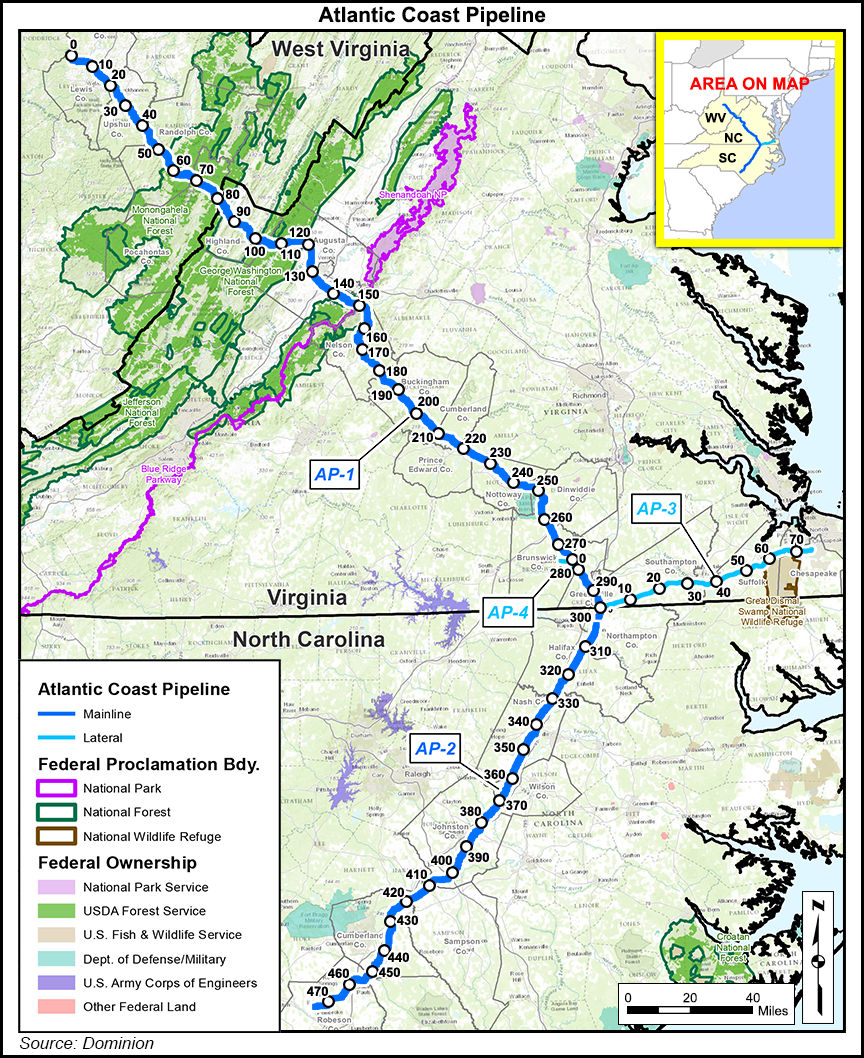
Pipeline Passes FERC Environmental Review
Share this article
ADVERTISEMENT
(comments below)
Comments
Comments
8 responses to “Pipeline Passes FERC Environmental Review”
-
No one on either side of this fight actually believed that the EIS would be any different than what has just been released, a go ahead for the ACP. There are only 2 ways this dated idea will be stopped … If the investors rethink the notion that burning natural gas is ‘clean’, or if Virginia says NO, something that did happened in New York. Governor Cuomo has rejected pipelines on the recommendation of his Department of Environmental Protection, and the loud voices of many, many voters.
It’s unlikely that will happen in Virginia though, where the conflicts of interest abound, and where the job of overseeing the integrity of 2,000 water crossing is just too big a job for our DEQ. Before assigning oversight responsibility to the Army Corp of Engineers, Virginia’s DEQ is required to confirm that the Corp’s requirements comply with Virginia’s water quality standards. Our DEQ has outsourced that job as well as the basic oversight job. Dominion will pay a contractor designated by the state to evaluate their ACP proposal for the DEQ. Incredibly, that contractor is currently doing several other jobs for Dominion, and yet no one thinks this is a conflict of interest.
Building this pipeline is Dominion and Duke’s ploy to remain monopoly utilities, in charge of generation and distribution of electricity throughout the state. The majority of the gas in the ACP pipeline is designated for electricity production. Dominion’s two new gas plants already have contracts with legacy pipelines. They just want ‘backup’ supply. Additional plants, not yet approved by the State Corporation, are to be built over the next 10+ years. All these gas-fired plants will actually produce more GHG emissions than the utility now emits. Will the Governor’s new committee take that into account as they attempt to reduce emissions? That might negate the need for the ACP.
The Atlantic Coast Pipeline is being called a “once in a lifetime opportunity,” and he Chairman of the Royal Dutch Shell Group and I agree. We just see opportunity differently. Speaking to leaders from the oil, gas, and electricity industries, the Chairman said it is time to envision a “wholly renewable energy future … it’s feasible, it’s profitable, and that’s where we’re headed.”
Virginia won’t be headed in that ‘profitable and feasible’ direction until we change the rules and give our utilities a reason support a reduced level of demand. Our regulators need to “decouple profits from sales in order to create incentives for utilities to invest in or promote more energy efficiency, demand response, or Disributed Generation,” according to Hank Paulson and Michael Bloomberg in ‘Ricky Business”.
The FERC playing field is not level. The ACP will lock us into a risky and potentially expensive future. Dominion predicts a 98% rise in gas prices by 2030. We have other energy choices, renewable choices, that will be cheaper, won’t require property takings through eminent domain, and will not risk harm to our mountains and our water. It’s time to give up an old idea. The builders of Keystone XL are rethinking that pipeline too.
-
Sad to see this.
-
interesting how some media is saying that
“… would mostly be “reduced to less-than-significant levels” by the developers’ mitigation measures.” (Richmond.com)
while others like BR say
” … would have temporary adverse impacts on people and the environment, the impact can be reduced to “less-than-significant levels,”
similar wording was used with the Mountain Valley pipeline which was released in June.
” “would result in limited adverse environmental impacts, with the exception of impacts on forest” (Roanoke Times)
I generally support pipelines done on a for-profit basis.. as the Rockies Express pipeline was done and well over 90% of the right-of-way was obtained via willing-buyer/willing-seller transactions.
The reason that is important is because the pipeline should be economically viable… i.e. a real “need” not just a claim by the proponents and in this case, we actually have TWO competing proposals – both of which are being questioned on “need” and there is a real question that both together would be economically viable especially if they had to negotiate for price instead of relying on the threat of eminent domain.
But the Mountain Valley is a Transco proposal and will use more existing infrastructure and rights-of-ways and is a direct competitor to Dominion and if Transco/Williams goes forward independent power producers will be able to get lower prices than if they were just dealing with Dominion alone.
Dominion is apparently planning on providing gas for their own plants – in competition with other gas plants – independents in Virginia and in PJM.
Williams has a Cap of 6 billion – but has had financial problems..
Atlantic Coast Pipeline, LLC is a subsidiary of Dominion Energy – which has a cap of 50 billion… if not mistaken..
-
Transco is not involved in the MVP, it only connects to Transco in order to try and find customers. The MVP is 100% subscribed by subsidiaries of the owners of the pipeline. ConEd is a potential customer for its utility in NY (12.5% of the capacity) but it could get gas transported more cheaply directly from the Marcellus in the Northeast. NextEra is another utility holding company with utilities in FL, GA and AL (12.5% of capacity). Roanoke Gas is the only real customer at 0.5%of capacity, but they would get gas transported much with a connection to other nearby pipelines.
There is no need for this pipeline to have an adequate gas supply to this region. With Rover coming on and perhaps NEXUS and the other pipelines tapping West Virginia production there will be 50% more pipeline capacity than the Appalachian Basin (Marcellus+ Utica) can supply in the foreseeable future.
https://btuanalytics.com/wp-content/uploads/2017/03/Slide-2d.png
-
-
So when the issue is ripe, file an appeal in the federal courts. If FERC made errors and those errors are significant, a court would likely grant relief. If not, the process has been followed and final approval would be appropriate.
-
The appeal process with FERC is not functional. They have a “tolling orders” process that delays appeals while construction continues. About 80% of the materials for the pipeline have been pruchased and Dominion is staging them along the route. There are at least 11 simultaneous construction spreads planned. So much of the pipeline will be built before any appeal process can take hold that no court will have an appetite to overturn the decision no matter how much it is merited. At least that is ACP’s plan.
-
-
Makes me wonder if the Williams/Transco proposal also gets approval if that would undermine Dominion’s pipeline because Transco has a larger existing network already in place and paid for…which might give them a competitive advantage on price … as well as wider range of availability.
that might mean more independent natural gas power plants.. which will
lower priced gas will let them sell power on PJM for less.You can see where Dominion is trying to diversify and expand but competition is going to be present.
-
I guess nothing I have said in this blog has gained any traction. There is no need for either the MVP or the ACP. Even if you take the high gas usage scenario, we have enough to serve Virginia and the Carolinas with existing pipelines. Transco alone is adding almost twice the capacity of the MVP and ACP combined.
Gas usage for power production in the US is expected to peak around 2030 and it is the main justification for new pipelines.
The Industrial Energy Consumers of America ($1 trillion in revenues) say that burning gas in power plants and exporting it will severely diminish manufacturing employment in the US (because the cost of gas will increase and reduce US’s competitive advantage).
No one is talking about how the $18 billion that ratepayers in Virginia and North Carolina will have to pay the ACP over the next 20 years will impair the economy, when the same amount of gas can be transported at a fraction of the cost using existing pipelines. This whole scenario is wrong on so many levels. If people really want lower cost energy and more jobs, this isn’t the way to get them.
-


Leave a Reply
You must be logged in to post a comment.