
What Virginia Can Learn from GE’s Relocation to Boston
Share this article
ADVERTISEMENT
(comments below)
Comments
Comments
11 responses to “What Virginia Can Learn from GE’s Relocation to Boston”
-
The reason firms like GE located in Connecticut is simple — low taxes. That won’t be the case in Massachusetts.
-
Great post!
-
Peter, CT taxes are so high now that moving to Mass may have been motivated by tax savings, at least in part.
https://taxfoundation.org/2017-state-business-tax-climate-index/
But I’m sure that moving to Boston is because of the mix of companies and the other reasons Bacon stated. Not sure how we respond to this, however – more sidewalks in Innsbrook?
-
The whole nature of business has changed from the time when a corporation could locate in a suburban area and people hired could settle nearby – ironically within walking distance because both the company and the worker expected to spend their career there
The Corporation would become part of the community.. involved in little league sports, and other community organizations and events.
Companies had their own internal R&D department where they would go about incorporating technology into their product line…
Corning and Kodak are two similar companies…
GE is one of the few companies that has evolved as technology and business has … and is on the forefront of many modern technologies everything from powerplants to aircraft engines to MRIs ,etc and now these things are being given “brains” and they talk to each other on networks.
One of the most important qualities for durable corporations these days in NIMBLE and proactive… it’s the difference between a Kodak and a GE
but the Millennial narrative itself is not single dimension.. as many high tech companies locate in smaller urbanized areas usually with research universities, . that have evolved to become tech centers and have a rich talent pool… which draws the companies.
but here’s what caught my eye – and it violates Bacon’s philosophies about “bribing” companies to locate:
” GE will get an incentive package from the city and state valued at as much as $145 million for moving 200 jobs”
let’s repeat that 145 million for 200 jobs – ZOUNDS – that’s 750K PER JOB!
so… is GE moving to Boston because it likes the BOSTON urban area for being an urban area? I don’t think the 145 million “hurt”…
-
GE has 295,000 employees. The top 200 (presumably) work at headquarters. Unless they plan on moving a whole lot of additional operations to Boston I’m not sure what millennials have to do with it. This sounds more like a small number of filthy rich top corporate executives deciding they’d rather live in Boston than in Fairfield, CT. I’m sure it will be easier to get customers and potential customers to visit. Why? Because the City of Boston, et al finished the “Big Dig” and made it possible to get from the airport to the business district. funny how government sometimes has to spend money to attract business.
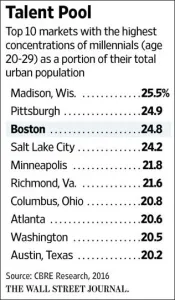
As for Jim’s list of cities with the most millenials – nobody cares. Show me a list of cities with the most college educated millenials and we’ll be getting somewhere.
-
Steve,
I haven’t kept up with CT taxes. Also, GE is one of the biggest tax avoiders in the nation.
-
re: tax avoiding…
been reading lately about the difference between corporations and their taxes and what is called “pass through” businesses which is a great number of most businesses from sole proprietorships , limited partnerships, S corps, etc.
the non-corporation businesses pay taxes on an individual tax basis.. so if their company makes even as little as 100K in income – they can pay a marginal tax rate of 50% when you take into account, Federal, State and FICA taxes..
I’d like to see Bacon do a column on this since we are now seeing supposed efforts at tax ‘reform’ that will lower the statutory tax on corporations and some want to change the tax on pass-through entities .. and that can play a role at the State level.. and be a factor in attracting companies. (or pushing them away). Kansas lowered the marginal tax rate on pass-through businesses.. with disastrous consequences… they lost over 700 billion in revenues in one year and got almost no increase in economic activity – which was the theory – that increased economic activity would produce more jobs and more than make up the revenue shortfall… did not happen . and Mr. Gillespie is making similar noises in his campaign for Gov.
At any rate – don’t discount the effect that taxes, incentives, and “business-friendly” policies can have on influencing a company to stay or move…
GE is a uniquely American company that sells big globally… I’d not want to hobble them… and make it harder for them to stay. It would be our loss.
-
Peter, Peter – I’m sure the millions of GE shareholders and the hundreds of thousands of GE employees over the years are wracked with guilt. We are a nation of tax avoiders. We were founded by tax avoiders. Only tax evaders are breaking the law, not tax avoiders….but the passing cheap shot is your forte.
-
Interesting article:
” Where New Grads Can Find a Roof and a Paycheck”
-
Isn’t it likely that moving to cities is a phase in the business cycle? Just like ditching offices for many companies. The pendulum swings.
And Larry, the figures for Kansas’ elimination of taxes on corporate pass-thorough income was $800 million, not billion. Still nothing to ignore.
Fairfax County’s CFO has been meeting with various groups and informing them that, for the foreseeable future, county revenue growth will only be around 2% annually. What happens to RoVA? We should not be cutting taxes willy nilly, but we need to look at eliminating programs, agencies and jobs that don’t produce results. And we need to stop importing poverty, by fining the crap out of businesses that don’t follow the immigration employment laws. We might also look at how much overlap we have in major programs at our state universities and colleges.
-
my bad on the 800 … it was million… but nearly 20% of the state budget and fiscal chaos … as a result.
” we need to look at eliminating programs, agencies and jobs that don’t produce results.”
well we need to agree on a standard or benchmark as to what “results” should be… and not let that idea be used as stealth “starve the beast” strategy for programs there is disagreement on.
“And we need to stop importing poverty, by fining the crap out of businesses that don’t follow the immigration employment laws.”
I’m totally in favor of strict enforcement of e-verify and that includes fining the dooda out of ANY business that cannot produce valid e-verify certification for ANY employee…
but I AM hearing that many farmers are freaking out over the dearth of labor to harvest crops…
“We might also look at how much overlap we have in major programs at our state universities and colleges.”
where we are now with the universities is the worst of both worlds.. we fund them but have no real way to influence their operations and spending.
Move the state money away from the Universities and to individual students.. and let the Universities “compete” for the dollars.. that does not keep individual parents from adding more of their own funds for their kids to choose more expensive options – but then that becomes their legitimate cost and not taxpayers. Taxpayers provide the minimum… if you want more than that -have at it with your own money.
we agree.


Leave a Reply
You must be logged in to post a comment.