Warner: Wind and solar power will not suffice. 

By Steve Haner

An electricity drought is looming, not only for Virginia but also for much of the United States, if the political hostility toward the most reliable forms of electricity generation is not reversed.  Warnings that wind and solar power alone will not be sufficient resonated like a drumbeat from the podium of a two-day conference on Virginia’s energy future last week.   

Virginia is on the leading edge of the national risk because Virginia is ground zero for the expanding data center industry, including the massive power-hungry facilities needed to harness artificial intelligence.  Some use power measured in gigawatts, not megawatts.  Virginia’s electricity demand could double by the mid-2030s.  

“All the solar and all the wind cannot get you to the 24-7 baseload you need to run the AI economy,” reported U.S. Senator Mark Warner, D-Virginia, who leads the Senate Intelligence Committee.  Warner was one of many speakers to use the “all of the above” cliché to summarize his advice on needed power sources, but he focused on emerging small modular reactor (SMR) nuclear technology and recent federal legislation to accelerate it. The giant corporations are still standing by their public carbon-free promises, “without SMRs none of them will get there.” 

Winning the international race to develop the dominant designs for the next generation of nuclear “ties directly into national security,” Warner said.  We cannot let the Chinese win that race.  

Virginia Republican Governor Glenn Youngkin, another speaker at the Virginia Manufacturers Association gathering in Virginia Beach, highlighted his own support for those SMR reactors, and 2024 legislation that will allow Virginia utilities to collect their exploratory development costs from ratepayers.  But Youngkin was also blunt about the need not just to preserve natural gas as an electricity resource, but to expand it, including a contested new plant proposed for Chesterfield County.   

Without both more nuclear and natural gas, Youngkin warned, “get ready to be California in the summer or to be Texas in an ice storm.”  Both states have had high profile energy brownouts or failures, due at least in part to their heavy reliance on wind and solar power during very challenging weather.  

Out of the two full days of panels filled with policy and industry experts, experienced regulators and leading manufacturers, only Youngkin’s speech attracted reporters. One Hampton Roads television report included his key points, but the anti-carbon fuel outlet Virginia Mercury then quoted wind and solar advocates to dispute some of his points and insult him as anti-environment.  None of the other 30 or so conference speakers got a mention.   

Federal Energy Regulatory Commission member Mark Christie, who formerly served on Virginia’s State Corporation Commission, pointed out that the energy crunch is already evident.  On a hot day last week, PJM Interconnection, the regional transmission organization which includes Virginia, set a new 13-state record for electric usage of more than 153 gigawatts.  The PJM system did still have reserves available that afternoon, but only 11 gigawatts. (For comparison, Dominion Energy Virginia reportedly peaked at more than 23 gigawatts of demand that afternoon.) 

At the peak that day at 5 p.m., 45% of the electricity being used in PJM was generated by natural gas and 20% by coal.  Two-thirds of the electricity came from two crucial fuels targeted for full elimination by Virginia’s Clean Economy Act and similar laws in other PJM states.  The fuel sources that VCEA was written to mandate, solar and wind power, covered less than 6% of the PJM load on that very hot afternoon. 

All through the PJM territory, coal and gas power plants that run 80-85 percent of the time are closing or scheduled to close by 2030, with wind and solar projects less than half that reliable promised to replace them.  “The math does not work,” Christie said. 

The whole point of the PJM system, the largest by power demand and population of the regional power pools, is to shift electrons to where they are needed.  Virginia needs to worry about what is going on through the entire PJM network, because it is routinely importing power.  As former Dominion Vice President Katharine Bond told the packed audience, “Eventually you run out of other people’s power.”    

Bond was of course borrowing a line from the late British Prime Minister Margaret Thatcher, who said the problem with socialism was, “Eventually you run out of other people’s money.”   

The need is for “dispatchable” electricity, Bond said, with the on-off controls that wind and solar lack. Right now, 79% of generation assets are dispatchable, but 99% of those closing or slated to close are dispatchable and only 15% of planned replacements are.  There again is the equation for disaster Christie mentioned.  

James Robb of the North American Electricity Reliability Corporation, which has the job of worrying about meeting future electricity demands, said the number one priority for meeting the challenge is to connect as many of the pending no- and low-carbon energy projects as rapidly as possible.  Second, we need expansive transmission projects to tie them together. A crucial power line for just two states, Arizona and New Mexico, took 17 years to build.  Virginia’s new Mountain Valley gas pipeline needed an act of Congress to end the litigation delays after nine years.    

Robb calls his group the “trade association for physics” because it focuses on the hard scientific reality of how the electricity grid works.  The third overwhelming challenge will be to maintain the constant grid balance between supply and demand, and the key energy source for that remains natural gas. “We’ve got to stop making natural gas an enemy,” he said.  He told the audience gas would remain a core mainstay of the grid for the rest of their lives.   

Looking across the whole of North America, including Canada but not Mexico, at this point the PJM region is not considered the most vulnerable.  A NERC map he displayed shows the red high-risk areas in the middle west, heavily wind-dependent, and the orange elevated risk regions mostly in the far west.  He predicted a more dire outlook for PJM and perhaps another color when that map is updated.   

One of our Democratic U.S. senators is warning us.  Our Republican governor is warning us.  Our main electric utility is warning us.  The federal energy regulators charged with maintaining electric reliability are warning us.  Some of Virginia’s largest employers are warning us. Virginia and indeed most of America is on the wrong path.   
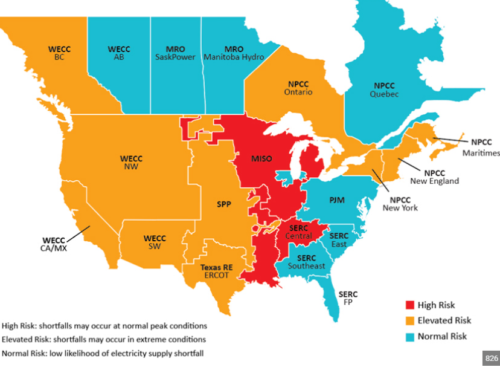
 

The North American Electric Reliability Corporation’s 2023 grid failure risk assessment for various U.S. and Canadian regions, including Virginia’s PJM Interconnection.

First published this morning by the Thomas Jefferson Institute for Public Policy.


ADVERTISEMENT

(comments below)


Comments


Comments

107 responses to “Virginia Risks Running Out of Other People’s Power”

  1. Haig48 Avatar

    When oil futures get to $40.00 per bbl, inflation is over.

    1. Eric the half a troll Avatar
      Eric the half a troll

      Hope you are not holding your breath for thatโ€ฆ

    2. Eric the half a troll Avatar
      Eric the half a troll

      Hope you are not holding your breath for thatโ€ฆ

  2. DJRippert Avatar
    DJRippert

    Well … now that the political party that wants to defend democracy has forced out the candidate overwhelmingly elected by primary voters to be the nominee, we need to look at the energy policies espoused by Kamala Harris. For that, we have to go back to Sept 4, 2019 and see what Kamala Harris had to say in the 15 minutes or so she was in the 2020 primary race (collecting something like 2% of the votes).

    https://www.democracyinaction.us/2020/harris/harrispolicy090419climate.html

    "Kamala Harrisโ€™ $10 Trillion Comprehensive Climate Plan Outlines Bold Vision to Build Clean Economy By 2045 and Create Millions of Jobs"

    "Plan Gives Blueprint For 10-Year Mobilization, Including 100% Carbon-Neutral Electricity By 2030"

    $10 Trillion dollars spent over 15 years to achieve 100% carbon-neutral electricity by 2030.

    C'mon Mark Warner – challenge Kacklin' Kamala for the nomination.

  3. Steve, you and I have been beating the "reliability" drum for years. It's heartening to see others seeing what we see. I think the dawning of the AI revolution was the turning point. AI's demand for energy is so voracious that there's no pretending that the Virginia Clean Economy Act can possibly accommodate it.

    1. Took you long enough to get there "there's no pretending that the Virginia Clean Economy Act can possibly accommodate it"

  4. walter smith Avatar
    walter smith

    Are the Democrats Forrest Gump, without the likeability?
    What does it take for them to drop blind loyalty to Party narrative and acknowledge reality?
    Solar and wind CAN'T work in any meaningful way.
    Is it that the politicians are stupid? Or the people? Or both? Or is this just a massive money-laundering grift? It makes no sense to anybody with a brain.

  5. Irene Leech Avatar
    Irene Leech

    Was there any discussion about distributed generation instead of all centrally controlled generation? It seems that these discussions lack a broad array of possible solutions, quickly focusing on the same resources and same operational format.

    Was there any discussion of requiring that when new data centers, AI facilities, etc. are proposed that energy needs must be included? Why do we think we can continue just assuming that the local energy provider can/will ramp up to provide, especially in a place like Loudoun county where these things are proliferating like flies.

    1. walter smith Avatar
      walter smith

      I believe that is why the server farm people are investigating modular nuclear (which I believe is like a nuclear submarine concept for power).

      Which raises the question – if this makes sense on a totally private business basis, why doesn't it make sense for a "public" utility?

  6. Spoke with a CEO of a regional electrical utility company a month ago on the west coast. Said the same thing. The demand is rapidly increasing and supply isn't even close to keeping up. Rolling brownouts are coming maybe sooner than we like to think.

    1. walter smith Avatar
      walter smith

      Just in time for the election chaos! Bird flu. More mail in ballots. Electric failures the day of the election. We must save our democracy by destroying it!

  7. DJRippert Avatar
    DJRippert

    Well … now that the political party that wants to defend democracy has forced out the candidate overwhelmingly elected by primary voters to be the nominee, we need to look at the energy policies espoused by Kamala Harris. For that, we have to go back to Sept 4, 2019 and see what Kamala Harris had to say in the 15 minutes or so she was in the 2020 primary race (collecting something like 2% of the votes).

    https://www.democracyinaction.us/2020/harris/harrispolicy090419climate.html

    "Kamala Harrisโ€™ $10 Trillion Comprehensive Climate Plan Outlines Bold Vision to Build Clean Economy By 2045 and Create Millions of Jobs"

    "Plan Gives Blueprint For 10-Year Mobilization, Including 100% Carbon-Neutral Electricity By 2030"

    $10 Trillion dollars spent over 15 years to achieve 100% carbon-neutral electricity by 2030.

    C'mon Mark Warner – challenge Kacklin' Kamala for the nomination.

    1. LarrytheG Avatar
      LarrytheG

      re: "Kacklin Kamala" – that could be a vote GETTER, right? She's
      likely gonna win way more of the surburban women if Trump continues like he has been…..

      1. DJRippert Avatar
        DJRippert

        She isn't senile, so that's a step forward.

        But the real issue is that she was never the choice of the voters.

        Biden won a huge majority of the primary votes. Like 95%?

        Then, the elites in the Democrat Party turned against him.

        Pelosi decided he shouldn't be the candidate. Shumer decided he shouldn't be the candidate. A small number of wealthy donors decided he shouldn't be the candidate.

        So they forced him out./

        Regardless of the fact that he got 14 million votes over the last 3 months.

        How is that democratic?

        But worse still … the elites have not only decided who won't be the candidate, they have apparently decided who will be the candidate.

        They are pressuring every other candidate to not contest Kamala.

        Why wouldn't the leaders of the Democrat Party encourage others to run?

        Let the delegates who were supposed to vote for Biden decide who they want to vote for among several candidates?

        Because the elites in the Democrat Party don't care about democracy or the voters.

        The elites have decided.

        They are fundamentally telling the "little people" (aka voters) to shut up and do what they are told.

        And if you don't think these same elite won't stoop to stealing the upcoming election … you're not paying attention.

        1. LarrytheG Avatar
          LarrytheG

          compare this to how Trump operates?

          ๐Ÿ˜‰

          I'll take the Dems any day whether Harris or another, no contest.

          1. WayneS Avatar

            Trump won a huge majority of the votes in the 2024 state primaries. He is the 2024 candidate. That's how it's supposed to work.

            So, what's your point?

          2. LarrytheG Avatar
            LarrytheG

            Trump has made it clear what he intends to do. I think he's got all the votes he's gonna get and as time goes by and more people realize who he is and what he will do, he will LOSE votes. that point.

          3. LesGabriel Avatar
            LesGabriel

            Trump has a 4 year track record. I don't think anything that Democrats will say at this point will change people's verdict on his first term.

          4. LarrytheG Avatar
            LarrytheG

            You are correct. We know FULL WELL what he does and will do if given another term.

            All the Dems have to do is point to his prior term and to his words today that he promises to do.

          5. WayneS Avatar

            I think he's got all the votes he's gonna get and as time goes by and more people realize who he is and what he will do, he will LOSE votes. that point.

            Okay.

          6. Eric the half a troll Avatar
            Eric the half a troll

            Plenty of history to show that is not necessarily how itโ€™s supposed to work.

        2. Eric the half a troll Avatar
          Eric the half a troll

          โ€œBut the real issue is that she was never the choice of the voters.โ€

          No, not really an issue. Dems are good with this.

          1. WayneS Avatar

            I have a question if you do not mind.

            Last night I heard a member of "the squad" say (while attacking those who do not like the VP): "They even intentionally mispronounce her name".

            So, my question is this: What is the correct pronunciation of her first name. Is the emphasis on the first syllable, [KAM-al-a], or is placing emphasis on the 2nd syllable, [ka-MAL-a], correct? I've heard it pronounced both ways by both supporters and detractors.

          2. WayneS Avatar

            I have a question if you do not mind.

            Last night I heard a member of "the squad" say (while attacking those who do not like the VP): "They even intentionally mispronounce her name".

            So, my question is this: What is the correct pronunciation of her first name. Is the emphasis on the first syllable, [KAM-al-a], or is placing emphasis on the 2nd syllable, [ka-MAL-a], correct? I've heard it pronounced both ways by both supporters and detractors.

          3. Eric the half a troll Avatar
            Eric the half a troll

            When in doubt, seek the wisdom of TikTokโ€ฆ

            https://www.tiktok.com/@thedailyaus/video/7394287519963155729

          4. WayneS Avatar

            Thanks, but I do not do TikTok. I will not even click on a link that includes 'TikTok' in its name.

  8. LarrytheG Avatar
    LarrytheG

    So is it wrong to presume that data centers, the things that data centers run, will increase productivity and as such ought to make some things more efficient and to use less energy?

    Perhaps an arguable point but the opposite would be to assume that data centers just use more power but don't provide any real benefits.. just burn power?

    I support Nukes and so do some "greenies" and progressives like Bill Gates.

    I support Nukes even it their power costs more than fossil fuels.

    So I ask others: Do you support nukes if their power will cost more than fossil fuel power?

    yea or nay?

    BTW, good article Haner… still got some boogeyman in it but not bad!

    1. DJRippert Avatar
      DJRippert

      "So is it wrong to presume that data centers, the things that data centers run, will increase productivity and as such ought to make some things more efficient and to use less energy?"

      Why do you think using more energy in one area will increase productivity and result in using less energy in other areas?

      Was farming more productive before the advent of gas powered tractors? Did the agricultural revolution result in humans using less energy overall?

      1. LarrytheG Avatar
        LarrytheG

        So you think the opposite? That data centers are not providing value and productivity.

        You're an IT guy, right?

        So data centers should be outlawed because they use more energy for no good reason, that without them, we'd use less
        energy? Right?

        1. DJRippert Avatar
          DJRippert

          Why do you think productivity is inversely related to energy use?

          People have been getting more and more productive while using more and more energy for well over a century.

          1. LarrytheG Avatar
            LarrytheG

            What I think is that data centers are profitable and that means companies are paying for their services and I presume when a company chooses a data center over their own IT center, it's cheaper and saves money (and probably energy).

            That's not true?

    2. f/k/a_tmtfairfax Avatar
      f/k/a_tmtfairfax

      Data centers do need to become more self-reliant and energy efficient. But there will be many, many more needed and constructed because of increased use of cloud services. Data mining requires more server capacity as well, I'm told. And the Fairfax County board of supervisors seems to be on a track to be promoting data center growth in the County in order to find more tax dollars to spend. Needless to say, there is strong opposition to them.

      Bottom line, the demand for more electricity will skyrocket and the existing grid cannot handle it.

      As a point of reference, here is some data from Wake Electric Membership Corp's 2023 annual report. Of 53,873 customers, 52,077 are residential. There are 3,605 miles of energized lines, of which 1717 miles are undergrounded.

      55% of its energy came from nuclear power, 29% natural gas, 9% renewable, 5% coal and 2% hydro. It interconnected with a new solar farm for 638-kW with a 1115 kWh Tesla battery. It's adding battery storage at a Wake Forest substation.

      1. LarrytheG Avatar
        LarrytheG

        Right. Do "cloud services" REPLACE some existing servers (that also use electricity)?

        We're NOT going to run out of power and we're NOT going to become unreliable. Even now, Dominion is build a natural gas storage facility – enough for 4 days of power.

        I expect them to continue to do things along these lines.

        I expect PJM to continue to approve new plants if that is what it takes.

        PJM and the power companies like Dominion are not going to become "irresponsible" just because some folks are predicting it.

        1. f/k/a_tmtfairfax Avatar
          f/k/a_tmtfairfax

          Get Ready to Pay More for Electricity — As the grid becomes increasingly unstable, utilities ramp up spending, Blunt, Katherine.โ€‰ Wall Street Journal, Eastern edition; New York, N.Y.. 19 July 2024: A.1.

          Americans used to spend little energy worrying about whether the lights would come on at the flick of a switch, or how much that electricity cost.

          For a growing number of people, those days are over.

          Larry Hilkene, who moved from Indiana to a quiet Detroit suburb just over a year ago, has since had nine power outages, the longest one lasting 16 hours. In the same period, his utility company, DTE Energy, raised electricity rates and sought regulatory approval for another increase as it works to improve the reliability of its system.

          Until recently, DTE used an antiquated tile map board to monitor its decades-old grid. When changes occurred on the system, an employee would use a 20-foot pole to place magnetic markers showing open and closed circuits. In 2022, DTE unveiled a massive digital display board to replace it, part of a major spending push to modernize the grid that will be shouldered, in large part, by customers.

          Hilkene, who works in cybersecurity, wrote to regulators to express his opposition to paying more for what he considers subpar service. "I call it DT(non)E because they do not appear to be about energy," he wrote, adding that he "cannot believe the abysmal state of power infrastructure here."

          Utility customers across the country are increasingly paying more for less-reliable service — a trend driven home by a massive heat wave that has triggered outages around the country in recent weeks.

          Utilities from Michigan to New York and beyond are planning their largest capital investments since World War II as the grid becomes more unstable as a result of age and extreme weather.

          After Hurricane Beryl made landfall outside of Houston and pummeled the city as a tropical storm, more than 2.2 million of CenterPoint Energy's 2.8 million Houston-area customers were without power, marking the company's largest-ever outage. CenterPoint estimated it would take 12 days to fully restore power. The company this year sought regulatory approval to raise rates, which have remained relatively flat for 10 years.

          Meanwhile, demand is poised to soar, with millions of electric vehicles and massive data centers powering artificial intelligence needing to draw power.

          Customers of roughly 17 large utility companies may see rate hikes above the rate of inflation between 2022 and 2027, according to Sector & Sovereign Research. Utilities have generally kept rate increases at or below the rate of inflation to reduce the risk of pushback from regulators and customers.

          Utilities say significant spending is needed in part to address serious reliability issues. Between 2013 and 2022, the nation's utility companies recorded a roughly 20% increase in outage frequency, according to the most recent federal data. Outage duration increased by more than 46% over the same period, largely as a result of weather-related disasters.

          During his first few power outages, Hilkene noticed something he hadn't heard before in Indiana: the sound of his neighbors' backup generators firing up. He surveyed the neighborhood, a community of three- and four- bedroom homes near a small lake and an equestrian center, to find that more than a quarter of them had installed natural gas-powered generators.

          On a recent spring day, a team of five men arrived with a trailer and unloaded a backup power unit to install on the lush lawn. The generator cost him about $12,000, a sum he considers substantial but worth it to avoid outages.

          When a mid-June thunderstorm briefly knocked out the power, Hilkene said he sighed with relief as he heard the generator start up.

          Days later, more than 25,000 people were without power in his county as more storms hit.

          After years of relatively modest increases, U.S. electricity prices are on a sharper rise. Russia's invasion of Ukraine in 2022 drove up the price of natural gas needed to fuel power plants. Gas prices have since receded, but rate increases are still accelerating as utilities invest tens of billions of dollars to stabilize the grid itself, and pass those costs onto customers.

          Pedro Azagra, CEO of Avangrid, which operates utilities in New England and New York, said the company has substantially ramped up spending in recent years to address a range of reliability challenges.

          "The problem that we have right now comes from decades of lack of investment," he said. "You cannot catch up in one minute."

          U.S. electricity prices increased 4.4% over the past year, according to data from the Bureau of Labor Statistics, faster than the broader inflation rate of 3%.

          Hugh Wynne, Sector & Sovereign's co-head of utilities research, said gas price volatility, combined with higher interest rates and higher costs associated with replacing old equipment, is beginning to put pressure on rates for utility customers in regions where a substantial amount of work has been proposed. Some utilities aren't expected to seek major rate hikes in the coming years, but he said the firm is tracking an unusually high number that are.

          "There were a lot of trends that were moving in a positive direction for the industry that are now going in the opposite direction," he said.

          Utilities are expected to invest more than $165 billion a year in 2024 and 2025 to make significant upgrades and replacements, according to trade group Edison Electric Institute, more than any year since the group began collecting data. Many utilities are also ramping up spending on routine activities such as maintenance and tree-trimming to reduce outages, and, throughout the West, wildfires caused by fallen power lines.

          The need for work is spread throughout the country, with parts of the mid-Atlantic, the Midwest and California expected to see some of the steepest rate increases in coming years. Nationwide, large sections of the grid are decades old and need replacing, and labor and equipment have each become more expensive as a result of inflation and supply-chain snarls.

          "Rates are going to go higher, and there's not much you can do about it," said Guggenheim analyst Shahriar Pourreza. "It's kind of the new normal."

          Avangrid subsidiary New York State Electric & Gas, which serves much of the rural upstate region, has for years delivered some of the state's least-reliable power. NYSEG failed a state target for outage frequency for the fifth consecutive year in 2023, regulatory filings show, though the company improved that metric last year.

          Trees were the primary reason. Some grow more than a foot each year, increasing the likelihood of contact with power lines.

          NYSEG told regulators that it has struggled to trim trees frequently enough to maintain safe distances between lines and branches. A 2022 regulatory filing showed that in large parts of the system, vegetation hadn't been cut in at least six years, if ever.

          NYSEG is now spending tens of millions of dollars to improve its tree work. That spending, combined with investments to upgrade outdated substations, circuit breakers and other equipment, is projected to drive power bills up by about 22% between 2023 and 2025.

          Avangrid's Azagra said system reliability is faltering largely because of age, as well as more frequent storms and changing weather patterns that are stressing the trees and creating other hazards such as flooding.

          "If anyone says they don't see that, come to me," he said. "Come to upstate New York."

          In Oregon, Portland General Electric is investing heavily to upgrade the grid to withstand more extreme weather. The company has in recent years been working to reduce the risk of its power lines starting wildfires by burying certain circuits, trimming more trees and expanding its network of weather stations to monitor for risky conditions.

          PGE is also preparing for an anticipated surge in demand to power new data centers and semiconductor manufacturing. The company last year significantly revised its expectations for industrial energy usage, telling regulators that come 2030, the need for additional power supplies could be more than 40% higher than earlier forecasts.

          CEO Maria Pope said many of the upgrades involve expanding system capacity to better distribute electricity supplies during periods of extreme demand, when power prices spike. The utility saw record summer power demand during a multiday heat wave last August. Eight months earlier, it saw all-time high winter power demand during an intense cold spell, breaking a record set about 25 years earlier.

          PGE this year raised residential rates by about 17%. The company is seeking regulatory approval for another 7.2% increase next year.

          Pope said the company needs to work with state and federal regulators to determine how to better manage costs and reduce the burden on customers as the utility completes the most substantial system overhaul in decades. She likened the spending need to the initial build-out of the electric system in the Pacific Northwest more than a century ago, a massive undertaking that involved the region's utilities as well as the federal government and other investors.

          "There's no question that we need to accelerate the work that we're doing," she said. "We're going to need to come up with creative solutions from a regulatory and probably also a legislative standpoint."

          DTE, which serves Larry Hilkene and 2.3 million electric customers in southeastern Michigan, has one of the least reliable systems in the country, with customers experiencing some of the longest outages each year. Outages are substantially more frequent as well for many customers, though not throughout the entire system.

          The company is planning to invest $9 billion over the next five years to reduce outage duration and frequency by 50% and 30%, respectively. It spent $5 billion over the past five years.

          CEO Jerry Norcia said the breakdown in reliability — and the need to spend heavily to address it — is the result of more frequent and intense storms exacerbated by climate change, as well as historical inadequacies in some of the utility's work programs. DTE for years failed to trim trees growing alongside its power lines at a frequency needed to avert major outage problems, particularly during severe wind and ice storms.

          Until about 2019, the company patrolled its lines for vegetation on a nine-year cycle, nearly twice the industry average of roughly five years, regulatory filings show. To achieve a five-year cycle, DTE is now spending hundreds of millions of dollars on what it calls a "tree-trimming surge" expected to last through 2025. The company has sought to reduce the burden on customers by issuing low-interest bonds to recover the costs over time.

          Norcia said the company's previous tree-trimming standard was untenable, especially as storm patterns intensify. The company has in recent years seen an uptick in summer and winter storms, some of which have occurred back to back and left hundreds of thousands of people in the dark for days.

          "I'm in a much different situation than my predecessors were," Norcia said. "We have to accept this new reality that what used to happen every 50 years is now happening every three to five years."

          On top of that, Norcia said, the system serving much of downtown Detroit, designed nearly a century ago, needs near-complete replacement to support population growth, the adoption of electric vehicles and other power-demand drivers.

          DTE has been working to automate and digitize parts of its system with technologies that many utilities have been using for years, including the digital display board installed in 2022.

          1. LarrytheG Avatar
            LarrytheG

            Reliability does cost money, you do get what you pay for.

            Cleaner electricity that kills and injures less people also costs more than more deaths.

            So TMT, you're willing to pay MORE for Nuclear electricity?

    3. The VCEA has hard and fast numbers about the amount of coal & gas generated power which has to be eliminated and hard and fast numbers about the amount of solar & wing generated power which must be built. The VCEA did not consider the vast increase in electricity demand caused by the data centers. The law, as it stands today, is unworkable… except for guaranteeing browns outs in the coming years. It's a math problem.

      1. LarrytheG Avatar
        LarrytheG

        goals and targets that can and will be adjusted as needed just as we have done all along for other things over time – like more efficient cars or cleaning up the Chesapeake Bay.

        VCEA did not anticipate AI nor bitcoins but who thinks that AI and bitcoins don't add value to the economy and instead harm the economy AND some companies are willing to pay money to data centers to harm their own company's interests when they could do AI and bitcoin on their own servers for less money?

        Are data centers a net loss to energy and the economy that actually HARM the economy?

    4. WayneS Avatar

      So I ask others: Do you support nukes if their power will cost more than fossil fuel power?

      Yes. I support nukes.

      (Note the punctuation mark I used at the end of my last sentence)

      1. LarrytheG Avatar
        LarrytheG

        yep. saw that.. and not untypical with some of the "pro-nuke" folks… on the fence, looks like..

        Apparently hard answer for some.

        here's another:

        Do you support the govt subsidizing nukes?

      2. LarrytheG Avatar
        LarrytheG

        yep. saw that.. and not untypical with some of the "pro-nuke" folks… on the fence, looks like..

        Apparently hard answer for some.

        here's another:

        Do you support the govt subsidizing nukes?

        1. WayneS Avatar

          I support the government subsidizing nothing.

          But in the real world, where our governments subsidize thousands of useless things, I will not complain too loudly if the federal government subsidizes nukes to the same (but not greater) extent that it subsidizes other forms of energy production.

        2. WayneS Avatar

          I support the government subsidizing nothing.

          But in the real world, where our state, federal, and even local governments subsidize thousands of useless things, I will not complain too loudly if the federal government subsidizes nukes to the same (but not greater) extent as it subsidizes other forms of energy production.

  9. Teddy007 Avatar
    Teddy007

    Anyone who pushes against solar and wind needs to tell everyone how close they believe to a coal fired plant for a nuclear power plant. Coal fired plants are only supported by those who live a long way away from such plants.

    1. DJRippert Avatar
      DJRippert

      I grew up about 5 miles from one in Alexandria, Va.

      https://thezebra.org/2023/05/19/potomac-river-generating-station/

      It closed in 2012.

      It was messy.

      Closing coal-fired plants is definitely a good idea. Thank goodness we have a lot of natural gas in America.

      1. Eric the half a troll Avatar
        Eric the half a troll

        That was a pretty clean plant. Did some work in it when it closed. As I recall, local community pushed hard for that closure.

    2. LarrytheG Avatar
      LarrytheG

      sort of the same thing with data centers.. "we may need them but not where I live…."

      1. DJRippert Avatar
        DJRippert

        Drive up to Loudoun County. Both the fastest growing major jurisdiction in Virginia and, I'd wager, the major jurisdiction with the most new data centers uder construction.

        What harm do data centers do … other than creating a need for lots of power?

        1. LarrytheG Avatar
          LarrytheG

          so you think they don't do anything worth the companies that pay for their services? It would be
          cheaper for those companies to not use data centers?

          1. DJRippert Avatar
            DJRippert

            No, it's cheaper to use public data centers than private data centers, generally. I just don't think the people of Loudoun County (or, at least their elected officials), want to stop the money train.

          2. LarrytheG Avatar
            LarrytheG

            Can you explain why it's cheaper than running their own servers?

            If they shut their own servers down, and use a data center, does that reduce electricity consumption at their site?

          3. how_it_works Avatar
            how_it_works

            Of the two government contracts that I am familiar with….word is around the water cooler that the expenses went way up when they moved the infrastructure into AWS (Amazon Cloud).

          4. LarrytheG Avatar
            LarrytheG

            So why would they do that instead of reverting back and why would other companies do that if they heard it was more expensive to do that?

            Does this mean that once the word gets out that Data Centers will go broke and close?

          5. how_it_works Avatar
            how_it_works

            Reverting back from AWS costs more money, and it would require a government official to admit they made a mistake.

          6. LarrytheG Avatar
            LarrytheG

            More than govt involved. Lots of private sector companies also and if it was more costly, the word would get out and companies keep their own servers I would think.

            The Data Centers are going great guns, not only in NoVa but all over and it's hard to believe all these companies signing on for more expensive IT that they could do in-house.

            Do we see any signs that data centers are a bad deal and they're losing customers?

            It could be, that over time, it turns out that data centers are a bad deal and people move away from them, maybe?

          7. how_it_works Avatar
            how_it_works

            The problem with AWS and all other cloud providers is that they charge you a variable amount for things that, if done in house, are fixed cost.

            So unless you know exactly what your workloads and data usage are, and how they will change in the future, it can be difficult to accurately predict what your costs will be.

            I find it amusing, for example, that AWS S3 storage costs for 16TB of data are around $300 a month. You know how much a 16TB hard drive is? Less than that. And it’s a hell of a lot faster than S3.

          8. LarrytheG Avatar
            LarrytheG

            Yep, but not just raw drive you're paying for, right? You're paying for things like backup/recovery, and adding new storage without having to re-do your own servers. You're saving IT personnel costs and I think you're saving some electricity and adding it to the data centers so it's a swap, not new demand.

            I still think if it turns out that the Data Centers are "not worth it" that they'll go away and/or get cheaper but at this point, there's clearly a stampede to them and that's what's driving their building boom.

          9. how_it_works Avatar
            how_it_works

            You’re not saving much in the way of IT personnel costs, because the hardware maintenance doesn’t take that much time. Modern IT equipment requires very little in the way of maintenance or repair, and when repair is needed, it takes minutes to swap the bad component.

            The system administration and security and development teams are still needed whether you are on-site or in the cloud.

            Electricity costs are probably the smallest of IT expenses.

          10. LarrytheG Avatar
            LarrytheG

            Things like backup/recovery, system updates, cybersecurity, etc… that takes skilled personnel and one group taking care of multiple servers is likely less expensive.

            Here's the thing about electricity for data centers.

            If they use SO MUCH, then what are they using it for beyond what any business would for their on-site servers?

            If it's the "smallest" on site at a company, then why is it so much at a data center unless they're serving many, many companies with on-site servers?

            I still believe that the data centers are basically consolidating IT services that are cheaper to the companies and the personnel are likely more skilled than some companies "IT" staffs which often are in-house on-the-job types.

          11. how_it_works Avatar
            how_it_works

            In the Federal contracts I’m familiar with, it’s the same skilled personnel taking care of the same group of servers that are now in the cloud instead of onsite. There is no cost savings there.

            As far as what datacenters are being used for, I’ve heard that a lot of datacenter capacity is used for bitcoin mining.

            In AWS, they do NOT provide personnel for taking care of the admin tasks of your servers. That is still up to you. That is true for MOST data centers–they do NOT get into the administration of the servers hosted there, it’s all done by 3rd parties (and could be done by 3rd parties even if the equipment is hosted on-site instead of a data center).

          12. LarrytheG Avatar
            LarrytheG

            No fan of contractor IT nor in-house job-training IT. It's a legitimate professional discipline with a lot of "hacker" types.

            On bitcoin, once again, why pay more for something you could do in-house ?

            AWS/Data Centers again, offers a suite of services including 100% And again, at the end of the day, companies have a bottom line for IT and are not going to pay more for IT than they can do in-house.

            You've got data centers out the wazoo… it's can't be "wrong" on the economics… the money for data centers comes from investors who are not going to throw their money away.

            This is not unlike VDOT contracting with Transurban instead of doing the tolling themselves.

            Turn it over to companies that specialize and have the right personnel and right technology and are driven by competition.

          13. how_it_works Avatar
            how_it_works

            ” it’s can’t be “wrong” on the economics”

            That’s what they were saying about a lot of .coms that turned into .flops about 24 years ago.

          14. LarrytheG Avatar
            LarrytheG

            This is true but look what eventually happened to .com… this is why we now have AWS and perhaps it was the lack of AWS why it flopped originally?

            True IT is a true professional discipline. Too many folks thought that an in-house employee could become their "IT" guy and a lot of bad stuff came out of it, hard lessons learned.

            Got a bank or an MRI machine or software in a vehicle or an airplane , etc.. not for pretenders and posers …who don't think backup/recovery is a serious thing or patching the OS to stop hackers, etc… it's a big time occupation now and that's what many Data Centers are offering that attracts customers willing to pay for it.

            And more and more true for peer-to-peer networking… and data sharing.

            Data Centers are likely here to stay and the default way for many businesses to get their IT stuff "done right".

          15. how_it_works Avatar
            how_it_works

            I worked for a dedicated server hosting company at the time. Many of the customers were the .coms that eventually went out of business.

            Data centers offer hosting. They offer a place to put your server. They don’t generally offer the kind of IT services you are talking about, that is done by other companies such as Peraton.

            At least for Federal contracts.

          16. LarrytheG Avatar
            LarrytheG

            They may or may not but those other services can often be provided remote since it's in the cloud. THe folks onsite are more oriented to hardware, I agree.

            But the .coms didn't fail because what they were trying to do on the web was wrong – the means to do it was not at the level it needed to be to work.

            Take grocery shopping or bill paying, etc. It didn't "fail" because it was a bad idea. They lacked all the pieces and parts needed for a fully-functional online site and all that eventually caught up.

            Name a .com that failed that was never going to work online… most all that "failed" , came back… I can't remember any, maybe you can.

          17. how_it_works Avatar
            how_it_works

            Doesn’t matter where the equipment is, it can be administered remotely whether it’s onsite or in the cloud.

            As I recall some of these .coms were getting money thrown at them and they didn’t even seem to have a viable business model.

          18. LarrytheG Avatar
            LarrytheG

            We agree on remote cloud administration. Almost surely saves money.

            Yeah, the .coms had money thrown at them but what changed between .coms that failed back then and .coms today doing what they were trying to do and failed.

            Do you know of any failed .coms that never came back and now are on the web?

          19. how_it_works Avatar
            how_it_works

            Not about .coms per se, just the idea that investors won’t invest in something that will lose money. That’s not true. The .com thing is an example.

          20. LarrytheG Avatar
            LarrytheG

            so the data center thing could be like the .coms?

            what economic "model" would replace the data centers, decentralized?

          21. LarrytheG Avatar
            LarrytheG

            The other big thing that big data centers do is provide hot/warm/cold failover servers that are critical for all manner of IT although, apparently, not as advanced as it could be given that hackers have been taking down everything from hospitals to car dealers that apparently don't even have backups.

            When you login to a bank like BOA, there is no indication at all at how many servers are working nor if there have been failures or casualties… for the most part their system self-heals and keeps on going.

            The main threat to them is some company like CloudStrike that apparently does not do it's updates so they can be backed out of if they go kaflooey. Amazing how many companies are so reliant on Microsoft and have no Plan B if the MS server goes belly up.

          22. how_it_works Avatar
            how_it_works

            Too many IT folks apparently think that a backup is a mirrored drive.

          23. LarrytheG Avatar
            LarrytheG

            Well, that might be part of it.

          24. Lefty665 Avatar
            Lefty665

            It can be, but that's not the only way to do it. Fault tolerance on some (but only some) versions of RAID also offer resilient data integrity. There's more than one way to skin that cat.

          25. how_it_works Avatar
            how_it_works

            How does that help you retrieve a copy of a file backed up on Thursday because it got messed up on Friday? Need tape or image backups or something like that.

            I dealt with a ransomware incident roughly 10 years ago and I just restored the files from tape.

            No big deal.

          26. Lefty665 Avatar
            Lefty665

            Media of backup is immaterial, although rotating disk will be faster than tape.

          27. how_it_works Avatar
            how_it_works

            Yes, just having a mirror or RAID doesn’t get you there.

          28. Eric the half a troll Avatar
            Eric the half a troll

            โ€œIf they use SO MUCH, then what are they using it for beyond what any business would for their on-site servers?โ€

            Heat dissipation.

          29. Lefty665 Avatar
            Lefty665

            Even on Amazon a 16Tb drive is about $175 and a NAS version about a hundred bucks more. Pay for it in a month of leasing and pennies a month to run. Even with another one to mirror for backup it pays out in 2 months. And you get the speed advantage of local access. Seems a pretty simple make or buy decision. AWS must have some really good sales people.

          30. how_it_works Avatar
            how_it_works

            AWS definitely seems to have some really good sales people. As for me:

            “Cloud computing: The mainframe, reimagined.”

          31. Lefty665 Avatar
            Lefty665

            Funny, it is easy to view a data center as the equivalent of time sharing on an old IBM 360 or 370. Never thought of it that way, but the analogy works, just with lots of cpus instead of time slices on one.

            and "Cloud computing, someone else's computer."

        2. Eric the half a troll Avatar
          Eric the half a troll

          Drive around a bit and see the anti-power lines signs everywhere.

  10. Kathleen Smith Avatar
    Kathleen Smith

    Great writing! I was thinking that last week when I read about the expansion of data centers in Virginia.

  11. LarrytheG Avatar
    LarrytheG

    Re: California and Texas. If you rank these two states as if they are countries, they'd rank something like 7 and 8th in the world.

    That's a LOT of power! And for the most part, they have reliable power 24/7/365 except for a couple of times when temperatures went to extremes.

    Virginia had a problem like that also and so has PJM, in fact.

    So the question is , are those events happening more often and that is an indication that they are falling behind on meeting reliable power?

    I don't see it. I see a lot of culture war boogeyman politics but for the most part, most of the time, we do indeed have reliable power.

    Wind/Solar were NEVER INTENDED to be base load dispatchable power, The informed advocates (who include the power folks in Texas, California and PJM) have made it clear from the get go that wind/solar are cheaper alternatives WHEN THEY ARE AVAILABLE.

    And WHY in the world would you turn down using a much cheaper fuel when it IS available to begin with?

    Baseload is expensive – no matter what fuel.

    Nuke Baseload by all indications whether SMRs or the larger plants power will cost MORE!

    There's a silver lining with costing more. People will use less. They'll conserve and invest in technologies that will reduce use and that includes those who can – putting solar on their roofs but also things like Smart Thermostats, zone heating/cooling, geothermal HVACs, etc and we should
    incentivize it – credits to help with the up front costs.

    1. how_it_works Avatar
      how_it_works

      I like the simple things, like building houses that can pass a blower door test.

      My old house, built in 1994, wasn't required to pass one.

      And, one night during a cold winter, as I lay in bed, I heard a big gust of wind outside and saw the bedroom door move.

      It was at that moment that I was certain that it couldn't pass one.

  12. Dick Hall-Sizemore Avatar
    Dick Hall-Sizemore

    To give the authors and supporters of the VCEA the benefit of the doubt, the projections of the need for power have increased significantly since 2020. Not only have data centers proliferated more quickly, but now there is AI. I don't think anyone thought in 2020 that, by 2024, the use of AI would have become commonplace and expanding rapidly. Presumably, that is why there is a work group led by Sen. Marsden looking at needed changes in VCEA.

    How do the strong supporters of wind and solar respond to the dire math being cited by the likes of Mark Warner and Mark Christie? Do they have anyting to offer more than the hope that battery storage capability will expand exponentially and quickly?

    I have never understood the environmentalists' opposition to nuclear power. It is reliable and clean. It does not entail ugly windmills marring the landscape or seascape or acres and acres of solar panels. Disposing of the spent nuclear fuel rods used to be the main problem with nuclear power, but now there is technology that enables that fuel to be recycled.

    1. LarrytheG Avatar
      LarrytheG

      re: "enviro oppositon" – there's this thing about saying something that is not true often enough and some will believe it… gaslighting…

      https://uploads.disquscdn.com/images/ea7a3cc86b79d782c04180a7d7d9e3312285f49a83488cac510179a04f4df571.png
      https://www.npr.org/2022/08/30/1119904819/nuclear-power-environmentalists-california-germany-japan

      And ask those who are not enviros who say NUKE NUKE NUKE if they still want Nukes if the power costs more than fossil-fuels.

      Can't get a straight answer from them……………..

      So I'm suspecting that some of them won't support nukes if it costs a lot more……….. they'll support more gas…

    2. LarrytheG Avatar
      LarrytheG

      re: "enviro oppositon" – there's this thing about saying something that is not true often enough and some will believe it… gaslighting…

      https://uploads.disquscdn.com/images/ea7a3cc86b79d782c04180a7d7d9e3312285f49a83488cac510179a04f4df571.png
      https://www.npr.org/2022/08/30/1119904819/nuclear-power-environmentalists-california-germany-japan

      And ask those who are not enviros who say NUKE NUKE NUKE if they still want Nukes if the power costs more than fossil-fuels.

      Can't get a straight answer from them……………..

      So I'm suspecting that some of them won't support nukes if it costs a lot more……….. they'll support more gas…

    3. walter smith Avatar
      walter smith

      Yeah….I'm not prepared to give the benefit of the doubt. Prior to demand load increasing it was clear reliability vs cost outweighed "climate change" (and that is assuming "climate change" is real, which I don't). It imposed unnecessary costs and hurt the "marginalized" (ie poor people the DeMarxists claim to care about). My take is nothing but a govt grab for power and GRIFT.

      Kind of similar to massive illegal immigration and those people being the ones taking the new jobs "created," suppressing the wages of citizens at the bottom who actually have the right to be here. Then factor in AI and the elimination of so many lower skilled jobs and what do you do with the 10 million illegal newbies and the others already at the bottom and under-employed?

      Nothing the Left does makes any sense, unless the intent is to destroy the country. Like the crack job the Secret Service did on July 13…

    4. DJRippert Avatar
      DJRippert

      I don't understand the resistance to nukes either. Maybe the Baby Boomers watched too many Jane Fonda movies in the late 70s / early 80s.

      1. LarrytheG Avatar
        LarrytheG

        I think you're gonna find that there is support for Nukes even among environmentalists AND they are still in favor even if it costs more because they prefer that to fossil fuels.

        On the other hand, folks who are not environmentalists and, in fact, oppose them and say they're in favor of Nukes – are not really if they cost more than fossil fuels. Wrong?

    5. Eric the half a troll Avatar
      Eric the half a troll

      Grew up about 30 miles downwind of TMI when it happened. I understandโ€ฆ I also support nuclear power though.

    6. Eric the half a troll Avatar
      Eric the half a troll

      Grew up about 30 miles downwind of TMI when it happened. I understandโ€ฆ I also support nuclear power though.

  13. Maybe it's that new 'non-Euro-centric white male' math they're using

  14. energyNOW_Fan Avatar
    energyNOW_Fan

    I am a bit out of date, but historically Virginia and most RGGI Northeast states import much of their power. They are opposed to fossil energy, so they ban power plants and import power. The power exporting states are/were PA, WV, OH and Canadian hydro. California imports hydro from PNW etc. So the Green states accomplish their greenness by imports, then they blame other states for not being as green, but not everyone has cheap hydro to import.

    The state-run utilities want to ban or discourage companies from making their own small power plants eg; nat gas cogen etc.

    The Virginia public thinks they understand that we need to endorse Dominion's building out super expensive nukes and offshore wind. I'd say be careful what we wish for: very high Virginia utility bills are on the horizon. The way Virginia discourages companies from building their own small power plants is giving business very cheap power rates. So it is we the public being asked to foot these big dollars. Remember utilities are not private industry- they are guaranteed hefty profits from us. Zero risk for them.

    To some extent, PA WV MD are endowed with cost-effective Appalachian onshore wind resources as well as nat gas etc. Importing is not so bad if it is cost effective.

  15. Paul Sweet Avatar
    Paul Sweet

    I think that a lot of Virginia's electricity comes from Dominion's Mt. Storm plant in West Virginia. This plant was built in the 1960s next to a coal mine because it was less expensive to run power lines to NoVa than to drive coal trucks from the mine to a plant in Virginia and back for the life of the plant. There may also have been less opposition to a power plant in WVa than in NoVa.

    1. LarrytheG Avatar
      LarrytheG

      which makes one wonder why the Mountain Valley Pipeline was needed for "electricity"… no? Why not burn gas in WVa also?
      You could all kinds of "reliability" by multiple gas plants right at the source!

      WVA could be the energizer bunny for PJM!

  16. Bob X from Texas Avatar
    Bob X from Texas

    The green power movement is a zombie child of the KGB started in the mid sixties and continuing until today with the goal of having citizens of the USA freeze in winter and bake in the summer. Useful idiots in the USA are helping this idiocy come to fruition.

  17. Clarity77 Avatar
    Clarity77

    So we are just now waking up to what has been predicted over and over again when it comes to the Green New Deal?!! Or as Trump accurately calls it the Green New Scam!
    Germany and Venezuela who eagerly went down the road of the green energy lunacy are rapidly reversing course back to fossil fueled power generation. Meanwhile, Governor Hair Jell in California just blew up 4 hydroelectric dams. Since when did leftists ever have any common sense whatsoever? And why does ANYONE pay attention to them?

  18. Turbocohen Avatar
    Turbocohen

    August is almost here. Let's do a dress rehearsal and cut off the coal and nat gas electricity generation for a few weeks. Im done asking democrats to do the right thing. Punish them with their own policies.

    1. Eric the half a troll Avatar
      Eric the half a troll

      Dude, we donโ€™t live in Texas!

      1. LarrytheG Avatar
        LarrytheG

        Well, there, apparently, "punishment" is a "free market" concept that comes with less regulation? ๐Ÿ˜‰

        1. Eric the half a troll Avatar
          Eric the half a troll

          And much higher power billsโ€ฆ

          1. LarrytheG Avatar
            LarrytheG

            well, sure, even better than guaranteed monopoly profit! It’s okay. When the cost goes up, people use less!

  19. James Kiser Avatar
    James Kiser

    Yet Warner and Kaine, neither is an engineer, continue to support the objectives of the green weenies at the epa. An example is the epa directive requiring all trucks and locomotives especially tractor trailer to be all electric.

    1. LarrytheG Avatar
      LarrytheG

      Except that's not totally the truth.

      I feel the issue is being repeatedly misrepresented:

      " The Environmental Protection Agency projects the new rule could mean that 25 percent of new long-haul trucks, the heaviest on the road, and 40 percent of medium-size trucks, like box trucks and landscaping vehicles, could be nonpolluting by 2032.

      The rule does not mandate the sales of electric trucks or any other type of zero or low-emission truck."

      And for other vehicles " The EPA said that under its final rule, the industry could meet the limits if 56% of new vehicle sales are electric by 2032, along with at least 13% plug-in hybrids or other partially electric cars, as well as more efficient gasoline-powered cars that get more miles to the gallon."

      https://apnews.com/article/epa-electric-vehicles-emissions-limits-climate-biden-e6d581324af51294048df24269b5d20a

      https://www.nytimes.com/2024/03/29/climate/epa-trucks-emissions-regulation.html

      And not just the US:

      " Countries with proposed bans or implementing 100% sales of zero-emissions vehicles include China (including Hong Kong and Macau), Japan, Singapore, the UK, South Korea, Iceland, Denmark, Sweden, Norway, Slovenia, Germany, Italy, France, Belgium, the Netherlands, Portugal, Canada, the 12 U.S. states that adhered to California's Zero-Emission Vehicle (ZEV) Program, Sri Lanka, Cabo Verde, and Costa Rica.[2]"

      https://en.wikipedia.org/wiki/Phase-out_of_fossil_fuel_vehicles#:~:text=Countries%20with%20proposed%20bans%20or,U.S.%20states%20that%20adhered%20to

      And I cannot find anything about "new" regulations for locomotives. If there is a link, would appreciate it.

      1. James Kiser Avatar
        James Kiser

        Ca rules which the epa uses.

      2. James Kiser Avatar
        James Kiser

        My sources were articles from the WSJ and several blogs.

  20. William O'Keefe Avatar
    William O'Keefe

    The hens are coming home to roost and there is no more road to kick the can down.. The need for more investment in the grid has been obvious for decades. It's known problems have only gotten worse with the VCEA and the net -zero fixation. If Virginia and the rest of the nation don't face up to the importance of reliable, dependable, and affordable energy very soon, the economic consequences could border on being disastrous.

Leave a Reply


ADVERTISEMENT