

Redistricting: Breakdown!
Share this article
ADVERTISEMENT
(comments below)
Comments
Comments
40 responses to “Redistricting: Breakdown!”
-
Thanks. And yep – what the Dems did is called “bad faith” – or perhaps even sabotage.
The only good thing to come out of this – is that it’s being done in the light of day and we can all see just what a partisan, ugly process it is AND how each party PREFERS to draw the maps when they hold the power!
I pray and hope the Judge who gets this , does the right thing but I also know he/she was likely appointed by the GA …
ugh
-
It will not e a judge. It will go to the State Supreme COurt. The court will appoint a special master who will fashion the districts and the court will sign off after reviewing the plan.
-
I need to correct my earlier statement. A state statute (Sec. 30-399) requires the Supreme Court to select two special masters, one from a list submitted by the Democratic leadership of the GA and one from a list submitted by the Republican leadership. These special masters are “to work together” in presenting any plan for the Supreme Court to review.
-
uh oh….
-
-
-
Poisonous partisanship rules the day. The proceedings Dick describes here reflect the total dissolution of trust between Republicans and Democrats in our society. Sadly, both have ample grounds for their feelings.
-
2 points for not blaming the Democrats alone.
-
but they both have “ample grounds” for refusing to agree…
😉
-
-
-
If the impasse proceeds to the State Supreme Court I would expect results that favor the Democrats.
-
Okay, who had October 8 in the pool?
-
I blame the legislative members of the Commission when they insisted that incumbency be considered. It was contrary to the intent of the Amendment. Still wondering about the definition of the Political Class?
-
Protecting incumbents did not have a role in this failure. If anything, protecting incumbents would have improved what little chance of success there was.
-
Dick – my point was once the politicians requested that incumbency be considered, the process was poisoned.
-
Protecting incumbents was a symptom of the poisoning. It was poisoned from the time the Constitutional amendment was adopted the first time by the 2019 General Assembly, putting an equal number of legislators on the Commission with any two of them being able to thwart the will of the other members.
-
Good point, Dick. But is it too much for the voters to expect elected officials to put voters above the politicians’ personal interests? Let’s just say, JFK would not put any members of the GA in Profiles in Courage, Volume II.
-
your expectations for Pols? geeaze…
-
-
-
Poisoned and doomed once people who were appointed whose interests and concerns included incumbency and basically . choosing preservation of the existing system and reform.
It’s just a bridge to far for some folks – both at the citizen level and elected level.
Our system is a mess.
First, it’s a winner take all system – if someone wins by .05 %, in terms of impacts, it’s no different than winning by 75%.
Second, the two political parties have completely co-opted the process and it’s next to impossible for a true independent to win.
Third, our judicial system is expected to referee and it’s getting politicized in the process also.
And all of this is on display in this redistricting process IMHO.
-


According to media reports, Harris is now saying she did not resign. I was watching the meeting and she certainly gave the impression she was resigning.

Instead of casting partisan blame, it would be more productive for the GA to hire a non-partisan firm to evaluate the process used and the flaws in it. If it didn’t start with a process to build trust, it was doomed. It seems like there were no guiding principles that were applied in drawing maps and hiring a D and R mapmaker to each draw maps only kicked conflict down the road.
-
But would we be expecting partisan pols to develop a non-partisan process? I just don’t think there can be a true non-partisan process as long as partisan pols are picking the participants.
That’s why I opposed it at the start.
The advocates were claiming it was better than the existing.
I just felt like it was the same thing at it’s core.
The one thing it did give us was/is the transparency.
Now we can actually see how it won’t work as long as partisans are participating.
-
Federal law, state law, and court decisions provide a set of principles and criteria. The 2020 General Assembly set out statutory criteria to be used. The Commission established a set of criteria and principles that were provide to the map drawers to use as guidance. But when you are engaged in an exercise in which the results can affect both parties’ fortunes for the next ten years, those high stakes do not engender trust, especially when both parties have memories of injuries done to them by the other party in the past.
It was evident from the first meeting that there was mistrust–they opted to elect co-chairmen, one from each party.
-
It’s sorta like trying to get two divorced folks to get back together… a heavy lift and probably not a good idea anyhow!
-
Given the existence of principles and criteria, they should have started with a facilitator to work with them to build trust and to help when they got stuck. I am simply not willing to accept that this had to be doomed from the start.
-

I voted against the Commission because I knew it was going to be partisan hackery disguised as citizen involvement. I prefer my partisan hackery from partisan hacks who can be voted out of office. Actually, I’d prefer statesmanship, but we’re long past that…
-
Agreed… shocking, I know…!!
-
Truly…the end of the world MUST be near!
-
Just try to keep 3′ apart. Critical mass, ya know.
-
-
-
Just because the “citizens” are not elected officials doesn’t keep them from being hacks. The non-GA members are all politically aligned and active. The only way this would have worked would have been random selection.
-
Random might be good, better than current.
-


For all the love and admiration for our “founding fathers” for designing the penultimate form of government in the world and then formalizing it in a Constitution that is supposed to be text-only in interpretation, quite a few things got left out or were never really envisioned to end up the way they are now or perhaps they knew and realized that “partisan” could not be really “fixed” in a founding document…
Whatever – this redistricting fiasco is the tip of the iceberg and really quite civilized compared to some other modern-day shenanigans going on with voting processes and elections today.
I keep saying one-man-one-vote and Dick takes it literally, but I’m pointing out a lot of this stuff is really about changing the way votes CAN be “counted” which in my mind is antithetical to the basic concept of one man, one vote.
And in that regard, even the Founding Fathers had some ideas about counting 3/5 and poll taxes and other “qualifications” for voters… a standard and strategy still in full flower today.

Dick — Does the law explicitly require the creation of primarily Black districts assuring the election of Black legislators? Or would the state only have to prove the absence of discrimination in the drawing of districts? I ask because I’ve long supported a process in which computers are given only raw population data – no information on race, socio economic status, party affiliation, past election results, the home addresses of incumbents — and programmed to draw geographically compact boundaries which coincide, to the extent possible, with the boundaries of towns, cities and counties. No more Pack and Crack. No more drawing boundaries to benefit incumbents. I am very disappointed that this commission made protecting incumbents such a priority by not putting them in the same district.
-
Ronnie, your question and comment does not lend themselves to simple answers, so bear with me.
The Voting Rights Act and accompanying case law require that minorities be provided a realistic opportunity to elect the representatives they prefer (not necessarily minority candidates). When there are a sufficient number of minority residents and they can be shown to have voted in a “cohesive” manner, the courts have held that a minority majority district must be created. Majority means that the minority residents constitute more than 50 percent of the voting age population in the district. How much more than 50 percent depends on the specific circumstances. The attorneys for both sides agreed on this aspect.
The attorneys diverged when it came to the so-called coalition districts and opportunity districts. Coalition districts are those in which two or more minorities (nonwhite) could make up more than 50 percent of a district. The Democratic attorneys contended that the Voting Rights Act required that such districts be formed where available. The Republican attorneys contended that the 50 percent minority majority requirement was applicable only to a single minority, not a combination.
Opportunity districts are those in which a minority makes up 40-50 percent of the voting age population. The Republican attorneys asserted that using race as a primary criteria to draw a district with 50 percent or less of minority voting age population could subject the state to a 14th Amendment (equal protection) challenge. The Democratic attorneys argued that case law and Virginia statutory law allowed, if not required, that race be used to fashion such districts.
Many of the citizen members of the Commission and most citizens providing comments to the Commission opposed the use of incumbents’ addresses as one of the criteria in drawing the district lines. The legislators relied on statutory language (which they wrote) prohibiting any map, considered as a whole, from “unduly” favoring or disfavoring one party. I have argued in previous posts that drawing line without regard to the residence address of any incumbent would not “unduly” disfavor any incumbent who found himself in a new district with another incumbent. It was just the luck of the draw, so to speak. However, apparently the chairwomen of the Commission were persuaded by the legislators’ arguments and told the map drawers to include that information in their maps. In any event, VPAP did not help matters. It showed the residences of incumbents from the beginning on its maps, so any Commission member looking at maps on the the public VPAP site would know which incumbents were endangered by which map.
-
Of course, if a majority/minority district is created, it may well require some “gerrymandering” type packing.
Doing that actually provides opportunity to create other districts that are ‘safe’ for other demographics.
I understand the rationale for the Voting Rights Act but I wonder if the cure might be worse than the disease.
Minorities in sufficient numbers spread over many districts – even if not a majority, can have major influence on candidates and actually benefit minority candidates who might appeal to more than one demographic.
-
You have defined one of the dangers or opportunities of creating minority majority districts. The courts have struck down redistricting plans that a bigger majority of minorities into a district than was necessary to provide them an opportunity to elect the representative of their choice. This is the “packing” you refer to. It is why few, if any, of the minority majority districts proposed during the Commission’s deliberations exceeded 52 percent voting age population.
Your comment about “minorities in sufficient numbers spread over many districts” defines exactly what they were fighting about–the “opportunity” districts. Democrats wanted to create as many as possible; Republicans were trying to limit them.
-
I was unaware of the 50% rule so that would (hopefully) limit “packing”
Someone else made a comment about not paying attention to demographics at all, just keep the districts compact and intact communities of interest (which I would see as similar to how the census defines metropolitan and micropolitan: e.g. “…metropolitan statistical area must have at least one urbanized area of 50,000 or more inhabitants. Each micropolitan statistical area must have at least one urban cluster of at least 10,000 but less than 50,000 population”
I wonder if the GOP would fear that also as it would surely including some exurban counties as part of MSAs.
Doing that would let each district be whatever the demographics are and encourage would-be representatives to be cognizant and responsive to that district’s demographics and much harder to hew to standard left or right politics and in my mind, much easier for independents to compete and challenge the two-party rule.
This is going to play this way anyhow over the longer term as our population becomes more and more diverse and less “white”.
-
Let me expand on the MSA idea. Some MSAs as one area would exceed the population requirements for voting districts.
In those cases, start with the MSA first, then divide it into sectors like pie slices.
Then expand or reduce the “slices” to get the proper population numbers – and do so without regard to demographics – just do the lines necessary to get the proportions correct.
-
Also – does anyone know how Virginia Planning District boundaries were determined?
From what I can tell, they had no relation what-so-ever with demographics.
true? not true?
-
-
If one gerrymanders to create “safe” minority districts, however defined, it becomes very hard not to have other gerrymandered districts, most especially since it’s likely that GOP-heavy precincts would not be part of the safe minority districts. If race were not considered (and I’m not arguing for or against its consideration here), minority precincts, most especially black-heavy precincts, would tend to balance out GOP-heavy precincts, creating more competitive districts. However, that would probably mean fewer black legislators.
-
-
-
Thanks for your coverage of this. It’s useful and appreciated.
To follow up on options for maps. Virginia formed Planning Districts by legislation in 1968:
The formulated the boundaries by “communities of interest” but look for more in-depth information about how, has so far, been no joy.
So the Virginia Planning districts look like this on a map:
http://www.virginiaplaces.org/regions/graphics/pdcregions.gif
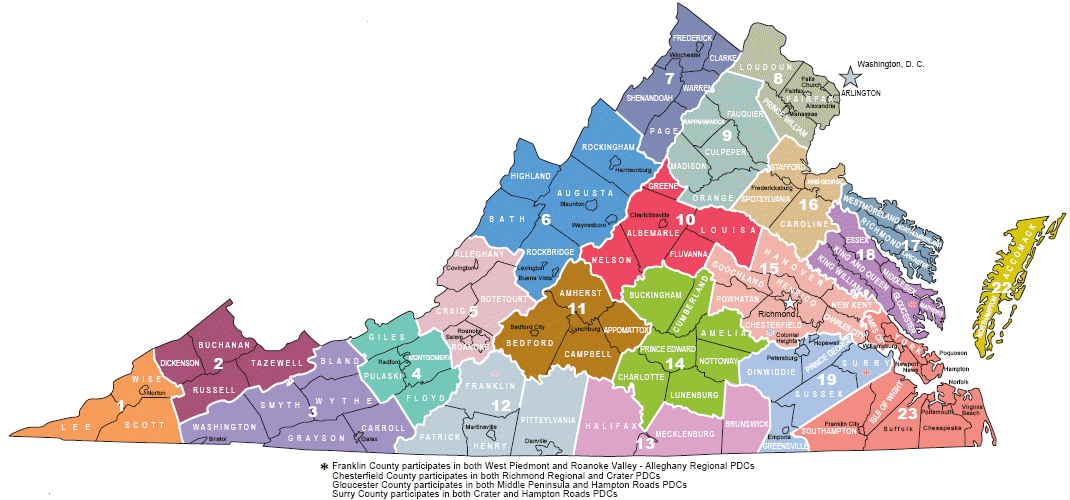
They are unequal on population numbers. But they could be used as a starting point than then can be sliced and diced so that the subdivisions would be equal.
THe method of slicing and dicing might be to start at the center and draw lines outward to the PD boundary limits.
The higher the population density, the smaller the “slice”.
This could be done without regard to incumbents nor demographics.
Some further boundary adjustments might well be needed, but those adjustments would not be based on incumbency nor demographics – just pure geography and population numbers. The geographic size in rural areas would be larger than urban areas and might require combining two planning districts to get to the required population in a voting district.
Leave a Reply
You must be logged in to post a comment.