
Prison Space Fiscal Impacts
Share this article
ADVERTISEMENT
(comments below)
Comments
Comments
22 responses to “Prison Space Fiscal Impacts”
-
The late Clifton A. “Chip” Woodrum, Jr. devised this ingenious process to kill crime bills without risking being tagged “soft on crime”. They usually needed killing, and it gave the patrons a way out, too. But the real purpose was to make it harder to put more people in jail, or put them in jail for longer periods. I do think it started to dampen down the numbers of such bills.
-
So, George Allen was 1994, after 1993 with his “tough on crime” measures. Was he required to do the “Woodrum” treatment also for his bills?
-
The crush of silly crime bills (and some serious ones defense lawyers hated) was very bipartisan. Allen never had the pleasure of working with GOP majorities in either body, so anything he did — including parole reform, truth in sentencing — was very bipartisan. Partisan hacks ignore that, so I’m happy to remind….Parole reform and truth in sentencing actually didn’t add to time served in many cases.
-
Perhaps but the end result was the prisons were overfilled and more had to be built – no?
That HAD to impact the budget – not only new prisons but the continuing cost to staff them.
-
-
Yes, the Woodrum requirements applied to parole abolition, as well as other crime-related bills introduced during those years. See HB 5001 (https://lis.virginia.gov/cgi-bin/legp604.exe?943+sum+HB5001) and HB 5002 (https://lis.virginia.gov/cgi-bin/legp604.exe?943+sum+HB5002) of the 1994 Special Session II.
-
I thought that a lot of things had to have FIS not just prisons. How is this aspect different?
-
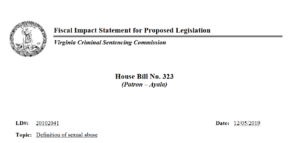
All bills that have fiscal implications eventually have a FIS. The Woodrum is different in several ways: it is required by Code (there is no Code requirement for most FIS); the fiscal impact is printed on the actual bill (no other bill has the fiscal impact printed on the bill itself); the FIS is prepared by the Sentencing Commission, using actual sentencing and crime data (DPB prepares most FIS, using its own knowledge of agencies and information provided by them); there is a statutory requirement that an appropriation be provided for the Woodrum impact (the GA can ignore the FIS for other bills and not provide an appropriation to cover their impact). Another major difference is that, because the Woodrum impact must be printed on the bill, the Sentencing Commission gets to start preparing its FIS when the bill request is initially received by Legislative Services. When the bill is introduced, the Sentencing Commission FIS is in the computer system and the impact is incorporated into the bill upon printing and the FIS report is available immediately in the Legislative Information System. For other bills, DPB must wait until a bill is actually introduced and then start preparing the FIS. The result is that, for a Woodrum bill, the GA knows right away what the fiscal impact is. For other bills, there is usually a delay and the GA charges ahead without knowing what the fiscal impact may be.
-
-
-
-
The late Clifton A. “Chip” Woodrum, Jr. devised this ingenious process to kill crime bills without risking being tagged “soft on crime”. They usually needed killing, and it gave the patrons a way out, too. But the real purpose was to make it harder to put more people in jail, or put them in jail for longer periods. I do think it started to dampen down the numbers of such bills.
-
So, George Allen was 1994, after 1993 with his “tough on crime” measures. Was he required to do the “Woodrum” treatment also for his bills?
-
The crush of silly crime bills (and some serious ones defense lawyers hated) was very bipartisan. Allen never had the pleasure of working with GOP majorities in either body, so anything he did — including parole reform, truth in sentencing — was very bipartisan. Partisan hacks ignore that, so I’m happy to remind….Parole reform and truth in sentencing actually didn’t add to time served in many cases.
-
Perhaps but the end result was the prisons were overfilled and more had to be built – no?
That HAD to impact the budget – not only new prisons but the continuing cost to staff them.
-
-
Yes, the Woodrum requirements applied to parole abolition, as well as other crime-related bills introduced during those years. See HB 5001 (https://lis.virginia.gov/cgi-bin/legp604.exe?943+sum+HB5001) and HB 5002 (https://lis.virginia.gov/cgi-bin/legp604.exe?943+sum+HB5002) of the 1994 Special Session II.
-
I thought that a lot of things had to have FIS not just prisons. How is this aspect different?
-
All bills that have fiscal implications eventually have a FIS. The Woodrum is different in several ways: it is required by Code (there is no Code requirement for most FIS); the fiscal impact is printed on the actual bill (no other bill has the fiscal impact printed on the bill itself); the FIS is prepared by the Sentencing Commission, using actual sentencing and crime data (DPB prepares most FIS, using its own knowledge of agencies and information provided by them); there is a statutory requirement that an appropriation be provided for the Woodrum impact (the GA can ignore the FIS for other bills and not provide an appropriation to cover their impact). Another major difference is that, because the Woodrum impact must be printed on the bill, the Sentencing Commission gets to start preparing its FIS when the bill request is initially received by Legislative Services. When the bill is introduced, the Sentencing Commission FIS is in the computer system and the impact is incorporated into the bill upon printing and the FIS report is available immediately in the Legislative Information System. For other bills, DPB must wait until a bill is actually introduced and then start preparing the FIS. The result is that, for a Woodrum bill, the GA knows right away what the fiscal impact is. For other bills, there is usually a delay and the GA charges ahead without knowing what the fiscal impact may be.
-
-
-
-
Dick, Thanks again for an informative primer on General Assembly legislating and budgeting…
The Woodrum bill requirement to disclose fiscal impacts makes sense. I don’t see that Virginia’s criminal justice system is any the worse off for it — Virginia has the 4th lowest violent crime rate in the country (the lowest outside of New England), and the prison system has one of the lowest recidivism rates. As Steve notes above, the Woodrum requirement has probably stifled a lot of “tough on crime” bills that needed killing.
-
Does the law work in reverse? If a law will decrease the prison population, are funds withdrawn from the prison-support fund?
-
I would HOPE that on the operating side (not capital) that Corrections receives funding on a per inmate basis – like schools do for kids.
If not, I might be with Fred….
-
First of all, the Woodrum process does not operate in reverse. If a bill would reduce the number of offenders in prison, funding is not taken from DOC.
Second, the funding for DOC is not generally on a per inmate basis. The basis for funding is the total cost of operating prisons. The cost of operating a prison with the capacity of housing 1,200 inmates will be largely the same whether the average daily number of inmates is 1,100 or 1,185. There are some exceptions, however, especially in those instances in which DOC contracts out services. In those cases, the funding is based on the annual average number of inmates.
-
-
-
Dick, Thanks again for an informative primer on General Assembly legislating and budgeting…
The Woodrum bill requirement to disclose fiscal impacts makes sense. I don’t see that Virginia’s criminal justice system is any the worse off for it — Virginia has the 4th lowest violent crime rate in the country (the lowest outside of New England), and the prison system has one of the lowest recidivism rates. As Steve notes above, the Woodrum requirement has probably stifled a lot of “tough on crime” bills that needed killing.
-
Does the law work in reverse? If a law will decrease the prison population, are funds withdrawn from the prison-support fund?
-
I would HOPE that on the operating side (not capital) that Corrections receives funding on a per inmate basis – like schools do for kids.
If not, I might be with Fred….
-
First of all, the Woodrum process does not operate in reverse. If a bill would reduce the number of offenders in prison, funding is not taken from DOC.
Second, the funding for DOC is not generally on a per inmate basis. The basis for funding is the total cost of operating prisons. The cost of operating a prison with the capacity of housing 1,200 inmates will be largely the same whether the average daily number of inmates is 1,100 or 1,185. There are some exceptions, however, especially in those instances in which DOC contracts out services. In those cases, the funding is based on the annual average number of inmates.
-
-


Leave a Reply
You must be logged in to post a comment.