• Football Analogies Run Amok

    When ideas and arguments fail, politicians resort to sports analogies. And most of the time, regrettably, the sport they pick is football. Witness the Governor’s press conference yesterday regarding his tax hike plan. Close your eyes, and you can almost hear the crashing pads:

    “I’m a good fourth-quarter player,” [Kaine] said of the measure, introduced yesterday at a news briefing at the Capitol, which at times resembled an anemic pep rally.

    “Anemic pep rally.” Were Craig and Arianna in the back of the room?

    In spite of that, the football lingo kept flowing:

    “The time for kicking the can down the road is over,” he said at the Patrick Henry Building. “Adult leadership means taking adult responsibility.”

    Kick the can. Maybe this was really just a dress rehearsal for a new “Our Gang” series.

    As for the adult leadership thing, well… the less said about politicians and adult behavior the better (particularly on a family blog).

    But right when it seems as though the football imagery was spent and we were consigned to another Hal Roach short, Ward Armstrong boldly leaps into the gap:

    “I’m ready to carry the ball, coach.”

    Just like Roy “Wrong Way” Riegels.


  • Malthus, Singularities and Chins-up

    The NY Time’s Jay Tierney has a good post that is also a useful tonic for what seems to be a creeping Malthusian trend on the Rebellion of late.

    He discusses an article by George Mason University economist Robin Hanson that focuses on “singularities,” the stunning advances that have completely transformed the way we do just about everything (think the creation of agriculture and the industrial revolution). Hanson believes we’re due for another such event, perhaps within our lifetimes. What might it be? Hanson thinks it could be intelligent machines (no, not Terminators) that will increase growth 60 to 250 fold over current levels.

    It’s all a big guess, of course. But I think it’s a far more likely outcome than the ashen forebodings that are both easy and fashionable to embrace.

    In other words: Chins-up, people!


  • Dominion to Invest $600 Million in Smart Grid

    Dominion Virginia Power has unveiled a plan to invest $600 million in “smart grid” technology plus a slew of energy conservation programs that it estimates will save electric consumers $1 billion over 15 years and reduce greenhouse gas emissions by 12 million tons.

    “This plan will provide a jump start toward meeting the 10 percent conservation goal enacted last year by the Virginia General Assembly and the governor, getting the Commonwealth more than one-third of the way there within five years,” said David A. Heacock, president of Dominion Virginia Power. “It will provide significant environmental benefits in a cost-effective manner that translates into very real financial savings to customers.”

    If the plan is approved by the State Corporation Commission, Dominion said in a press release issued this afternoon, it will begin executing it next year.

    The centerpiece of the plan is the installation of “smart grid” technologies that enhances the performance of the electric distribution system. The grid will allow energy to be delivered more efficiently, resulting in substantial energy savings and permitting more precise control of the energy flow.

    Under the smart grid program, Dominion would replace all of its existing electric meters with Advanced Metering Infrastructure, capable of two-way communications, as well as equipment to monitor and control electric distribution. The resulting fuel savings will more than offset the cost of the capital investment. As a bonus the technology should lead to improvements in service reliability and the ability of customers to monitor and control their own electricity usage.

    The plan has many other elements, including:

    • Incentives for constructing energy-efficient homes that meet EnergyStar standards, whcih are 15 percent more efficient than homes built to regular standards.
    • Incentives to install energy-efficient light.
    • Energy audits and improvements for homes of low-income customers.
    • Incentives for residential customers who allow the company to cycle their air conditioners and heat pumps during periods of peak demand.
    • Power cost monitors that display how much electricity customers are using and what it’s costing them.
    • Incentives for residential customers to upgrade heat pumps to more efficient units.
    • Incentives for commercial customers to improve the energy efficiency of their HVAC units and to reduce consumption during periods of peak demand.
    • Incentives to turn in refrigerators that are 20 years old or more.

    Electricity savings could reach 2.6 million megawatt-hours annually by 2013 , the company said. That’s enough to power 216,000 typical homes — but the savings will not be big enough or kick in soon enough to mitigate the need to add enough new generating capacity to meet demand expected to grow by 4,000 megawatts over the next decade.

    This is just the first wave in the overhaul of the DVP electric system. The company continues investigate other energy-conservation and demand-reduction initiatives, including rate structures that would send better pricing signals to customers and emerging technologies that would leverage the smart grid to help customers manage the cost of individual appliances. “These technologies,” states the company, “will support the integration of on-site customer generation and future plug-in hybrid vehicles.”

    Bacon’s commentary: Plug-in hybrids? Hoo-ah! See comments for details.


  • MORE HEADLINES

    WaPo had an interesting front page โ€œanalysisโ€ by Neil Irwin this morning:

    โ€œWhy Weโ€™re Gloomier Than The Economy: Consumer Anxiety Outstrips the Data.โ€

    Earth to Neil: Citizens can Read.

    They can read the headlines we noted in the recent post โ€œHEADLINES, HEADLINES.โ€

    They can read the other headlines on todayโ€™s front page of WaPo and every other MainStream Media Outlet:

    โ€œIowa Flooding Could Be An Act of Man, Experts Sayโ€ and citizens know the era of Corps of Engineer โ€˜flood controlโ€™ providing โ€˜protectionโ€™ is past. They can shoot all the pigs on levies they want but the water will keep rising because the there is no storage area.

    โ€œBush Calls for Offshore Oil Drilling, President Joins McCain in Seeking to Lift Long-Standing Banโ€ and citizens know Bush, McCain and Car Tax Gilmore all would like to barrow from the great grand children to buy a new belt instead of the addressing the consumption / obesity problem.

    Citizens also know the economic data is cooked to make a โ€˜growth is goodโ€™ stew. All the economists MainStream Media quotes are paid directly or indirectly by the Business-As-Usual advocates who thrive on ever-expanding levels of consumption.

    Finally, more and more citizens are coming to realize that MainStream Media is also an Enterprise that lives on advertising by those same Business-As-Usual advocates. See THE ESTATES MATRIX

    EMR


  • Climate Change Commission a Waste of Effort?

    Patrick Michaels, Global Warming skeptic, has weighed in on the Virginia Commission on Climate Change — and this time there’s no question that it’s him and not one of his colleagues (as was unclear in another recent communique discussed in “Low Hanging Fruit vs. Deep Green.”) This time, he has written a column in the Times-Dispatch under his own name.

    In a nutshell, Michaels’ point is that nothing the Commission can do will have a discernible impact on climate change. One of the Commission’s goals is to cut greenhouse gas emissions by 30 percent by 2025, a goal which, if accomplished, would set Virginia emissions back to the level they were back in 2000. That’s way less ambitious, he notes, than the goals of the Kyoto protocols, which aspire to cut global emissions to about 5 percent below 1990 levels for the years 2008-2012.

    And even the draconian Kyoto protocols would barely impact climate change. Citing scientists at the U.S. National Center for Atmospheric Research in Boulder, Colo., Michaels says that Kyoto would reduce global temperatures by 0.07 degrees C in the next half-century. “That’s right: not 7 degrees or even seven-tenths of a degree, but seven hundredths of a degree.”

    Adopting the Virginia plan across all Kyoto nations would result in about 72 percent of the emissions reductions of Kyoto itself by 2050, again according to data from the Energy Information Agency. That translates into five hundredths of a degree of warming by then, and 0.13 degrees by 2100. “The 2050 figure is about 20 times less than the mean annual temperature difference between downtown Richmond and suburban Short Pump.”

    (In one sense, Michaels is being generous to the Commission. His figures assume that commission goals could be applied to all Kyoto nations, which they clearly cannot. Virginia accounts for only a tiny sliver of global economic output. The impact of Virginia actions on global climate will be so infinitesimal as to be unmeasurable.)

    Michaels concludes: “It’s hard to believe that any member of Virginia’s commission really thinks he’s doing much about global warming. … People need to know that the proposed goal of the Governor’s Commission on Climate Change will simply have no detectable effect on global warming. So what’s the point?

    Bacon’s bottom line: Michaels is missing the point. As I see it, the Commission has at least two valid missions. First, Virginia needs to understand the risks posed by climate change. Regardless of whether our actions can affect climate change, climate change can affect us. As we’ve discussed on this blog, there is a significant risk that rising global temperatures and sea levels could inundate large parts of Virginia’s low-lying coastline. How do we prepare for that possibility? I’d like to see that issue aired.

    Secondly, there are sound reasons for reducing the energy intensity of Virginia’s economy that have nothing to do with climate change. You can be an agnostic on global warming (as I am) and still see value in cutting carbon dioxide emissions, which are a good metric of fossil-fuel energy intensity. The prices of oil, natural gas and coal are soaring. Because Virginia institutions are geared to a cheap-energy era, we are suffering needlessly as the world economy transitions to an dear-energy era. Rising energy prices are sucking billions of dollars out of our economy, crimping living standards and reducing the competitiveness of our businesses.

    If the Commission on Climate Change can identify strategies for going “deep green” — changing transportation systems and human settlement patterns that keep Virginians stuck in an energy-intensive mode — we can all benefit. If reducing energy dependence and cutting CO2 emissions also happens to reduce global temperatures by .00007 of a degree, then so much the better!


  • Electronic Health Records Coming to a Doctor Near You

    The Kaine administration has been doing some useful things behind the scenes, but because of my monomaniacal fixation on transportation, land use, energy and the environment, I have not had time to highlight the more positive initiatives. With this post, I hope to make up for that deficit to some small degree.

    One of Gov. Timothy M. Kaine’s priorities has been to increase the efficiency of Virginia’s health care system by encouraging physicians and hospitals to adopt electronic health records. Until this week, none of these endeavors had resulted in anything terribly newsworthy. But on June 12, U.S. Secretary of Health and Human Services Michael Leavitt visited Richmond to announce Virginia’s participation in a Medicare initiative to promote the use of certified electronic health records (EHRs).


    Leavitt thanked Kaine, legislators, members of his cabinet, and Michael Mathews (CEO of MedVirginia), and others for developing a winning application. The project, one of 12 in the country, will provide financial incentives to as many as 100 primary care physician practices in Virginia to use certified EHRs.


    If there’s anything close to a silver bullet for out-of-control health care expenditures, it’s probably EHRs. Let me rephrase that. There are no silver bullets. But of all the remedies discussed, getting physicians, hospitals and other health care providers to adopt electronic records would do more than any other single thing anyone can do to cut costs and improve patient outcomes.


    The U.S. health care industry has been notoriously slow to adopt electronic records. A majority of physicians still make hand-written notes, which are sometimes illegible and lead to transcription errors. Paper records also are far more difficult to share, resulting in redundant and unnecessary procedures when a patient moves to a new setting. Although systems with computerized provider order entry have existed for more than 30 years, fewer than 10 percent of hospitals as of 2006 have a fully integrated system, according to Wikipedia.

    According to one 2004 estimate, one in seven hospitalizations occurred when medical records were not available. Additionally, one in five lab tests were repeated because results were not available at the point of care. โ€œThe evidence is too compelling and the stakes are too high to maintain [the] status quo,โ€ said Mathews, the MedVirginia CEO.

    MedVirginia, Virginia’s Regional Health Information Organization, is the logical group to take the lead in the Medicare initiative. Since its inception in 2001, the organization’s vision has been to create “the most electronically connected medical community in the United States.” In 2005, MedVirginia developed the capability to collect patients’ hospital, lab and pharmacy data and organize it into one single electronic chart. The key now is to get all players to use electronic records.

    Medicare will begin working with Virginia in the summer of 2009 to build partnerships and develop strategies to recruit Virginia physicians into the program. It’s a shame we have to wait a full year just to start work on this important project. More.


  • Left and Right Converge on Basic Economics

    Mr. Peter Galuszka took one for the team when he bought, read and reported on Thomas Sowell’s “Basic Economics.” I was unable to respond to his post in a timely fashion, so I’m posting here to show where our political perspectives from the Right and the Left blend on the basics of basic economics. Because, I theorize, we are both children of the Enlightenment and agree that rational empiricism is the foundation of good science.

    Likewise, we might posit, jointly if I may presume so, that good governance for policy issues that involve issues with scientifically-based alternatives should rack and stack alternatives with clear links to rational empiricism. Analysis. Good analysis.

    Here are my comments on Mr. Galuszka’s (PG) findings.

    I would grade him with an A-. And I was a tough grader at the Department of Social Sciences, USMA. The minus comes from his last comment which is addressed at the end of this list.

    I, too, used Paul Samuelson’s text on econ as an undergrad and went took economics at Keynesian grad schools.

    But, what jumped out at me in Herman K. Bator’s bedsheet model of the macroeconomy was how little government spending did and how much productivity did. Nothing beat improvements in productivity as a single variable change in the olde GNP.

    Since then I read Milton Friedman on the role of capital growth. But, even in grad school I got the idea that the way to cut the American pie for the American People better is, first, to grow the pie. Bigger slices for all are possible.

    I agree with PG that unions are important. Unions and shareholders are the only checks and balances on corporate bad behavior. When the legislatures try to fix the corporate barn doors after the horses have run, they pretty much muck it all up for everyone – creating a new set of winners and losers in the business/government mixed economy.

    I argue that unions and shareholders have vital roles in the future to provide the moral suasion needed on organizations run by sinful men (as we all are) and to protect the employees. My political issue with unions is ideological – and not pertinent here.

    I agree that CEO compensation is out of whack. But, it isn’t an issue for government. It’s an issue for the unions, shareholders and the public marketplace of ideas.

    The impacts of free trade are tough to live with. But, economic risk has always been brutal. The long range study I led (back in 90-92 for the period 2005-2015) pointed to the biggest single driver of change would be – domestically and internationally – political understandings (reactions) to economic changes. Whole regions can lose industries in no time. But, there are counters that can mitigate such events – to a degree – like Commonwealth Trust Accounts and SS that are individually owned. Producing more capital can offset the loss of an industry. New industries will be created.

    I don’t see the problem with foreign corporations given our laws and shareholders – what is different now that is so scary?

    My only complaint with PG’s findings is his comment about not seeing the application specifically for Virginia.

    We need a Macro-Economic model of the Commonwealth. The GA could put together a consortium of our universities for a couple of million and get a first class model for tax policies. And the economic effects of transportation and land policies, as well as environmental policies.

    We may still break Right and Left on issues, but where possible, lets do so from the same common economic analysis.


  • Wagner Plays the Offshore Drilling Wildcard

    So far, the special General Assembly session on transportation has been shaping up as a flounderfest: no one agreeing on anything, everyone just flopping around. But Sen. Frank Wagner, R-Virginia Beach, has thrown a wild card into the game.

    In a news conference today, Wagner linked offshore drilling for natural gas with Virginia transportation. He called for Gov. Timothy M. Kaine to use his “considerable influence in national Democratic politics” to urge his fellow party members to lift the federal ban on off-shore drilling. And he promised to introduce legislation next week that would devote much of the state royalties from such drilling to transportation, Chesapeake Bay clean up and energy-related uses.

    Wagner, who reminds readers in his press release that he was the chief patron of the bill calling for the Virginia Energy Plan, would establish the Offshore Energy Revenue Fund. Proceeds would be distributed as follows:

    40% to the Transportation Trust Fund
    40% for Chesapeake Bay cleanup efforts
    10% to the Renewable Electricity Production Grant Fund
    10% to the Virginia Coastal Energy Research Consortium

    Now, some might accuse Wagner of cheap political grandstanding. After all, what can Gov. Kaine really do to influence the federal ban on offshire drilling? Further, what are the chances that a Democratic Congress, which looks forward to aligning itself within half a year with a Democratic president, will make a move that would anger its environmentalist base? Pretty low, I’d say.

    Moreover, there is absolutely no logical nexus between offshore drilling and transportation. I can see a tangential connection to the Chesapeake Bay: If people are worried about the environmental impact of drilling, it sorta makes sense to dedicate some of the royalties to environmental clean-up. Drilling offshore would take place in the water… The Chesapeake Bay has lots of water… What more could you ask for?

    Other than the fact that the Business As Usual interests are desperate for a new source of revenues to perpetuate Virginia’s failed transportation model, however, why should the revenues be dedicated to transportation as opposed to any other need? None that I can think of.

    But the gambit is sure to generate a lot of headlines and absorb a lot of discussion. A special session that was shaping up as snooza-palooza just might be fun to follow after all.


  • Deep Green in Blacksburg

    Yesterday I blogged about the need to take a “deep green” approach to energy conservation. It’s one thing to snap up low-hanging fruit, but Virginia needs to enact fundamental institutional changes — to transportation and land use especially — if we are to achieve meaningful reductions in energy consumption. As it happened, at least three speakers at the Governor’s Commission on Climate Change meeting in Blacksburg yesterday brushed up against those topics.

    I wasn’t there, so I don’t know what exactly what they said. But the Commission has posted PDFs of their presentations online, and you can get a flavor of what they had to say.

    Providing Transportation Choices to Reduce Greenhouse Gas Emissions, Petra Mollet, American Public Transportation Association

    Urban Development and Climate Change, John V. Thomas, Ph.D., Development Community and Environment Division, U.S. Environmental Protection Agency

    Climate Change and Development Patterns, Eric J. Walberg, Principal Planner, Hampton Roads Planning District Commission


  • HEADLINES, HEADLINES

    There has been a lot of loose talk on this Blog about Fundamental Transformation not being an urgent need, especially in the Commonwealth of Virgina.

    Our friends the Tiger Riders may have not been reading the headlines.

    Last Saturday the Business section of WaPo was headlined by: โ€œFlying Is Going to Get Even Less Fun.โ€ You may recall our column 21 April column โ€œThe End of Flight as We Knew It.โ€

    Early this week AOL Money featured an analysis of recent stock trends and suggested 17 large Enterprises that, based on stock market performance, may not be with us for long. Number one on the list and four of the top 5 were airline Enterprises โ€“ American, United, Northwest and Delta. Five of the top 8 were airline Enterprises.

    Add the cost of aircraft impact on the upper atmosphere to the price of a ticket and the US of A will be back to one flag carrier, airport overcapacity and very few who can afford to travel. Deregulation and cheap fuel sure did improve air travel.

    Think of all those Households (formerly known as โ€œfamiliesโ€) who believed it was fine to disaggregate and scatter across the globe because they could always fly โ€œhomeโ€ for the holidays and when there was an emergency…

    On the AOL list were three were major financial institutions and the two biggest Autonomobile manufactures โ€“ Chrysler already having been towed away after a fire sale. They also believed their own ads and the chant that demand for Large, Private Vehicles was inelastic.

    On 13 June WaPo had a headline โ€œMedical Fraud a Growing Problemโ€ and in the same issue the Business section headlined โ€œThe Economyโ€™s Steady Pulse: Health-Care Sector Is Poised to Keep Growing, But so Are Its Costs.โ€

    Not likely any Tiger Riders are going to try to track down fraud or cut costs if medical services is the only sector of the economy โ€“ other that flood damage repair and ad revenue from the Internet โ€“ that are expanding. The health and welfare of other nation-states is better with a different system but this one makes some more profit in the short term.

    On Monday the 16th WaPo had a full page ad by HybridTechnologies touting the value of lithium battery powered vehicles. The ad was not there to sell cars, it was selling stock in a company that will sell the cars. Small, efficient vehicles are good, but are not a good investment without fundamental change in settlement patterns. See โ€œAptera and the Tiger Riders.โ€

    On the 17th one of the above-the-fold front page stories was headlined โ€œMcCain Seeks to End Offshore Drilling Ban.โ€ WaPo commentators had a field day with the flip-flop from prior positions but the real story was that the flip side of the jump page was that overexposed crying baby ad paid for by โ€˜The people of Americaโ€™s Oil and Natural Gas Industryโ€™ that asks โ€œwho really pays when congress taxes oil companies?โ€ The children of well paid energy CEOs?

    A society that has seven parking places for every Autonomobile and five bed places for every body needs to reconsider where the current trajectory is taking everyone, including those at the top of the Ziggurat.

    Perhaps citizenS need to come up with a new metric for well being.

    It is enough to make one want to add some paragraphs to THE ESTATES MATRIX.

    EMR


  • “Low Hanging Fruit” vs. “Deep Green”

    The Governor’s task force on climate change is meeting in Blacksburg today. One of the voices that will not be heard is that of Patrick Michaels, former state climatologist and one of the nation’s leading Global Warming skeptics. Despite his extensive knowledge on climate change issues, Michaels was conspicuously not asked to serve on the commission. That’s no surprise, of course, given the fact that the commission was predicated on the key assumption, which Michaels questions, that human-caused increases in carbon dioxide will cause calamitously higher temperatures and sea levels. Under the circumstances, inviting Michaels to participate arguably would not lead to a productive exchange of ideas.

    To my knowledge, Michaels has never commented on Virginia’s climate change task force… until now. In a post on the World Climate Report blog either Michaels or one of his co-bloggers takes on the subject of “The Virginia Climate Change Commission and the Mirage of Low Hanging Fruit.” (Authorship of the blog post is not attributed to any one of the blog’s three contributing editors, so it’s not clear who wrote the post. But if the author wasn’t Michaels, it seems likely that he shares the author’s views.)

    Rather than revisit the familiar global-warming controversies, the author focuses on the commission’s stated goal of cutting greenhouse gas emissions by 30 percent by the year 2025 in order to restore emissions to 2000 levels. The goal, contends the author, who apparently has attended one or more of the commission hearings, will be harder than it looks.

    The Commission [is] seeking potential ways to meet this goal through conservation, energy efficiency improvements, encouragement of renewable energies, etc. Oftentimes the discussion turned to identifying the โ€œlow hanging fruitโ€ that was available to achieve the agreed upon goal โ€” that is finding the easiest and most straightforward way of attempting to reduce emissions.

    But there is no low-hanging fruit, the author contends. Obvious changes are already spoken for. Recommending changes that business and government are likely to make even in the absence of any action by the commission will amount to double counting and won’t get Virginia any closer to the commission’s goals. The argument is a bit arcane but worthy of consideration. Here’s the logic:

    Virginiaโ€™s gross state product has been growing over the last 10 years at an average rate of about 3.5 percent yearly (2000 constant dollars). Virginiaโ€™s energy usage as well as its CO2 emissions have grown at a slower rate: slightly more than two percent yearly. In other words, Virginia’s economy is getting more energy efficient per unit of economic output.

    Forecasts of Virginia’s economic output, energy consumption and CO2 emissions through 2025 take that improving energy efficiency into account. According to the “Greenhouse Gas Reduction Goal Update,” the Kaine administration is already assuming “continuing improvement in energy efficiency/energy intensity” for its “Business As Usual” energy scenario.

    “Virginians have found ways to produce more per unit energy usage year-over-year through innovation and hard work,” writes the World Climate Report author. Motivated by higher energy prices, Virginians are projected to increase energy efficiency by 25 percent without any action on the part of the commission. The commission needs to find an extra 30 percent in CO2 reduction.

    Writes the author:

    What all of this means, is that the Commission cannot suggest things that would otherwise occur in their absence โ€” for as we have seen, these things are implicit in the business-as-usual extrapolations. Thus, the Commission cannot recommend actions that are somewhat obvious (i.e. the low hanging fruit) and that are ongoing or will occur on their own in response to higher fuel costs, introduction of new technologies, price saving measures, etc.

    Such actions include a constant push towards improving manufacturing efficiencies, the trend towards cars with higher gas mileage, the gradual switchover to compact florescent light bulbs, and any other initiatives that are already on the books or would otherwise be thought up. … Again, business-as-usual implies innovation.

    Bacon’s bottom line: I concur with this appraisal. Now, to follow the World Climate Report author’s logic to its logical conclusion: Achieving the Commission’s goals will require Fundamental Change to Virginia’s institutions. In other words, we need to go “deep green.”

    “Green Lite” — relatively easy-to-implement conservation measures from CFL light bulbs to building-automation systems, from higher gas-mileage vehicles to more efficient industrial processes — is already happening. Implementation of these solutions will be driven by the soaring price of gasoline, coal, natural gas and electricity. Households and businesses are amply motivated to seek them out.

    But there’s a deeper level of energy conservation that’s not so easily achieved because it entails changes not just to individual or corporate behavior but changes to intractably energy-intensive transportation systems and human settlement patterns. Reaching the Kaine administration’s goal of cutting CO2 by 30 percent (on top of the Business-As-Usual reduction of 25 percent) will require more than increasing the average fuel efficiency of Virginia’s automobile fleet by three or four miles per gallon. It will require cutting vehicle miles driven by 20 percent (or some enormous percentage). Likewise, reaching the goal will require more than installing more efficient HVAC systems and stuffing insulation in the cracks of single family dwellings. It may require a 20 percent reduction in the cubic footage of residential, retail, office or industrial space to be heated and cooled.

    While necessary for a prosperous and sustainable society, embracing “deep green” and achieving Fundamental Change will be neither easy nor popular.

    Today is the Climate Change commission’s last day for the presentation of facts and ideas by experts. It will be interesting to see if any of the materials posted online include any discussion of the need for changes that go beyond “Business As Usual” scenarios.


  • UVa Increases Endowment Payout

    The University of Virginia will tap more of its $3.2 billion endowment to strengthen university programs and help hold the line on tuition increases, reports the Daily Progress. The Board of Visitors voted Friday to increase the payout rate to 5 percent of the fund’s market value on June 30, a move that should generate $16 million more for university academics and UVa Health System patients.

    The board also approved a new formula for determining how much of its endowment is spent each year: After fiscal 2009, the university will increase its endowment spending by the rate of inflation, as long as the resulting payout is within four percent to six percent of the fundโ€™s market value.

    The $2.24 billion operating budget for 2008-2009 provides $1.22 billion for academics, $980 million for the medical center, and $34 million for the College at Wise — a 5.4 spending percent increase. The budget allows for 159 new full-time workers, up from 12,170, a new student data system, more student financial aid, and more.

    Bacon’s bottom line: Good. This move is long overdue. I’ve long criticized UVa, my alma mater, and other public Virginia universities for piling up bigger and bigger endowments for the seemingly sole purpose of claiming, “Mine’s bigger than your’s” — even as they aggressively jacked up tuitions year after year. The increased payout and future indexing for inflation helps ensure that the endowment is used for the purposes of improving the quality of education and keeping tuitions affordable.

    The BoV’s actions are not necessarily the end of the story. Alumni and other stakeholders must continue to scrutinize where the money goes. But Friday’s actions signal that the Board clearly understands that the endowment does not exist for its own sake — it needs to be used.


  • A Virginia Dem on Transportation: One Good Idea

    Virginia Senator John Miller (D-1SD) will introduce a bill to abolish the Hampton Roads Transportation Authority (HRTA).

    This unelected, unaccountable, unseparated powers Regional Government – ruled un-Constitutional (by unanimous decision of the Virginia Supreme Court) -has already spent $200k.

    Let’s see which Hampton Roads legislators sign up to be co-patrons of this bill – and how many Republicans make it bi-partisan for good governance.


  • Virginia GOP on Transportation: One Good Idea, One Bad

    As the special transportation session of the General Assembly draws nigh, the House Republican leadership has thrown out some new ideas regarding transportation funding. One of them deserves serious consideration. The other one is dangerous: a potential blank check for the political class.

    Del. G. Glenn Oder, R-Newport News, announced Friday that he had introduced legislation to create a “constitutional lock-box” for the Transportation Trust Fund. This idea, backed by Gov. Timothy M. Kaine early in his administration, would protect dedicated transportation from revenue razzias to fund other programs. Politically, a constitutional lockbox is mandatory to induce voters to support tax increases for transportation construction. Without such a guarantee, only the most naive would trust the politicians to honor a commitment to leave the funds alone.

    Said Oder in a press release: “It is time to put ‘trust’ back into the Transportation Trust Fund. This constitutional amendment provides a guarantee to the citizens of Virginia that money dedicated to transportation will be spent on transportation. To prevent similar diversions and raids, we approved a constitutional amendment to protect funds for education raised through the State Lottery. We should protect transportation dollars as well.”

    Oder’s legislation is backed by the House Republican leadership, including Speaker William J. Howell, R-Stafford. Said Howell: “The people of Virginia have every right to expect that moneys dedicated for transportation will, in fact, go to transportation.”

    Right on!

    While Howell’s logic is impeccable in that instance, he floated a stinker last week when discussing how to address the transportation needs of Hampton Roads. In an interview with the Daily Press, Howell suggested leasing the long-term tolling rights for Hampton Roads bridges and tunnels in return for up-front payments in cash.

    “You can’t raise taxes enough to build all of those things,” Howell said of the region’s list of seven major transportation projects, which includes expanding the Hampton Roads Bridge-Tunnel, reports the Daily Press’ Kimball Payne. “Looking at tolls and concessions is the only way you’re going to solve Hampton Roads’ problems.”

    The problem with the transportation projects favored by the political class of Hampton Roads is they are largely for the benefit of the port and maritime interests, and to some extent development interests. By leasing off bridge and tunnel concessions and hiking tolls to pay for those projects, Howell’s proposal would represent a multibillion-dollar transfer of wealth from the general citizenry to the port/maritime/development sectors of the business community.

    I’m all in favor of finding creative ways to build the new transportation capacity needed to expand the ports — as long as the projects can pay their own way, and as long as private interests shoulder the risk that revenue projections might not materialize. Toll the trucks. Tax the containers. Create Community Development Authorities to develop industrial real estate along the expanded highways and use the proceeds to issue bonds. Privatize the Virginia Port Authority. But don’t tax or toll already overtaxed citizens for something that benefits them only indirectly if at all.


  • Obligatory Ruminations about Human Settlement Patterns in Disney World

    Before departing on vacation, I promised to share my impressions of what might be gleaned from the Disney World experiment for building functional human settlement patterns in the Rest of the World. I fully acknowledge that the commentary that follows is based upon quick and superficial observation, which may be of limited value. But some interesting points do emerge.

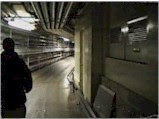
    Utilidors. Disney turned down my request to view the underground complex — a network of corridors that contain utilities and accommodate logistical transportation — that I deemed the most innovative aspect of Disney World and, possibly, the most instructive for design of other communities. Accordingly, most of what I know about the “utilidors” I gleaned from an online article, “Under the Magic Kingdom,” on the HiddenMickeys.org website.

    The 15-foot-high corridors were built at ground level, then covered with soil from excavation of the Seven Seas Lagoon. Disney World was actually built atop this spoil, creating the above-ground level visible to visitors and a below-ground level used by employees. From the website:

    You have never seen a delivery truck at Disney – have you? Magic Kingdom’s first floor has all the access roads for the Cast Members (employees) and service vehicles, the “tunnels” or Utilidors, the AVAC, service rooms, wardrobe and costuming, male and female locker rooms, offices, storage, kitchens, break rooms, two employee cafeterias, including the Fantasyland Dining Room, Kingdom Kutters, a Fire Prevention Center, Studio “D” and many of the support departments for the Magic Kingdom. The Fantasyland Dining Room and restrooms are to the left.

    Underground corridors strike me as a possibly useful adjunct to Claude Lewenz’ concept of pedestrian villages. (See “First, Shoot All the Cars.”) While the pedestrian-only aspects of Lewenz’ village are highly appealing, the difficulty in accommodating delivery trucks and other utilitarian vehicles creates problems that I’m not sure that Lewenz ever resolved satisfactorily. Disney-esque corridors could solve those problems — though, admittedly, at a significant cost.
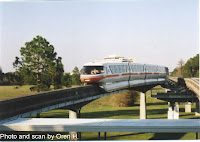
    Monorail. I did have a chance to ride the monorail, which is showing its age after 27 years. The mass transit system has 12 trains consisting of six cars each, capable of running up to 40 miles per hour. I’m no expert in mass transit, so I apologize in advance if my commentary sounds like Urban Planning 101

    The Disney monorail strikes me as a “niche” system that is appropriate in certain settings, but not a tool capable of providing mobility and access for large populations. The beauty of the monorail, or so it would appear to my uninformed eye, is that the structure takes up relatively little space. The struts upon which the track rests have a small “footprint,” therefore can be retrofitted into an existing urban space, presumably a highway or boulevard, relatively easily.

    The monorail stations need not be large if located inside a building, as the Disney World monorail is in one of the Disney hotels. However, the ramps connecting the monorail to the pedestrian level did consume considerable space — posing an obstacle for retrofitting an already-developed area.

    Multimodal. Where Disney truly excels is in its implementation of multi-modal transportation. Each of the four main theme parks is surrounded by vast acres of parking lots, which function as the resort’s interface with the world. Tens of thousands of visitors arrive by car daily. To transport them quickly and efficiently from the parking lots into the pedestrian-oriented parks, Disney operates an elaborate tram system. To provide access between the theme parks, as well as the various resort hotels and other facilities, Disney runs buses, passenger boats and the aforementioned monorail.

    The key to making the Disney system work is the existence of well-placed multi-modal transportation hubs, where parking-lot trams, passenger boats, monorails, buses and pedestrian walkways all come together and visitors can easily switch from one mode to the other. Once the newcomer has figured out the system — what connects with what — the multimodal system functions reasonably well.

    Where planning for Virginia’s transportation facilities seem deficient, it strikes me, is (a) the paucity of such multi-modal centers, and (b) the failure in imagination to incorporate water-borne craft into the multi-modal system. Unfortunately, I have no idea what it cost to put the Disney system into place, nor how much it costs to operate. I suspect that Disney treats such information as closely guarded competitive intelligence. Therefore, there is no way to know whether implementation of such a system would make sense in real-world urban conditions in Virginia today.

    There you have it, folks, the sum total of what I learned from the Mouse.

    Celebration. P.S. To answer Ed Risse’s question, I did not have a chance to visit Celebration, Disney’s New Urbanist development built nearby. From what I heard from a friend who works for the Disney organization, Celebration is both a success and a failure. The New Urbanist formula was such a commercial success that the prices of property there rose to astronomical levels that priced less affluent households out of the “affordable” housing envisioned for the development. The obvious answer: Build more communities like Celebration, eliminate the scarcity value, and “affordable” housing will stay affordable.

    I found one other observation made by my friend to be noteworthy: Performance of the retail development in Celebration has been disappointing. Turns out, people still like driving long distances to Big Box retail outside the development. Whether the phenomenon of $4-per-gallon changes that predilection remains to be seen.

    (Photo credits: Utilidors, HiddenMickeys.org; monorail, Oren’s Transit Page.)

