• The Right to Academic Freedom

    Like many conservatives, the anonymous blogger who goers by the name of his high school, likes to limit individual rights. Regarding the Virginia Attorney General’s chilling harassment of a reputable climatologist, Mr. High School writes:
    “There has never been a right to academic freedom. There is no right to academic freedom. And, God Bless, there will never be a right to academic freedom. So, any criticism of Ken Cuccinelli’s Civil Investigative Demand against Michael Mann as violating the right of academic freedom is null and void.”
    He provides absolutely no explanation for this bold and bizarre statement. But since a commenter asked “what is academic freedom” I volunteer to take one for the team.
    Back in 1940, “academic freedom,” defined as the RIGHT of professors and students to pursue academic inquiries without interference from external and political groups or authorities, was first put forward by the then Association of American Colleges and the American Association of University Professors. They stated that teachers have a right to freedom discuss their subjects in a classroom although some institutions can restrict those rights if they are religious institutions.

    Note the date of the statement — 1940. At that time Nazi Germany had invaded much of Europe and had been on a rampage over the previous decade ridding German universities of Jewish professors and other “undesirables,” revamping curricula so it would reflect the views of national socialism, burning books (see photo) and generally terrorizing academia.

    In the U.S., the “right” to academic freedom stems from the Constitutional right to freedom of speech. America’s universities have taken academic freedom very seriously over the past 70 years. It is part of a college’s accreditation consideration. AAUP keeps a list of colleges that fail on academic freedom.

    So, you have a right based directly on agreement among universities and professors and, indirectly, from the U.S. Constitution. Other countries’ constitutions do make academic freedom an explicit right, such as France, Germany, South Africa and others.

    Granted, the U.S. concept of academic freedom has been tested quite a bit since 1940. It comes from all sides. University of Colorado Professor Ward Churchill wrote that the 9/11 attacks were justified because of U.S. foreign policy. The school withstood calls for his removal. Obama adviser Larry Summers got into hot water when he stated that women’s genetic makeup may make them less likely to do well in math.

    And on it goes.

    My personal experience with academic freedom, albeit indirect, happened when I was an undergraduate at Tufts University. Just down the street from my dorm, Tufts has a graduate school with Harvard known as the Fletcher School of Law and Diplomacy. Although I have no association with Fletcher, I used their library and became friendly with some of their professors

    Its dean at the time was a former Foreign Service officer named Edmund Gullion who had experience as a diplomat in South Vietnam. This was during the highpoint of the Vietnam War and left wing radicals at school lambasted Fletcher for having as students military, CIA and foreign service officers. One night someone launched a bomb into Gullion’s office and the explosion caused extensive damage. It knocked me out of bed.

    Now that is a violation of academic freedom. So is Cuccinelli’s witch hunt.

    Peter Galuszka


  • Another New Right From The Left


    Another New Right From The Left.

    Liberals love inventing new rights. For the past 18 months I have heard the liberals chirping about the “right to health care”. Now the imaginary liberal rights machine has manufactured a “right to academic freedom”. Yet another pseudo-right extended only to liberals after having been manufactured in the liberals’ invisible rights factory.

    There has never been a right to academic freedom. There is no right to academic freedom. And, God Bless, there will never be a right to academic freedom. So, any criticism of Ken Cuccinelli’s Civil Investigative Demand against Michael Mann as violating the right of academic freedom is null and void.

    But did Cuccinelli do the right thing? Was there smoke sufficient to indicate a possible fire?

    There was already a review of Prof. Mann’s work by a crack team of fellow professors at Penn State, where Mr. Mann now works.

    Why did Penn State see the need for a warm and cozy review by fellow academics?

    From the final report, “Begining on and about November 22, 2009 The Pennsylvania State University began to receive numerous communications (e-mails, phone calls and letters) having accused Dr. Michael E. Mann of acts which included manipulating data, destroying records and colluding in order to hamper the progress of scientific discourse around the issue of anthpogenic global warming from approximately 1998.”.

    Cuccinelli doesn’t need to go looking for a smoking gun, Mann’s collegeues already think they found it.

    What did Penn State find?

    There were four avenues of inquiry. Dr. Mann was cleared of three allegations by a group of his academic friends perhaps wearing cardigans with leather elbow patches while alighting in the blue curls of pipe smoke wafting around their beards during this “trial”. However, even “cleared” leaves some room to question – “While a perception has been created in the weeks after the CRU e-mails were made public that Dr. Mann had engaged in the suppression or falsification of data there is no credible evidence that he ever did so and certainly not while at Penn State.”.

    “…certainly not while at Penn State.”

    Unfortunately, Dr. Mann taught at the University of Virginia (not Penn State) from 1999 – 2005.

    In the minds of liberals, our elected attorney general should outsource investigations of potential malfeasance to cabals of academics from Pennsylvania. The fact that the investigation involved actions taken in Virginia, at a state university with public funds should be ignored. Ignored, presumably, because of the Right to Academic Freedom written in invisible ink in the liberals’ version of the US Constitution.


  • The “Cooch” and Academic Freedom

    Of all of Attorney General Kenneth Cuccinelli’s bizarre initiatives, the one probing scientific research at the University of Virginia is the most frightening. It goes to the heart of academic freedom issues and conjures up some very ugly moments in American history.
    Cuccinelli’s target is Michael E. Mann, a former U.Va. climatologist now at Penn State University which is well-regarded for its study of the climate and meteorology. “The Cooch” is targeting five grants worth about $500,000 that Mann was involved with before he left Charlottesville in 2005. Cuccinelli also wants copies of all communication, including emails, scratch paper notes, whatever, between Mann and 39 other scientists around the globe.
    This latest round of wing-nuttery comes after Cuccunelli has sued the U.S. EPA for declaring carbon dioxide a pollutant, told public universities they can’t protect homosexual employees, says it’s OK if a rural prosecutor wants to rummage through a student newspapers files and so on.
    Mann is a target for Cuccinelli because he espouses the so-called “hockey stick” theory that due to human activity, global temperatures have spiked upwards in the past 100 years or so. Never mind that worldwide scientific groups see merit in Mann’s theory, it runs afoul of the conservative cognoscenti, including the National Review, American Enterprise Institute, the Heartland Institute, the Cato Institute, Rush Limbaugh, James A. Bacon and a host of others.
    So, Cuccinelli has turned to a law intended to see if academic researchers are skimming funds from their grants. He has issued “civil investigative demands,” which operate much like criminal subpoenas, for all information related to the grants and attendant communication.
    Instead of looking for financial cheating, Cuccinelli is looking for heretics. His move is reminiscent of the church putting Galileo under house arrest for saying the planets move around the sun instead of the earth.
    True, Clark Hall, the UVA center for environmental studies, has been a hotbed of global warming controversy for years. The attractive, 78-year-old brick building “on grounds’ as Wahoos like to say, was home for S. Fred Singer, the head of environmental studies who later became an outspoken opponent of global warming theories and is now an occasional speaker for right-wing talk shows.
    Later, Patrick Michaels, another UVA professor skeptical of global warming theories, drew controversy when Gov. Tim Kaine did away with his “state climatologist” job in 2006 because Kaine, a Democrat, tends to support ideas that global warming is a big problem. Conservatives and libertarians are quick to point out Kaine’s action as interference in academia.
    True, there may be an element of political payback in Cuccinelli’s hounding of Mann. But there’s a big difference between Kaine’s deal and Cuccinelli’s. For one thing, the post of “state climatologist” was a largely honorary position that hadn’t been funded for years. It originated back in the years when it was a common practice for politicians in Richmond to toss out honorary titles like bagatelles. Kaine expressed his dislike for Michael’s view by saying he did not speak for the state government and ending the honorary position. This is akin to a new governor tossing out holdovers and putting in his or her own people.
    That’s a big difference from what Cuccinelli is doing. He is going specifically after scientific research by attaching highly political tags to it and then running up big bills and harassment levels because he doesn’t like what the research says.
    Universities usually have sophisticated systems of peer review to vet both grant proposals and the research they provide. Mann told me in an email that his research was so vetted by such bodies as the National Academy of Sciences and other bodies. He has been under reviews at U.Va. and at Penn State and has always come out vindicated, he says.
    Another big question is why Cuccinelli chose these specific five grants. Mann and another U.Va. scientist told me that one such grant worth about $200,000 has nothing whatsoever to do with global warming. It is meant to help train graduate student scientists in micro-climate conditions in places such as North Alaska and the Kalahari Desert in Southern Africa. Part of the funds were used to fund field work in Botswana.
    It will indeed be interesting if Cuccinelli and his staff find a smoking gun in Botswana. But more likely is that they really don’t know anything about these five grants and are using the “CIDs” as a rather expensive way to get the “Cooch” publicity and attention among his cabal of right wing global warming naysayers.
    He has sure stirred the pot on this one. Groups such as the American Association of University Professors, the Union of Concerned Scientists and the American Civil Liberties Union have all weighed in saying that Cuccinelli’s act is an appalling violation of academic freedom.
    Some say it smacks of “McCarthyism,” referring to the alcoholic and reactionary Wisconsin senator who ruined scores of academic careers by claiming professors were influenced by Communists at the dawn of the Cold War. McCarthy didn’t have much to stand on. At one speech in West Virginia he claimed to have in his hand the names of several hundred Communist sympathizers who worked for the State Department. It turned out that he didn’t have one name. The sad thing is that no one in the news media had the sense, or the guts, to ask.
    In a figurative sense, does Cuccinelli have any names? It doesn’t appear so, given the nature of the grants he’s dead set to investigate. He’ll get the Tweets and the headlines. But UVA will be stuck with the bill of researching documents to meet his “CIDs” and its reputation will be diminished.
    Why would an honest researcher want to work with Virginia universities if his or her work is going to be challenged by the likes of Cuccinelli and he or she will have to pay all of those lawyers fees to fund the Grand Inquisitor’s witch hunts through their emails?
    Researchers and venerable institutions might well chose to go elsewhere rather than have to deal with “the Cooch.”
    Peter Galuszka

  • Cuccinelli Gets Gas

    Overview: Controversial Virginia Attorney General Ken Cuccinelli has gas. Or, more accurately, he has a problem caused by the gas which is trapped in the coal seams under large swaths of Southwest Virginia. In 1990 Ken Cuccinelli was walking down “the lawn” at UVa to pick up his BS in Mechanical Engineering. That same year the Virginia General Assembly passed the Virginia Gas and Oil Act. For the next 20 years Ken Cuccinelli would prove to be an ambitious and successful politician while the Oil and Gas Act would prove to be yet another almost totally incompetent piece of legislation passed by an inept state legislature. On April 19 of this year the paths of Ken Cuccinelli and the Virginia Oil and Gas Act intersected. On that day, a landowner and his attorney met with one of Cuccinelli’s top deputies to discuss a new law signed by Bob McDonnell on April 13. The landowner hopes the new law will resolve a number of the more idiotic aspects of the original law. Mr. Cuccinelli seems less convinced that the new law is much better than the old law. He has complained that the new law is “too gentle”. Mr. Cuccinelli is willing to sue the federal government, he is willing to subpoena records from the University of Virginia. Let’s hope he doesn’t “chicken out” now. I’d hate to have to admit that Mr. Cuccinelli’s legal courage wanes when the targets are big companies instead of academics and the feds. How Mr. Cuccinelli handles this situation will speak volumes about his real philosophy.

    Timeline: I’ve often thought that one could win a Pulitzer Prize for reporting on the buffoonery of the Virginia General Assembly. I no longer think that to be true. I know it to be true. I know it because Daniel Gilbert of the Bristol Herald has done just that. While Mr. Gilbert might not agree that the prize was awarded for reporting on buffoonery, I think he would characterize the overall situation as sad. His excellent series of articles on the matter can be found here – http://bit.ly/9XBrBo. For those without the time required to read Mr. Gilbert’s compelling prose, let me summarize:

    There is a lot of natural gas trapped along with coal underneath Virginia. The mineral rights to the natural gas belong to the landowners. In 1990, the General Assembly passed a law forcing the landowners to sell their gas rights on a pre-defined pricing schedule. Some coal companies claimed that their long ago purchase of coal rights gave them the gas rights too. In 2004, the Virginia Supreme Court ruled against the coal companies saying that the sale of coal rights did not include the sale of gas rights. This required the energy companies to negotiate with the landowners. Disputes arose. Some of the disputes are widely seen as contrived. The state of Virginia has consistently refused to use its regulatory power to adjudicate these disputes. Royalty payments from disputed gas ownership claims are put into an almost unaudited escrow fund. In 2010, Terry Kilgore patroned legislation to allow the state to adjudicate gas royalty disputes. However, there is some ambiguity in the new law (surprise, surprise). Mr. Cuccinelli has been asked for an opinion as to whether the state really has the legal position to adjudicate these disputes. While his opinion is pending, Mr. Cuccinelli has stated that he thinks the 2010 law is “too gentle” – perhaps indicating that he will opine that the state still cannot adjudicate the disputes. If the state can’t or won’t adjudicate the disputes then the landowners will have to retain counsel and sue the energy companies in court. Since many landowners are of limited means, the legal action may be prohibitively expensive. Therefore, the landowners may settle for less than the disputed amount rather than go to court.

    Legislation and Regulation: Some commenters on BaconsRebellion routinely call for more government regulation as something of a cure-all for many of today’s problems. I am not among those commenters. I fundamentally believe that our government, at both the federal and state level, is too dysfunctional to be given any more power. The sad situation regarding gas rights in Virginia is just one more example of an inept government in action. Twenty years after the state passed a law forcing landowners to sell their mineral rights on a pre-ordained pricing schedule the state is still unable to get many of the landowners their money. Disputes are often invented. The escrow accounts are essentially unaudited. Recent legislation is “too gentle”. However, there may be an answer. Our newly elected Attorney General has shown he has the courage to take on the status quo. Will he do the same here? Mr. Cuccinelli, we eagerly await your opinion.


  • “Streamlining” State Government


    Grabbing onto a popular, bi-partisan trend, Gov. Bob McDonnell is set to “streamline” Virginia government. He has named a 31-member panel headed by the man who led President George H.W. Bush’s unsuccessful reelection campaign in 1992.

    On one level, there are reasons to examine cutting state government. The state faces a multi-billion budget shortfall, which is part of the $60 billion national shortfall that states face after the Great Recession, according to stateline.org. So, it may make sense to make sure that taxpayers are getting a decent bang for their tax buck.
    To be sure, a number of states are doing this. In Washington state, Democrat Christine Gregoire, the governor, has been on a streamlining binge. She’s eliminated 75 state commissions and shut down 25 driver’s license centers, replacing them with online kiosks. Nebraska is thinking of merging staffs at community colleges. Massachusetts has merged four transportation authorities into two. And in Louisiana, the state is trying to require prison inmates to take high school GED training with the idea if they get a diploma while in the pen, they’ll likely get a job on the outside and be less likely to go back to prison and cost the state more money.
    As a Republican, McDonnell likes the idea of government streamlining because it fits his political philosophy of promoting limited government. This could be his defining issue after four months of debacles that have left Virginia a national laughingstock.
    Yet there are some limits to what can actually be done.
    The biggest is that Virginia already seems to be doing a pretty good job in state government. The Pew Center on the States rates the state A minus, along with Utah and Washington. The average score is a B minus. Neighbor Maryland got a B and North Carolina got a B minus. West Virginia got a C plus. The ratings deal with how well a state manages employees, budget, finance, information and infrastructure.
    If the Pew Center ratings are to be believed, we are not in a situation where a broken-down state government badly needs a house cleaning. This may be how McDonnell’s team projects the issue, along with their cronies in the conservative state media. But the fact remains that previous Democratic Governors Mark Warner and Tim Kaine did a pretty good job running the state. Pretending they didn’t is counter-productive.
    But, as noted before, McDonnell needs a defining issue if he is to have a political future. Streamlining seems a sensible way to go, especially since loose cannon Atty. Gen. Kenneth Cuccinelli has taken all of the high ground when it comes to social, hard-right issues. In fact, the “Cooch” is making McDonnell look like a buffoon by straying so far afield by suing the EPA on carbon dioxide and harassing the University of Virginia with a Joe McCarthy-style probe on global warming (more on that tomorrow).
    What the states need more than a blue ribbon commission on “streamlining” is one that creates more jobs. To his credit, McDonnell is on the case, but he’s efforts won’t even make recommendations until this fall.
    Badly-hit areas such as Southside and Southwest Virginia can’t wait that long. After all, McDonnell managed to pay up to $14 million in state money to get the HQ of defense contractor Northrop Grumman to move from Los Angeles to Northern Virginia. That involves all of 300 jobs in a firm that probably would have located to the state anyway.
    Peter Galuszka

  • New Face at Bacon’s Rebellion

    We have a new face here at Bacon’s Rebellion — we just can’t show it to you yet. But we will as soon as we can!

    I am winding up the writing of my book, “Boomergeddon,” and soon will begin the task of generating publicity for it. That task will entail building and maintaining a Boomergeddon website and blog, writing op-ed pieces and giving speeches to more or less anyone willing to listen to me. I have spent all too little time with the Bacon’s Rebellion blog as it is, and I will have even less time in the future.

    Therefore, I have invited the blogger known as Groveton to fill in for me. Regular readers of the blog know Groveton from his frequent comments. Among all the regular participants, he comes the closest to representing my perspective on many issues, and, hence, will provide a worthy philosophical balance to Peter G. and EMR. He will continue in the tradition of providing pointed political commentary on Virginia public policy in a civil spirit.

    Close readers of the blog know that Groveton is a senior executive with a major technology company with a presence in Northern Virginia. He attended Groveton High School and graduated from the University of Virginia. He travels around the world for his business, bringing valuable insight into the realities of competing in a global economy. Like me, he is a fiscal/economic conservative, a social moderate and a political independent. He is slowly but surely coming to see the light on transportation/land use issues. And he has a great sense of humor.

    In inviting Groveton to contribute to Bacon’s Rebellion, I have broken a cardinal rule: that all contributors should be open and transparent about who they are. Because of his employment with a prominent company, Groveton is faced with a devil’s choice: Either stay anonymous, or go public and pull his punches so as not to cause his employer any embarrassment. We reached a deal. Groveton will pull no punches.When he retires a year from now, he will go public, blogging under his real name and identity.

    Welcome aboard, Groveton.


  • Cheerleading Against Regulation


    You have to love the Richmond Times-Disgrace, err, Dispatch.

    It is a perpetual fount of cheer leading for the ruling elite with no regard for average folks. Its news sections take down, stenographic-style, the opinions of corporate pooh -bahs while their Sunday editorial pages are dominated by self-dealing lobbyists or non-profit bureaucrats telling us what a great job they are doing or TD publisher Tom Silvestri tapping out another bizarre tome about how busy and interesting and what a leader he is.
    In recent weeks, we had John A. Luke, head of paper-maker MeadWestvaco which relocated its HQ to Richmond a few years ago, tell us that government regulation is bad, bad bad. Luke, who avoids real interviews with journalists, didn’t bother to provide much detail at a country club speech other than mentioning President Barack Obama’s stimulus program and plans for a federal agency to protect consumers.
    Before, we had Bruce Whitehurst, head of the Virginia Bankers Association, complain that banking reform sought by Democrats such as Chris Dodd and Barney Frank comes with harmful new rules, chief among them an agency that would (gasp) actually protect consumers consumers from the predatory practices of banks.
    One wonders where Mr. Whitehurst was when Bear Stearns, Lehman Brothers, Merrill Lynch, American International Group, Wachovia, Washington Mutual and many others either went down or had to find someone to buy them because of their incredibly bad choices in the subprime mortgage mess and other areas. Who got screwed here? The consumers, that’s who. They suffer 9.9 percent unemployment while the suits in C-Suites got gigantic golden parachutes not to mention a $700 billion plus federal bailout.
    Now comes the latest on the front pages of today’s Wall Street Journal. There is a fascinating front-page story that the federal Minerals Management Service, which may or may not be tasked with overseeing offshore oil rigs, has regularly conceded safety oversight to the drilling industry.
    Gov. Bob McDonnell and his group who want Deepwater Horizon rigs offshore of Virginia say that the industry is already well-regulated. The WSJ seems to beg to differ. MMS seems to follow a policy popular in the George W. Bush administration that federal regulators will step back and let the real experts — oil companies and their lobbyists — write the rules. No need to mention the result — millions of gallons of crude oil still pumping unhindered into the Gulf of Mexico in one of the worst environmental disasters in decades. And, compared to other countries with large offshore petroleum reserves, the U.S. is seen as a regulatory slouch.
    I remember during the Bush administration covering the U.S. Securities & Exchange Commission. I did so when Christopher Cox, an amiable former California congressman and fan of free market maven Ayn Rand, was in charge. His mission was to lighten up on the Sarbanes-Oxley law that toughened up accounting after the 1990s Enron and WorldCom scandals.
    At the time, the John Lukes of the Corporate World were moaning big-time about Sarbox. Cox helped soften implementing it, which actually was effective and resulted in far-fewer forced restatements of company earnings. But the general feeling was light-touch regulation and letting the industry write the rules.
    Cox somehow was hard to find when the you know what hit the fan in 2008. As for the shareholders he was worn to protect, well, they lost trillions.
    Peter Galuszka

  • What Is It About Lacrosse?


    Lacrosse, the kind of hockey with sticks invented by Native Americans, has gained special popularity in Virginia, the Mid-Atlantic and parts of the South. Or make that notoriety.

    The game had been played for years at regional schools such as the U.S. Naval Academy and Johns Hopkins, but it only won broader popularity about 20 years ago.

    In my neighborhood, kids with “Duke” on their t-shirts walk up and down the streets chucking the little balls from basket to basket. When I went to my 40th high school reunion at a Jesuit prep school near Washington, the showcase event was a lacrosse game which we won, beating highly-ranked Landon 4 to 3. Back in the late 1960s when I was a student, football was king.
    But there seems to be something dark about the sport. A former Landon and University of Virginia lacrosse midfielder, George Huguely, faces first degree murder charges in the death of another Virginia lacrosse player, Yeardley Love. She was found beaten to death. Huguely’s lawyer says it was an accident.
    Just a few years back, lacrosse got another black eye at Duke, when a Durham stripper hired for a party falsely accused three Duke lacrosse players, including one from Landon, of rape. That case with a travesty with the university quickly damning the players. The local prosecutor lost his job and lawyer’s license for bungling the case and helping ruin the boys’ reputations.
    Even so, what is it about lacrosse?
    True, football players at Big 10 schools get into trouble with booze and girls. But there’s something about lacrosse’s recent popularity that seems to suggest that it is the sport of the rich kinds, or the new rich kids. If you handle the ball well, you’re on your way to a name school in the region, such as Virginia or Duke, and then on to a great law or medical school and a lucrative career.
    With that status in mind, maybe some of the kids think they are a little too special, a little too entitled. That might make some not hold back one’s temper with a girlfriend. Or do something tacky like hire a doped up stripper for an all-guys’ party.
    When I watched the Landon game last month, I found it fast and interesting. But I wish it had been football on a fall day.
    Peter Galuszka

  • Drill, Baby — Maybe

    The nation has watched in horror as the oil slick from the British Petroleum rig in the Gulf of Mexico approached the ecologically fragile wetlands of the Louisiana coast, and I found myself among those thinking, “We cannot let this happen in Virginia.”

    For once, I found myself agreeing with Peter, who wrote in a previous post: “Big Oil with its Big Money would not be the only industry along Virginia’s coast that [Gov. Bob McDonnell] is sworn to protect. Consider the fishing, tourism and commercial shipping sectors, not to mention the U.S. Navy, Air Force and Coast Guard which use offshore Virginia waters and pump in billions to the state’s economy.”

    But before we conclude that offshore drilling cannot possibly be conducted safely off the Virginia coast, let us bear in mind the vast differences between conditions in the Gulf and conditions in Virginia. The BP rig is drilling in 5,000 feet of deep water — pushing the technological envelope for operating in extreme conditions. Any drilling that takes place in Virginia would be on the continental shelf in shallow water (shallow by oil industry standards).

    Andrea Shea King posts on her website a fascinating description of the disaster, which details the engineering challenges of operating in deep water. The question for Virginians is this: How likely are these conditions likely to be replicated off our coast? To what extent do risks of oil spills increase with the depth of the ocean bed? Does it make sense for the state to permit drilling at certain depths with exceedingly low risk and to prohibit drilling at deeper depths where risks are greater?

    Assuredly, some people will use the BP disaster as an excuse to limit all drilling under all circumstances. Let’s keep our cool and ascertain all the facts before jumping to any conclusions.

  • Race and Class in Arizona

    There’s no getting past the racist implications of Arizona’s tough new immigration law that requires police to check the citizenship of anyone they suspect to be an illegal alien.
    Supporters of the law claim that it is badly misunderstood and that Arizona is only doing a job that the federal government has so far not done. Too many Mexican drug gang fire fights have been spilling into border U.S. states. And we in Virginia have had our own version of such a law — Prince William County’s three years ago that authorized police to check immigration status at all criminal arrests.
    Listen to the right wing media, such as American Family Radio, and you’ll hear of some “expert” tell use that Jose and Esmerelda want to sneak their 17 children north past the border so they can suck on the teat of U.S. social welfare programs, when, in fact, Hispanics tend to be among some of the hardest working and most conscientious people anywhere.
    But you simply can’t get past the white-skin, dark-skin elements of the immigration dilemma and it brings up some very ugly traits in American society that are both racist and anti-intellectual. Not that long ago, for instance, North Carolina forbade Catholics from holding public office and “No Nothings” went after Irish Catholic immigrants in the 1840s, followed by the Ku Klux Klan in later years.
    Immigration laws in the early 20th century set “limits” for what the dominant White Protestant power elite considered “inferior” races such as Italians, Irish, Poles, Croatians, Mexicans, Japanese, Chinese and so on. As for African-Americans, the record is incredibly evil. I read on the obit page last week in The New York Times about a champion female diver who was denied use of a swimming club at a ritzy San Francisco hotel in the 1940s because she was half English and half Filipino. Leading colleges held Jews to “quotas” until the mid-1900s.
    Turning now to Arizona, one also finds a strange history. To be sure, I have never been there but I have been to neighboring states. For centuries, of course, the land that is now Arizona was dominated by Native American tribes. One of the first Western explorers was non-other than an Hispanic — a Spanish friar named Fray Marcos de Niza. He was wandering around the area in the 1530s, which is quite a bit earlier than the “White” Englishmen who founded Jamestown and Plymouth in the 1600s, or even, for that matter, Sir Walter Raleigh.
    Like many areas in the U.S. Southwest, Arizona’s culture was dominated by the dark-skinned Spanish and Mexicans. An 1860 census showed that Arizona was still predominately Native American and was so until 1912 when it became a state.
    The big change came in the 1960s when thousands of “White” Americans from the Mid-west and Northeast, many of them retirees from well-paying white collar or highly-skilled blue collar jobs, flooded into to new “communities” to take advantage of the dry, warm climate. They brought with them car-centric urban sprawl and golf courses that demanded millions of gallons of scare water that ended up changing the micro-climate by making it more humid and destroying one of the reasons so many came to Arizona in the first place.
    These “Whites” also wanted to shape the state’s culture around what it was like back in suburban Detroit or Chicago or St. Louis or New York. They wanted everyone to speak only English, as they did, and conform with the small family, consumption-oriented lifestyle that they loved, along with white bread, schmaltzy programs such as Lawrence Welk on TV.
    Now we find that Arizona is a “crisis” of illegal immigration and the culprits (no getting around this one, sorry) are “brown-skinned Latinos who actually have been in those parts quite a bit longer that the “come-here” and “White” retirees. So, we have a new and hateful law that will probably spur a more conservative federal law if and when it ever comes. The last attempt at one, supported by President George W. Bush by the way, couldn’t clear Congress. President Obama has been too sidetracked by health care and financial regulation to focus much on it yet.
    Whatever happened in Prince William and can it be a guide? Consider this blog by Paige Winfield Cunningham in The Washington Post.
    At first, she notes, Hispanics, the target of the law, fled PWC. English as a Second Language classes had been growing by 1,500 students a year but quickly fell to 760 before growing again. Surveys show that Hispanics overwhelmingly support local police but did not after the law.
    As for the big crime crackdown that was anticipated, well, it turned out to be somewhat underwhelming. Of 12,839 criminal arrests in 2009, only 6 percent involved illegal immigrants.
    Peter Galuszka

  • Offshore Myth Busting


    Virginia Gov. Bob McDonnell gave a somewhat disingenuous response when confronted with the facts that the massive oil rigs explosion and spill in the Gulf of Mexico make his plans for Virginia’s emergence as “the Energy Capital of the East Coast” highly questionable.

    The governor said essentially that one doesn’t stop all airline flights because of one crash.
    Other than the obvious lameness of that response, there are some things that McDonnell, his confederates in the oil and gas lobby and even President Barack Obama might need to think over.
    Essentially, the point is this: technology and “leave it to the private sector” simply don’t always work in the world of complicated engineering and cut-to-the-bones private sector management styles that are really far more concerned with the bottom line and p/e ratios than with saving the environment no matter how many millions of dollars they pay to slick ad firms and image projectors to paint themselves green.
    At the core are some very real contradictions between the approaches of people like McDonnell and reality. You can’t rely on for-profit companies, privatizations, law to non-existent government regulation, the wonders of high technology and so on to keep workers safe and biosystems clean.
    Even so, a number of myths have been spun that raise serious and troubling questions about the quest for offshore drilling near Virginia’s coasts.
    Myth One: High technology will save us. Not exactly. McDonnell may say that rigs used offshore Virginia will have such advanced engineering systems that a blow-out or up and spill are highly unlikely. It turns out that Deepwater Horizon, the operator of the rig that blew up and caused the Gulf spill did not have a seismic-based device that would automatically shut off oil flows at the ocean-floor level. Brazil and Norway, both big offshore operators have them and Norway has required them since 1993. Such a device might have prevented the gigantic Gulf spill.

    Myth Two: For-profit companies always operate for the public good. Let’s take a peek at British Petroleum or BP which owned the platform that had the blast and leak. BP is no stranger to tragedy. Its complicity in a blast at a Texas City, Texas refinery that killed 15 workers in 2005 has been called into question. After the disaster, the U.S. Chemical Safety Board, an independent federal agency, accused BP of cutting the costs of safety and maintenance for increased profits.

    Myth Three: You always know who works for you. McDonnell loves privatizing and farming out public functions to for-profit companies. He even pushed two unsuccessful bills in this General Assembly session that would have given big money benefits to private contractors who do state road work while also cutting schools, health, the arts, and so on. But when you farm out all of those jobs, do you really know who is working for you? The BP rig was a contractor and sub-contractor jobs. And in the Texas City case, after the explosion, BP boss John Browne flew to Texas City where he met reporters and said he’d be investigating. He was disarmed by a reporter who noted that all of the dead were contract workers. In the end, BP did compensate their families.

    Myth Four: If a company says it is green, believe it: BP wanted to turn itself around in 2005 and go against the ExxonMobil behemoth. As part of this goal, it spent millions with media firms, ad mavens and graphics artists who redid the BP logo in a sunburst scheme with the slogan “Beyond Petroleum (BP, get it?)” At the same time, to cut costs, BP was firing thousands of its experienced engineers and replacing them with hired hand contractors.

    So, McDonnell and Obama should ask themselves, “What’s it going to be for Virginia?” Obama says there will be no new offshore drilling until a thorough study is made of Deepwater Horizon. That’s cold comfort.

    As for McDonnell, he might want to knock off the idiotic “plane crash” excuse and consider that Big Oil with its Big Money would not be the only industry along Virginia’s coast that he’s sworn to protect. Consider the fishing, tourism and commercial shipping sectors, not to mention the U.S. Navy, Air Force and Coast Guard which use offshore Virginia waters and pump in billions to the state’s economy. That’s right here, right now. Not sometime off in 2020.

    Peter Galuszka

    PS: All of my cites, curiously, come from the Wall Street Journal, which is editorially in tune with McDonnnell.

  • ARE YOU AWAKE CARGOSQUID?

    In case you missed it, today CNN reports:

    โ€œAn oil spill off Louisiana was designated a spill of “national significance” Thursday, meaning assets can be drawn from other states and areas to combat it, Homeland Security Secretary Janet Napolitano said.

    โ€œThe U.S. military may be called on to assist authorities scrambling to mitigate the potential environmental disaster posed by the spill as it expands toward the Gulf Coast, the Coast Guard said.

    โ€œIn addition, another controlled burn of the oil slick may be conducted, Coast Guard Chief Petty Officer Erik Swanson said.

    โ€œOfficials said late Wednesday the estimated amount of oil spewing into the Gulf from three underwater leaks after last week’s oil rig explosion has increased to as much as 5,000 barrels, or 210,000 gallons, a day — five times more than what was initially believed.โ€

    And you said โ€œno oil is leakingโ€?

    Tobacco does not cause cancer either.

    DDT does not harm the environment.

    The world is flat.

    The climate is not changing.

    OK if it is, humans have no role in that change.

    And they need not take action to protect against negative impacts.

    Oh yes, be sure to tell your friends that it is intelligent to continue to rely on Autonomobiles for Mobility and Access.

    And all the while, the Dow is up by 125 or so because after all cleaning up oil spills is a plus for the GDP.

    Sleep well.

    EMR


  • Making Stone Soup on Roads

    The policies of Gov. Robert F. McDonnell have more than a few contradictions.
    A key one is his stubborn refusal to raise taxes while
    he also deals with a state highway system that badly needs upgrading. Yet, it so short of money that funds for maintenance are routinely raided from construction funds.

    Trying to reconcile this is Sean T. Connaughton, the former chairman of the Prince William County Board of Supervisors, a former head of the U.S. Maritime Administration and now McDonnell’s Secretary
    of Transportation.

    Connaughton sat down with me last week for an interview that focused on how he expects to make stone soup for the state’s transportation sector with the state running a $4.4 billion budget deficit.
    The former Coast Guard and Navy officer insists that he can be done. Money isn’t exactly the main problem, Connaughton told me. Of its $3.8 billion transportation budget, the state still puts about $1 billion a year into infrastructure. “But right now we have money for construction that isn’t moving through the pipeline. So we’re trying to understand why,” he says.
    To find out, the McDonnell administration has launched a series of audits of the Virginia Department of Transportation. Besides that, Connaughton says he wants to find out why state and federal transportation planning often runs at cross ends and why it takes so
    long to get an improvement completed.

    One example is the plan for so-called “hot lanes” on Interstate 395 and 95 south of Washington which offer motorists expedited rush-hour access for extra fees. Conaughton complains that he was hearing about the project eight years ago when he was chairman of the Prince William board “and we still haven’t gotten to a comprehensive agreement.”
    Another question mark involves federal money for higher-speed rail. Politicians and the state’s business elite had big plans to get a big chunk of the $8.5 billion offered for passenger rail by President Barack Obama’s American Recovery and Reconstruction Act. They dreamt of
    fast passenger trains that would whisk them from downtown Richmond to
    Washington in 90 minutes.

    But this year, Virginia got a paltry $75 million while North Carolina got $545 million. One reason is that North Carolina has been working on higher speed rail much longer than the Old Dominion and has a more sophisticated program. And even though the two states have a
    compact for cooperation on the issue, “they have never met about it,”
    says Connaughton who planned to visit Raleigh to get things moving.
    What’s more, Connaughton is a big fan of the Virginia Public Private Transportation Act which some claim leads the states in its sophistication. Public-private funding lets the state have its cake and eat it, too, by letting the private sector shoulder the financial burden
    for new roads since the state has no available funds and is unwilling to
    raise money through taxes.

    McDonnell is fast-tracking a plan to build a public-private superhighway along U.S. 460 from Petersburg to Hampton Roads that would be completely private.”We believe with will have a (program) that will move this project forward that will not require any state or federal
    financial involvement. They are consulting lawyers right now. We would have essentially a true private toll road,” Connaughton says.
    Another scheme to get around revenue woes would be putting toll booths on the southern approaches to Interstates 85 and 95. There’s one big caveat, Connaughton acknowledges. Funds raised from those tollbooths can be used only for maintenance on those federal interstates. But doing so would take the maintenance burden off the state and could speed safety improvements in accident-prone areas of the interstates.

    Will Connaughton’s schemes work? He is known for out-of-the-box solutions.
    As chairman of the Prince William board, he pushed the county to start building and maintaining its own roads rather than having to deal with the state.
    But relying on public-private partnerships doesn’t always work. The Pocahontas Parkway near Richmond was such a deal but demand for the toll road was so weak that the state came close to losing its pristine AAA bond rating, forcing the state to scramble for a new
    deal.
    There’s only so far Virginia can go without actually paying for its transportation needs.
    Peter Galuszka

  • Just When You Thought Drilling Was Safe


    Drill Baby, Drill” advocates who include President Barack Obama along with Virginia Gov. Bob McDonnell have been telling us that modern offshore oil technology is so modern that deaths and devastating spills are the problems of yesteryear.

    Think twice.
    This Tuesday a powerful blast ripped apart and then sank the Deepwater Horizon platform about 50 miles off Louisiana in the Gulf of Mexico. The floating platform which was in mile-deep water burned for two days before sinking. Eleven workers are still missing and presumed dead.
    Environmentalists fear that as much as 336,000 gallons of crude oil could be oozing from the wreck every day. Salvage teams are scrambling to see if the wreck of the platform has blocked the wellhead which would make fixing the problem a lot more difficult.
    Despite what the politicians and oil lobbyists would have you believe, there have been similar disasters in recent years. One that comes to mind is the Piper Alpha rig off Scotland in the North Sea. Located in 474 feet of water, the rig exploded in July, 1988, killing 167. That one is vivid because I was working in the Soviet Union and some of my friends who were working for British newspapers and wire services covered the disaster.
    McDonnell and Obama want to lease a block 50 miles off of Virginia’s Eastern Shore for exploration. So far there’s scant evidence of much oil but some of natural gas reserves.
    McDonnell wants to make Virginia “the energy capital of the East Coast.”
    He might want to also provide some state economic development grant money for funeral homes in Cape Charles, just in case.
    Peter Galuszka

  • The Ugly Ain’t Over, Part III

    Consumers account for roughly 70% of the U.S. economy, and their spending is the driving force behind economic growth. Over the past three business cycles, consumers increased their buying power through borrowing: running up credit cards, purchasing automobiles and houses on easier credit terms, and tapping their home equity. This trend was particularly pronounced during the Bush II expansion, a period in which incomes stagnated but consumers, buoyed by the rising value of their houses, borrowed more than ever.

    In the United States, consumer debt grew from about 60% of GDP in 1990 to 96% of GDP by 2008, according to a McKinsey Global Institute report. A simple arithmetical calculation suggests that debt accumulation added an average of roughly 1.4% per year to economic growth over that period.

    (For those generation war-mongers who would flagellate U.S. Baby Boomers for throwing prudence, frugality and thrift to the winds, it is worth noting that the leveraging of consumer debt was widespread throughout the U.S., Canada, Europe and South Korea as well. The debt accumulation coincided with a period of low and declining interest rates that reduced the cost of borrowing. McKinsey did not address why interest rates were so low, but the trend clearly seems connected to the โ€œglobal capital glutโ€ noted by Federal Reserve Chairman Ben Bernanke in a Sept. 11, 2009, speech to the German Bundesbank in Berlin.)

    Not only will the U.S. economy lose the propellant of consumers getting into hock up to their eyeballs and spending with wild abandon, consumers will actually cut back their borrowing. In economist-speak, they will โ€œde-leverage.โ€ Although consumers have increased their saving in the past year or two (no mean accomplishment when joblessness and underemployment approach 18% of the workforce), they still have a lot of de-leveraging to go.

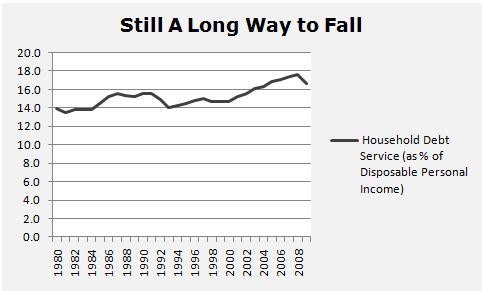
    The chart to the left, based on Federal Reserve Board data, shows that service on mortgages, credit cards and other forms of household debt peaked at 17.5% of after-tax income in the third quarter of 2007 before falling to 16.4% two years later. That implies that consumers have accomplished only one-third of the de-leveraging needed to get back to the 14.0% indebtedness experienced as recently as 1993. (Click on image to view details.)

    Economists debate whether the โ€œnew frugalityโ€ represents a fundamental shift in American values, or if consumers are just making a virtue of necessity as financial institutions curb their lending for their own reasons. Evidence suggests that a little of both is occurring. Boomers have awakened to the fact that they will retire soon and that they have done too little to prepare for life after the paycheck. Although some Boomers will put their faith in God or the U.S. government, others are trying to spend less and save more.

    Similarly, there is evidence that the U.S. population generally has come to see the pitfalls in a life dedicated to the accumulation of material possessions and status symbols. As part of the nationโ€™s greening consciousness, people are increasingly aware that buying more โ€œstuffโ€ sends economic and environmental ripple effects across the globe, from the decimation of rain forests to the emission of greenhouse gases. In a parallel trend, market research tells us that people are more likely to say that the most important priorities in life are friends and family rather than earning more money or being famous. It is unknowable how long this cultural shift will last, but when reinforced by badly burned financial institutions imposing stricter lending standards, itโ€™s a good bet that consumer spending will remain depressed for years.

    By simply not borrowing more, consumers will slow economic growth by 1.4% per year compared to the U.S.’s historic performance since 1990. If newly frugal consumers continue de-leveraging to levels of indebtedness prevailing 20 years ago, the unwinding could steal an additional 1.0% of annual economic growth over the next 20. Absent a new source of dynamism, a potential combined loss of 2.4% in the annual economic growth rate suggests that economic performance could be sickly for the next two decades.

    So, how does this quick analysis inform our understanding of the debacle, known as Boomergeddon, to come? First, slow consumer growth must be viewed in the context of the massive overhang of bad commercial and residential real estate debt (see “The Ugly Ain’t Over Yet, Not by a Longshot” and “The Ugly Ain’t Over, Part II“), which will ravage bank balance sheets and crimp lending. If economic growth is slower and of shorter duration than projected by the Obama administration, deficits will be considerably higher than the $9 trillion between 2010 and 2020 also forecast by the Obama administration.

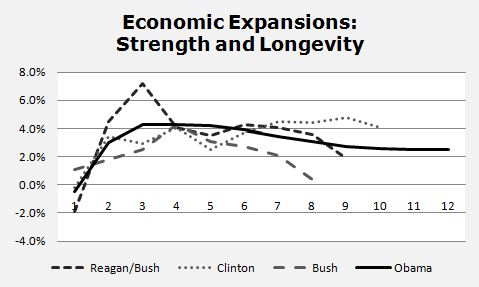
    On the surface, the Team Obama’s 10-year budget forecast seems fairly cautious. This year, 2010, will resume economic growth at a tepid rate, but the expansion will gain momentum over the next few years and then settle into a slow-but-steady mode for the rest of the decade. However, a comparison with previous business cycles shows that the O Team is predicating its optimistic budget forecast on the strongest, longest economic cycle of the past 40 years. (Click on image to view details.)

    First, compare the Obama forecast for the first four years of the business cycle: Under an Obama presidency, the U.S. will outperform the first four years of the Clinton and Bush II business cycles, lagging only the turbo-charged expansion of the Reagan years. Moving into the middle years of the business cycle, Obama expects U.S. economic performance to trail Reagan and Clinton, but only by a modest margin. Then, in the final stages of the expansion, Obama expects the economy to keep to going — the Energizer Bunny of the economic world. While the Bush II’s business cycle lasted only eight years, Reagan/Bush’s nine and Clinton’s ten, Obama projects economic growth into the indefinite future in a state of never-ending bliss.

    Needless to say, not everyone expects to see such a strong business cycle. Some, like U.S. Chamber of Commerce President Tom Donohue, have warned of a double-dip recession brought on by a wave of new taxes, regulations and mandates. One need not heed Donohue, however, to think that the current economic expansion will be weak — for reasons that predate Obama’s elevation to the presidency and have nothing to do with his political agenda. Let me emphasize: Republicans could win control of Congress this fall, Obama could lose re-election in 2012, a new team could enact a new economic policy, and the political pyrotechnics would not change the underlying economic trends. Obama’s sin is not in creating our current economic dilemma but in failing to acknowledge the effect it will have on the economy, deficits and the national debt over the decade ahead.

    Boomergeddon is coming, baby. Deficits are gaining momentum, with entitlements and interest payments on the debt spinning out of control. Within a few years, the chain reaction will be unstoppable.