The Bacon’s Rebellion blog migration continues. I have succeeded in moving all 3,500 blog posts to this website, but only 40% of the comments. Additionally, I need to undertake an additional maneuver to move the author attributions. In other words, we have the stories, but not who they are written by! I will be working on these and other issues over the next week or two.
I have deferred until later the task of assigning categories and tags to blog posts. Any thoughts on how I should organize the blog content would be welcome. Thanks for your patience.
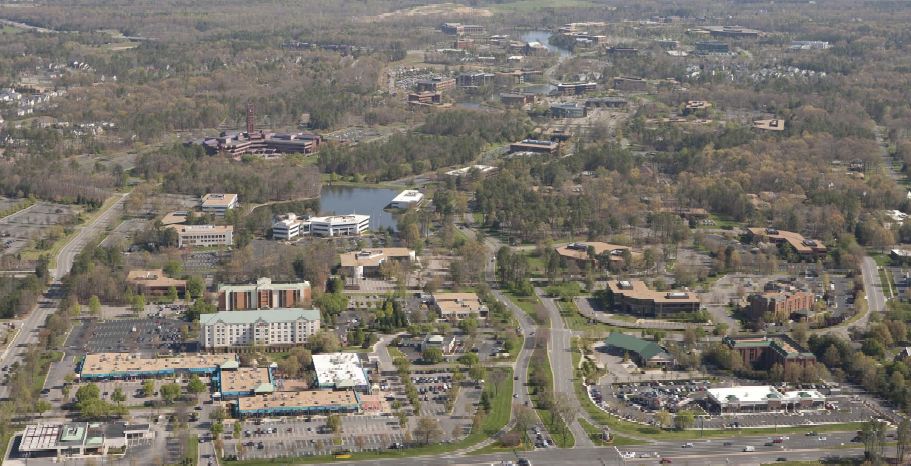
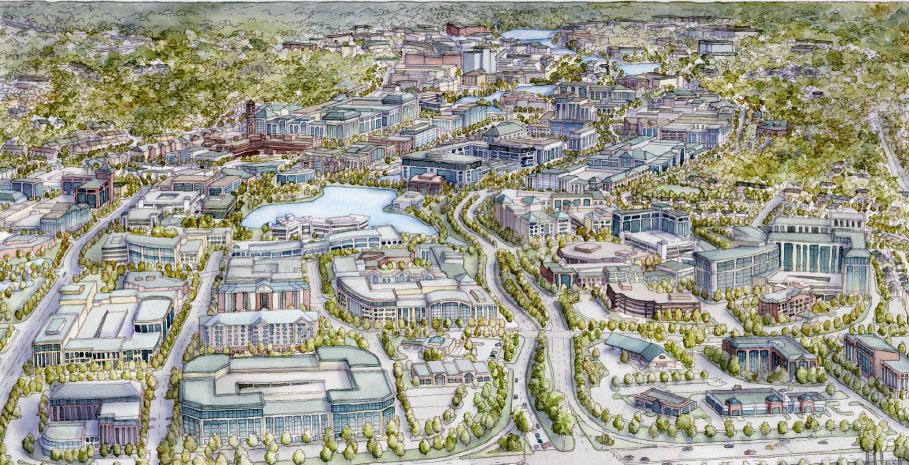
Highwoods Properties, owner of roughly one-third of the Innsbrook Corporate Center, has asked the county to rezone 188 acres to allow intensive, mixed-use development, including office towers up to 16 stories tall. If approved by the county, the project would commence the transformation of the second largest employment center in the Richmond region from a meandering 80s-era campus of two- to three-story offices surrounded by parking lots and tree groves into an urban oasis. (Click on photos to view more legible images.)
Innsbrook in 20 to 40 years?
The Highwoods plan calls for an additional 3.5 million square feet of office space, 415,000 square feet of retail and restaurant space, 1,000 hotel rooms and 6,000 residential units to be redeveloped over 20 years, reports the Times-Dispatch. “We have come as far as we can as a suburban office park,” said Paul W. Kreckman, Highwoods vice president. “We are very proud of it, it is beautiful, it is great. But you can’t stay here, you got to move on.”
The Henrico Board of Supervisors must approve the request but it laid the groundwork in September 2010 by adopting the Innsbrook Area Study study, which designated a 1,351-acre tract in the western county as an Urban Development Area (UDA). The study articulated a set of guiding principles for the area, including the need for (a) greater density, (2) a balance of jobs, housing, retail, entertainment and other amenities, and (3) urban design that encourages walking and mass transit as an alternative to the automobile.
The study critiques the current design, which separates buildings by large areas of surfacing parking, places services and amenities on the periphery, and banishes all housing, thus forcing people to use automobiles for nearly every trip. Henrico planners recognize that traditional “suburban” development (low densities, separated land uses, cul de sac subdivisions, massed concentrations of retail) will not be able to economically accommodate anticipated residential growth of 50,000 new housing units by 2026.
The county’s goal is to maintain a ratio of 65% residential to 35% nonresidential development, not just countywide but within the Innsbrook development area. It makes sense to locate a portion of that residential growth close to the county’s largest employment center on the grounds that it “could reduce workforce dependency on the automobile.”
The need for balance goes beyond housing and jobs. It extends to daily services such as grocery stores, banks and childcare. Re-development also should support mass transit and, above all, walkability. The study aims to create a comprehensive “pedestrian circulation system” by means of grid or modified-grid streets, individual blocks, alleyways, sidewalks and streetscapes, paths, trails and links to adjacent neighborhoods. Cul de sacs and other dead-end streets should be avoided unless necessitated by the presence of natural features or other site constraints.
The big question is whether existing connectors, such as the congested Broad Street Corridor and the under-utilized Nuckols Road can handle the increased traffic. In theory, if enough people can accomplish most of their trips on foot, in trams or in short car trips within the re-development area, the densification of jobs and residents will have only a modest impact on connector roads and Interstates. Henrico County undoubtedly will have to spend to upgrade its connector streets, but it will arguably spend less than it would if the construction were all green-field development.
Henrico botched the planning in the nearby Short Pump area, a horrendous mass of strip and mall commercial development where the traffic bogs down in the worst congestion in the Richmond region. As a Henrico resident, I hope that the planners and supervisors get Innsbrook right. Early indications are that they will.
I celebrated Independence Day yesterday. Not America’s — the Southern Sudan’s. I joined a couple of hundred Southern Sudanese, the so-called “lost boys” and their families, who had gathered from all corners of Virginia at a Methodist church in Richmond’s West End to mark the birth of the world’s newest nation. These black Africans were all refugees of the Darfur-style warfare that the Arab regime in Khartoum had inflicted upon the region before the United States brokered a peace several years ago.
There was dancing, feasting (an interesting mix of Sudanese and American cuisine) and, of course, speech making. At last, the people of the Southern Sudan have a chance to build normal, peaceful lives. Thousands of refugees living in America, many of whom are now college educated, share their aspirations and hope to help.
As my artist friend Awer Bul told me, the last time he went back to the refugee camps, where he spent much of his youth growing up, the children there would draw pictures of soldiers, war and mayhem. After 10 years of peace, he hopes, they will be drawing pictures of happy domestic scenes.
Whether lasting peace will come is anyone’s guess. Oil deposits have been discovered in the Southern Sudan, and many fear that the genocidal Khartoum regime may renew the conflict by arming the militia of neighboring tribes. This time, though, the southerners will be prepared to defend themselves. Still, what a shame it would be to spend the emerging nation’s oil wealth on arms. Awer’s goal is to bring schools and water wells to the villages of his people — and, who knows, to build a museum to preserve their history and culture. Let us all pray that Awer’s vision prevails.
Saving Mass Transit: Competitive Contracting Heritage Foundation
To become an economically competitive form of transportation, mass transit needs to bring down costs. One place to start is to implement competitive contracting.
Putting Low-Income Fathers Back to Work Brookings Institution
Low-income men need to financially help support their children. The authors point to Texas’ Noncustodial Parents’ Choices as a program that works.
Higher Ed Policy Making for Dummies American Enterprise Institute
Among the lessons legislators need to remember when discussing higher ed funding: Do not confuse enrollments with degrees. Many students never graduate. Also remember, not all degrees are created equal. Some cost more, some provide more marketable skills.
Note: Some may have seen that AZA and TMT have been playing “I post, you post” in the comment threads following somewhat unrelated posts concerning the parameters of functional density of Alpha Communities and how these densities relate to the Beta Community of Reston.
In response to TMT’s latest note I have tried to put these perspectives – clarified and updated – together in one place. I asked Prof. Risse to post it and welcomed him to edit and add notes from his perspective. Since this is all about human settlement patterns, I also asked him to alert those that review comments for violations of The Litmus Test to be especially watchful of unfounded Idea Spam and Intentional Information Sabotage.
AZA
DENSITY IN FOCUS
Following the post by Mr. Bacon on school reform, I noted:
Only when there are densities of around 30 persons per acre at the Alpha Community scale can there be efficient and effective transport alternatives that enable students to choose different educational options.
This statement is based on our understanding of the transformations that reflect 1) the end of the era of the ‘Autonomobile’ domination of settlement patterns, 2) the end of vast subsidies for dysfunctional settlement patterns, and 3) the changes in citizen settlement pattern preferences noted below.
In a later comment, TMT noted that “30 persons per acre” seemed high to him. (Most of the dialogue from his comment and my response is summarized below.)
I responded to the reference to “30 persons per acre” by noting that the original statement was “30 persons per acre AT THE ALPHA COMMUNITY SCALE.” I suggested that without a spacial quantifier, a statement on density is a meaningless abstraction. This is NOT just nit picking. Density must always be expressed in terms of quantity per some measure of area that has a specific definition.
TMT said: “I don’t think this level of density is politically feasible except in selected locations.” Read more.
As I argued back in April (see “Sandy Alberta, the Saudi Arabia Next Door“), America can import its oil from our democratic, market-oriented, environmentally friendly neighbor to the north, or from anti-American crackpots like Venezuela’s Hugo Chavez and anti-American madmen like Mahmoud Ahmadinejad. The Obama administration appears to be leaning toward the crackpots and madmen.
As the Wall Street Journalreports today, the administration has been causing endless to a TransCanada Corp. proposal to build a pipeline linking the oil sands of Alberta to the Gulf of Mexico refinery complex. By approving the pipeline, the United States could create thousands of construction and oil refinery jobs and capture much of the economic value of the oil production in Canada itself– American companies are big participants in the oil sands boom –in the process.
But President Barack Obama has said publicly that he wants to investigate “how destructive” oil-sands operations might be to the environment before approving the line. The Environmental Protection Agency has urged a more thorough environmental impact study. And the State Department is dragging its feet in signing off on the transnational pipeline, which would cross the Canadian-U.S. border.
Let’s set aside the concern that America’s job creation numbers remain dismal: only 18,000 net jobs created last month. Let’s overlook the arrogance of the United States dictating environmental policy to Canada, a nation with mature democratic institutions and a mature environmental movement. Let’s look at the hypocrisy. Canada’s heavy oil is very similar to the heavy oil we import from Venezuela. Which country do you think is a better steward of its environment — Canada, where the nation’s strong democratic institutions provide for ample input by environmentalists, or Venezuela, a Third World kleptocracy where a populist thug is running the economy into the ground through short-sighted policies geared to keeping him in power?
Is President Obama concerned about the oil pollution in Lake Maracaibo and the Caribbean? Does he want to investigate “how destructive” Venezuelan policies are to the Amazonian rain forest?
Wow, this is just breathtaking. In one policy-debacle trifecta, the Obama administration is harming U.S. energy security, dampening U.S. job creation, and discriminating against an environmentally friendly democracy.
Studying Health Care Disparities National Academy for State Health Policy A Virginia study of health care disparities is one of two initiatives highlighted in this report. That document, the 2011 Health Equity Report, should be published soon.
A half year ago, I didn’t think that I had a weight problem. At 6′ tall, I tipped the scales at 193 pounds. I exercised fairly regularly, ate balanced meals and indulged little in desserts, snacks or fast food. I had a little flab around the waste but didn’t feel overweight, much less obese. Then, in a routine physical, my doctor told me my blood sugar was running high. I was pre-diabetic, he said. If I didn’t control my nutrition, I could wind up a full-fledged diabetic.
Boy, was that a wake-up call! There was no way I would let myself become a diabetic. I would take control of my diet. Out went the soft drinks; in came the flavored water. Out went the starch at dinner time; in came the vegetable salads. Out went the breakfast cereals; in came yogurt, granola and fresh fruit. Out went the processed bread; in came whole-grain bread. My intent was to restore my blood sugar to healthy levels. I wasn’t looking to lose weight. But as a side effect of adopting a better diet, I did lose 10 pounds.
Through the lens of that experience I now report the latest findings of a new study by the Trust for America’s Health, “F as in Fat: How Obesity Threatens America’s Future 2011.” Twelve states now have obesity rates above 30%. Four years ago, only one state was above 30%. The obesity epidemic is the worst in the South, lowest in the Northeast and West. But viewed over a 20-year timeline, obesity is increasing across the board.
Virginians can take some small consolation that we are less fat than the national average. We rank 30th nationally. But considering that higher-income people are less likely to be fat and we Virginians rank among the 10 highest income-per-capita states in the country, we have no grounds to get smug. Obesity is a major contributing factor to heart disease and diabetes, which runs up health care costs, which we all pay. So, one person’s obesity is not just his or her problem, it’s everyone’s problem.
(See the detailed statistics for Virginia here. Fifteen years ago, Virginia had a combined obesity and overweight rate of 48.9 percent. Today, the combined rate is 61.2 percent.)
There are many explanations of America’s rising obesity rate. The population is getting older, for one, and people who put on one or two pounds a year can find themselves overweight by middle age. Our lifestyles are more sedentary, and we get less exercise. (Our auto-centric human settlement patterns play a role here.) And we eat way too much processed food, and not nearly enough fresh fruit and vegetables. But none of these contributing factors is destiny. Every one of us has free will. We all know what we need to do — it is impossible to escape the mantra that we need to eat right and exercise more. We just need to do it.
I know that it can be done because I have done it. It’s not easy changing food-eating habits but it is possible. It’s not easy finding the time and energy to exercise but it is possible. Here’s the question: Will other Americans do the right thing? Or do they have such an entitlement mentality — “I’m entitled to health care, and I’m entitled to have someone fix my medical problems, even if they are of my own making”– that most of them are too complacent and lazy to change? My fear is that preaching and moral suasion will not work. The morality of personal responsibility is dying in this country. And the logic of the social engineer — we’ll tax soda pop so people will drink less of it — is all that is left to save us from ourselves.
To be frank, I have always had a bad feeling about blogging for Bacon’s Rebellion while its sister electronic magazine of the same name was controlled by a right-wing, lobbyist-infested outfit grandly called the Thomas Jefferson Instutute for Public Policy.
Thankfully, this unholy arrangement will be coming to an end soon. Bacon’s Rebellion has achieved a good reputation as a spot where serious policy discussions can be found — an important point given that mainstream media outfits have so badly cut their staff there’s not a lot of informed discussion. Sure there’s a lot of sparring that sometimes goes over the top. Ditto the e-zine which used to have some of the best reporting and analysis on Virginia’s land use and transportation issues.
Somehow, the so-called Thomas Jefferson people got hold of the e-zine and now they are supposed to give it back. From the git-go, it was a bad conflict of interest since their supposedly scholarly and libertarian sounding board was actually run by a bunch of less-than-scholarly hacks who were really lobbyists in sheep’s clothing.
Nowhere is this more clear than in a study the institute did regarding affordable housing policies in Fairfax County. The report, written by Michael Thompson, a major Republican contributor and director of the “institute,” slams the county for “subsidizing” luxury housing by putting housing aid recipients in apartments where there may be swimming pools, gyms and other benefits, according to The Washington Post. The reasoning seems to be that if you are poor and you get government aid, you have no right to exercise.
Thompson’s skewed report has split the supervisors down party lines. Board Chairman Sharod Bulova, a Democrat, says only 15 of the 41 condo projects where the poor are housed have swimming pools. Thompson apparently ignores the fact that many of the county’s housing units
were built with amenities and that in towards serious downturn, many more people can’t afford the usual, high rents.
So what are they supposed to do? Live in cinderblock cells without TV sets because they are poor? Michelle Krocker, executive director of the Northern Virginia Affordable Housing Alliance characterizes the report this way: “There are no data, no interviews, no sources. There are no statistics. I’m finding it very curious that a think tank would put out something less than scholarly.”
No surprise there. I’ve scratched my head at some of the papers I’ve read from the TJ people because they don’t offer many statistics or facts to back up their opinions. I remember one Thompson report lauded offshore drilling and gave a laundry list of supposed benefits without any sourcing.
The point is that the institute is not really a think tank — it is a Republican lobby. It is hardly “non-partisan” as it pretends to be. Bacon’s Rebellion is severing its relationship with these people. Not a moment too soon.
A lawsuit seeking to block the Metropolitan Washington Airports Authority from assessing tolls on the Dulles Toll Road has been dismissed by Anthony J. Trenga, United States District Judge in Alexandria. The judge ruled against the plaintiffs in all important particulars. Details to come tomorrow.
I so unhappy!
Update: I talked to Pat McSweeney, one of the attorneys behind the suit. Trenga’s logic was so obviously flawed, McSweeney says, that he thinks there is a good chance that the ruling will be overturned in higher court. The plaintiffs expect to file an appeal to the case to the Federal Circuit Court of Appeals next week.
Someone is finally going to bat for the much-abused users of the Dulles Toll Road. Rep. Frank Wolf, R-10th, took the first step by introducing legislation that would increase Virginia’s representation on the Metropolitan Washington Airports Authority (MWAA), which oversees the toll road, and make it easier to replace directors serving on the board. But that’s a half measure, argues Jamie Radtke, Republican candidate for Jim Webb’s U.S. Senate seat.
If she were elected, Radtke announced today, she would introduce a bill that would: (1) Abolish MWAA, (2) return the Dulles Toll Road to the Commonwealth of Virginia, and (3) give the commonwealth the option to manage Dulles International airport, Reagan National Airport, the Dulles airport access highway and construction of the Rail-to-Dulles Metrorail project.
The issue is all about accountability, says Radtke. MWAA, created by federal legislation in 1986, is governed by board members from Virginia, Maryland and Washington, D.C. Wolf’s legislation would increase Virginians’ representation from a minority to a majority. But Radtke contends that Maryland and D.C., shouldn’t have any representation over decisions affecting users of the Dulles Toll Road. The lack of accountability to Virginians or their elected representatives, she said in a prepared statement, is “unacceptable and unconstitutional.”
In 2005, Gov. Tim Kaine sealed an agreement in which MWAA would take over management of the Rail-to-Dulles project along with the Dulles Toll Road, which would be tapped to help pay for the project. In January 2006, Phase 1 of the metrorail project was projected to cost $1.8 billion. Sixteen months later, the estimated cost had risen to $2.8 billion and it was decided that Dulles Toll Road users would pay the extra $1 billion. Meanwhile, the cost of Phase 2 escalated by more than $1 billion, no thanks to MWAA board decisions to build an expensive underground rail station and to mandate the use of union labor. At present, toll roads are the only available revenue source to cover that overrun.
MWAA consultants have warned that Dulles Toll Road users, who currently pay a top charge of $4 for a round trip, could be paying $40 (that’s not a typo) for a round trip by 2040. “This mismanagement has the potential for devastating financial repercussions on Northern Virginia residents and businesses,” said Radtke. “Virginians are paying hundreds of millions of dollars in additional costs incurred by MWAA, but these decisions are being made by a board where a majority of the members are non-Virginians.”
Characterizing the MWAA experiment as a “financial disaster” for Virginians, Radtke blasted Kaine for giving MWAA “unfettered power and control” over the toll road and its revenues without General Assembly or Congressional approval.
Abolishing MWAA might strike some as using a sledge hammer to drive home a nail. Sure, the state should take back control of Rail-to-Dulles and the Dulles Toll Road, but what’s wrong with having an independent airports authority? Here’s the problem: Once the state has contractually committed to giving MWAA control of the rail project and the toll road, it can’t readily back out. The only solution, then, is abolishing MWAA through federal legislation.Think of MWAA as collateral damage.
Radtke’s proposal would not require the state to take control of Dulles and Reagan airports, only give it the option to. If the state chooses not to exercise the option, the airports presumably could refashion an independent authority to do what MWAA was doing before it got entangled in the Rail-to-Dulles project.
Stalemate in the War on Poverty Brookings Institution Forty-seven years and trillions of dollars later, Americans haven’t come close to winning the war on poverty. Unemployment, low wages, dissolving families, mediocre education and an influx of ill-educated immigrants keep poverty rates high.
Want Better Schools? Deal with the Bad Teachers Hoover Institution Replacing the worst 5% to 10% of school teachers would dramatically lift educational the achievement level of American students.
Let States Opt Out of the Dysfunctional Highway Trust Fund Heritage Foundation Let states opt out of the federal highway trust fund, from which a third of the revenue is pillaged for non-road projects, and hand over the money in a block grant.
The Impact of Job Losses on Student Achievement National Bureau of Economic Research When you’re rating school systems by their ability to show Adequate Yearly Progress under No Child Left Behind, just remember that high unemployment among parents and in the community has a deleterious effect on student achievement.
Tort Reform Won’t Halt Rising Health Care Costs Century Foundation Conservative arguments that capping awards on medical malpractice lawsuits can contain health care costs are totally bogus.
Time to Get Cracking on Setting up Health Care Exchanges Center for American Progress Obamacare requires states to set up health care exchanges by 2014, or Uncle Sam will do the job for them. States have a lot to think about before they get started.
Kentucky Medicaid: Expensive and Ineffective Bluegrass Institute Obamacare will suck people people out of private health plans and accelerate the rising cost of Medicaid. Program incentives thwart sound medical practice, and participants show little improvement in their health.
Maternity Leave Has Little Impact on Childrens’ Cognitive Development National Bureau of Economic Research Paid maternity leave is often justified on the grounds that stay-at-home moms foster babies’ cognitive development. Turns out that, at least among Canadians, that’s not true.
Cut Driving to Reduce Greenhouse Gas Emissions and End Oil Imports World Resources Institute In 2008 transportation accounted for 71% of U.S. oil consumption and 31% of carbon dioxide emissions. Transportation spending should be targeted to projects that reduce both.
Meeting the Infrastructure Challenge Urban Land Institute The United States lags its global competition in investing in the infrastructure needed to support economic prosperity. Among the recommendations: Maintain what you’ve got, prioritize gateway regions, and institute user fees to generate sustainable revenue streams.
Most Local Government Pension Plans in Better Shape than State Funds Center for Retirement Research Despite some prominent exceptions, local governments are doing a better job overall than state governments in keeping their employee pension funds in sound actuarial condition.
The General Assembly had the right idea in 2007 when it passed legislation to enable Virginia’s urban counties to take over responsibility for secondary roads from the Virginia Department of Transportation. Accountability for road-building decisions should be seated at the same level of government as accountability for land use decisions.
But as Jonathan Gifford, a public policy professor at George Mason University, explained in a report to Transportation Secretary Sean T. Connaughton, there was one little problem: There weren’t any takers. “County officials,” he wrote, generally agreed that state payments, as currently set under the Virginia Code, will not cover all the costs of a local road program for maintaining secondary roads.”
Gifford then explored a range of options for secondary road policy, from sticking to the current policy, which effectively means doing nothing, to raising budgetary allowances for secondary roads, implementing performance-based maintenance contracting, empowering localities to raise revenues and imposing devolution upon the counties.
Ultimately, it all boils down to money. There’s not enough of it, and county supervisors don’t want to impose new taxes upon their citizenry. What’s the solution? Here’s my proposal. VDOT should jack up maintenance payments to levels that approximate costs. Where does VDOT get the money? By fully funding its maintenance budget, even if it means sacrificing new road construction.
Remember, the state’s top should be to maintain the existing road network. Allowing the system to deteriorate will not save money — it will only postpone expenditures. Because roadways deteriorate at an exponential rate over time, the postponed expenses will increase exponentially over time. Such a policy is incredibly short-sighted and stupid.
How, then, do we fund new construction? Through mechanisms like tolls, time-of-day pricing, tax increment financing and a Vehicle Miles Driven tax in which the users (drivers) and beneficiaries (property owners) of roadway improvements are the ones who pay for new infrastructure, not the general public. For details, I refer the reader to any number of past articles and blog posts.
Public-Private Finance Tools for Energy Efficiency World Resources Institute Financing has long been a barrier to investment in energy-conservation projects, but a variety of public-private financing tools can help unlock capital flows.
The year: 2075. The American colonies on the Moon are getting restless under Washington’s tyrannical rule….
This second edition of “Dust Mites” has a snazzy new cover, includes helpful lunar maps, and is 5,000 words tighter than the original. The sequel, “Trogs,” is scheduled for publication this summer.
Advertisement
Advertisement
Advertisement
Advertisement
About
Bacon’s Rebellion is Virginia’s leading politically non-aligned portal for news, opinions and analysis about state, regional and local public policy. Read more about us here.
Fund the Rebellion
Shake up the status quo! Your contributions will be used to pay for faster download speeds and grow readership. Make a one-time donation by credit card or contribute a small sum monthly.
Can’t wait until tomorrow
For your Bacon’s Rebellion fix?
Enter your email address to receive immediate notifications of new posts by email.
SUBSCRIBE
Search Bacon’s Rebellion
Categories
Archives
The Jefferson Council
Protecting Thomas Jefferson’s Legacy at the University of Virginia
Forgot Your Password?
Shoot me an email and I’ll generate a new password for you.

 The Bacon’s Rebellion blog migration continues. I have succeeded in moving all 3,500 blog posts to this website, but only 40% of the comments. Additionally, I need to undertake an additional maneuver to move the author attributions. In other words, we have the stories, but not who they are written by! I will be working on these and other issues over the next week or two.