Let’s check in on the left — and paid social media influencers — to see what they’re screaming about today, shall we?
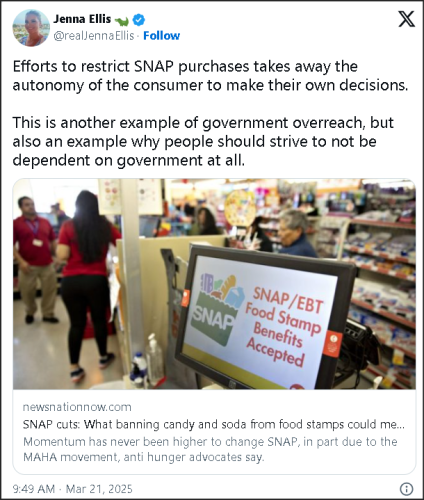
Oh boy, this is a good one: they’re livid that food stamp recipients in the SNAP program may be prevented from using their government assistance to buy junk food.
You know, sodas, cookies, sugary cereals, chips, etc.
Exactly five years ago, March 23, 2020, Virginia’s Governor issued “Executive Order 53” which shut down the state economy in order to “flatten the curve” of COVID19 infections. It would continue in force until June 30, 2021, or over fifteen months.
Five years later, there is not a shred of evidence that these unconstitutional actions saved a single life. Indeed, Executive Order 53, like most shutdown orders, very likely caused thousands of unnecessary deaths as Virginians stopped visiting their doctors, stopped checking in on relatives and radically increased their use of illegal narcotics.
Today it is quietly acknowledged that the COVID shutdowns were an embarrassment; a reaction driven by public fear and hysteria. Sadly, the usual guardians of executive abuse -– the media and judiciary –- failed to intervene. I know that for a fact, as I personally filed lawsuits to undo these disastrous actions while lives and businesses could be saved.
Are Rockingham County leaders fabricating numbers and seeking more power just because they can?
by Joe Fitzgerald
Travis McGee once mentioned a particular type of no-see-um mosquito that swarmed but did not bite. He said the evolutionary question was, “What do they want?”
The difference with the Rockingham County School Board is that we can see them, but the question remains.
Watch the average school board meeting and see people discussing policy details, programming decisions, budget issues, teacher raises, and student accomplishments.
Watch a county board meeting and tell me what happens. I’ve suffered enough.
A short review is in order. The board banned 57 books, seven of which aren’t in their libraries. They’re still deciding on the rest, 15 months later, and they’re ignoring the recommendations of the secret committee they appointed to review the books. But let’s allow that to be a metaphor for the rest of their rushed changes and move on to the Massanutten Technical Center (MTC).
I is for indoctrination. To celebrate Women’s History Month this month, West Springfield High School erected an alphabetized display in the school colors. A is for abortion. F is for feminism. J is for justice. Q is for queer. T is for trans women. W is for wage gap. Z is for male gaZe. You get the idea. “There is simply no defense for this display, which would be expected in the Democratic Party’s National Headquarters but not in a taxpayer-funded public school,” writes Stephanie Lundquist-Arora in The Daily Signal. “This display clearly encapsulates … the pressing need for school choice in America. Perhaps DEI should be rebranded Diversity, Equity & Indoctrination.
Speaking of equity… how about making kids walk to school? Faced with a shortage of school bus drivers, Charlottesville Public Schools in 2021 expanded the “walk zones” from a quarter mile to three-quarters of a mile. Walking is healthy, right? And buses emit CO2, right? But for some kids the trek can take half an hour, which in the cold and rain can be unpleasant. Now some parents are complaining, reports The Daily Progress. “The school system claims to be big on equity.… It feels hard for me to believe they are big on equity when the kids who need the most services don’t have a ride to school,” said one. “These kids are the ones who have the horrible attendance rates, and literacy rates are the lowest. You’re not even providing them a way to get to school to learn.”
Waaah.
So inclusive that she kicked her meds! After a year at the University of Virginia, Rebecca Fitch hadn’t found her niche. “At the end of my first year, it felt almost like UVA wasn’t for me,” she said. “I was just really depressed. I didn’t feel like I was making any friends, because I wasn’t. I didn’t feel like I had people who really cared about me.”
So, how did she finally find a sense of belonging?
Governor Youngkin is again showing that he’s “all hat and no cattle.”
The latest example is his fawning response to the President’s actions to gut the U.S. Dept. of Education. In it, he declares, “Virginia is ready to take full responsibility for K-12 education.” That sounds impressive, but I thought that Virginia has always had full responsibility for operating public education. What will Virginia be able to do that it could not do before the President’s executive order?
Perhaps I should give Youngkin a little more credit. Perhaps, when he said, “full responsibility,” he meant “full” in the literal sense of the word. We are ready to go it alone, without any federal assistance. We are taking full responsibility, which includes paying for it all.
But, no. That couldn’t be what he meant, because in the next paragraph of the news release, Secretary of Education Aimee Rogstad Guidera is talking about federal dollars the state will be receiving. So, it looks like the state will not be taking full responsibility after all. We still expect the federal government to pay part of the costs of our educational system.
Secretary Guidera seems really excited that “the President’s Executive Order ensures that federal dollars will arrive in Virginia with less red tape and bureaucracy and allow” the state and localities to spend all that federal money however it deems best. She might want to read that order again. Nowhere in that order does Trump address the issue of how federal funding, if there is to be any, will be allocated to states and localities, except to say that none will go to any entity that has programs “under the label ‘diversity, equity, and inclusion’ or similar terms and programs promoting gender ideology.”
Despite his declaration that “waste, fraud and abuse is stunning and shocking, and everybody sees it,” Youngkin seems to be assuming that Virginia will still be getting federal dollars to help pay for its schools. It seems that the “waste, fraud and abuse” is somewhere else and not in Virginia.
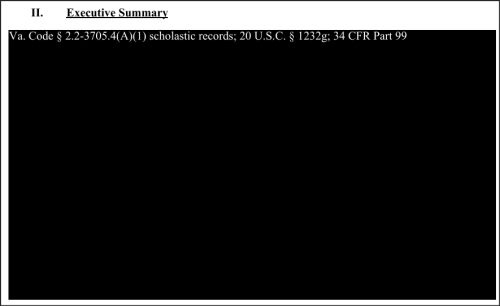
Image from the University of Virginia Special Counsel Review taken from the executive summary.
by James A. Bacon
After more than a year of delays, the University of Virginia has finally released two reports ordered by the Attorney General — one detailing the University Police Department (UPD) response to the Nov. 13, 2022, mass shooting at UVA, and one reviewing the failure of the University’s Threat Assessment Team (TAT), despite abundant red flags, to prevent the tragedy.
The reports provided comprehensive background information about formal policies and administrative structures of the UPD and threat assessment team. But extensive redactions removed almost all content describing how events folded and what specifically went wrong.
The reports recommend some administrative reforms, but literally no names are named in the unredacted portions of the reports. No one is called to account. There is not even a timeline. The public learns almost nothing new about the events that transpired, and no narrative of bureaucratic decision-making is provided to help readers understand the basis for the conclusions.
It would be unfair to describe the redacted reports as worthless. They do contain some useful insights and recommendations. (More about those in a follow-up post.) But they leave important questions unanswered.
Almost eight of the 16 pages in the executive summary of the Quinn Emanuel Urquhart & Sullivan report on the threat assessment team were blacked out. Roughly 34 of 43 pages in the executive summary of the Vinson & Elkins report on the University Police were suppressed. Of the approximately 70 exhibits mentioned in the Vinson & Elkins report, only four were identified — and none were attached to the report.
Two weeks ago, following the decision of the Virginia Military Institute Board of Visitors not to renew his contract, Superintendent Cedric T. Wins, defended his record and asserted that the Board’s decision was influenced by political bias rather than job performance. Bacon’s Rebellion posted his statement here.
Wins, a 1985 alumnus, was appointed superintendent by former Governor Ralph Northam amid accusations of institutional racism and sexism. His tenure included initiatives such as removing the Stonewall Jackson statue and implementing Diversity, Equity, and Inclusion (DEI) programs. Some alumni supported the changes and others criticized them for undermining the traditions that made VMI distinctive and worthy. The Board, dominated by appointees of Governor Glenn Youngkin, voted 10-6 against renewing his contract.
The Cadet, which has had a tumultuous relationship with Wins, found that some of the claims in his letter were accurate but needed context, others lacked substantiation, and yet others weren’t supported by the facts. Among the highlights:
Claim: The Board’s decision was politically motivated
Assertion: The decision not to renew his contract, said WIns, “was not based on my performance or the tangible progress we achieved.”
Evaluation: Unsubstantiated. “This claim suggests political motivation without evidence. The BOV follows a standardized evaluation process, and no public evidence supports allegations of bias. The BOV, consisting of sixteen highly qualified individuals, conducted its annual performance rating in a closed session as required by its Bylaws and state law. MG Wins was not in the room for those discussions and has no first-hand knowledge.”
Last night, as promised repeatedly during the campaign, President Donald Trump signed an Executive Order directing Education Secretary Linda McMahon to take all necessary steps to facilitate the closure of the Department of Education (the Department). The order also ensures the continued delivery of essential services such as federal student aid and funding for students with disabilities. This historic move will rightly transfer most education funding and authority back to states and local communities — the first step, one would hope, in getting funds to parents, where it belongs.
This has led to the expected outrage from progressives. Senate Minority Leader Chuck Schumer described the attempt to dismantle the Department as “one of the most destructive and devastating steps Donald Trump has ever taken” (probably the hundredth time he has made this assertion). House Minority Leader Hakeem Jeffries accused the administration of “taking a chainsaw to public education in America,” warning that such actions could lead to increased class size, educator layoffs, and cuts to special education programs.
President Trump’s Department closure, however, aligns with long-standing conservative philosophy that education policy is best that is determined closest to the students being served — namely, state and local entities and parents. The Thomas Jefferson Institute recently advocated for the closure of the Department, arguing that federal education oversight and funding imposes uniform standards that hinder schools’ adaptability to local needs and divert resources away from classrooms and towards administrative overhead. Eliminating the Department empowers states and local communities to tailor educational policies more effectively, fostering environments that better serve their unique student populations.
Virginia’s latest bid to raise academic standards took center stage at last month’s state board of education meeting, where policymakers debated the future of the state’s proficiency benchmarks. At the heart of this discussion is Virginia’s “honesty gap”—the misleadingly high proficiency rates reported on state exams compared to the more sobering results on the National Assessment of Educational Progress (NAEP). While there’s widespread recognition of the need for greater transparency in student achievement, not everyone sees the problem—or the solution—the same way.
For years, Virginia’s Standards of Learning (SOL) assessments have set the bar too low, creating a false sense of student success. This is part of a broader national issue where many states, unwilling to confront the true scale of their educational challenges, have lowered expectations to avoid delivering bad news. The recent board meeting underscored that support for raising the SOL cut scores is nearly unanimous. The only real outlier was a lone board member whose resistance to the proposed changes reflects a narrow, and frankly unhelpful, view of what’s at stake.
This dissenting voice didn’t dispute the need to raise the bar, as some might have expected. Instead, she dismissed the honesty gap as a ‘communications tool,’ arguing that students could still perform well under the existing, lower cut scores. Perhaps, but why not be upfront with parents and students from the start? Without honest data, how can resources be targeted to the students most in need—a constituency for which that this board member claimed to advocate?
In a case prosecuted by the Attorney General’s Office of Civil Rights, a Franklin County jury rendered a $750,000 verdict against a landlord for evicting two families from her rental property on Smith Mountain Lake after learning that one of the family members was black.
“Housing discrimination—and discrimination of any kind—will not be tolerated in Virginia,” said Attorney General Jason Miyares. “We are pleased by the jury’s verdict, and I’m immensely proud of my Civil Rights Unit. The people of Franklin County have spoken: Smith Mountain Lake is for everyone.”
According to a summary issued by the AG’s office, Regina Turner, owner of Lazy Cove Campground on Smith Mountain Lake, had rented lots to families for decades. A couple with a camper on one of Turner’s lots encouraged friends—an interracial married couple with a young son—to lease a neighboring spot. The wife, who is white, negotiated a lease with Turner. However, upon learning that the husband was black, Turner took steps to evict both families, openly stating that she would not have rented to them had she known his race.
After deliberating less than two hours, the jury awarded $100,000 to each couple for their losses, as well as the humiliation and emotional toll they endured. The jury awarded an additional $550,000 in punitive damages to punish Turner’s actions and serve as a deterrent against future discrimination.
Just about any aspect of Virginia history is intertwined with the Civil War, and geology is no exception.
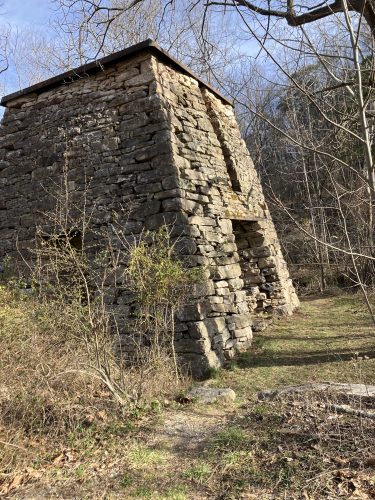
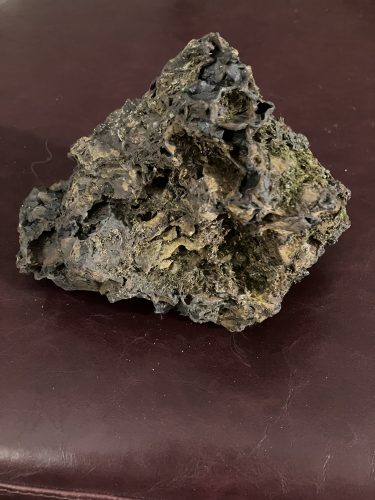
Pictured is the Catherine Furnace on Massanutten Mountain. Some of the pig iron used in Tredegar Iron Works in Richmond to manufacture cannons and other items for the Confederacy came out of this furnace. Workers dug the iron ore out of open trenches (sample shown) further up the mountain. At the furnace, the ore was melted and molded into pig iron. The blocks that constitute the walls of the furnace are Massanutten Sandstone, which came from outcrops nearby.
Iron ore, Massanutten Mountain
There is a story that the operator of the furnace during the war was a Union sympathizer who helped Union soldiers escape capture. He was arrested as a result of those activities. However, his captors realized that he was the only one around who knew how to operate the furnace and thus he was released on bond.
Then there were Melrose Caverns, on Rt. 11 near Harrisonburg. When Union General Nathaniel Banks camped near the spot in 1862, his troops soon discovered the cave and began exploring. For some time, the Union Army used the cave to store ammunition and other arms.
It turns out that Union soldiers were like soldiers everywhere and in every time. They left their mark on their surroundings. They carved their names into the walls and columns in the caverns, along with etchings of American flags and regimental coats of arms.
Ben Castleman (left) and Stephen Farmer address the UVA Board of Visitors.
By James A. Bacon
What might a meritocratic admissions system at the University of Virginia look like now that the Board of Visitors has banned racial preferences across the board?
Board members got a glimpse at some of the factors that could be considered and the tradeoffs involved during a discussion two weeks ago during its March meeting about the use of standardized test scores in evaluating applications.
UVA President Jim Ryan kicked off the discussion by noting that during the COVID epidemic, UVA had joined many other colleges and universities in jettisoning the once-ubiquitous practice of requiring applicants to submit SAT or ACT scores. Since then, Harvard, Yale, Stanford and MIT, among others, have reinstituted mandatory submissions. Ryan was not convinced, however, that UVA should follow their lead. He said he is leaning toward what he termed a “text flexible” approach that would accept Virginia Standards of Learning (SOL) test results for in-state students as well as other substitutes.
Standardized college-admission tests like the SATs and the ACTs are predictive of academic success at UVA, said Benjamin L. Castleman, a professor of economics in education who led a faculty group that delved into the value of the tests. UVA students scoring in the 1500-to-1550 range for SATs earned 3.72 GPAs on average. Students scoring in the 1300-to-1350 range earned 3.42 GPAs on average.
But many other factors predict a student’s academic performance, he added. When other factors including high school grades are taken into account, the added predictive value of SATs is a modest 10% to 20%, he said.
From a document attached to a letter addressed to the UVA Board of Visitors.
by James A. Bacon
At the direction of Board of Visitors Secretary Susan Harris, a compilation of nearly 50 letters and email messages to the Board and President Jim Ryan was distributed to Board members Tuesday. The letters were almost uniformly critical of the Board’s decision earlier this month to abolish the office of Equity, Inclusion & Community Engagement.
Many authors declared themselves to be “ashamed” by the action, and several vowed to cease donating to the University. Many described the vote as racist, sexist, and homophobic; several decried it as “fascist.” Some letters criticized Ryan for failing to stand up to the Board, while a few urged him to be true to his values and fight back.
The purpose of distributing the emails was not clear. The cover letter from the clerk of the Board said only this: “Susan Harris tried to send you an email over the weekend that contained the emails that had been received in regards to the DEI decision that was made. The file was very large and many of you most likely did not receive it. The attached file contains all of the messages to both the President’s Office and the BOV Office on the DEI decision.”
Several days ago, Governor Glenn Youngkin, who supported the Board’s decision, declared on national TV that “DEI is done” at UVA. He might want to read the letters and re-evaluate his appraisal of the political dynamics at play.
The year: 2075. The American colonies on the Moon are getting restless under Washington’s tyrannical rule….
This second edition of “Dust Mites” has a snazzy new cover, includes helpful lunar maps, and is 5,000 words tighter than the original. The sequel, “Trogs,” is scheduled for publication this summer.
Advertisement
Advertisement
Advertisement
Advertisement
About
Bacon’s Rebellion is Virginia’s leading politically non-aligned portal for news, opinions and analysis about state, regional and local public policy. Read more about us here.
Fund the Rebellion
Shake up the status quo! Your contributions will be used to pay for faster download speeds and grow readership. Make a one-time donation by credit card or contribute a small sum monthly.
Can’t wait until tomorrow
For your Bacon’s Rebellion fix?
Enter your email address to receive immediate notifications of new posts by email.
SUBSCRIBE
Search Bacon’s Rebellion
Categories
Archives
The Jefferson Council
Protecting Thomas Jefferson’s Legacy at the University of Virginia
Forgot Your Password?
Shoot me an email and I’ll generate a new password for you.